
- Home
- Blog
- It Service Management
- Proactive Problem Management: What Is It and How to Implement It?
Proactive Problem Management: What Is It and How to Implement It?
Updated on Nov 21, 2025 | 1.73K+ views
Share:
Table of Contents
View all
- What is Proactive Problem Management?
- Why Proactive Problem Management Matters?
- Components of an Effective Proactive Program
- Benefits of Proactive Problem Management
- How to Implement a Proactive Problem Management Process?
- Incident Management vs Problem Management
- Overcoming Common Challenges of Proactive Problem Management
- Final Thoughts
Modern IT environments are growing more complex, with thousands of interconnected systems and applications supporting daily operations. Yet, many organizations still focus on fixing incidents rather than preventing them.
Proactive Problem Management (PPM) tries to change that mindset. It identifies and resolves potential issues before they cause disruptions.
By shifting from reaction to prevention, proactive problem management improves service stability, reduces downtime, and enhances customer satisfaction.
In this blog, we’ll explore what proactive problem management is, why it’s vital, and how to build a process that detects, analyzes, and prevents recurring issues across systems.
Master the Right Skills & Boost Your Career
Avail your free 1:1 mentorship session
What is Proactive Problem Management?
Proactive Problem Management (PPM) is the practice of anticipating and resolving problems before they result in incidents or outages. It’s a core component of the ITIL problem management framework that focuses on identifying underlying causes of potential issues using trend analysis, monitoring data, and predictive tools.
Unlike reactive problem management, which begins after an incident occurs, PPM continuously monitors system performance and user behavior to detect patterns of instability. It aims to reduce the number and impact of incidents by addressing their root causes early.
Key activities include analyzing historical incident data, reviewing performance metrics, conducting capacity assessments, and implementing corrective measures such as software patches or process redesigns.
In short, proactive problem management is about being one step ahead. This involves spotting early warning signals, addressing vulnerabilities, and strengthening service resilience before customers notice a problem.
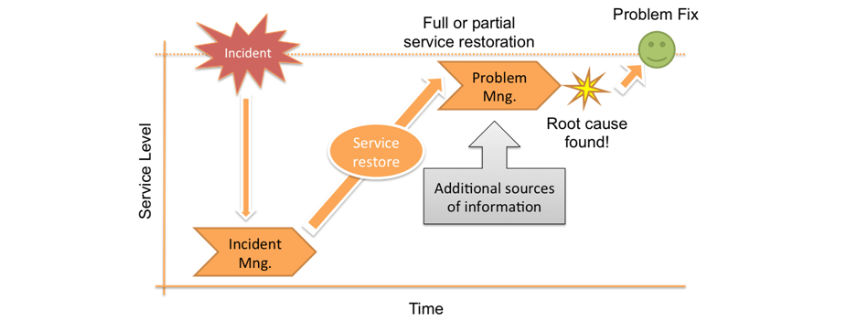
Source: Advisera
Why Proactive Problem Management Matters?
Before exploring its components, it’s crucial to understand why proactive problem management is becoming essential in today’s IT landscape.
Reactive management keeps services running but consumes time and resources that could be better used to prevent issues in the first place. Proactive management, by contrast, minimizes repetitive incidents and helps IT teams focus on continuous improvement.
Organizations that practice proactive problem management gain:
- Reduced downtime: Fewer incidents mean higher service availability.
- Cost efficiency: Early detection prevents expensive escalations.
- Customer trust: Consistent reliability builds long-term satisfaction.
- Data-driven insight: Trend analysis reveals systemic weaknesses.
Ultimately, proactive problem management enables IT teams to move from firefighting to forward planning — a transformation that directly impacts service quality and business performance.
Components of an Effective Proactive Program
Let us now understand the key elements that make a proactive problem management program effective.
1. Early Detection and Monitoring
Comprehensive monitoring tools (like Prometheus, Dynatrace, or Splunk) detect anomalies and performance degradation early, giving teams time to act before incidents occur.
2. Data Analysis and Trend Identification
Historical data and incident records are analyzed to identify recurring issues, performance bottlenecks, or configuration errors.
3. Root Cause Analysis (RCA)
Techniques such as Pareto Analysis, 5 Whys, and Fishbone Diagrams help uncover the true cause behind recurring issues rather than just symptoms.
4. Preventive Actions and Change Control
Once causes are identified, changes are introduced to remove or mitigate them—like code fixes, automation scripts, or capacity adjustments.
5. Knowledge Management
Documenting problems and solutions in a Known Error Database (KEDB) allows teams to learn from past issues and apply consistent fixes across environments.
Together, these components establish a data-driven foundation that continuously improves system reliability and operational efficiency.
Benefits of Proactive Problem Management
Before diving into implementation, let’s look at the measurable advantages proactive problem management delivers to IT operations.
- Fewer Incidents: By resolving root causes, teams drastically reduce repetitive issues.
- Improved Service Uptime: Systems stay stable and predictable.
- Lower Support Costs: Preventing failures saves time and reduces the need for emergency responses.
- Enhanced Collaboration: Cross-functional teams share data insights to identify and address systemic problems.
- Stronger Governance: Proactive management provides audit-ready documentation and better compliance.
- Higher Customer Satisfaction: A stable service experience builds confidence and loyalty.
These benefits don’t just make IT operations smoother. They turn the service desk into a proactive, value-driven partner in business growth.
How to Implement a Proactive Problem Management Process?
Building a proactive problem management process requires structure, collaboration, and continuous learning.
1. Establish Clear Goals and Ownership
Start by defining what “proactive” means for your organization. Set measurable objectives such as reducing recurring incidents by 30% or improving Mean Time Between Failures (MTBF). Assign ownership to a dedicated problem management team or service reliability function.
2. Collect and Analyze Data
Leverage multiple data sources such as incident records, monitoring dashboards, user feedback, and change logs. Use analytics tools to identify repeating failures, performance anomalies, or dependencies that cause instability.
3. Prioritize Problems by Business Impact
Rank issues based on their potential impact on critical business services. This helps teams allocate resources to the most valuable preventive actions.
4. Conduct Root Cause Analysis (RCA)
Perform structured investigations using RCA techniques to determine underlying causes. Document findings and preventive actions in a Problem Record.
5. Implement Preventive Solutions
Translate RCA results into tangible improvements—upgrading infrastructure, refining configurations, or automating error detection.
6. Integrate with Change Management
Ensure preventive actions go through formal Change Management to prevent unintended consequences. Collaborate with DevOps teams to automate rollout and rollback procedures.
7. Build a Knowledge Repository
Capture solutions in a Known Error Database (KEDB) to avoid duplication of effort and accelerate future resolution.
8. Monitor, Measure, and Refine
Track key metrics such as reduced incident frequency, cost savings, and user satisfaction. Regularly review performance and adjust processes for continuous improvement.
Implementing these steps transforms problem management from a reactive cost center into a strategic, efficiency-driven capability.
Incident Management vs Problem Management
Parameter |
Incident Management |
Problem Management |
| Objective | Restore normal service as quickly as possible | Identify and eliminate the root cause of issues |
| Trigger Point | Initiated by an active incident | Initiated through trend analysis or recurring issues |
| Focus Area | Short-term recovery | Long-term prevention |
| Metrics Tracked | Mean Time to Resolve (MTTR) | Mean Time Between Failures (MTBF) |
| Outcome | Service restoration | Permanent resolution and improved stability |
Both processes are vital — incident management ensures quick recovery, while problem management ensures the same issue doesn’t happen again.
Overcoming Common Challenges of Proactive Problem Management
Before concluding, it’s worth acknowledging the obstacles that often slow down proactive programs.
- Limited Visibility: Without unified monitoring tools, early detection becomes difficult.
- Data Overload: Too much raw data without context can lead to decisions taking longer.
- Siloed Teams: Lack of cross-department collaboration slows problem resolution.
- Resource Constraints: Teams often prioritize urgent issues over preventive work.
To overcome these, organizations should invest in integrated observability platforms, define clear ownership models, and promote a proactive culture through training and recognition.
When properly managed, these challenges turn into opportunities for improvement, enabling teams to mature from reactive responders to strategic problem solvers.
Final Thoughts
Proactive problem management shifts IT operations from reaction to prevention, creating a foundation of stability and confidence.
By combining data analytics, automation, and collaboration, organizations can identify risks before they disrupt service.
Ultimately, success depends not just on tools, but on cultivating a mindset that values continuous improvement and accountability.
As businesses move toward digital-first operations, proactive problem management isn’t optional. It’s essential for sustainable service excellence.
Frequently Asked Questions (FAQs)
1. What is the proactive problem procedure?
It involves identifying potential issues, analyzing trends, finding root causes, and implementing preventive actions before incidents occur.
2. What is an example of proactive management?
Using monitoring tools to detect and resolve a network bottleneck before it affects end-users.
3. What are the 5 P's of being proactive?
Prioritize, Plan, Prepare, Prevent, and Perform are the five steps for proactive behavior.
4. What are the 4 P's of problem-solving?
Problem Identification, Pattern Recognition, Process Design, and Performance Evaluation.
1639 articles published
KnowledgeHut is an outcome-focused global ed-tech company. We help organizations and professionals unlock excellence through skills development. We offer training solutions under the people and proces...
Get Free Consultation
By submitting, I accept the T&C and
Privacy Policy
Ready to fast-track your ITSM career?