
- Home
- Blog
- Project Management
- Mega Project: Definition, Benefits, Examples & Challenges
Mega Project: Definition, Benefits, Examples & Challenges
Updated on Aug 13, 2025 | 2.37K+ views
Share:
Table of Contents
View all
When you hear ‘mega project’, don’t think of a neat bullet point in some annual corporate slide deck. Picture something far wilder - a decades-long gamble that can tilt economies, redraw maps, and stamp itself into national identity. One decade it’s a bullet train racing through mountain ranges, the next it’s an airport so vast it feels like its own country. These giants burn through billions, outlast multiple CEOs, and leave footprints people will talk about long after we’re gone. For project managers, the lure is obvious - nail one of these and your career changes forever.
But before you start sketching blueprints in the clouds, you need a grip on what counts as a mega project - and why it’s worth the risk for anyone aiming to lead one after completing a project management certification course.
Ultimate PMP Formula Cheat Sheet
Get a quick, exam-ready PMP cheat sheet with all essential formulas and key concepts in one place.
What is a Mega Project?
Ask ten people what a 'mega project' is, and you’ll hear answers about size, budgets, or shiny new infrastructure. All true - but incomplete. At the heart of it, a mega project is the kind of undertaking that changes how a society functions. Yes, the budgets often stretch past a billion dollars. Yes, the timelines can eat up a decade. But the real hallmark is complexity - the kind that knots together dozens of contractors, government agencies, legal frameworks, and decisions where one misstep can derail years of progress.
Take California’s high-speed rail. On the surface, it’s about tracks and trains. In reality, it’s land acquisitions, environmental battles, funding debates, and engineering challenges stretched over years. Or consider the expansion of New York’s JFK Airport - not just a construction job, but a choreography of airlines, architects, security bodies, and city planners.
Yes, these undertakings usually cost north of $1 billion and can run for a decade or more. But the number alone doesn’t capture the stakes. They reshape economies, redefine how people move, and sometimes even become symbols of national ambition - like the Hoover Dam or NASA’s Artemis lunar program.
Mega projects pop up in every sector - infrastructure, energy, defense, and technology. For the project manager in charge, they’re not just career milestones. They’re legacy work - the kind you point to years later and say, I helped make that happen.
Why Do Mega Projects Matter?
Ever driven across the Golden Gate Bridge or zipped through London’s Crossrail and thought, someone had to dream this up…and then actually build it? That’s the power of a mega project. They’re not just concrete and steel - they’re engines that pump jobs into the economy, shift trade routes, and quietly rewrite how cities breathe and grow. But here’s the twist - these massive undertakings are also risky business. Boston’s 'Big Dig' reimagined a city’s heartbeat, but the budget headaches became legendary. One delay? You feel it for years. One overrun? Taxpayers remember.
And yet, they keep happening - partly because governments love the political mileage, partly because they force innovation. New tunneling methods, stronger composites, advanced project-tracking software - all born from the chaos of 'too big to fail'. For a project manager, steering one is like piloting a ship the size of a city through a storm. The rewards? Career-defining. The demands? Brutal. Miss the balance, and your name’s in the papers - for all the wrong reasons.
Many project managers prepare for this challenge through advanced training, such as a PMP course, to develop the skills needed to deliver at this scale.
Key Characteristics of Mega Projects
No two mega projects are identical, but most share a familiar DNA - the kind that makes them both thrilling and terrifying to manage.
- Sheer size and price tag: These aren’t ‘big’ in the casual sense - we’re talking budgets that clear $1 billion, sometimes several times over.
- The long game: Timelines are measured in presidential terms or even generations, not quarters. Boston’s ‘Big Dig’ took more than 15 years; California’s high-speed rail is still in the making.
- Crowded tables: Governments, corporate giants, community groups, regulators, even everyday citizens - all with opinions, all with influence.
- Risk at every turn: A recession, a policy change, or a tech breakthrough can send the plan sideways overnight.
- Change on a grand scale. When done right, they rewire cities, open new trade corridors, or revolutionize connectivity.
- Rules, rules, rules. Environmental laws, zoning codes, safety mandates - compliance isn’t a checklist; it’s a chess match.
- Moving targets. Expect scope to evolve. Designs get tweaked, priorities shift, funding sources change. Flexibility isn’t optional but the lifeline.
Being able to spot these traits from the outset is what turns planning into preparedness. It’s what allows a project manager to budget with both eyes open, set expectations that survive reality, and build contingency plans worth the name. The difference between someone who delivers and someone who buckles under pressure? Often, it’s how well they saw these challenges coming.
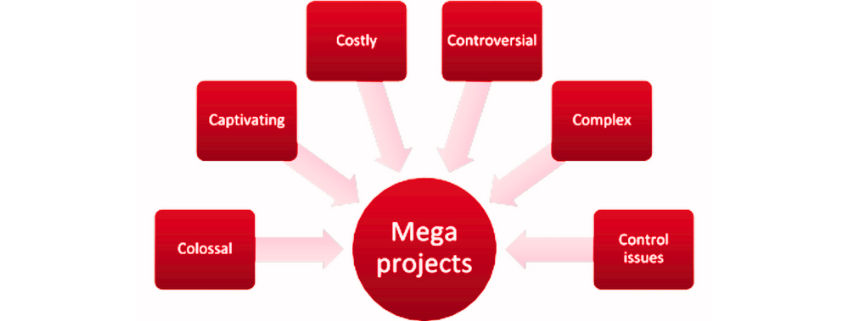
Source: ResearchGate
Elements of Mega Projects You Must Know
Running a mega project is a balancing act - part strategy, part diplomacy, part firefighting. Although not necessarily in the order you’d expect here are the essential elements:
- Vision that doesn’t blur: Without a clear, shared purpose, the project risks wandering off-course before it’s halfway done.
- Money under control: Secure funding early, watch the cash flow like a hawk, and plan for fiscal shocks.
- Planning built to flex: Borrow from frameworks like PRINCE2 or PMBOK - but adapt them to handle multi-billion-dollar budgets and marathon timelines.
- People on board: all of them - from political leaders to neighborhood associations, every stakeholder has influence (and sometimes conflicting goals).
- Risk always on the radar: Economic swings, tech changes, or new regulations can appear midstream; mitigation can’t be an afterthought.
- Tech in your corner: Digital twins, AI scheduling, and BIM aren’t just trendy words - they can surface issues before they become expensive disasters.
- Change that sticks: It’s not enough to roll out new systems; people need to embrace them, or execution grinds down.
Miss even one of these, and a promising mega project can become the cautionary tale no project manager wants to tell.
What Are the Benefits of Creating Mega Projects
Big undertakings come with big challenges, but the wins can be game-changing:
- Economic ripple effects: These projects often act like economic engines - not only putting thousands to work, but also spurring suppliers, contractors, and entire industries into motion, all while boosting tax income for years.
- Infrastructure leaps: Roads, ports, power grids, high-speed internet - upgrades like these don’t just fix old problems; they open doors to new possibilities for business and daily life.
- Social uplift: Better connections between cities, faster access to services, and improvements in living standards often follow in the wake of such investments.
- International pull: High-profile developments tend to draw in outside capital, new trade relationships, and raise a nation’s standing in global rankings.
- Breeding ground for innovation: The scale forces teams to push boundaries in engineering, materials, and project delivery, often creating solutions that trickle into other industries.
For those at the helm, the payoff is more than a salary. Running a mega project is a career-defining moment - the kind of accomplishment that earns respect, leaves a visible legacy, and feels a bit like planting your flag on top of Everest.
Real-World Examples of Mega Projects
By now, you must’ve got a fair understanding of what mega projects are. Let’s now examine a few international real-world examples and mega project infrastructure projects in India that have reshaped economies and cities.
1. Channel Tunnel (UK–France): This undersea rail stretches beyond 50 km beneath the seabed of the English Channel - tying Britain to France in just over two hours. Once a slow ferry ride, the London–Paris trip is now a smooth, high-speed journey - an engineering triumph that redefined cross-channel travel.
2. Panama Canal Expansion (Panama): By widening the canal and upgrading its locks, Panama made room for colossal 'New Panamax' vessels. The multi-billion-dollar overhaul didn’t just speed up shipping alone - it also shifted global trade patterns and cemented Panama’s standing as a linchpin in maritime commerce.
3. Hong Kong–Zhuhai–Macau Bridge (China): This remarkable 55 km bridge-tunnel link connects three of China’s most propellent economic zones. The country's ability and desire for ambitious infrastructure is demonstrated by the fact that trips that once took hours can now be finished in minutes.
4. Burj Khalifa (UAE): Towering above Dubai’s skyline, the Burj Khalifa is not merely the tallest structure on the planet. It’s a declaration of ambition, merging advanced engineering with a design that has become a global architectural icon.
5. Delhi–Mumbai Industrial Corridor (India): Supported by an incredible investment of $100 billion investment, this initiative is building industrial cities, manufacturing centers, and modern transport links from the ground up. It signals India’s intent to shift toward large-scale, technology-driven production.
6. Mumbai Coastal Road Project (India): This 29 km seaside expressway is set to untangle one of Mumbai’s busiest traffic arteries. Once complete, it will slash travel times along the city’s waterfront, transforming the daily grind for millions.
7. California High-Speed Rail (USA): This ambitious project looks to provide the US with a sustainable long-distance rail alternative. In a nation where cars and airplanes are the go-to choice, It is designed to transport passengers between San Francisco and Los Angeles in less than three hours.
8. Three Gorges Dam (China): The largest hydroelectric power station on Earth, it generates electricity for tens of millions. More than just a feat of scale, it reflects China’s command of complex water engineering and long-term energy planning.
These projects aren’t just construction feats - they’re case studies in leadership, multi-stakeholder coordination, and managing complexity at a level most projects never reach.
Common Challenges of Mega Projects
Even the best-planned mega projects face hurdles:
- Budget Overruns: Often due to scope creep, inflation, or underestimation.
- Delays: Caused by land acquisition issues, labor disputes, or supply chain disruptions.
- Political Risks: Policy shifts or leadership changes can alter priorities.
- Environmental Concerns: Compliance with sustainability regulations and public opposition.
- Stakeholder Conflicts: Misaligned objectives leading to decision-making gridlock.
Experienced managers know these risks aren’t just obstacles - they’re constants to be anticipated and managed.
Conclusion
Mega projects are where project management meets nation-building. They demand vision, resilience, and the ability to orchestrate complexity on an unprecedented scale. For professionals aiming to lead one, mastering the principles, anticipating the challenges, and studying real-world successes is the first step toward steering a billion-dollar dream to reality. The question isn’t just what a mega project is - it’s whether you’re ready to lead one.
Frequently Asked Questions (FAQs)
1. What are the benefits of mega projects?
Mega projects fuel economic growth, create thousands of jobs, and modernize infrastructure. In addition, they also improve connectivity, enhance quality of life, and often spur innovation in engineering and technology.
2. How to make a mega project?
Successful mega projects begin with a clear vision, robust funding, and methodic planning. They require strong stakeholder alignment, agile risk management, and the use of advanced tools like BIM or digital twins to manage complexity.
3. What are the types of mega projects?
Common types include infrastructure, energy, defense, and technology. Each type has distinct technical, financial, and regulatory demands.
4. What is the value of a mega project?
The value lies in its long-term economic, social, and strategic impact - often running into billions of dollars. Beyond financial worth, they can redefine how societies live, work, and connect.
1639 articles published
KnowledgeHut is an outcome-focused global ed-tech company. We help organizations and professionals unlock excellence through skills development. We offer training solutions under the people and proces...
Get Free Consultation
By submitting, I accept the T&C and
Privacy Policy