
What Is Enterprise Agility? Benefits, Frameworks, Examples
Updated on Aug 14, 2025 | 1.87K+ views
Share:
Change has become the only constant in a fast-paced world. Organizations that stick to old methods are finding it difficult to keep their pace. Embracing a culture that adapts to change is no longer a mere necessity. It is a crucial part of staying afloat in constantly changing customer requirements.
Organizations need to deeply instill agility throughout their culture. Agile teams working in silos will not be able to collaborate without limitations. Agility needs to be a core part of company culture, strategy, and structure.
In this blog, let’s take a closer look at enterprise Agility. We will look at its importance, benefits, implementation, and challenges.
Master the Right Skills & Boost Your Career
Avail your free 1:1 mentorship session
What Is Enterprise Agility?
Enterprise agility is an organization’s capacity to quickly respond to changes without affecting operational stability. Agile principles are followed by all departments – IT, HR, finance, marketing, etc.
This creates a thorough, adaptive system that works as a unit. Such Agile maturity extends beyond scattered teams working in their own Agile silos.
This kind of transformation takes a lot of time and effort. Culture, processes, and structures should be reshaped to allow quick and coordinated responses. Organizations can tackle shifting market and customer needs if they are completely Agile.
Deloitte and PwC suggest the enterprise agility model focuses on a larger picture. It looks beyond individual projects. It leads to a connected system that distributes decision-making. Teams in these organizations are built to focus on delivering value.
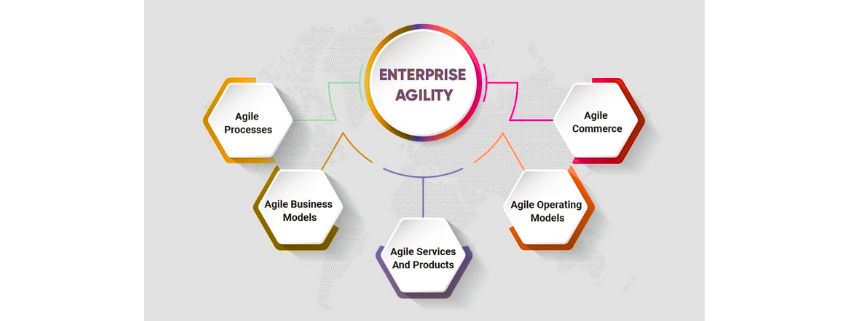
Source: Bacancy Technology
Why Enterprise Agility Matters Today?
Agile has become crucial to stay afloat in today’s economy. It has moved beyond a competitive edge to become a staple of any scaling organization. Implementing the enterprise agility model empowers decision makers. They can sense disruption and proactively pivot before it spells disaster.
Research by McKinsey shows that highly agile organizations drastically outperform their peers. Such organizations become 5 to 10 times faster and three times more likely to be in the top 25 percentile. This is duse to improvements up to 30% in the following factors:
- Efficiency
- Customer satisfaction
- Engagement
- Operational performance
Enterprise agility helps organizations shift into proactive decision-making. They no longer take a reaction-based approach putting out fires. Change is converted from being a threat into a proven business strategy. Agility ensures that your organization adapt, innovates, and leads. In the absence of agility, organizations can see themselves being stagnant or obsolete.
Successful transformations can come only with the help of proper training. Earn your skills with the best Agile training available today!
Frameworks for Enterprise Agility
There are different frameworks that can be used to implement the enterprise Agile model. Each of them is suitable for different kinds of organizations.
Let's look at some of the key frameworks used to implement enterprise agility.
1. Scaled Agile Frameworks (SAFe, LeSS, DAD)
These frameworks are used to coordinate and implement Agile in scale:
- Scaled Agile (SAFe): SAFe aligns teams through different initiatives. Some of those initiatives include coordinated planning and structured roles. This helps in scaling Agile for larger organizations.
- Large-Scale Scrum (LeSS): LeSS is a light framework focusing on scaling Scrum principles. This is ideal in organizations where multiple teams work on the same product.
- Disciplined Agile Delivery (DAD): DAD is a hybrid and context-driven framework. It integrates practices from Scrum Lean, and other Agile methods.
2. Mckinsey’s Operating Model Redesign
McKinsey is an advocate for restructures to implement Agile properly across the enterprise. They call this the “Agile Impact Engine”.
3. Living Agile™ and TCS Enterprise Agile
TCS has an Enterprise Agile model they call “Living Agile™”. Aimed at enterprise-wide agility by 2020, this model focuses on culture primarily. TCS used to have only 15% of their projects use Agile in 2017. Now they have over half a million Agile practitioners globally.
How to Implement Enterprise Agility?
Implementing and maintaining enterprise agility can seem daunting. There is one major thing to understand before setting out for this goal. Agility isn’t a project that has a defined scope or timeline. It is a transformation that can sustain itself only when powered by the right purpose.
Let us look at the different steps involved in implementing enterprise agility.
1. Conduct a Current State Assessment
Understand the current state of your organization. You need to know where you currently stand to define the goal of implementing enterprise agility. Assess culture, structure, and current Agile maturity. Identify areas where success is consistent and where help is needed.
2. Align Leadership
Leaders need to be aligned and educated with the purpose behind this transformation. Activities like immersive simulations will help everyone see Agile in action. McKinsey highlights this as a crucial piece to enable outcome-driven Agile transformation.
3. Define a Shared Vision
Understand and map out what Agility means to your organization. There should be a consensus on why agility is needed and what it means in the context of your business. Co-create guiding principles by involving teams and leaders.
4. Choose Front-Running Departments
Choose sectors in the business that are ready to lead. Ideally, these would be teams that have shown consistent success. Initiate systems like R&D and innovative labs to enable these sectors. Move fast to show relevant impact within 12-18 months.
5. Build Enablement Systems
The selected sectors need to have tools that will help them adopt Agile. Teams need to have access to coaching sessions and clearly defined objectives. A roadmap will not work if the right tools aren’t available.
6. Scale with Intent
Scaling can happen efficiently once the initially chosen sectors have succeeded. Their journey is analyzed, and a refined process is implemented for scale. Scaling Agile can only happen when previous attempts are used as learning experiences.
7. Track and Adapt
Outcomes are analyzed and processes should be refined. Data plays a key role in improving existing systems.
Implementing enterprise agility requires collaboration from all facets of the organization.
Benefits of Enterprise Agility
There are various benefits with the correct implementation of enterprise agility. Let us look at a few of them.
1. Consistent Speed & Responsiveness
Agile enterprises see faster project completion. This isn’t isolated to IT teams, and is seen across departments. Some examples of faster turnarounds include product launches, regulatory changes, and modifications in business strategy.
2. More Attempts at Innovation
Agile empowers teams to be self-organized and cross-functional. This creates independent teams with more time and opportunities for innovation and experimentation.
3. Increased Employee Retention
Teams can see the direct influence of their work. This creates teams that are empowered and invested in the work they do. There is an increase in morale and lower turnover.
4. Improved Performance
McKinsey studies show that enterprise agility results in monumental increase for various parameters. Metrics like customer satisfaction, operational performance, and turnaround times gradually improve. Organizations also perform better than competitors who haven't maturely adopted Agile.
These benefits are exponential and are a valuable investment for any organization.
Earn your skills with the upGrad KnowledgeHut best Agile training courses!
Examples of Agile Organizations
Organizations that have deployed a scalable and defined enterprise agility model have seen a lot of improvements. Let us look at some organizations that have succeeded after a well-defined enterprise agility framework.
Tata Consultancy Services (TCS)
In 2017, TCS used Agile only in 15% of their projects. They set out to embed Agile across a half-million strong workforce. Using their Living Agile™ model, they were able to scale and achieve their goal by 2020.
This model was done with the help of immersive 3-day hackathons. These hackathons instilled the Agile mindset across teams in a systematic manner. Agile practices were embedded in even the HR, finance and legal teams.
A gentle and incremental help allowed TCS to see a steady increase in Agile practices across the organization. This “Living Agile” mindset has been widely adopted by Agile coaching networks.
Bosch
Bosch saw the need to stay Agile and innovate themselves in the changing market. The company started their transformation into enterprise agility in 2018. It started by employing Scrum teams.
Bosch tried to take a “dual organization” approach to agility. Normal functionality continued while certain teams adopted Agile. The failure of this approach prodded the organization to start from scratch.
Learning from failure, Bosch started from leadership this time around. By starting from the management, Bosch was able to transition into a completely Agile enterprise. The backlog of the entire organization was prioritized.
After the transformation, Bosch adapted to changers faster and was more flexible. Organizational issues were seen as issues affecting the entire company instead of specific groups.
PayPal
PayPal did not have a defined product hierarchy or common leadership. This led to minimal value delivery despite a lot of hard work. They started the transformation towards enterprise agility back in 2013. Scrum teams were employed across 40 of their offices globally.
PayPal’s Agile transformation revolved around 4 key pillars. They were implemented as the following steps:
- Teams were brought closer to the customers. Teams began to have a deeper understanding of customer needs and difficulties.
- Defining clear product ownership. Leadership was structured based on the company’s product portfolio.
- Deployment of Scrum teams. Once leadership and teams took their first steps, it was time to implement these principles.
- The final step was to define and track the relevant metrics. This allowed PayPal to measure the progress of their Agile transformation.
These examples highlight the need for enterprise agility. While these companies were able to fix their problems, there are some historic projects which failed due to rigid structures.
Common Challenges of Enterprise Agility
Attaining enterprise agility can face some challenges if not done properly. Understanding these hurdles and being prepared for them is ideal.
Here are some of the most common challenges in implementing enterprise Agility.
1. Resistance in Hierarchy
Rigid structures often resist the onset of change. Leaders need to step up and take the charge by following the Agile model. Change will happen only if it is embraced from the top.
2. Cultural Resistance
It is often difficult to bring a about a huge change in the culture of an organization. There should be initiatives like leadership coaching, communication, and transparency. This allows all employees to slowly adapt without much resistance.
3. Confusion in Roles
Teams and leaders can only take the right decisions when they understand their role clearly. An undefined structure will lead to chaos. Clearly defining and communicating the responsibility of each role will help mitigate this.
4. The Balance Between Control & Autonomy
Coherent strategy should be implemented along with decentralized execution. Teams should be enabled to maintain alignment without sacrificing on velocity.
Understanding the root cause behind these challenges is crucial. The right strategy will help create a resilient and Agile organization.
Measuring the Impact of Enterprise Agility
A successfully deployed model of enterprise agility always looks for ways to improve their Agile maturity. Let us look at the various ways to assess the impact of enterprise agility.
1. Performance & Customer Metrics
Analyzing metrics like customer satisfaction, quality, operational efficiency, and time-to-market are important. This helps leadership understand how the final products and services are functioning.
2. Employee Engagement
Engagement is extremely correlated with Agility. Monitoring team morale, turnover, and autonomy helps understand the cultural impact of transformation.
3. Innovation
Assess the time required for ideas to get deployed after the initial concept. Teams need to be empowered to experiment and come up with innovative ideas.
4. Market Outcomes
Agile organizations beat competitors in factors like market positioning and revenue growth. These are indirect signals of the long-term effect of such transformations.
Final Thoughts
Enterprise agility is a transformative framework for organizations today. Creating a strategic and incremental plan for deployment is key. Organizations need to ensure that they don’t hamper current functionality when chasing these long-term benefits.
Unless there is steady scaling, companies will lose out on both long-term and short-term benefits in the pursuit of enterprise agility.
Frequently Asked Questions (FAQs)
1. What is the difference between enterprise agility and business agility?
Enterprise agility spans the entire organization—including support functions like HR and finance—while business agility typically focuses on customer-facing units and operational responsiveness SixSigma.us.
2. What is meant by business agility?
Business agility refers to an organization’s ability to rapidly adapt to market, environmental, and customer changes in a productive, cost-effective way, often centered on customer-facing operations Wikipedia.
3. What is the goal of business agility?
To continuously innovate and respond to evolving demands—keeping products, processes, and strategies aligned with fast-moving environments.
5. What are the four types of agile?
Common agile frameworks include Scrum, Kanban, Lean, and Disciplined Agile Delivery (DAD), each suiting different needs and scales.
6. What are common barriers to achieving enterprise agility?
Barriers include leadership inertia, cultural resistance, unclear roles/governance, and difficulty balancing autonomy with alignment—overcome with intentional change programs and leadership modeling.
1639 articles published
KnowledgeHut is an outcome-focused global ed-tech company. We help organizations and professionals unlock excellence through skills development. We offer training solutions under the people and proces...
Get Free Consultation
By submitting, I accept the T&C and
Privacy Policy
Ready to learn about Agile Certifications Roadmap?