
What is SAFe Certification? Prerequisites, Cost, Benefits
Updated on Sep 02, 2025 | 7 min read | 23.37K+ views
Share:
Table of Contents
View all
- What Is SAFe?
- Prerequisites for SAFe Agile Certification
- Who Gets SAFe Certified?
- Why is SAFe Important?
- Levels of SAFe Certification
- What is the Cost of SAFe Agile Certification?
- Renewal Process and Fees
- Maintaining Certification Validity
- SAFe Agile Certification's Benefits
- How to Prepare for SAFe Certifications?
- Conclusion
In today’s VUCA environment, Agile methodologies have become indispensable for effectively managing complex projects - no matter the industry.
However, as organizations grow, they face challenges in scaling Agile practices beyond individual teams. This is where the Scaled Agile Framework® (SAFe®) steps in, offering a proven, structured approach to implementing Agile at an enterprise level.
SAFe certification has emerged as a widely recognized credential that validates professionals' ability to apply Agile principles on a large scale. With over 70% of Fortune 500 companies adopting SAFe, earning this certification opens doors to exciting career opportunities and advancement worldwide. Whether you are an Agile practitioner, Scrum Master, product owner, or an executive, SAFe certification can enhance your expertise and credibility.
In this blog, we guide you through everything you need to know about SAFe certification - what it is, the prerequisites, costs involved, benefits, the different certification levels, and practical tips on preparing for the exams. Whether you are considering your first SAFe certification or looking to advance your skills, this comprehensive overview will help you make informed decisions and plan your Agile career path effectively.
Master the Right Skills & Boost Your Career
Avail your free 1:1 mentorship session
What Is SAFe?
Scaled Agile Framework is a certification program that Scaled Agile, Inc, developed. It is the most widely used framework today with over a third of companies using it in some capacity.
In SAFe, companies follow patterns of workflow based on lean and agile principles. To meet project and strategic goals, companies need a simple way to scale agile across their organization. Despite having originated in software development, this concept has made its way into many different departments today at businesses and government agencies alike.
Rather than scrambling to figure out how to run a project, companies look to SAFe as a well-documented, tried, and true framework. We have a clear structure for roles and events and a people-centric view focused on delivering high-quality products.
Prerequisites for SAFe Agile Certification
- Scrum experience
- Expertise in software industries - analyzing business processes, improving product quality, and managing any project or product for more than five years.
Prerequisite exam for Leading SAFe Training
You need to attend a SAFe course from a reputable provider to get all the study materials and exam details. To achieve quality performance, reasonable efforts are also required to take the course. It would help if you had a good deal of experience implementing SCRUM and SAFe to pass the SAFe exam. To prepare for the final SAFe Agile certification exam, you should study sample test papers and take mock tests.
Who Gets SAFe Certified?
SAFe certification is an option that has been considered by many Scrum and agile workers looking to move up the career ladder. SAFe is a promising career path, as it's been trained by over 700,000 people.
People with a wide range of occupations are likely to get certified due to the variety available certifications. After getting your certificate, you'll be able to select your certification program based on the type of career you want to pursue. If you want to get the job, certification makes all the difference. Having evidence that the person they hire can handle the job gives employers a sense of security.
You can receive Scrum master certification based on your current experience level if you are a Scrum master or wish to become one. The product owner certification is specific to your position as the owner of the product. The practitioner certification prepares members of an agile team for their roles within a large and complex environment.
Managers, directors, and executives can even gain certification in SAFe. It's designed to help management staff manage the company's agile strategy by giving them a more thorough understanding of the framework.
Enhance your project management skills with certified PMP training and unleash your true potential!
Why is SAFe Important?
SAFe is a popular choice of certification since its worldwide recognition makes it a popular option among those trying to advance their careers. You instantly gain credibility by using the name SAFe, as most employers understand the value of the certification process.
If you get certified, your salary package almost always goes up regardless of where you work. In fact, you may find your job prospects increasing since you will be in greater demand and have more opportunities to network with the SAFe community. You will be able to apply for any job that requires certification, and you will be able to add a digital badge to your resume to demonstrate your accomplishment.
SAFe Certifications (Here, under each level, we can see many roles like SAFe Agilist, SAFe Agile Product Manager, etc.)
The software industry faces a skills gap that is a significant concern. Getting a SAFe certification will enable you to demonstrate to hiring managers that you are familiar with the SAFe framework.
There are various types of certifications in SAFe-
- SAFe ® 6.0 Training (SAFe Agilist Certification)
- SAFe Product Owner/Product Manager (POPM) 6.0
- SAFe Practitioner 6.0
- SAFe Lean Portfolio Management (LPM) 6.0
- SAFe Scrum Master (SSM) 6.0
- SAFe Advanced Scrum Master (SASM) 5.1
- SAFe Agile Product Manager (APM) 6.0
- SAFe Practice Consultant (SPM) 6.0
- SAFe DevOps Practitioner (SDP) 6.0
- SAFe Architect (ARCH) 6.0
Explore more about other Agile certifications here.
Levels of SAFe Certification
Each Of These Certifications Has Four Levels to Build On
In scaled agile frameworks, there are four levels: team, program, portfolio, and significant solution level. Now let's take a closer look.
Scaled Agile Framework Level 1: Team Level
Teams that work together. The next level above the team level within the scaled agile framework is the program level.
Scaled Agile Framework Level 2: Program level
Many teams are involved at the Program Level, delivering solutions via an "Agile Release Train" (ART). Agile Release Trains (ARTs) are usually composed of 50 to 130 individuals working together in sub-teams to deliver value to the organization. Some teams organize Agile Release Trains.
Scaled Agile Framework Level 3: Large Solution Level
There may be several Agile Release Trains required. To properly organize it, we'll need a "team-of-teams-of-teams.” The solution train is the name for all Agile Release Trains in one place.
Scaled Agile Framework Level 4: Portfolio Level
An entire business area (or division) was able to adopt agile methodologies in this case. This means that managing agile practices does not only apply to IT teams but also to management practices. Strategic governance and lean budgeting are similarly applicable.
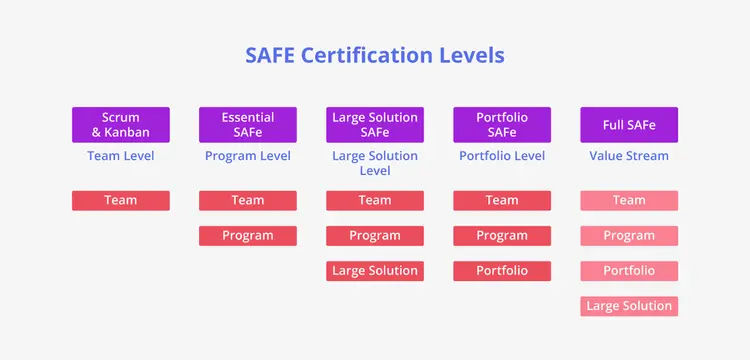
Check out one more infographic on leading SAFe—most in-demand scaled agile framework certification.
What is the Cost of SAFe Agile Certification?
The cost required to earn a SAFe® certification depends on two factors – the credential and training provider. Let's look at the various components that contribute to the cost of various SAFe certifications. We will also look at the costs involved in renewing these certifications as well.
Breakdown of Certification Costs
Here are the estimated costs for a list of popular SAFe certifications in USD:
- SAFe® Agilist (Leading SAFe®) – $795 – $995
- SAFe® Scrum Master (SSM) – $695 – $895
- SAFe® Product Owner/Product Manager (POPM) – $745 – $945
- SAFe® Advanced Scrum Master (SASM) – $795 – $995
- SAFe® Release Train Engineer (RTE) – $1,895+
- SAFe® Program Consultant (SPC) – $3,295+
These fees typically include the following:
- 2 – 4 days of instructor-led training. The number of days is dependent on the certification
- One attempt to write the certification exam
- SAFe Community Platform membership for a year
- Access to study resources and digital course materials
Renewal Process and Fees
SAFe certifications are only valid for a single year. They need to be renewed on an annual basis through Scaled Agile. The renewal fees vary based on the certification:
- Most certifications (SA, SSM, POPM, SASM, etc.): $100/year
- SPC Certification: $895/year
- SPCT Certification: $1,295/year
Renewal is done via the Scaled Agile Community Platform. When you renew a SAFe certification, it automatically renews all other certifications that are at a lower level,
For example, if you renew your A-SPC certification, it will automatically renew SPC, RTE and other SAFe certifications.
Maintaining Certification Validity
Here are some tips to help you maintain the validity of your SAFe certificatiions.
- Renew the certification before the expiration date
- Keep yourself engaged through webinars, workshops, or learning modules
- Retain practical knowledge by applying SAFe practices at your role
- Network with other professionals via the SAFe Community
Keeping your certification current not only enhances your credibility but also ensures you stay aligned with evolving Agile at scale frameworks and industry best practices.
SAFe Agile Certification's Benefits
A SAFe certification offers both immediate and long-term advantages in your career. The increasing number of organizations adopting the SAFe framework has created a high demand for SAFe-certified professionals.
Let's look at some of the most prominent benefits of obtaining a SAFe certification:
- Career Advancement: SAFe-certified professionals have an opportunity to go for various roles within the Scaled Agile Framework. Roles like Agile Coach, Scrum Master, Product Owner, or RTE are some of the various options. They can help you earn higher salaries and step into leadership roles.
- Better Implementation Skills: SAFe certifications will teach you how to apply Lean-Agile principles consistently across different portfolios. This enables you to deliver consistent value.
- Global Recognition: Since SAFe credentials are globally recognized, you can pursue roles across the world without any barriers.
- Professional Networking: SAFe certifications provide you with access to Scaled Agile’s global community. This opens access to resources, and continuous learning content while giving you various networking opportunities.
SAFe certifications are strategic investments in Agile maturity and leadership.
How to Prepare for SAFe Certifications?
Preparing for a SAFe® certification involves a combination of structured practices like training, hands-on practice, and exam readiness. Here’s a step-by-step guide to help you succeed:
1. Choose the Right Certification Path
You need to identify the SAFe certification that aligns with your career path and aspirations. Here are some examples where each certification makes sense:
- Leading SAFe® (SAFe Agilist) – the right fit for managers and transformation leaders
- POPM – makes sense for product owners and managers
- SSM/ASM – suited for Scrum Masters working in SAFe environments
- RTE/SPC – aligned with Agile coaches or program-level leaders
2. Enroll in an Accredited Course
SAFe exams require you to attend SAFe-certified training program from a recognized Scaled Agile partner. Enroll with accredited training organizations like upGrad KnowledgeHut. The training program offers hands-on simulations, instructor-led insights, and real-world case discussions.
3. Study the SAFe Body of Knowledge
Make use of resources provided via the SAFe Community Platform, such as the following:
- Course slides and handbooks
- Practice tests and sample questions
- The SAFe Big Picture and glossary
Making yourself familiar with Lean-Agile principles, ARTs (Agile Release Trains), PI Planning, and SAFe roles and responsibilities is crucial to ace the exam.
4. Practice Exam Techniques
Most SAFe exams are timed, multiple-choice online tests with 45–60 questions. Preparing with the help of mock tests will help you to improve time management and identify weak areas.
5. Join SAFe Communities
Scaled Agile’s global community offers you a treasure trove of opportunities. Use them to learn from others’ experiences. Staying active in the community helps clarify doubts and reinforces learning.
By following these steps, you’ll be better equipped to pass your SAFe exam on the first attempt and apply your knowledge in real-world Agile transformations.
Discover the leading Agile Category Courses
Conclusion
Professionals working in Agile frameworks and planning to grow in leadership roles can pursue the various certifications offered by Scaled Agile, Inc. These certifications open different career opportunities for professionals on a global scale.
With the right preparation and approach, you can see yourself grow and make best use of certifications ranging from Leading SAFe Agilist, Release Train Engineer to Advanced SAFe Practice Consultant.
Frequently Asked Questions (FAQs)
1. Which SAFe certification is best?
- SAFe Agilist 5.0 Certification.
- SAFE Scrum Master Certification.
- SAFe Advanced Scrum Master Certification.
- SAFe POPM Certification.
2. Is the SAFe certification worth it?
It helps to simplify an individual's credentials management when they have the SAFe Agilist Certification. To keep their knowledge of SAFe current and relevant, they have access to a wealth of resources, including professional development.
3. Does SAFe certification expire?
It's important to remember that each SAFe® certification is valid for one year only. A Scaled Agile e-mail will be sent to you accordingly when your renewal time comes. Your SAFe certificate will need to be renewed after one year by paying the renewal fee.
4. Is SAFe the same as agile?
A small team of ten or fewer members is usually the target group for Agile. A SAFe framework, on the other hand, does not limit enterprises to smaller teams and guides them in scaling lean and agile practices.
1638 articles published
KnowledgeHut is an outcome-focused global ed-tech company. We help organizations and professionals unlock excellence through skills development. We offer training solutions under the people and proces...
Get Free Consultation
By submitting, I accept the T&C and
Privacy Policy
Ready to learn about Agile Certifications Roadmap?