
- Blog Categories
- Project Management
- Agile Management
- IT Service Management
- Cloud Computing
- Business Management
- BI And Visualisation
- Quality Management
- Cyber Security
- DevOps
- Most Popular Blogs
- PMP Exam Schedule for 2025: Check PMP Exam Date
- Top 60+ PMP Exam Questions and Answers for 2025
- PMP Cheat Sheet and PMP Formulas To Use in 2025
- What is PMP Process? A Complete List of 49 Processes of PMP
- Top 15+ Project Management Case Studies with Examples 2025
- Top Picks by Authors
- Top 170 Project Management Research Topics
- What is Effective Communication: Definition
- How to Create a Project Plan in Excel in 2025?
- PMP Certification Exam Eligibility in 2025 [A Complete Checklist]
- PMP Certification Fees - All Aspects of PMP Certification Fee
- Most Popular Blogs
- CSM vs PSM: Which Certification to Choose in 2025?
- How Much Does Scrum Master Certification Cost in 2025?
- CSPO vs PSPO Certification: What to Choose in 2025?
- 8 Best Scrum Master Certifications to Pursue in 2025
- Safe Agilist Exam: A Complete Study Guide 2025
- Top Picks by Authors
- SAFe vs Agile: Difference Between Scaled Agile and Agile
- Top 21 Scrum Best Practices for Efficient Agile Workflow
- 30 User Story Examples and Templates to Use in 2025
- State of Agile: Things You Need to Know
- Top 24 Career Benefits of a Certifed Scrum Master
- Most Popular Blogs
- ITIL Certification Cost in 2025 [Exam Fee & Other Expenses]
- Top 17 Required Skills for System Administrator in 2025
- How Effective Is Itil Certification for a Job Switch?
- IT Service Management (ITSM) Role and Responsibilities
- Top 25 Service Based Companies in India in 2025
- Top Picks by Authors
- What is Escalation Matrix & How Does It Work? [Types, Process]
- ITIL Service Operation: Phases, Functions, Best Practices
- 10 Best Facility Management Software in 2025
- What is Service Request Management in ITIL? Example, Steps, Tips
- An Introduction To ITIL® Exam
- Most Popular Blogs
- A Complete AWS Cheat Sheet: Important Topics Covered
- Top AWS Solution Architect Projects in 2025
- 15 Best Azure Certifications 2025: Which one to Choose?
- Top 22 Cloud Computing Project Ideas in 2025 [Source Code]
- How to Become an Azure Data Engineer? 2025 Roadmap
- Top Picks by Authors
- Top 40 IoT Project Ideas and Topics in 2025 [Source Code]
- The Future of AWS: Top Trends & Predictions in 2025
- AWS Solutions Architect vs AWS Developer [Key Differences]
- Top 20 Azure Data Engineering Projects in 2025 [Source Code]
- 25 Best Cloud Computing Tools in 2025
- Most Popular Blogs
- Company Analysis Report: Examples, Templates, Components
- 400 Trending Business Management Research Topics
- Business Analysis Body of Knowledge (BABOK): Guide
- ECBA Certification: Is it Worth it?
- Top Picks by Authors
- Top 20 Business Analytics Project in 2025 [With Source Code]
- ECBA Certification Cost Across Countries
- Top 9 Free Business Requirements Document (BRD) Templates
- Business Analyst Job Description in 2025 [Key Responsibility]
- Business Analysis Framework: Elements, Process, Techniques
- Most Popular Blogs
- Best Career options after BA [2025]
- Top Career Options after BCom to Know in 2025
- Top 10 Power Bi Books of 2025 [Beginners to Experienced]
- Power BI Skills in Demand: How to Stand Out in the Job Market
- Top 15 Power BI Project Ideas
- Top Picks by Authors
- 10 Limitations of Power BI: You Must Know in 2025
- Top 45 Career Options After BBA in 2025 [With Salary]
- Top Power BI Dashboard Templates of 2025
- What is Power BI Used For - Practical Applications Of Power BI
- SSRS Vs Power BI - What are the Key Differences?
- Most Popular Blogs
- Data Collection Plan For Six Sigma: How to Create One?
- Quality Engineer Resume for 2025 [Examples + Tips]
- 20 Best Quality Management Certifications That Pay Well in 2025
- Six Sigma in Operations Management [A Brief Introduction]
- Top Picks by Authors
- Six Sigma Green Belt vs PMP: What's the Difference
- Quality Management: Definition, Importance, Components
- Adding Green Belt Certifications to Your Resume
- Six Sigma Green Belt in Healthcare: Concepts, Benefits and Examples
- Most Popular Blogs
- Latest CISSP Exam Dumps of 2025 [Free CISSP Dumps]
- CISSP vs Security+ Certifications: Which is Best in 2025?
- Best CISSP Study Guides for 2025 + CISSP Study Plan
- How to Become an Ethical Hacker in 2025?
- Top Picks by Authors
- CISSP vs Master's Degree: Which One to Choose in 2025?
- CISSP Endorsement Process: Requirements & Example
- OSCP vs CISSP | Top Cybersecurity Certifications
- How to Pass the CISSP Exam on Your 1st Attempt in 2025?
- Most Popular Blogs
- Top 7 Kubernetes Certifications in 2025
- Kubernetes Pods: Types, Examples, Best Practices
- DevOps Methodologies: Practices & Principles
- Docker Image Commands
- Top Picks by Authors
- Best DevOps Certifications in 2025
- 20 Best Automation Tools for DevOps
- Top 20 DevOps Projects of 2025
- OS for Docker: Features, Factors and Tips
- More
- Agile & PMP Practice Tests
- Agile Testing
- Agile Scrum Practice Exam
- CAPM Practice Test
- PRINCE2 Foundation Exam
- PMP Practice Exam
- Cloud Related Practice Test
- Azure Infrastructure Solutions
- AWS Solutions Architect
- IT Related Pratice Test
- ITIL Practice Test
- Devops Practice Test
- TOGAF® Practice Test
- Other Practice Test
- Oracle Primavera P6 V8
- MS Project Practice Test
- Project Management & Agile
- Project Management Interview Questions
- Release Train Engineer Interview Questions
- Agile Coach Interview Questions
- Scrum Interview Questions
- IT Project Manager Interview Questions
- Cloud & Data
- Azure Databricks Interview Questions
- AWS architect Interview Questions
- Cloud Computing Interview Questions
- AWS Interview Questions
- Kubernetes Interview Questions
- Web Development
- CSS3 Free Course with Certificates
- Basics of Spring Core and MVC
- Javascript Free Course with Certificate
- React Free Course with Certificate
- Node JS Free Certification Course
- Data Science
- Python Machine Learning Course
- Python for Data Science Free Course
- NLP Free Course with Certificate
- Data Analysis Using SQL
Top 10 Cybersecurity Project Ideas for Beginners
Updated on Sep 18, 2026 | 1.27K+ views
Share:
Quick Overview:
- Cybersecurity project ideas for beginners help build practical skills in areas such as password security, network monitoring, encryption, and threat detection.
- Projects such as password strength checkers, phishing detection tools, file encryption, and password managers can help strengthen foundational cybersecurity knowledge.
- Network port scanners, intrusion detection systems, malware detection tools, and log monitoring projects provide hands-on exposure to common cybersecurity concepts.
- This guide tells you about the top 10 cybersecurity project ideas for beginners and the skills each project can help develop.
Build advanced cybersecurity skills with the Cybersecurity Master's Program and prepare for roles in modern cybersecurity and information security.
Master the Right Skills & Boost Your Career
Avail your free 1:1 mentorship session
What are the best cybersecurity project ideas for beginners?
The best Cybersecurity Project Ideas for Beginners are simple enough to understand but practical enough to demonstrate core security concepts. A good beginner project should also have a clear purpose, measurable functionality, and room for improvement.
Projects can help learners practise:
• Security awareness and risk identification
• Authentication and password security
• Encryption and data protection
• Network security
• Threat detection
• Log analysis
• Malware awareness
• Security monitoring
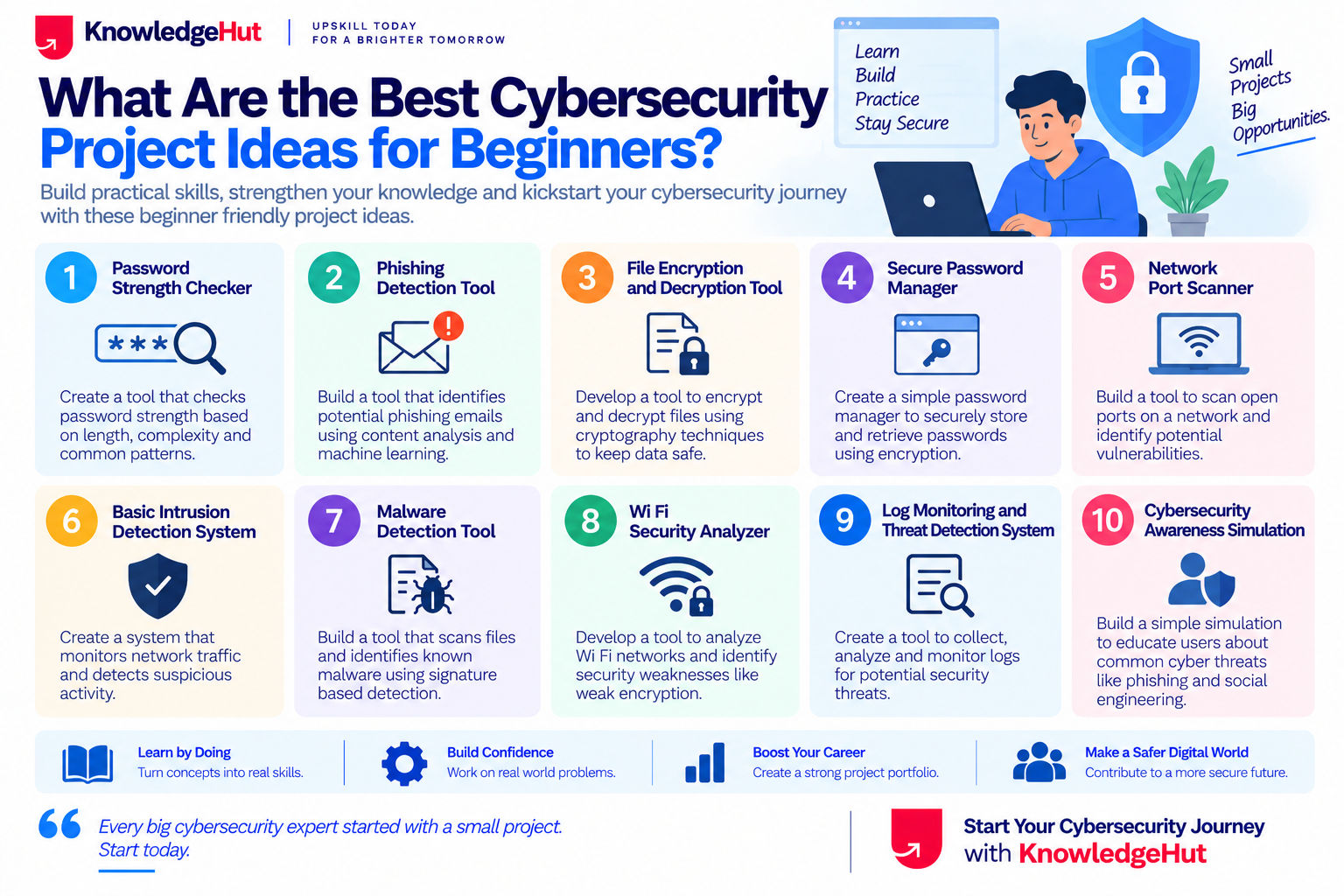
1. Password strength checker
A password strength checker is one of the simplest Cybersecurity Project Ideas for Beginners because it introduces the basics of authentication and password security.
The project can assess whether a password follows common security principles, such as:
• Sufficient length
• A mix of character types
• Avoiding common words
• Avoiding repeated patterns
• Avoiding easily guessed information
A useful version can provide a simple strength rating and explain which password characteristics need improvement.
This project helps beginners understand why strong passwords matter and how weak credentials can increase security risk.
To make the project more useful, additional features can include:
• Common password detection
• Pattern detection
• Password policy checks
• Secure feedback messages
• Local testing without storing the password
Also Read: Top 20+ Cyber Security Projects for 2026
2. Phishing detection tool
A phishing detection tool introduces beginners to the problem of identifying suspicious emails, links, or messages.
Among the Cybersecurity Project Ideas for Beginners, this project is useful because phishing combines technical security with human behaviour.
The tool can check for indicators such as:
• Suspicious URLs
• Unusual domains
• Mismatched links
• Urgent or threatening language
• Requests for sensitive information
• Unexpected attachments
• Poor or misleading sender details
Also Read: 105 Latest Cyber Security Research Topics in 2026
3. File encryption and decryption tool
A file encryption project introduces an important cybersecurity concept: protecting data so that unauthorised users cannot read it.
This is one of the most practical Cybersecurity Project Ideas for Beginners because it connects security theory with data protection.
The project can focus on:
• Selecting a file
• Encrypting the file
• Protecting the encryption key
• Decrypting the file when authorised
• Detecting invalid or corrupted input
Beginners can also document important security concepts such as:
• Confidentiality
• Key management
• Authentication
• Data integrity
Check out: Essential Cybersecurity Tools for Real-World Jobs
4. Secure password manager
A password manager project can take password security a step further by focusing on secure storage and controlled access.
Among these Cybersecurity Project Ideas for Beginners, this project covers several concepts at once, including authentication, encryption, and secure data handling.
A beginner version can include:
• A protected login mechanism
• Encrypted password storage
• Password generation
• Search and organisation of saved credentials
• Automatic session timeout
Build practical cybersecurity expertise with the Best Cyber Security Certification Courses and prepare for roles across modern cybersecurity domains.
5. Network port scanner
A basic port scanning project can help beginners understand network services and the idea of exposed entry points.
It is among the useful Cybersecurity Project Ideas for Beginners because it connects networking fundamentals with security assessment.
A learning focused project can examine an authorised test environment and identify:
• Open ports
• Closed ports
• Available services
• Unexpected network exposure
Explore What Projects Should Beginners Build After Learning AI Basics? to discover practical project ideas that can strengthen AI skills and build hands-on experience.
6. Basic intrusion detection system
A basic intrusion detection system introduces the concept of identifying potentially suspicious activity from network or system events.
This is one of the more advanced Cybersecurity Project Ideas for Beginners, but it can still be approached with a simple rules based design.
A beginner system can look for:
• Repeated failed login attempts
• Unexpected connection patterns
• Unusual access behaviour
• Sudden traffic changes
• Repeated requests from the same source
The system can generate alerts whenever a defined threshold is crossed.
This project helps learners understand:
• Event monitoring
• Rule based detection
• Alert generation
• False positives
• Security logs
Also Read: Top 40 IoT Project Ideas and Topics in 2026
7. Malware detection tool
A malware detection project introduces the basics of identifying potentially harmful files or behaviours.
For a beginner, the project can focus on safe and controlled datasets rather than analysing unknown live malware.
A simple approach can examine:
• File metadata
• Known indicators
• File hashes
• Suspicious characteristics
• Safe sample datasets
Explore the Fundamentals of Cybersecurity to understand core concepts, security principles, common threats, and essential protection practices.
8. Wi Fi security analyzer
A Wi Fi security analyzer can help learners understand common wireless security concepts and identify configuration issues in an authorised environment.
The project can focus on:
• Network security settings
• Encryption configuration
• Signal information
• Connected device visibility
• Basic configuration risks
Explore Latest Ethical Hacking Projects 2026 to discover practical project ideas for building hands on cybersecurity and ethical hacking skills.
9. Log monitoring and threat detection system
Log analysis is a core cybersecurity activity, making this one of the more valuable Cybersecurity Project Ideas for Beginners for learners interested in security operations.
The project can collect and analyse security related events such as:
• Failed login attempts
• Successful authentication
• Access violations
• Unusual activity patterns
• Repeated errors
• Suspicious event sequences
A dashboard can present:
• Event counts
• Frequent alerts
• Time based patterns
• Severity levels
• Recent security events
Explore Top 22 Cloud Computing Project Ideas in 2026 to discover practical projects that build hands on cloud skills and real world experience.
10. Cybersecurity awareness simulation
A cybersecurity awareness simulation focuses on the human side of security. It can demonstrate how users respond to common security situations without collecting sensitive information.
The project can simulate scenarios involving:
• Suspicious emails
• Unsafe password practices
• Untrusted links
• Data sharing risks
• Social engineering awareness
After each scenario, users can receive:
• A short explanation
• Security recommendations
• A risk score
• Suggested best practices
Similar Reads: Top 20 Cyber Security Tools in 2026
Conclusion
These Cybersecurity Project Ideas for Beginners cover password security, encryption, network monitoring, threat detection, and security awareness. Each project can start small and become more advanced with experience.
Choose a project aligned with the cybersecurity area of interest, then build, test, document, and improve it to demonstrate practical skills.
Have A Query? Get in Touch With Our Customer Support | upGrad KnowledgeHut
Frequently Asked Questions (FAQs)
1. How do beginners choose a cybersecurity project based on their career goal?
The right project should match the cybersecurity role being targeted, such as SOC analysis, penetration testing, security engineering, or threat detection. Among Cybersecurity Project Ideas for Beginners, choose projects that build skills directly related to the desired role. This makes the project more relevant for both learning and career preparation.
2. Which cybersecurity projects are best for aspiring SOC analysts?
SOC aspirants can focus on projects involving log monitoring, intrusion detection, threat detection, security alerts, and incident analysis. These types of Cybersecurity Project Ideas for Beginners help build practical skills in monitoring and identifying suspicious activity. Projects should also include clear findings and documentation.
3. Which cybersecurity projects are best for penetration testing careers?
Projects involving authorised network scanning, vulnerability assessment, security testing, and controlled lab environments can help build relevant skills. Cybersecurity Project Ideas for Beginners in this area should focus on understanding vulnerabilities and documenting findings responsibly. Practice should always remain within systems that are authorised for testing.
4. How difficult should a cybersecurity project be for a beginner?
A beginner project should be challenging enough to build a new skill but manageable enough to complete and explain clearly. Good Cybersecurity Project Ideas for Beginners usually start with one focused security problem rather than trying to recreate a complete enterprise security system. Complexity can be added after the basic version works.
5. How long should a beginner cybersecurity project take to complete?
A beginner project can usually be planned around the scope and learning objectives rather than a fixed number of days. Smaller Cybersecurity Project Ideas for Beginners may take a few days, while projects involving monitoring, detection, or multiple features may take several weeks. A clear scope helps prevent unfinished projects.
6. How can beginners make a simple cybersecurity project stand out?
A simple project becomes stronger when it has a clear objective, thoughtful security decisions, testing, documentation, and measurable results. Among Cybersecurity Project Ideas for Beginners, adding useful features and explaining why they were included can make the work more impressive than simply adding complexity.
7. What should be included when documenting a cybersecurity project?
Documentation should explain the problem, objective, tools, approach, security considerations, testing process, results, and limitations. Good documentation is especially important for Cybersecurity Project Ideas for Beginners because it shows how the project was planned and evaluated. Screenshots, findings, and improvement notes can also add clarity.
8. How can beginners evaluate whether a cybersecurity project is actually successful?
Success should be measured against the project's original goal. Depending on the project, this could include detection accuracy, successful identification of security issues, reduced false alerts, improved monitoring, or reliable encryption and validation. Clear measurements make Cybersecurity Project Ideas for Beginners more meaningful and easier to evaluate.
9. How can a beginner turn a cybersecurity project into a strong GitHub portfolio piece?
The repository should include a clear README, project objective, setup information, security considerations, screenshots, testing results, and future improvements. A well organised presentation can make Cybersecurity Project Ideas for Beginners easier for recruiters and hiring teams to understand. Avoid including sensitive credentials or confidential data.
10. How should beginners explain cybersecurity projects during interviews?
The explanation should focus on the problem, security risk, approach, tools used, challenges, results, and what could be improved. Instead of only describing features, explain the reasoning behind important security decisions. This helps show that Cybersecurity Project Ideas for Beginners were used to develop practical cybersecurity thinking, not just technical familiarity.
1639 articles published
KnowledgeHut is an outcome-focused global ed-tech company. We help organizations and professionals unlock excellence through skills development. We offer training solutions under the people and proces...
Get Free Consultation
By submitting, I accept the T&C and
Privacy Policy