
What is OKR Cycle? Phases, Examples, and Best Practices
Updated on Aug 18, 2025 | 1.66K+ views
Share:
In organizations that consistently hit their targets, it’s rarely luck. Someone, somewhere, has built a repeatable way to get there - and the OKR cycle often sits right in the middle of it. Whether you’re trying to get a small marketing team firing on all cylinders or you’re dealing with the chaos of a company-wide change, OKRs - that’s Objectives and Key Results - help keep everyone pointed in the same direction and moving with intent.
But just setting them once? That’s like planting a garden and walking away. Progress comes from running the cycle properly, over and over, until it’s second nature. In this piece, we’ll unpack how it works, how to choose a cycle that fits, and where Agile can slot right in.
Master the Right Skills & Boost Your Career
Avail your free 1:1 mentorship session
What is an OKR Cycle?
You can think of an OKR cycle as the pulse behind your team’s goals - the regular beat that keeps them from fading into the background. It’s not a one-off event but a loop you keep running - set your Objectives and Key Results, track them, see how you did, tweak, and go again.
In practice, it’s made up of a few moving parts. First, you decide how long each round lasts - maybe a quarter, maybe a full year. Then you figure out when to check in, when to measure, and when to sit down for a proper review. Those moments are where teams compare what they planned with what actually happened, and shift gears if needed.
Skip the cycle, and OKRs quickly turn into forgotten documents. Run it well, and they become an engine for momentum. A marketing team’s Q1 OKRs, for example, aren’t just left in a spreadsheet. They get tracked - often with a simple template — talked through in weekly standups, and adjusted on the fly. Over time, that habit creates muscle memory: dream big, execute, learn, and feed those lessons into the next round. That’s when goals stop being wish lists and start driving real change.
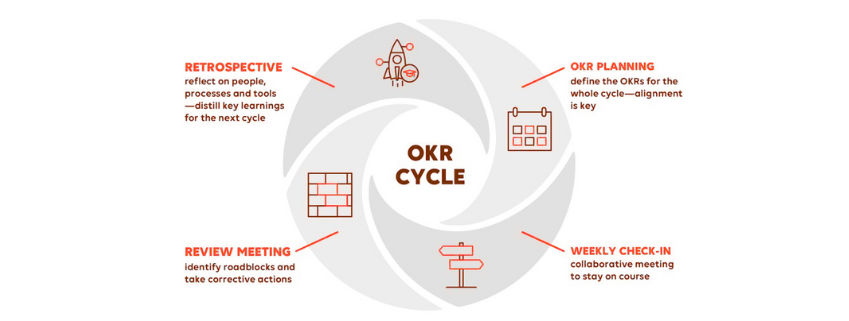
Source: dataminer.services
Typical OKR Cycle Phases
Most well-run OKR cycles follow a rhythm that repeats itself, but it’s not just a checklist - each stage builds on the one before it. Generally, you’ll see four big phases.
1. Planning & Alignment
Before anything else, leadership and teams get in the same room (or Zoom) to decide where they want to go. The aim is to land on objectives that stretch people beyond the obvious, yet still connect back to the company’s larger mission. This is where a simple OKR framework template can save a lot of headaches - it keeps different teams speaking the same 'goal language'.
You’re usually aiming for three to five objectives that feel worth rallying around. For each one, nail down three or four measurable key results that tell you if you’re getting there. And don’t forget alignment - an isolated objective is like a soloist ignoring the orchestra.
2. Execution & Tracking
Once the OKRs are set, the real work starts. Progress isn’t something you check on at the last minute but rather a running conversation. Many teams update their OKR tracking template weekly or biweekly so no one’s flying blind.
Bring these updates into team meetings so they’re part of the normal flow. A quick look at a dashboard can reveal what’s humming along and what’s stuck. And if something’s in the red, raise it early. It’s far easier to fix a blocker in week three than in week eleven.
3. Review & Reflection
When the cycle wraps, it’s time to take stock. Which key results hit the mark? Which ones fell short, and by how much? Which objectives got close but not quite there?
The goal here isn’t to assign blame. It’s to unpack what worked, what didn’t, and why. Think of it as a debrief - open, honest, and focused on learning rather than finger-pointing.
4. Reset & Iterate
Armed with those insights, you’re ready for the next round. Some OKRs will carry over, but they’ll get a refresh - maybe the numbers shift, or the strategy gets sharper. Others will be brand new, reflecting changes in priorities or market conditions.
This rolling cycle is what turns OKRs from a one-off exercise into an engine for growth. Each loop through makes the next one stronger, faster, and more focused. Over time, it becomes second nature. Not just a framework you use - but a way your organization thinks and operates.
How to Choose an OKR Cycle?
There isn’t a one-size-fits-all OKR schedule. Different teams work at different speeds, and your cycle has to match your reality - not someone else’s best practice from a blog post.
If you’re in a fast-moving space - SaaS, marketing, early-stage startup life - a quarterly cycle often makes sense. It’s short enough to react to campaign results, product tweaks, or market shifts, but still long enough to get meaningful work done. Miss a target in March? You’re already resetting in April.
Annual cycles feel slower, and that’s by design. They suit the big stuff - a major product build, infrastructure overhaul, or something strategic that simply can’t be rushed. You’re measuring progress in seasons, not weeks.
Then there’s the hybrid model: quarterly Key Results feeding into one or two long-haul objectives for the year. That way, you get the focus of a big-picture goal but the agility to course-correct every few months.
If you’re just starting out, here’s our two cents - go quarterly. More touchpoints, less chance for things to go stale, and way more opportunities to learn before the year’s up. Once you’ve got the hang of it, you can stretch timelines, mix cycles, or even run different cadences for different teams. The 'right' cycle is the one that keeps your people engaged and your goals alive.
OKR Cycle Example
Let’s put all this into something real. Say you’re running a quarterly marketing OKR.
Objective: Boost inbound leads by 30% in Q2.
Key Results might look like:
Publish three in-depth, SEO-friendly pillar blog posts that go after high-intent keywords.
Grow organic traffic by 15% - tracked week by week using your OKR template so you can spot the trend early.
Run two LinkedIn ad campaigns, both A/B tested, both pulling at least a 3% click-through rate.
Now, how does the cycle actually play out?
Week 1: Set the OKRs - but not in a vacuum. Pull in sales, content, and maybe even product to make sure the targets make sense.
Weeks 2–11: Keep tabs on the numbers. Talk about them in your marketing standups. Fix issues before they snowball.
Week 12: Review the whole run. Did you hit the lead goal? Where did traffic spike? What flopped? Capture those lessons, then roll right into Q3 with a sharper plan.
Working this way keeps the big goals visible, even when you’re knee-deep in campaign deadlines or chasing last-minute requests. It’s how you make sure the urgent stuff doesn’t bury the important stuff.
Challenges in an OKR Cycle (and Ways to Overcome Them)
Even the best-laid OKR plans can go sideways. Here are some of the usual suspects - and how to keep them from derailing your cycle.
Vague or fuzzy OKRs
If you can’t measure it, you can’t manage it. Always anchor your objectives and key results to numbers or clear outcomes. A quick test: can you answer “yes” or “no” when someone asks, “Did we hit it?” If not, tighten it up.
No alignment across stakeholders
An OKR that only one team believes in is already halfway to failure. Run collaborative workshops with a shared OKR framework template so everyone has a voice before anything is locked in. Buy-in upfront saves fights later.
Forgetting about mid-cycle check-ins
Set-and-forget is the silent killer of OKRs. Block time in the calendar for reviews - mid-cycle at the very least. A dashboard or simple tracking template can keep progress visible without adding admin overload.
Too many OKRs
It’s tempting to aim for everything at once, but overloaded teams rarely deliver well. Stick to three to five objectives per team per cycle. Better to nail a few than fumble ten.
Using OKRs as performance reviews
The moment OKRs become a grading system, ambition shrinks. Keep them separate from individual evaluations so people can set bold targets without worrying about tanking their appraisal.
Making OKRs and Agile Play Nice
OKRs and Agile share a lot of DNA - short feedback loops, adaptability, and transparency. If you’re running sprints, weave the two together:
Sprint-level KR updates: Sync them with sprint reviews so progress is visible every couple of weeks.
Backlog filtering: If a backlog item doesn’t move a key result forward, ask why it’s there.
Retrospectives: Add OKR reflection into your retros so goals aren’t forgotten mid-project.
Rolling cycles: For highly Agile teams, overlapping cycles can keep momentum while new OKRs take shape.
When they’re in sync, OKRs act like a compass, keeping Agile work pointed toward the bigger picture.
Agile Integration Best Practices in OKR Cycle
OKRs and Agile aren’t just compatible - they’re built for each other. Both OKRs and Agile, much like the concepts taught in many Agile courses online, thrive on iteration, transparency, and adaptability. The trick is weaving them together so neither one becomes an afterthought.
1. Sprint-level KR updates
Don’t wait until the end of a quarter to see if you’re on track. Tie KR check-ins directly to your sprint reviews. Every couple of weeks, you’ll know what’s moving and what’s stalling.
2. Backlog prioritization
Your backlog can get crowded fast. Use your OKRs as a filter - if a task doesn’t help push a key result forward, ask whether it really deserves a spot.
3. Retrospectives
Retros are all about learning. Include a quick OKR reflection in each one so goals stay visible instead of gathering dust in a document somewhere.
4. Rolling cycles
If your Agile setup moves quickly, consider overlapping OKR cycles. While you’re wrapping one, you’re already setting the next. It keeps energy high and prevents that awkward 'dead air’ between cycles.
When you do this right, OKRs aren’t just another management tool. They’re the compass that points all your Agile work toward something bigger - a shared, strategic direction. Agile gives you the pace; OKRs give you the purpose.
Final Thoughts
While OKRs aren’t a magic bullet, running the cycle with clarity and consistency can make them feel close. They sharpen focus, make progress easy to track, and keep every team member working toward shared priorities - even when conditions shift. Layering in Agile principles brings extra flexibility, helping objectives evolve with real-world changes rather than becoming outdated. Over time, this combination does more than manage goals - it builds a results-driven mindset that sustains momentum and measurable impact.
If you want to take this approach further, upGrad KnowledgeHut’s Agile courses online offer practical skills, proven frameworks, and the confidence to put OKRs into action in a way that consistently delivers.
Frequently Asked Questions (FAQs)
1. What are the 5 elements of OKR?
Objective, Key Results, Initiatives, Alignment, and Cadence. Together, they establish what you aim to achieve, how you’ll measure it, the actions you’ll take, how goals connect across teams, and how often they’re reviewed.
2. Is OKR part of Agile?
Although not inherently a part of Agile, OKRs align well with Agile principles. Both focus on adaptability, transparency, and continuous improvement - making them easy to integrate in Agile teams and workflows.
3. What is the difference between Lean and OKR?
Lean is a process improvement philosophy focused on eliminating waste and maximizing value, while OKRs are a goal-setting framework that defines outcomes and measurable results. Lean guides how work is done, and OKRs clarify what should be achieved.
4. What is the formula for OKR?
The basic formula is: I will [Objective] as measured by [Key Results]. Objectives describe the goal qualitatively, while Key Results provide specific, measurable indicators of success.
5. What is an OKR in Jira?
In Jira, OKRs are typically set up using add-ons or integrations that allow teams to define objectives, link them to epics or tasks, track progress visually, and align them with Agile sprints or projects.
1639 articles published
KnowledgeHut is an outcome-focused global ed-tech company. We help organizations and professionals unlock excellence through skills development. We offer training solutions under the people and proces...
Get Free Consultation
By submitting, I accept the T&C and
Privacy Policy
Ready to learn about Agile Certifications Roadmap?