
- Home
- Blog
- Artificial Intelligence
- Agentic AI Engineer vs AI Engineer: What’s the Difference in Roles?
Agentic AI Engineer vs AI Engineer: What’s the Difference in Roles?
Updated on Sep 15, 2026 | 1.82K+ views
Share:
Table of Contents
View all
- Agentic AI Engineer vs AI Engineer: Key Differences
- What Does an AI Engineer Do?
- What Does an Agentic AI Engineer Do?
- AI Engineer vs Agentic AI Engineer: How Their Day to Day Work Differs
- Skills Required for Agentic AI Engineer vs AI Engineer
- Tools and Technologies Used by Each Role
- AI Engineer vs Agentic AI Engineer: Business Impact and Project Ownership
- Which Career Path Should You Choose?
- Conclusion
Quick Overview
- AI Engineer vs Agentic AI Engineer: AI Engineers focus on machine learning, deep learning, statistics, data engineering, model deployment, and Python, while Agentic AI Engineers focus on LLMs, agents, tool integration, workflow automation, and autonomous systems.
- Agentic AI Engineers need skills such as LLMs, prompt engineering, agent frameworks, APIs, workflow automation, context engineering, and agent evaluation.
- Both roles share core skills such as Python, software engineering, cloud platforms, AI fundamentals, and problem solving.
- AI Engineers commonly use TensorFlow, PyTorch, Scikit Learn, MLflow, and Hugging Face, while Agentic AI Engineers use LangChain, LangGraph, CrewAI, AutoGen, MCP, and vector databases.
- This guide covers the skills, tools, business impact, project ownership, and career preferences that help you understand the difference between an AI Engineer and an Agentic AI Engineer.
Ready to build practical skills for an Agentic AI role? Explore the Applied Agentic AI Certification Course and learn how to design AI agents and build intelligent workflows.
Agentic AI Engineer vs AI Engineer: Key Differences
The following table provides a summary of the differences between the AI Engineer and the Agentic AI Engineer on various parameters.
Factor |
AI Engineer |
Agentic AI Engineer |
| Primary Goal | Build AI powered models and applications | Build autonomous AI agents and workflows |
| Focus Area | Prediction, classification, and generation | Reasoning, planning, and action execution |
| Core Technology | ML, deep learning, and LLMs | LLMs, agents, tool calling, and orchestration |
| Output | AI model, feature, or application | Goal driven autonomous system |
| Human Involvement | Usually higher | Reduced through controlled autonomy |
| Typical Projects | Chatbots, recommendation engines, predictive systems | AI assistants, multi agent systems, workflow automation |
| System Complexity | Often model or application centric | Often workflow and orchestration centric |
What Does an AI Engineer Do?
The AI Engineers design and implement AI systems that help the computer in completing its tasks. The AI Engineers use software engineering, machine learning, data science, and artificial intelligence techniques to develop an intelligent system that can learn from the data, make predictions, discover patterns, and automate decisions.
Responsibilities of an AI Engineer
The roles of an AI Engineer include:
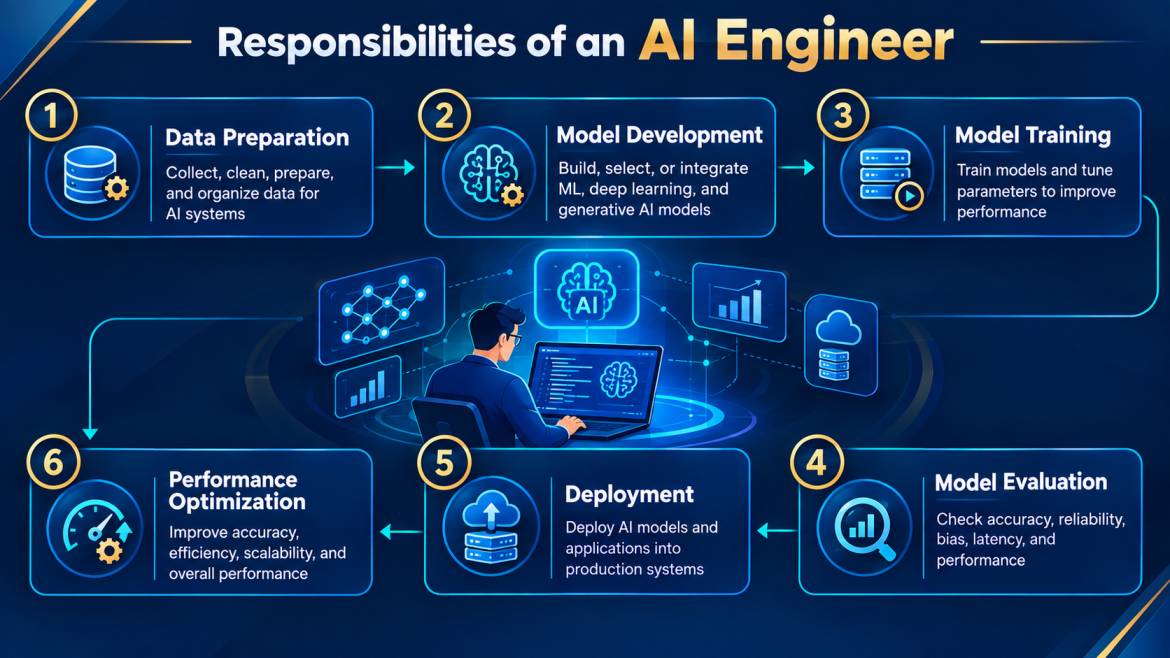
1. Data Preparation
Collect, prepare, and organize the data that can be utilized efficiently by AI systems.
2. Model Development
Develop, choose, or implement machine learning, deep learning, or generative AI models as per the need of the project.
3. Model Training
Train the models using appropriate datasets and tune their parameters to increase their efficiency.
4. Model Evaluation
Evaluate models for their accuracy, reliability, bias, latency, and other performance indicators before deploying them into production.
5. Deployment
Deploy the AI models and applications into production and integrate them with the current software system.
6. Performance Optimization
Optimize AI systems for accuracy, efficiency, and performance as per the changing requirements.
Typical AI Engineer Projects
An AI Engineer works on many different applications, such as:
- E-commerce and online entertainment recommendation system
- Computer vision application to analyze images and videos
- Forecasting system to predict future outcomes of businesses
- Systems to detect fraud in the financial world
- AI chatbots and assistants
- Natural Language Processing (NLP) applications
What Does an Agentic AI Engineer Do?
An Agentic AI Engineer is responsible for designing, constructing, and operating agentic AI systems that can plan, reason, decide, use external resources, and accomplish tasks while requiring limited human intervention.
The Agentic AI Engineer does not just develop a model which generates some kind of output, but rather an agent that can perform more than one step and be able to achieve certain tasks.
Also Read: Which Certification helps You Become an Agentic AI Engineer?
Key Responsibilities of an Agentic AI Engineer
Agentic AI Engineer usually focuses on:
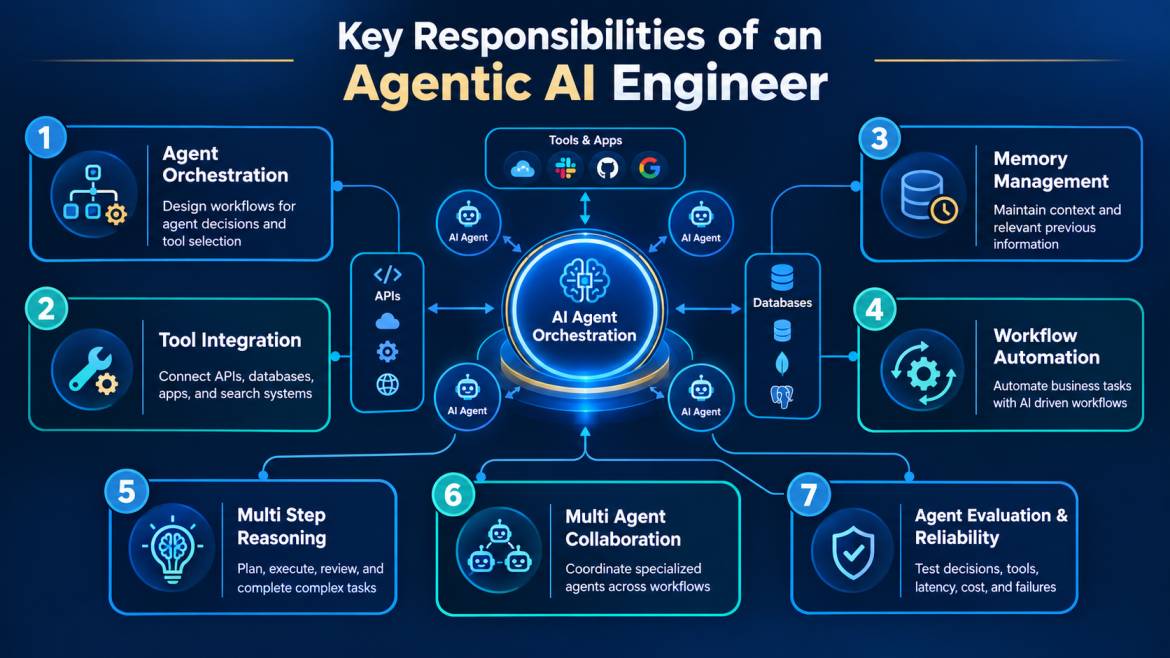
1. Agent Orchestration
Creation of workflows for the AI agent to decide which steps to follow and what tools it should use to complete the task.
2. Tool Integration
Connecting the agent with APIs, databases, software applications, search systems, and other tools outside of its direct control.
3. Memory Management
Building memory systems which help the agent to maintain necessary information, context from conversations and previous steps when needed.
4. Workflow Automation
Transforming business workflows into AI-driven workflows that can handle various tasks with less human intervention.
5. Multi Step Reasoning
Creating multi-step reasoning agents which are capable of breaking down complicated goals into individual tasks, executing them, reviewing results and moving further until goal is reached.
6. Multi Agent Collaborations
Creation of systems where several specialized agents work together, each responsible for different steps of a large workflow.
7. Agent Evaluation and Reliability
Evaluating responses of the agent, tool use, decision making, latency, costs, and potential failures of the system.
Also Read: Prerequisites for Agentic AI: Skills, Tools, and Foundations You Actually Need
Typical Agentic AI Engineer Projects
Agentic Artificial Intelligence Engineers usually participate in projects like:
- Self-learning research bots which collect and analyze data
- Customer service bots which solve problems and update systems
- Artificial intelligence copilots for productivity and business purposes
- Business workflows using multiple intelligent bots
- Intelligent task automators
Also Read: Agentic AI Frameworks
AI Engineer vs Agentic AI Engineer: How Their Day to Day Work Differs
Although both careers involve working with artificial intelligence, the daily activities that each is involved in are quite different.
A Typical Day for an AI Engineer
The routine of an AI Engineer includes developing and testing machine learning models, doing lots of experiments to improve their performance.
Their day may involve:
- Data quality: cleaning and preparing data to use for training models.
- Model accuracy: testing models and improving prediction performance.
- Training experiments: conducting many experiments to test algorithms, parameters, and architectures of the model.
- Monitoring: monitoring deployed models to make sure that they keep producing results of high quality.
A Typical Day for an Agentic AI Engineer
In an Agentic AI job role, daily activities center more around workflow creation than machine learning model training.
Some important activities are as follows:
- Agent Behavior: To ensure agents make appropriate choices and perform the correct workflow.
- Workflow Design: Developing step-by-step tasks for agents to accomplish their goals effectively.
- API Integrations: Linking agents with third-party apps, data bases, software, etc.
- Tool Usage: Coordinating the usage of the agent with different systems and resources.
- Agent Evaluation: Determining the performance of tasks, reliability of agents, etc.
- Reliability Testing: Running tests in edge cases, unexpected events, etc.
Skills Required for Agentic AI Engineer vs AI Engineer
The skills needed for being an Agentic AI Engineer and an AI Engineer vary according to their scope and responsibilities. Although the two jobs have similar AI and software skills, they require unique sets of skills according to the kind of AI they use.
Key Skills of an AI Engineer
An AI Engineer creates, trains, deploys, and optimizes AI models. Therefore, he should have high technical and analytical skills to do that successfully.
1. Machine Learning
Machine learning is the foundation of AI engineering. AI Engineers should know how to deal with machine learning algorithms, how to select models, perform feature engineering, and model training.
2. Deep Learning
Deep learning skills are required for an AI Engineer to work with neural networks, computer vision, speech recognition, and natural language processing.
3. Statistics
An AI Engineer needs to be good at statistics to analyze datasets and measure model performance.
4. Model Deployment
Besides creating models, an AI Engineer should learn how to deploy his models to production and monitor their performance.
5. Data Engineering
AI technologies require high-quality data. The role of AI Engineers often includes working with data pipelines, databases, and data processing tools to process data before using it to train models.
6. Python
Python is still the most popular language used to develop AI technologies. Most machine learning and deep learning libraries use Python.
Also Read: Is Python mandatory for learning Agentic AI Development?
Core Skills for an Agentic AI Engineer
An Agentic AI Engineer is not supposed to be just an engineer. While engineers specialize in making models, Agentic AI Engineers build reasoning and acting AI systems that are integrated with other software tools.
1. Large Language Models (LLMs)
An understanding of how LLMs function, including context windows, tool calls, reasoning abilities, and restrictions, is required for Agentic AI Engineers.
2. Prompt Engineering
Prompt engineering is important to control the behavior of agents and their task performance accuracy.
3. Agent Frameworks
Modern agent development often relies on frameworks such as LangChain, LangGraph, CrewAI, and AutoGen. Understanding these tools is essential for building autonomous systems.
4. APIs
AI agents frequently interact with external applications through APIs. Knowledge of API integration helps agents connect with databases, CRMs, web services, and other business tools.
5. Workflow Automation
One of the biggest differences in the AI Engineer vs Agentic AI Engineer is workflow automation. Agentic AI Engineers design systems that can perform multi-step tasks automatically.
6. Context Engineering
Maintaining relevant context across conversations and workflows is critical for agent performance. Context engineering helps ensure agents make informed decisions throughout a task.
7. Agent Evaluation
Instead of measuring only model accuracy, Agentic AI Engineers evaluate whether agents successfully complete tasks, follow workflows, and achieve intended goals.
Also Read: Skills for Agentic AI Engineer
Common Skills in Both Roles
There are some fundamental skills that are required by both AI Engineers and Agentic AI Engineers.
1. Python
It is the main language that is used in the development of artificial intelligence, automation, and agents.
2. Software Engineering
Good coding, system design, debugging, and testing are important skills that apply to both roles.
3. Cloud Platforms
Most AI systems are built using cloud platforms such as AWS, Azure, and Google Cloud. Therefore, cloud services are an important skill no matter which route you take.
4. AI Basics
Both roles require good knowledge of AI fundamentals and generative AI.
5. Problem Solving
Problem solving is always essential in your role whether you are optimizing a machine learning model or creating an autonomous process.
Looking to build a future ready AI career? Explore upGrad KnowledgeHut Artificial Intelligence Courses and strengthen your skills in AI, automation, and emerging technologies.
Tools and Technologies Used by Each Role
The tools that each role uses depend on their different goals.
Tools That AI Engineers Use
An AI Engineer generally uses:
- TensorFlow
- PyTorch
- Scikit-Learn
- MLflow
- Hugging Face
These tools are used to develop, train, test, and deploy machine learning algorithms.
Tools That Agentic AI Engineers Use
Agentic AI Engineers generally use:
- LangChain
- LangGraph
- CrewAI
- AutoGen
- MCP
- Vector Databases
These tools help develop autonomous agents and coordinate between different AI systems.
Also Read: How to Build Agentic AI with Python
AI Engineer vs Agentic AI Engineer: Business Impact and Project Ownership
Business Impact can be another criterion to analyze AI Engineer vs Agentic AI Engineer.
AI Engineer Business Results
The AI Engineer will achieve results like:
- Improved predictions for business decision-making
- Higher-quality recommendations that drive more sales and engagement
- Automated analysis, saving hours of review
- Agentic AI Engineer Business Results
The Agentic AI Engineer will achieve results like:
- Workflow automation through end-to-end process
- Efficiency gains through less manual work across the team
- Task completion autonomously without constant monitoring
- Coordination across systems
Also Read: Jobs in Agentic AI
Which Career Path Should You Choose?
Selecting the path towards becoming an AI Engineer or an Agentic AI Engineer depends on one’s preference and approach towards work.
Choose AI Engineer If You Like
- Mathematics and Statistics
- Creating models and conducting experiments
- Academic research
- Data Science
- Algorithm Optimization
Choose Agentic AI Engineer If You Like
- Developing end-to-end AI systems
- Automation and Process Engineering
- Software Development
- AI Workflow Design
- Agent Engineering and Orchestration
Also Read: Agentic AI Career Path
Conclusion
The AI Engineer vs Agentic AI Engineer difference mainly comes down to their focus and responsibilities. AI Engineers work on models, data, deployment, and AI applications, while Agentic AI Engineers focus on autonomous agents, tool integration, workflows, and task execution.
Both roles require strong Python, software engineering, AI fundamentals, and problem solving skills. Choosing between the two depends on whether you prefer model development and data science or AI automation, workflow design, and agent orchestration.
Have A Query? Get in Touch With Our Customer Support | upGrad KnowledgeHut
Frequently Asked Questions (FAQs)
1. How does Agentic AI work?
Agentic AI works by giving an AI system a goal and allowing it to plan steps, reason about the task, use tools, and take actions to achieve that goal. It can access APIs, databases, or other software, evaluate the results of its actions, and decide what to do next. This process allows agents to handle multi step tasks with limited human intervention.
2. What is an AI Engineer?
An AI Engineer is a professional who develops, integrates, deploys, and improves AI systems for specific business or technical needs. Their work can include machine learning, deep learning, data preparation, model evaluation, and AI application development. They also use programming, cloud platforms, and AI frameworks to move solutions from development into production.
3. Is Agentic AI Engineer a different role from an AI Engineer?
Yes, but the roles have significant overlap. An AI Engineer works across AI models and applications, while an Agentic AI Engineer specializes more deeply in systems that can reason, use tools, and complete multi step tasks. In many organizations, Agentic AI Engineering is treated as a specialization within broader AI Engineering.
4. What does an Agentic AI Engineer build?
An Agentic AI Engineer builds AI agents that can plan tasks, make decisions, use external tools, and execute actions toward a specific goal. They can develop research agents, AI copilots, customer support agents, and multi agent business workflows. These systems are designed to complete multiple steps rather than only generate a single response.
5. What is the difference between AI Engineer and AI Agent Engineer work?
AI Engineers generally focus on developing or integrating AI models, preparing data, evaluating performance, and deploying AI applications. AI Agent Engineers focus more on agent behavior, tool use, workflow orchestration, memory, and autonomous task execution. The latter role therefore involves more workflow and system coordination.
6. How does agent orchestration differ from normal AI application development?
Normal AI application development often connects an AI model to an application to produce a specific output or perform a defined function. Agent orchestration coordinates models, tools, memory, APIs, and multiple steps so an agent can decide what to do next. It focuses on managing the complete task execution process.
7. Is Agentic AI engineering the future of AI engineering?
Agentic AI engineering is likely to become an important part of AI engineering as businesses adopt AI systems that can execute workflows instead of only generating content. However, it is not replacing broader AI engineering because model development, data, deployment, evaluation, and AI application skills remain important. The two areas are increasingly overlapping.
8. Can an AI Engineer become an Agentic AI Engineer?
Yes, an AI Engineer can transition into Agentic AI Engineering by building skills in LLMs, prompt engineering, agent frameworks, APIs, workflow automation, context engineering, and agent evaluation. Existing Python, software engineering, cloud, and AI knowledge provides a strong foundation. Practical agent projects can help bridge the remaining skill gap.
9. What is the career scope of Agentic AI engineering?
The career scope includes roles involving AI agents, workflow automation, AI copilots, multi agent systems, enterprise automation, and intelligent assistants. Professionals can work across technology, finance, healthcare, retail, SaaS, and other industries adopting AI automation. Career progression can lead toward senior agent engineering, AI architecture, or AI leadership roles.
10. Which career is better: AI Engineer or Agentic AI Engineer?
AI Engineering is a better choice if you prefer machine learning, statistics, model development, data science, and algorithm optimization. Agentic AI Engineering is a better choice if you prefer software development, automation, AI workflows, and agent orchestration. Your existing skills and preferred type of AI work should guide the choice.
1639 articles published
KnowledgeHut is an outcome-focused global ed-tech company. We help organizations and professionals unlock excellence through skills development. We offer training solutions under the people and proces...
Get Free Consultation
By submitting, I accept the T&C and
Privacy Policy