
- Home
- Blog
- Project Management
- Enterprise Environmental Factors (EEF): Definition & Examples
Enterprise Environmental Factors (EEF): Definition & Examples
Updated on Oct 10, 2023 | 9 min read | 8.31K+ views
Share:
Table of Contents
View all
Projects operate in a complex environment and are driven by a lot of factors which include internal decisions of stakeholders, work environment, organization policies, etc. and external driving forces that guide market conditions and influence project decisions. No project or team can work in isolation and is always influenced by a lot of factors beyond their control, which may have a positive or a negative impact on the project outcomes. However, they always remain overcast affecting “how” projects operate.
In this article, let me take you through the what, the why, and the how of such factors that affect the project and how the organization and its project management practice can plan for them.
Ultimate PMP Formula Cheat Sheet
Get a quick, exam-ready PMP cheat sheet with all essential formulas and key concepts in one place.
What Are Enterprise Environmental Factors (EEF)?
Enterprise environmental factors in project management are those factors, situations, or conditions that may not fall within the purview of control of the project management function or the organization but have an impact on the project. EEF as they are popularly known have an impact or effect on the project, its outcomes, and the organization at large. Though the effect may be positive or negative, most enterprise environmental factors are known to cast a negative impact or pose a threat to the project. These factors, conditions, or influences may be internal i.e. within the organization, or external i.e. outside the organization but need to be factored in by the project management function to minimize disruptions and increase the plausibility of project success.
I am sure it is now evident that the chances of any project's success or derailing from the baselines very much depend on how effectively EEFs are managed in the project. Any project manager needs to take three basic steps in handling these factors:
- Identifying the EEFs
- Assessing their impact
- Planning to factor in the EEF’s into the project
Get a holistic understanding of project management with the industry-leading Project Management online training from KnowledgeHut - find out more today!
Examples of Enterprise Environmental Factors
Enterprise environmental factors examples can stem from both within the project/organization or outside of the two. Let us take a look at some popular categories of such factors or influences:
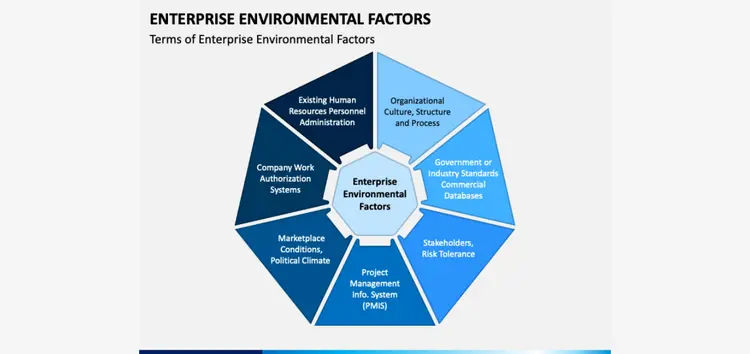
- Product Standards: Product standards are important EEFs that need to be taken into account to ensure quality and regulatory compliance. Though these are factors that may be well known to the project management function or PMO, there are several instances where such EEFs pmp are known to have disrupted the planning function owing to regulatory changes, late stakeholder discovery, etc.
- Quality Standards: Quality standards defined from the project and organization's governance model often introduce factors and influences that need to be taken into account from time to time in the project.
- Government Standards: Government standards, policies, regulatory framework, and local laws often pose significant factors that have an impact on the project and its outcomes demanding review in the form of enterprise environmental factors project management.
- Codes of Conduct: Like compliance and regulatory standards, the code of conduct also introduces certain technicalities that the project must abide by to be of value and fruitfully accepted at large.
- Work Authorization Systems: Work authorization systems such as special economic zone restrictions or client policy restrictions may at times pose certain enterprise environmental influences that may add to the project scope.
- Political Unrest: Political unrest along with changes in laws/policies are one of the biggest factors that may introduce new opportunities/threats as enterprise environmental factors pmp impacting the project and/or the organization.
- Risk Databases: Although these formulate part of organizational process assets, certain times may act as impediments/pmp enterprise environmental factors influencing project operations and introducing certain unknowns in the project.
- Reviews and Training Records: Though training records by themselves are organizational process assets (OPA's), given the context, reviews and training records mean specific training requirements or mandatory compliance training requirements to develop team skills and learning which often pose as an EEF for the project manager to abide by.
Identifying and planning for EEFs may look easy per se but the VUCA environments in which projects operate are not as easy as identifying a few categories and planning only for those. Avoid the common project management pitfalls by learning from our renowned and popular PMP online course - reach out to KnowledgeHut today.
Environmental Factors Influencing the Outcome of a Project
- Organizational Culture: Organizational culture and ethos play an important factor in influencing project decisions, deliverables, and timelines. For example, an organization that is driven by innovation and creativity fosters them into the project roadmap while those driven by traditional methodologies and ways of working cast influence on the environments in which projects operate.
- Organizational Structure: Organization structure undoubtedly has a large influence on the project - hierarchies in which projects operate, and the type of project organization i.e. project, matrix, or functional have a large impact on how the governance models for the projects are established.
- Existing Human Resources: Existing team composition, human resource policies, motivation levels, etc. have an impact on how projects operate and are greatly influenced by any changes in these factors.
- Available Capital Resources: Similar to the above, available capital resources in the form of assets, infrastructure, and facilities define the scalability and thresholds in which projects can operate and what kind of constraints need to be taken into consideration.
- Regulatory Environment: Regulatory framework, local laws, and restrictions often govern how organizations can be established and operate, thereby casting an influence on the projects.
- Market Conditions: This is undoubtedly the biggest and most challenging project management enterprise environment factors which has a major impact on how projects operate while also being the most tricky EEF that project stakeholders try to understand and take into account in project operations.
While the above is not an exhaustive list of enterprise environmental factors example in project management, project managers need to be sensitive and cautious about them in project planning at both operations (or tactical) and strategic levels to have minimal disruptions and drive the project to success. Explore top-rated and time-tested content from KnowledgeHut's Project Management certification courses to learn more about these and several other important areas of project management.
Enterprise Environmental Factors vs Organizational Process Assets
By the PMP study pattern, enterprise environmental factors (EEFs) and organizational process assets (OPAs) formulate a key structure among a majority of the project management processes. While we have gone through what are PMP EEF’s, let me take you through a quick explainer on assets in general and organizational process assets (OPA’s) in particular.
An asset is defined as any useful entity, object, or property owned by the person/organization that has value and use in times of adversity. So essentially, anything that enables operations and helps organizations in meeting commitments is an asset. Like people who own assets such as property, cars, electronics, etc. organizations too have assets that help fulfill the organization's goals and which are in turn called organization process assets (OPA's).
As per PMI, OPAs are all the "plans, policies, processes, procedures, and knowledge bases that are specific to and are used by the performing organization in managing projects." OPA's are essentially historical records or knowledge bases that help project managers and PMOs in future projects. OPA's help project managers take advantage of existing and known solutions over reinventing the wheel each time to solve project problems.
Though OPAs and EEFs are a part and parcel of the project management processes, they are both distinct attributes affecting/influencing the project and organization; here are a few notable differences between the two:
| Enterprise Environmental Factors | Organizational Process Assets |
|---|---|
| EEFs pose constraints or opportunities - they may or may not benefit the project. | OPA’s help and guide project managers in reducing compliance risks and issues - they benefit the project/organization. |
| EEFs are out of the control of the project manager. | OPA’s are within the control of the project manager and can be tailored to suit project needs. |
| The project team must take into account EEFs to ensure project success and these are not easy to change. | The project team may define which OPAs are mandatory and which are recommended or optional. |
| EEFs add to the project risks/challenges. | OPA's help streamlines project risks/challenges. |
| EEFs may be internal or external to the organization. | OPA’s are internal process assets of the organization. |
Get a foundational understanding of EEFs, OPA's, and how this helps build the project management framework based on the popular ITTO (Inputs, Tools, Techniques, Outputs) model - learn this and much more from online PRINCE2 training certification.
Conclusion
Enterprise environmental factors are factors that impact a project, program, or portfolio but are not within the purview of control of any of these management layers. The project governance models of the organization need to shelter changes as and when the EEFs are encountered either in form or constraints or in the form of opportunities. Project managers may do this in different ways depending on the situation in which these factors arise; for example, in some cases, scope changes may be deemed necessary while in some other cases, contingency or management reserves may help cast aside the challenge.
In either case, the objective of the project management function is always to help discover such factors as early as possible or result in minimal disruptions to the project. Both internal and external EEFs bring a similar challenge and need to be dealt with swiftly yet steadily to overcome the disorder.
Frequently Asked Questions (FAQs)
1. What are enterprise environmental factors?
Enterprise environment factors are internal or external conditions that may bring constraints or opportunities to the project and need to be factored in by the project manager while planning to ensure the adequacy of reserves to meet such unforeseen conditions.
2. What does an enterprise environment mean?
Enterprise environment means the boundaries or areas in which the organization operates and which directly or indirectly pose certain challenges and limits to the project operations.
3. What are EEFs and OPAs?
EEFs and OPAs are important inputs to the project management processes and need to be considered in project planning and implementation. EEFs are essentially constraints or opportunities which need to be handled while OPAs are process assets or knowledge bases that aid the project manager in effectively performing their duties.
29 articles published
Rohit Arjun Sambhwani is an IT professional having over a decade and half of experience in various roles, domains & organizations, currently playing a leading role with a premier IT services organizat...
Get Free Consultation
By submitting, I accept the T&C and
Privacy Policy