
Disciplined Agile: A Complete Guide to Principles, Benefits, Implementation
Updated on Aug 20, 2025 | 1.69K+ views
Share:
Table of Contents
View all
Business today moves at breakneck speed, and flexibility isn’t a luxury anymore - it’s the cost of staying in the game. But speed without guardrails? That’s destined to result in missed deadlines, shaky quality, and frustrated stakeholders. Disciplined Agile was formed for exactly this reason. Consider it more as a toolbox stocked with ideas from Agile, Lean, and other time-proven methods - not a rigid framework. Its strength lies in helping you adapt - picking the right tools for the challenge at hand, whether that’s reshaping an enterprise or coordinating delivery across teams.
Disciplined Agile development isn’t about replacing what you do today - it’s about giving you smarter options when the pace of business demands it. In this blog, we’ll unpack where Disciplined Agile came from, how it works in practice, and why it can help you work faster without losing your grip on quality.
Master the Right Skills & Boost Your Career
Avail your free 1:1 mentorship session
What is Disciplined Agile?
Disciplined Agile isn’t a neatly packaged 'follow this and you’ll succeed' method. It’s closer to a well-stocked workshop - tools, materials, and a few instructions - leaving you to decide what fits the job at hand. Some teams might lean heavily on Agile practices, others on Lean thinking - and many will end up with a mix that’s unique to them.
At its core Disciplined Agile can be seen as an agile delivery methodology that adapts practices
The philosophy behind it is refreshingly simple - you should have options. Rather than being boxed into a rigid formula, you shape your own way of working and keep refining it as projects unfold. That might mean running Scrum-style sprints but tracking progress on a Kanban board, pairing Extreme Programming’s engineering discipline with older scheduling habits, or creating something entirely different. What matters is that it works for your situation, not someone else’s ideal scenario.
Its guidance falls into four broad paths:
- Agile Delivery – for focused, solution-driven teams.
- Lean Delivery – keeping work flowing without pileups.
- Continuous Delivery – small, steady value drops rather than big releases.
- Program Management – orchestrating multiple moving parts across teams.
What attracts large organizations isn’t just flexibility - it’s the balance. Disciplined Agile lets you pivot when things shift yet keeps the guardrails in place so you don’t spin into chaos. It’s agility with structure, and structure that doesn’t get in the way.
History of Disciplined Agile
Disciplined Agile began life back in 2009, created by Scott Ambler and Mark Lines. At the time, they called it 'Disciplined Agile Delivery' and set out to solve a problem they’d seen repeatedly - popular agile methods like Scrum were fine for small, tight-knit teams, but their effectiveness often dropped when scaled across a large enterprise.
In those early days, the framework was positioned as a blend - a little from this method, a little from that - pulling proven ideas from Agile, Lean, and other delivery approaches. And as it matured, the scope widened. What had started as a delivery-focused method gradually grew into the full Disciplined Agile Toolkit - covering not just team-level work but also portfolio management, governance, architecture, and integration with DevOps practices.
The turning point came in 2019, when the Project Management Institute took Disciplined Agile under its wing. That move pushed adoption far beyond its original circles, embedding it into PMI’s global network of project management professionals.
Now, Disciplined Agile occupies a unique space. It connects the speed and adaptability of agile with the control and oversight large organizations require - serving as a bridge between traditional project management and modern delivery at scale.
Why Use Disciplined Agile Methodology?
Switching to Disciplined Agile isn’t about tossing out what’s already working. It’s more about giving your teams a wider set of tools - so you can pick the right one when the usual approach won’t cut it. Here’s what makes it worth considering:
1. Context-First Decisions
Every project has its quirks. Disciplined Agile lets teams choose from different lifecycles, then shape the workflow to fit the challenge - be it a high-risk compliance project or a fast-moving product launch.
2. Flexibility Over Rigid Rules
The methodology flexes around culture, size, and maturity rather than forcing every team into the same mold, . You can run Scrum with Kanban boards, keep a few traditional checkpoints, or blend something entirely new.
3. Enterprise-Scale Friendly
In large organizations, governance and compliance aren’t optional. Disciplined Agile was built to handle that complexity without grinding delivery to a halt.
4. Governance That Doesn’t Choke Progress
Risk management, architecture, and oversight are part of the design - not bolted on later - so control is there without the usual red tape slowdown.
5. Speed With Standards
By combining Lean flow and Agile iteration, teams can move work through steadily, avoid bottlenecks, and still hit the quality bar.
The bottom line? It’s about doing agility well, not just fast.
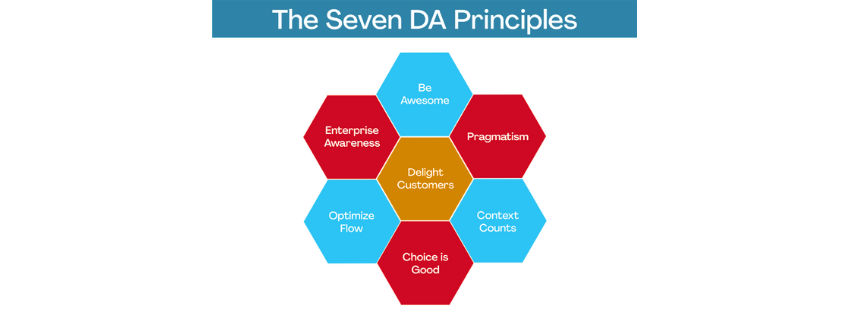
Principles of Disciplined Agile
Disciplined Agile works more like a compass you keep glancing at when the path twists, and less like a manual you follow step by step. And its principles act as that compass, pointing teams toward smart decisions in shifting conditions.
1. Keep the Bigger Picture in Sight
Every team is a part of something larger. Choices you make locally should connect back to the company’s overall goals and not create friction elsewhere.
2. Give People Room to Be Their Best
Teams win when the environment supports growth, learning, and mutual respect. Excellence isn’t an accident - it’s orchestrated.
3. Adapt the Recipe to Your Kitchen
Rigidly following one method can backfire. Sometimes you need to combine techniques or swap steps to fit your project’s specific realities.
4. Deliver What Actually Matters
A long checklist doesn’t guarantee success. What counts is whether the outcome delights the people you’re serving.
5. Keep Options Open
Limiting yourself to one process or tool can stall progress. DA offers multiple pathways so you can pick what fits, and switch if conditions change.
6. Make Work Flow Smoothly
Bottlenecks, long waits, and unnecessary approvals can often kill momentum. It's important to streamline handoffs and remove roadblocks early.
7. Learn and Adjust - Always
Processes evolve. Regular reflection helps you double down on what works and discard what doesn’t.
8. Borrow From Success Stories
If a practice has delivered results elsewhere, there’s no shame in reusing it. Reinventing the wheel wastes time.
9. Start With Context, End With Context
Every team, industry, and client has its own quirks. Personalize everything - plans, tools, priorities - to that reality.
Disciplined Agile empowers an adaptable mindset that blends structure with flexibility instead of enforcing one 'right' way. It’s focuses doing what works now - while staying ready for what comes next.
Source: Project balence
Benefits of Disciplined Agile
When an organization embraces Disciplined Agile, it’s not just adding another process - but rather unlocking a toolkit that can adapt to almost any environment.
1. Scalability Without the Growing Pains
Disciplined Agile can expand (or contract) without losing its balance, whether you’re working with a single product team or a sprawling network of global offices. The same principles hold up in both intimate and enterprise-scale settings.
2. A Workflow That Fits Like a Glove
Instead of forcing teams to march to one rigid drumbeat, DA lets them choose a way of working that actually makes sense for their context. It’s flexibility built right in.
3. Smooth Mergers of Different Methods
Agile sprints, Lean efficiencies, traditional project controls - DA doesn’t force you to pick one camp. It blends these worlds into something cohesive, so you’re not fighting your own process.
4. Value Delivered Sooner
By stripping away bottlenecks and reducing delivery slowdowns, teams get from concept to customer faster - often without sacrificing quality.
5. Collaboration Across Boundaries
Departments that once worked in silos find themselves speaking the same language. DA fosters alignment between tech, business, and support functions, keeping everyone moving in the same direction.
6. Built-In Risk Awareness
Governance in DA isn’t about stifling creativity - it’s about smart guardrails that prevent costly missteps while still leaving room for innovation.
When done well, Disciplined Agile doesn’t just make teams more efficient - it becomes a competitive edge, helping organizations deliver high-value results while trimming the waste.
How to Implement a Disciplined Agile Methodology?
Introducing Disciplined Agile should feel like a steady evolution rather than a disruptive overhaul.
Step 1: Assess Organizational Readiness
Begin by evaluating your current landscape. Look at how well teams already work with Agile concepts, whether leaders are committed to the shift, and how open the company culture is to flexible delivery models. This insight sets the tone for a realistic rollout plan.
Step 2: Educate Stakeholders
From there, invest in collective understanding. Offer practical sessions for executives, managers, and delivery teams so everyone speaks the same language - when it comes to principles, available life cycles, and the decision-making tools that underpin Disciplined Agile.
Educating stakeholders is critical, and many organizations turn to the best Agile courses to build a common foundation of knowledge before scaling disciplined agile development.
Step 3: Start with Pilots
Avoid leaping into a company-wide deployment. Begin with small-scale trials in carefully chosen projects instead. These early experiments are a proving ground - helping teams gauge what works and where adjustments are needed before extending the approach to more areas.
Step 4: Customize Workflows
Resist the urge to copy someone else’s playbook, when it comes to process design. The methodology’s strength lies in tailoring workflows to suit project goals, industry regulations, and the size or complexity of your teams.
Step 5: Integrate Governance
Build governance into the day-to-day flow rather than treating it as a checkpoint at the end. That means weaving compliance, architecture reviews, and risk management into the way tasks move from start to finish.
Step 6: Monitor and Improve
Finally, treat adoption as a living process. Gather input from those doing the work on a regular basis, run retrospectives to spot bottlenecks, and refine practices bit by bit. Sudden, organization-wide change might sound bold, but gradual adoption typically delivers more sustainable results and far less disruption.
Disciplined Agile Toolkit
The Disciplined Agile Toolkit is the heart of the framework. It provides process goals—outcome-based decision trees that guide teams in selecting practices.
Key components include:
- Process Blades: Think of these as the building blocks of delivery capability. They cover essential areas like governance, portfolio oversight, solution architecture, and DevOps. Each blade represents a focus area that can be refined and adapted to fit the unique challenges a team faces.
- Delivery Lifecycles: Instead of forcing a single approach, the toolkit offers several ‘routes’ to get work done - short Agile iterations, steady Lean flow, always-on continuous delivery, or large-scale program management. Teams choose the path that makes sense for their pace, culture, and project scope.
- Goal Diagrams: These are like a GPS for decision-making. Suppose if a team is figuring out how best to define project scope or roll out a deployment, these visual maps break the process into choices and trade-offs, making the next step clear without prescribing one ‘correct’ answer.
- Enterprise Awareness: This is the constant reminder that a team’s work doesn’t exist in silos. All decisions - technical or procedural - should connect to the organization's wider priorities, align with other departments, and respect long-term goals.
Put together, the toolkit works less like a rigid manual and more like a coach on the sidelines - offering plays, options, and perspectives so teams can adapt in the moment while still keeping an eye on the bigger picture.
Strengths and Weaknesses
Like any approach to delivery and organizational change, Disciplined Agile comes with both advantages that teams celebrate and challenges that can frustrate newcomers. Looking at both sides provides a more realistic picture of what adoption actually feels like in practice.
Strengths
1. Versatile Across Industries
One of the biggest selling points is its flexibility. It doesn’t lock a business into a single recipe. A product company experimenting with rapid releases, a government agency bound by regulation, or a consultancy managing distributed teams can all adjust the approach without breaking it.
2. Speed Without Chaos
Unlike lighter frameworks that sometimes sacrifice structure for speed, this one keeps a watchful eye on governance. That balance between agility and accountability makes it appealing to organizations that can’t afford chaos.
3. Commitment to Growth
Another strength is the emphasis on evolution. Teams aren’t expected to find the 'perfect' way of working on day one. The idea is to keep tuning and adapting - which fosters a long-term improvement culture.
4. Built for Scale
Small squads can benefit - but so can sprawling enterprises coordinating dozens of teams across time zones.
Weaknesses
1. Not Beginner-Friendly
The same flexibility that gives it power also makes it tricky for beginners. There’s no simple checklist to follow. Instead, newcomers face a maze of choices, which can slow them down.
2. Culture is the Make-or-Break Factor
Adoption hinges heavily on culture. If leadership treats it as just another process rollout, or if teams aren’t open to experimenting, progress stalls quickly.
3. Risk of Fragmentation
There’s also the danger of inconsistency. When every team customizes in isolation, you can end up with silos of practices that don’t line up, creating friction instead of flow.
4. Overwhelming Toolkit
And then there’s the toolkit itself. Rich in options, but for someone fresh to agile thinking, the sheer breadth can feel overwhelming - almost like standing in front of an overstocked library without a reading plan.
In short, Disciplined Agile rewards organizations willing to commit to learning and leadership support. Without that maturity, its strengths can easily flip into stumbling blocks.
Final Thoughts
Disciplined Agile is beyond a methodology. It’s a proven strategic advantage for organizations aiming to scale agility with precision. Disciplined Agile equips project managers to navigate complex challenges while keeping delivery outcomes sharp and predictable - by blending flexibility with governance.
If you’re ready to imbibe and implement Disciplined Agile effectively - explore upGrad KnowledgeHut’s best Agile courses that can equip you with the skills, tools, and confidence to lead from the front.
Frequently Asked Questions (FAQs)
1. What is the difference between Disciplined Agile and SAFe Agile?
Disciplined Agile is a flexible toolkit that lets teams tailor ways of working. SAFe Agile is a structured framework designed mainly for scaling agility across large enterprises. Disciplined Agile emphasizes choice and context while SAFe focuses on standardization.
2. What are the basics of Disciplined Agile?
Disciplined Agile is built on principles like customer focus, context-driven choices, continuous improvement, and enterprise awareness. It provides teams with guided options rather than prescribing a single methodology.
3. What are the three phases of Disciplined Agile Delivery?
The three phases are Inception (visioning and planning), Construction (building and testing), and Transition (deploying and releasing value to end users).
4. What are the four layers of the Disciplined Agile toolkit?
The four layers include the Foundation layer (principles and mindset), Disciplined DevOps layer (end-to-end IT delivery), Value Streams layer (flow across portfolios), and the Disciplined Agile Enterprise layer (enterprise-wide agility).
5. What are three unique Scrum roles?
Scrum defines three core roles: the Product Owner (sets priorities and vision), the Scrum Master (facilitates and removes blockers), and the Development Team (self-organizing professionals who deliver the product increment).
1638 articles published
KnowledgeHut is an outcome-focused global ed-tech company. We help organizations and professionals unlock excellence through skills development. We offer training solutions under the people and proces...
Get Free Consultation
By submitting, I accept the T&C and
Privacy Policy
Ready to learn about Agile Certifications Roadmap?