
How to Write an AI PRD (Product Requirement Document) – Template & Examples
Updated on Aug 24, 2026 | 0.8k+ views
Share:
Table of Contents
View all
Quick Overview
- An AI PRD combines traditional product requirements with AI specific details such as data, models, evaluation, and guardrails.
- It defines the AI use case, expected behavior, success metrics, and user requirements.
- Key areas include data requirements, model requirements, AI performance, safety, and failure handling.
- The process covers defining the problem, identifying the AI use case, setting goals, documenting requirements, testing, and monitoring.
- This guide explains how to write an AI PRD, what it should include, and provides a practical AI PRD template with examples.
Build practical testing and automation skills with the Certified Professional Automation Agile Testing Course.
How to write an AI PRD: step-by-step process
The most important point when learning to write an AI PRD is to begin with the product problem and not with the AI technology; the PRD should make clear what the product needs to achieve, who it is intended for, and the role that AI plays in reaching that outcome.
Step 1: Define the Problem and Target Users
Begin by describing clearly the problem that the product must solve.
Include:
- Target users
- User needs
- Current pain points
- Business context
- Existing limitations
The problem statement must be specific so that the team knows what needs to be improved.
Step 2: Identify the AI Use Case
Specify precisely the areas in which AI will be used within the product.
The use case may involve:
- Prediction
- Classification
- Recommendation
- Content generation
- Search
- Automation
- Conversational interaction
A clear use case means that AI will not be added merely because it is technically possible.
Step 3: Define Product Goals and Success Criteria
The PRD ought to clarify what success means.
Set goals around:
- User outcomes
- Business outcomes
- Product adoption
- Quality
- Efficiency
- Revenue or cost impact
For each goal to have measurable success criteria, the team should be able to assess whether the AI feature is providing value.
Step 4: Specify AI Capabilities and Expected Behavior
Explain what is expected of the AI system and the way in which it should behave.
Document:
- Inputs
- Outputs
- Expected responses
- Supported tasks
- Limitations
- Fallback behavior
It provides engineering and data teams with a clearer aim for their development.
Step 5: Document Data and Model Requirements
Data forms a fundamental element of an AI product; the PRD must specify what information the system needs and the way in which it will be used.
Include:
- Required datasets
- Data sources
- Data formats
- Data availability
- Model requirements
- Data processing needs
The way of preparing an AI PRD is different from that of preparing a conventional feature-focused PRD because the requirements are clear.
Step 6: Define User Experience and Human Oversight
The features of AI should integrate smoothly into the user's experience.
Specify:
- How users interact with AI
- What information users provide
- How AI responses are displayed
- When users can edit or reject outputs
- When human review is required
It is especially important to have human supervision when the outputs of AI can influence important decisions made by users or businesses.
Step 7: Establish AI Performance Metrics
The performance of AI should be assessed on its own, separate from that of the overall product.
Depending on the use case, metrics may include:
- Accuracy
- Precision
- Recall
- Response quality
- Relevance
- Latency
- Error rate
- User satisfaction
The metrics selected should correspond to both the AI task and the business objective.
Step 8: Document Risks and Constraint
The risks associated with AI products are not present in traditional software projects.
Consider:
- Incorrect outputs
- Bias
- Privacy risks
- Security concerns
- Data limitations
- Model limitations
- Cost constraints
- Regulatory requirements
The PRD must make clear how these risks will be handled.
Step 9: Define Testing and Validation Requirements
Testing must include both the product and the AI's behavior.
Define requirements for:
- Functional testing
- Model evaluation
- Edge cases
- Accuracy testing
- Safety checks
- User acceptance testing
- Ongoing monitoring
This makes it possible for the AI system to function reliably under real-world conditions.
Also Read: How to Write PRDs
What should an AI PRD include?
An effective AI PRD must provide teams with sufficient information so that they can understand the product, the AI capability, the data, and the expected results. When anyone is learning to write an AI PRD, they should regard these sections as fundamental components of the document.
1. Product Problem and User Needs
Start by describing:
- The problem
- Target users
- User pain points
- Desired user outcome
- Business context
This ensures that the AI feature remains linked to a genuine product's need.
2. Product Goals and Success Metrics
Make it clear what outcomes the product should attain.
Metrics may cover:
- Adoption
- Engagement
- Conversion
- Efficiency
- Retention
- Business impact
AI metrics should serve to complement those more general product measures.
3. AI Use Case and Expected Outcomes
State what the AI capability is responsible for and what improvement it should bring about.
Specify:
- AI task
- Expected output
- Intended user benefit
- Business value
- Known limitations
4. Functional and Non-Functional Requirements
The functional requirements specify the actions that the product should perform.
Non-functional requirements can cover:
- Performance
- Reliability
- Scalability
- Security
- Availability
- Response time
It is important to consider both sets of requirements when learning how to write an AI PRD for products that are ready for production.
5. Data Requirements and Data Sources
Record the data that is required for the development and operation of the AI capability.
Include:
- Data sources
- Data ownership
- Data format
- Data volume
- Data quality expectations
- Update frequency
6. AI Model Requirements
The PRD does not have to specify a particular model, but it should state the necessary capabilities.
Consider:
- Model type
- Accuracy expectations
- Response speed
- Context requirements
- Explainability
- Cost limits
7. User Experience and Interaction Requirements
Describe the way in which AI becomes involved in the product experience.
Define:
- User inputs
- AI outputs
- Feedback mechanisms
- Error states
- Approval steps
- Escalation paths
8. AI Safety, Privacy, and Responsible AI Requirements
Responsible AI must be incorporated from the start not added after development has taken place.
Requirements may address:
- Data privacy
- Access controls
- Bias
- Transparency
- Human oversight
- Safety controls
- Compliance
Learning through the upGrad KnowledgeHut Agile Management Course can help you understand how to apply Agile methodologies effectively in real-world project management scenarios.
How to document data requirements in an AI PRD?
The data requirements play a key role in deciding whether or not an AI product can be built. When preparing an AI PRD, the data requirements should be specific so that the data and engineering teams can assess the feasibility right from the start.
1. Data Sources and Availability
Find out where the data required comes from and determine if it is actually accessible.
Document:
- Internal systems
- External sources
- APIs
- Databases
- Files
- Third party platforms
Make it clear who owns it and who has access rights.
2. Data Quality and Preparation
Set the quality standards required for the AI system.
Consider:
- Missing values
- Duplicate records
- Inconsistent formats
- Outdated information
- Incorrect labels
- Data completeness
The PRD needs to explain how it will deal with poor quality data.
3. Data Privacy and Security
State the manner in which sensitive data should be collected, stored, processed, and accessed.
Include:
- Sensitive data categories
- Access restrictions
- Retention requirements
- Encryption expectations
- User consent where applicable
4. Data Governance and Compliance
Data governance sets out the way in which data should be managed over its entire lifecycle.
The PRD can specify:
- Data ownership
- Access policies
- Audit requirements
- Compliance obligations
- Data retention
- Usage restrictions
5. Training, Validation, and Testing Data
For different stages in the development of AI different datasets might be needed.
Clearly separate:
- Training data
- Validation data
- Testing data
- Production data
This allows teams to assess the model in a fair way and ensures that they do not use the same information at each stage.
Learn how ChatPRD and WriteScribe can streamline product documentation and automate repetitive documentation tasks.
AI PRD template with example
A good AI PRD must clearly outline the product problem, the users, the expected behaviour of the AI, the data and model requirements, the criteria to be used for evaluation, the risks involved, and the necessary post-launch monitoring; it should also, unlike a conventional PRD, take into account probabilistic outputs, failure scenarios, model performance, and the need for human intervention.
This template gives an example of the use of an AI-powered customer support assistant to illustrate how each section can be documented.
1. Product Overview
Template:
Summarise the product or AI feature, its purpose, who owns it, its status, and the business context.
Example:
- Product: AI Customer Support Assistant
- Objective: Assist customers in resolving the various questions relating to products and services by means of a conversational assistant powered by artificial intelligence.
- Status: Product planning
- Owner: Product Management Team
The assistant will give quick answers to common customer questions. It will send complex or sensitive issues to human support agents.
2. Problem Statement
Template:
Explain the particular user problem, the people who encounter it, and the reason it is important. Do not describe the solution before the problem has been established.
Example:
Customers now wait several minutes or hours to get answers to routine support questions. Support agents also spend a lot of time replying to the same questions about orders, returns, payments, and product features.
The aim of the product is to cut down the time it takes to respond to standard queries so that human agents can concentrate on more complicated customer problems.
Note from the writer: A well-constructed PRD should describe the problem from the user's point of view and, where possible, back this up with evidence from customers.
3. Target Users
Template:
Specify the primary and secondary users, along with their needs and the relevant use cases.
Example:
| User | Need |
| Customers | Get quick answers to routine questions |
| Support agents | Spend less time handling repetitive queries |
| Support managers | Improve support efficiency and response times |
Primary user: Customers seeking immediate assistance.
Secondary user: Customer support agents who handle escalated queries.
4. Goals, Non-Goals, and Success Metrics
Template:
Goals
State what the product should be achieved.
Non-Goals
It should be made clear what the product will not do in this release, since defining the scope explicitly helps to avoid feature creeping and unintended implementations.
Success Metrics
Instead of setting vague objectives like "improving customer experience", define specific outcomes.
Example:
Goals
- Give quick answers to common customer questions.
- Cut down the amount of work linked to repetitive support requests.
- Improve first-response time.
Non-Goals
- Get rid of human support agents altogether.
- Sensitive account problems can be resolved without any human review.
- Deal with any situation regarding refunds or the closure of an account by yourself.
Success Metrics
- Cut the average first-response time by 50%.
- Make sure that at least 85% of supported queries are successfully resolved.
- Stick to a clear threshold regarding factual accuracy and responses without support.
- Earning positive user feedback from interactions between customers and AI-assisted support.
5. AI Use Case and Expected Outcomes
Template:
Tell what AI will do, explain why AI is suitable, and state the desired outcome.
Example:
The AI assistant will carry out the classification of customer queries, obtain the relevant information from the approved support knowledge base, and then produce responses on the basis of that information.
The need for AI: is that customers may pose the same question in a variety of different ways, which makes it difficult to keep a purely rule-based system; an AI system is able to interpret natural-language queries and produce responses that are appropriate in the given context. That said, deterministic rules will still be used for actions which require strict control.
Expected outcomes:
- Faster responses
- Better handling of natural-language queries
- Reduced repetitive workload for support agents
- Consistent access to approved support information
It is advised in the present AI feature specifications to clearly state the reasons for needing AI rather than simply assuming that AI is the appropriate solution.
6. Functional and Non-Functional Requirements
Template:
The functional requirements specify the actions that the system must carry out, while the non-functional requirements deal with performance, security, scalability, reliability, and other aspects of quality.
Example:
Functional Requirements
The system must:
- Interpret questions that customers write in their natural language.
- Get information that is relevant from the approved knowledge base.
- Form a reply on the basis of the information retrieved.
- Maintain relevant conversation contexts.
- Send unsupported or sensitive questions to a human agent.
- Interactions should be recorded for the purpose of evaluation and improvement, provided that applicable data controls are considered.
Non-Functional Requirements
The system should:
- Set the response time to the defined target.
- Ensure that the expected number of users using it at the same time is supported.
- Maintain the required availability.
- Protect customer information.
- Keep the AI quality standards well defined.
Requirements must be specific and testable rather than relying on vague descriptions like "the AI should be fast" or "the AI should be accurate."
7. Data Requirements
Template:
Record the data that the AI system requires, the sources from which it comes, the standards that apply to its quality, and the measures that will be taken to protect it.
Example:
Data sources:
- Product documentation
- FAQs
- Return and refund policies
- Approved support articles
- Product manuals
Data requirements:
- It is necessary for the information to be both up-to-date and approved.
- Duplicate or conflicting content should be spotted.
- The knowledge base should not contain sensitive customer information unless it is absolutely necessary.
- Data must be looked at from time to time.
For testing the assistant, a separate set of representative customer questions should be kept both before and after its deployment.
AI product requirements should clearly set out the data sources, the quality of the data, its availability, and the privacy requirements since the quality of the data has a direct effect on the performance of the AI.
8. Model Requirements
Template:
State the model's capabilities and limitations without unnecessarily specifying implementation details.
Include:
- Model type
- Model selection criteria
- Context requirements
- Quality thresholds
- Latency requirements
- Cost constraints
- Security/compliance considerations
- Build, buy, fine-tune or prompt-engineering approach
Example:
The product must make use of a large language model which is able to understand customer queries and produce responses that are based on the approved knowledge base.
The selected model should meet the defined requirements for:
- Response quality
- Latency
- Context length
- Cost per interaction
- Data protection
- Reliability
Before choosing the production model, the team should assess the available models rather than assuming that the most powerful model is automatically the best one.
9. AI Behaviour and Failure Handling
Template:
State what action the AI should take when it is confident, uncertain, unable to provide an answer, or comes across an unsafe or unsupported request.
Example:
Expected Behaviour
The assistant should:
- Provide concise, relevant answers.
- Use approved support information.
- Make sure more information is needed.
- If it is necessary, ask some clarifying questions.
Failure Behaviour
The assistant must not produce an answer if it does not have enough information.
Instead, it should:
- Tell the customer that it is not confident enough to provide an answer.
- Suggest what to do next.
- When it's necessary, raise the issue to a human agent.
Human Escalation
Any queries concerning account security, sensitive customer information, complaints, or requests that are not supported should be directed to human support.
It is especially important in AI PRDs to specify the failure modes, the fallback behaviour and the escalation rules since AI outputs cannot always be given as deterministic pass/fail results.
10. User Experience and Human Oversight
Template:
Explain the way in which users interact with the AI and the situations in which human intervention is needed.
Example:
The customer can use the present support interface to interact with the assistant.
The interface should:
- It is clear that this interaction has been assisted by an AI.
- Let customers ask for human help.
- Provide simple escalation options.
- Do not treat uncertain information generated by AI as if it were certain fact.
Support agents should be able to look over conversations that have been escalated and take over the interaction if needed.
11. Evaluation and Testing
Template:
State the method that will be used to evaluate the AI feature both before and after its launch.
Include:
- Test dataset
- Evaluation methodology
- Quality metrics
- Acceptance thresholds
- Edge cases
- Human evaluation
- Ongoing evaluation
Example:
The assistant will be assessed by means of a sample dataset consisting of customer support questions.
Key evaluation criteria:
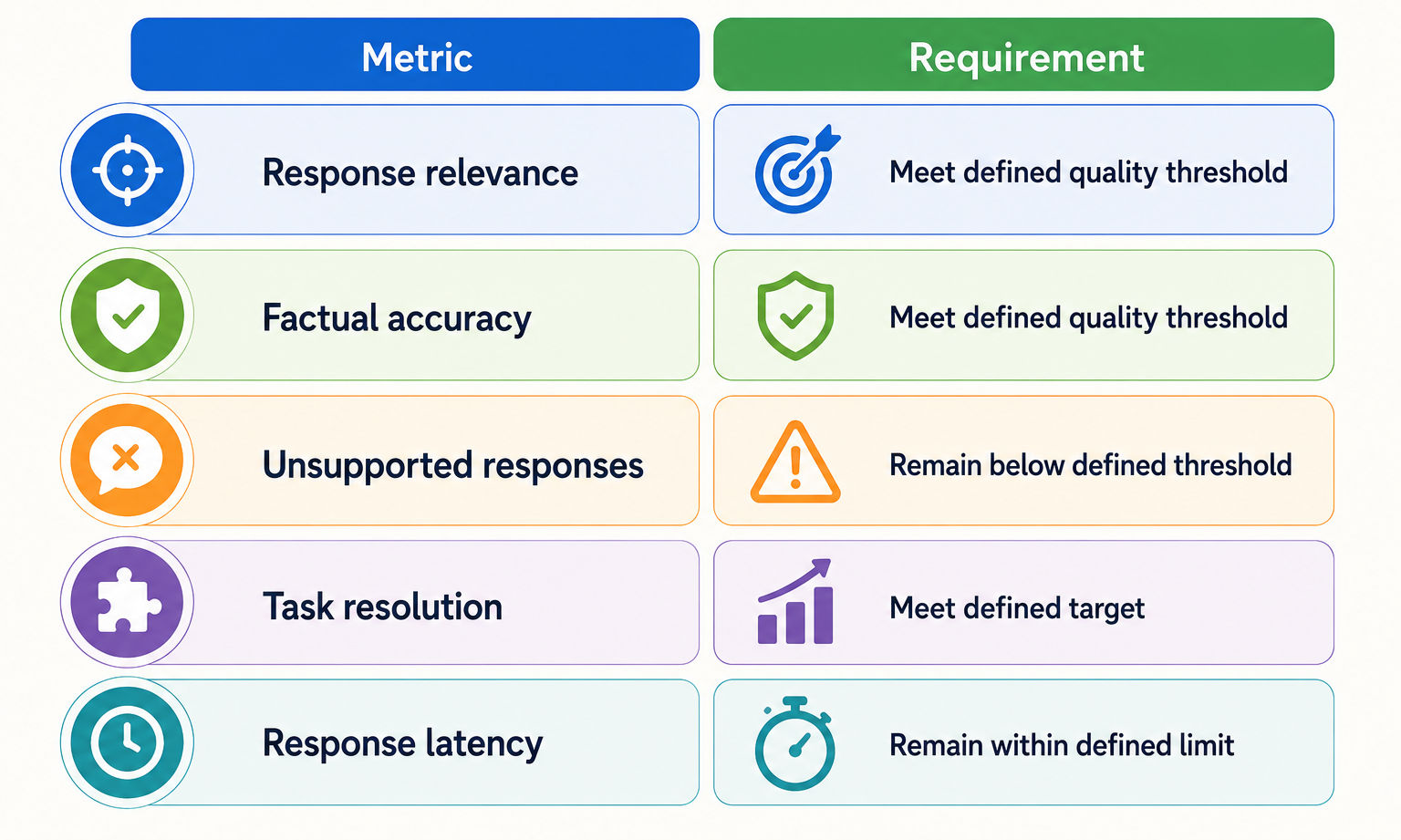
Testing should also involve edge cases such as ambiguous questions, queries that have no support, conflicting information, sensitive requests, and attempts to get restricted information.
The guidance on AI PRDs is now more in favour of specifying clear evaluation criteria, acceptance thresholds and representative test cases rather than depending solely on traditional QA.
12. Risks and Responsible AI
Template:
Spot the risks linked to the AI feature and establish measures to mitigate them.
Example:
| Risk | Mitigation |
| Hallucinated information | Ground responses in approved knowledge sources |
| Privacy exposure | Restrict sensitive data access and apply data controls |
| Biased responses | Test across representative user scenarios |
| Incorrect recommendations | Define human escalation rules |
| Outdated information | Regularly review and update knowledge sources |
| Excessive confidence | Require appropriate uncertainty/fallback behaviour |
Before starting development, the PRD ought to consider issues relating to safety, privacy, bias, transparency, and other responsible AI aspects.
13. Launch, Monitoring, and Maintenance
Template:
Specify the method to be used for launching the AI feature, as well as how it will be monitored and maintained after it has been deployed.
Example:
Launch
- Start with a small group of users.
- Check the performance before increasing availability.
- If the quality or safety thresholds are breached, it is necessary to have a rollback mechanism.
Monitoring
Track:
- Response quality
- Resolution rate
- User feedback
- Latency
- Error rate
- Token/inference cost
- Escalation rate
- Unsupported responses
Maintenance
The team should periodically:
- Review user feedback.
- Update the knowledge base.
- Re-evaluate the model.
- Review failed interactions.
- Keep an eye on the AI's performance.
- When the requirements change, update the evaluation datasets and thresholds.
AI products need to be continually monitored since the behaviour of the model, and the conditions of the data can change after they have been deployed. That is why the present AI PRD frameworks regard monitoring and maintenance as part of the original product requirements rather than as an afterthought.
Also Read: 30 User Story Examples and Templates to Use in 2026
Conclusion
Learning how to write an AI PRD means going beyond standard product requirements and documenting the AI specific details that affect product success. The strongest AI PRDs connect the problem, users, AI use case, data, model behavior, user experience, metrics, risks, and validation requirements.
The best next step is to start with the problem and expected outcome, then define the AI role, data requirements, measurable success criteria, and safety considerations. A clear AI PRD reduces ambiguity and gives product and technical teams a shared direction.
Contact our upGrad KnowledgeHut experts for personalized guidance on choosing the right course, career path, and certification to achieve your goals.
Frequently Asked Questions (FAQs)
1. How is an AI PRD different from a traditional PRD?
An AI PRD includes the standard product requirements along with AI specific details such as data, model behavior, evaluation, risks, and human oversight. Traditional PRDs generally focus more on product functionality, user needs, and business requirements.
2. Should an AI PRD specify the exact AI model to use?
Not always. The PRD should first define the required capabilities, quality, performance, cost, and constraints. The technical team can then evaluate which model, or approach best meets those requirements.
3. How should hallucination risk be documented in an AI PRD?
The PRD should describe where incorrect or unsupported AI outputs could occur and what level of risk is acceptable. It can also define requirements for grounding, validation, user warnings, human review, and fallback behavior.
4. How should AI failure modes and fallback behavior be defined in a PRD?
Document what should happen when the AI produces an incorrect, incomplete, or unavailable response. Requirements can include retries, alternative workflows, user notifications, human escalation, or a safe default response.
5. How can Product Managers define acceptable AI output quality?
Define quality using measurable criteria that match the use case, such as accuracy, relevance, completeness, consistency, or user satisfaction. The PRD should also specify minimum acceptable thresholds and how those results will be tested.
6. How should AI feature costs be documented in an AI PRD?
The PRD should consider costs related to model usage, data processing, infrastructure, storage, and monitoring. Expected usage volumes and cost limits can help teams evaluate whether the feature is financially viable at scale.
7. Should an AI PRD include model latency and response time requirements?
Yes, when response speed affects the user experience. The PRD can define target response times, acceptable delays, uptime expectations, and performance requirements based on how the AI feature will be used.
8. How should human approval and escalation rules be documented in an AI PRD?
The PRD should clearly identify actions that require human review and conditions that trigger escalation. It should also define who approves the action, when approval is required, and what happens if the AI cannot complete the task safely.
9. When should an AI PRD be updated during development?
An AI PRD should be updated when important assumptions about data, model performance, user behavior, risks, or technical feasibility change. Keeping it current helps product and technical teams stay aligned throughout development.
10. How can Product Managers know whether an AI feature is ready for launch?
Launch of readiness should be based on defined quality, performance, safety, and business criteria. The feature should pass validation and user testing, meet agreed AI performance thresholds, and have appropriate monitoring and fallback processes in place.
1639 articles published
KnowledgeHut is an outcome-focused global ed-tech company. We help organizations and professionals unlock excellence through skills development. We offer training solutions under the people and proces...
Get Free Consultation
By submitting, I accept the T&C and
Privacy Policy