
- Blog Categories
- Project Management
- Agile Management
- IT Service Management
- Cloud Computing
- Business Management
- BI And Visualisation
- Quality Management
- Cyber Security
- DevOps
- Most Popular Blogs
- PMP Exam Schedule for 2025: Check PMP Exam Date
- Top 60+ PMP Exam Questions and Answers for 2025
- PMP Cheat Sheet and PMP Formulas To Use in 2025
- What is PMP Process? A Complete List of 49 Processes of PMP
- Top 15+ Project Management Case Studies with Examples 2025
- Top Picks by Authors
- Top 170 Project Management Research Topics
- What is Effective Communication: Definition
- How to Create a Project Plan in Excel in 2025?
- PMP Certification Exam Eligibility in 2025 [A Complete Checklist]
- PMP Certification Fees - All Aspects of PMP Certification Fee
- Most Popular Blogs
- CSM vs PSM: Which Certification to Choose in 2025?
- How Much Does Scrum Master Certification Cost in 2025?
- CSPO vs PSPO Certification: What to Choose in 2025?
- 8 Best Scrum Master Certifications to Pursue in 2025
- Safe Agilist Exam: A Complete Study Guide 2025
- Top Picks by Authors
- SAFe vs Agile: Difference Between Scaled Agile and Agile
- Top 21 Scrum Best Practices for Efficient Agile Workflow
- 30 User Story Examples and Templates to Use in 2025
- State of Agile: Things You Need to Know
- Top 24 Career Benefits of a Certifed Scrum Master
- Most Popular Blogs
- ITIL Certification Cost in 2025 [Exam Fee & Other Expenses]
- Top 17 Required Skills for System Administrator in 2025
- How Effective Is Itil Certification for a Job Switch?
- IT Service Management (ITSM) Role and Responsibilities
- Top 25 Service Based Companies in India in 2025
- Top Picks by Authors
- What is Escalation Matrix & How Does It Work? [Types, Process]
- ITIL Service Operation: Phases, Functions, Best Practices
- 10 Best Facility Management Software in 2025
- What is Service Request Management in ITIL? Example, Steps, Tips
- An Introduction To ITIL® Exam
- Most Popular Blogs
- A Complete AWS Cheat Sheet: Important Topics Covered
- Top AWS Solution Architect Projects in 2025
- 15 Best Azure Certifications 2025: Which one to Choose?
- Top 22 Cloud Computing Project Ideas in 2025 [Source Code]
- How to Become an Azure Data Engineer? 2025 Roadmap
- Top Picks by Authors
- Top 40 IoT Project Ideas and Topics in 2025 [Source Code]
- The Future of AWS: Top Trends & Predictions in 2025
- AWS Solutions Architect vs AWS Developer [Key Differences]
- Top 20 Azure Data Engineering Projects in 2025 [Source Code]
- 25 Best Cloud Computing Tools in 2025
- Most Popular Blogs
- Company Analysis Report: Examples, Templates, Components
- 400 Trending Business Management Research Topics
- Business Analysis Body of Knowledge (BABOK): Guide
- ECBA Certification: Is it Worth it?
- Top Picks by Authors
- Top 20 Business Analytics Project in 2025 [With Source Code]
- ECBA Certification Cost Across Countries
- Top 9 Free Business Requirements Document (BRD) Templates
- Business Analyst Job Description in 2025 [Key Responsibility]
- Business Analysis Framework: Elements, Process, Techniques
- Most Popular Blogs
- Best Career options after BA [2025]
- Top Career Options after BCom to Know in 2025
- Top 10 Power Bi Books of 2025 [Beginners to Experienced]
- Power BI Skills in Demand: How to Stand Out in the Job Market
- Top 15 Power BI Project Ideas
- Top Picks by Authors
- 10 Limitations of Power BI: You Must Know in 2025
- Top 45 Career Options After BBA in 2025 [With Salary]
- Top Power BI Dashboard Templates of 2025
- What is Power BI Used For - Practical Applications Of Power BI
- SSRS Vs Power BI - What are the Key Differences?
- Most Popular Blogs
- Data Collection Plan For Six Sigma: How to Create One?
- Quality Engineer Resume for 2025 [Examples + Tips]
- 20 Best Quality Management Certifications That Pay Well in 2025
- Six Sigma in Operations Management [A Brief Introduction]
- Top Picks by Authors
- Six Sigma Green Belt vs PMP: What's the Difference
- Quality Management: Definition, Importance, Components
- Adding Green Belt Certifications to Your Resume
- Six Sigma Green Belt in Healthcare: Concepts, Benefits and Examples
- Most Popular Blogs
- Latest CISSP Exam Dumps of 2025 [Free CISSP Dumps]
- CISSP vs Security+ Certifications: Which is Best in 2025?
- Best CISSP Study Guides for 2025 + CISSP Study Plan
- How to Become an Ethical Hacker in 2025?
- Top Picks by Authors
- CISSP vs Master's Degree: Which One to Choose in 2025?
- CISSP Endorsement Process: Requirements & Example
- OSCP vs CISSP | Top Cybersecurity Certifications
- How to Pass the CISSP Exam on Your 1st Attempt in 2025?
- Most Popular Blogs
- Top 7 Kubernetes Certifications in 2025
- Kubernetes Pods: Types, Examples, Best Practices
- DevOps Methodologies: Practices & Principles
- Docker Image Commands
- Top Picks by Authors
- Best DevOps Certifications in 2025
- 20 Best Automation Tools for DevOps
- Top 20 DevOps Projects of 2025
- OS for Docker: Features, Factors and Tips
- More
- Agile & PMP Practice Tests
- Agile Testing
- Agile Scrum Practice Exam
- CAPM Practice Test
- PRINCE2 Foundation Exam
- PMP Practice Exam
- Cloud Related Practice Test
- Azure Infrastructure Solutions
- AWS Solutions Architect
- IT Related Pratice Test
- ITIL Practice Test
- Devops Practice Test
- TOGAF® Practice Test
- Other Practice Test
- Oracle Primavera P6 V8
- MS Project Practice Test
- Project Management & Agile
- Project Management Interview Questions
- Release Train Engineer Interview Questions
- Agile Coach Interview Questions
- Scrum Interview Questions
- IT Project Manager Interview Questions
- Cloud & Data
- Azure Databricks Interview Questions
- AWS architect Interview Questions
- Cloud Computing Interview Questions
- AWS Interview Questions
- Kubernetes Interview Questions
- Web Development
- CSS3 Free Course with Certificates
- Basics of Spring Core and MVC
- Javascript Free Course with Certificate
- React Free Course with Certificate
- Node JS Free Certification Course
- Data Science
- Python Machine Learning Course
- Python for Data Science Free Course
- NLP Free Course with Certificate
- Data Analysis Using SQL
Product Owner Salary in Canada
Updated on Aug 19, 2026 | 4 min read | 0.6k+ views
Share:
Table of Contents
View all
Quick Overview
- The average Product Owner salary in Canada is around CAD $91K per year,with salaries varying based on experience, location, employer, and responsibilities.
- Experience and product ownership can influence earning potential, with average salaries increasing from CAD $91K for 1 to 3 years of experience to CAD $106K for 15+ years.
- Product Owner salaries in Canada vary by location, company, and responsibilities. Ottawa has the highest salary at $110,483 per year, while Vancouver has the lowest at $99,852 per year among the listed cities.
- This guide covers Product Owner salary by experience and city, how responsibilities affect pay, and the skills and career factors that can support salary growth in Canada.
Want to advance your Product Owner career? Build in-demand Product Owner and Product Management skills with upGrad KnowledgeHut SAFe® 6.0 POPM Certification and prepare for opportunities in Agile and product-driven organizations.
Master the Right Skills & Boost Your Career
Avail your free 1:1 mentorship session
What is the average salary of a Product Owner in Canada?
The average salary for a Product Owner in Canada is $91K annually. This amount refers to the basic pay and must be regarded as a market reference rather than a fixed salary.
Compensation |
Salary |
| Base Salary Range | $78K to $106K/year |
| Average Base Pay | $91K/year |
| Average Additional Salary | $8K/year |
| Additional Salary Range | $5K to $14K/year |
Source: Glassdoor
The basic salary might also be different from the total compensation since certain employers offer bonuses, incentives, or extra benefits.
Also Read: How to Become a Product Owner?
Product Owner Salary in Canada by Experience
In Canada there is a direct link between a product owner's salary and their level of experience. When Product Owners go on to take responsibility for larger products and start to have an impact on business strategy, their duties generally increase.
| Experience Level | Average Base Salary |
| 1 to 3 years | $91K/year |
| 4 to 6 years | $92K/year |
| 7 to 9 years | $98K/year |
| 10 to 14 years | $103K/year |
| 15+ years | $106K/year |
Source: Glassdoor
Boost your Product Owner career with the right Agile skills. Explore upGrad KnowledgeHut Agile Management Courses and build skills for your next career opportunity.
Product Owner Salary in Canada by City
Location influences the salary of product owners in Canada, especially in the major business and technology areas, as the Indeed figures presented indicate varying amounts across the chosen Canadian cities.
| City | Average Salary |
| Ottawa, ON | $110,483/year |
| Toronto, ON | $103,902/year |
| Montréal, QC | $103,612/year |
| Calgary, AB | $103,600/year |
| Vancouver, BC | $99,852/year |
Source: Indeed
What the City Salary Data Means
The figures show that Ottawa has the highest salary reported for any of the cities at $110,483 per year; Toronto, Montréal and Calgary being about the same, whereas Vancouver is a little lower in the dataset given.
Salary differences can reflect:
- Employer concentration
- Industry demand
- Product role seniority
- Company size
- Product complexity
- Local hiring conditions
The salary figures available on job websites can likewise vary depending on the number and type of salaries that have been reported; as a result, the figures at the city level should be regarded as market benchmarks not as guaranteed salary amounts.
Also Read: Product Owner vs Scrum Master
How Experience and Responsibilities Increase Product Owner Salary
The salary that a product owner earns in Canada is not merely determined by the number of years of experience but also by the degree of ownership and business responsibility they have. Individuals can increase their value by shifting from a focus on delivery to taking on a wider range of product and strategic responsibilities.
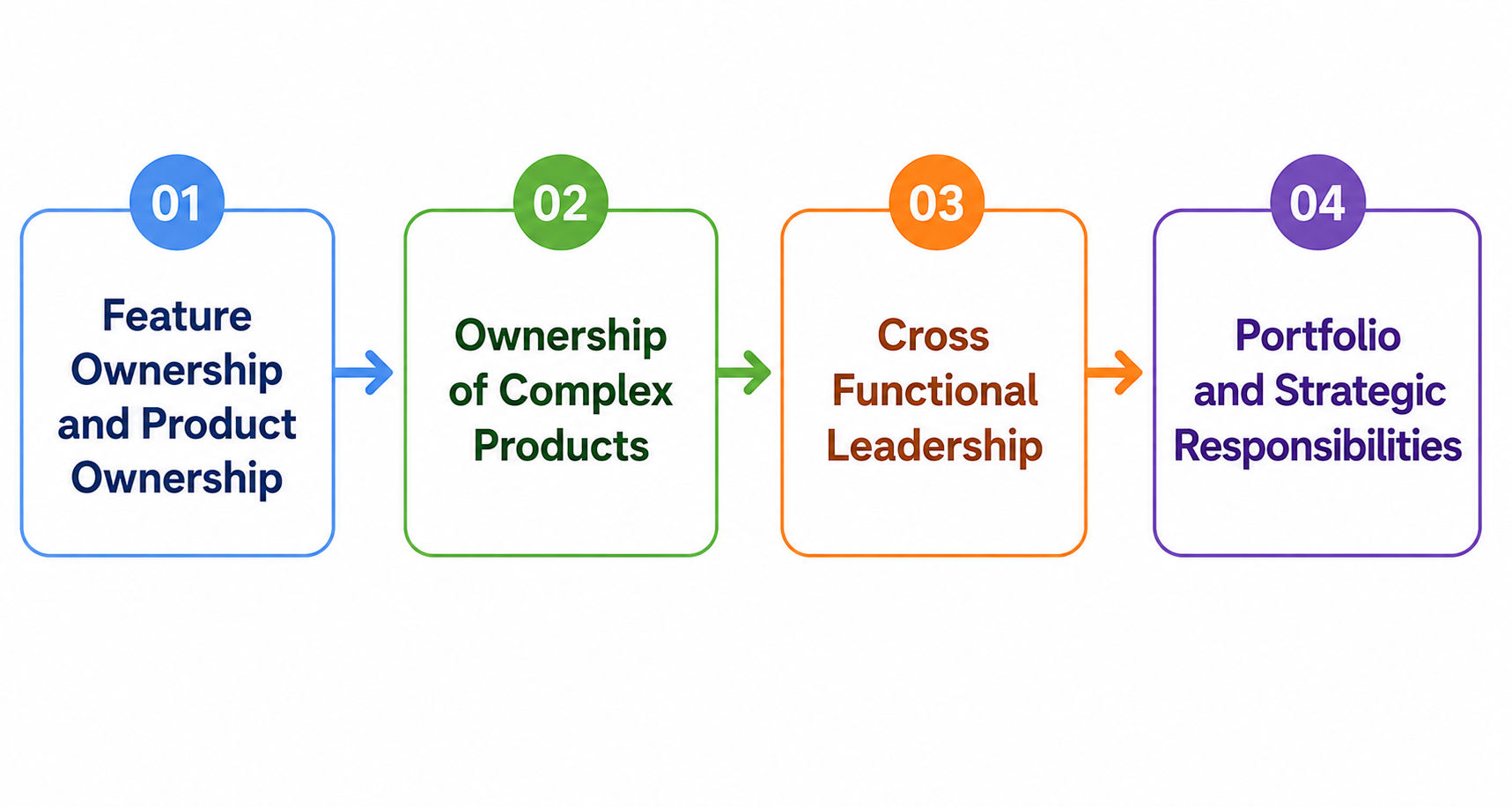
1. Feature Ownership and Product Ownership
In the early stages of their careers, Product Owners often concentrate on individual features or backlog items, but as their responsibilities grow, the role can become one of full product ownership.
This progression can involve:
- Managing the product backlog
- Defining priorities
- Understanding customer needs
- Supporting product strategy
- Measuring outcomes
2. Ownership of Complex Products
Because the products are complex, it is necessary to have a more thorough approach to prioritization, stakeholder management, understanding of the customer, and business decision making.
Product Owners working on more complex products may be responsible for:
- Multiple product components
- Larger customer groups
- Complex dependencies
- Higher business impact
- Cross functional coordination
3. Cross Functional Leadership
Product Owners work together with engineering, design, marketing, sales, operations, and business teams.
Strong cross functional leadership can involve:
- Aligning teams around product goals
- Resolving competing priorities
- Communicating product decisions
- Managing stakeholder expectations
- Supporting delivery outcomes
4. Portfolio and Strategic Responsibilities
In more senior positions, Product Owners can be involved with a number of products or with broader product portfolios.
Strategic responsibilities can include:
- Product portfolio prioritization
- Long term planning
- Business growth
- Resource allocation
- Executive communication
- Market and customer strategy
Also Read: Top 8 Product Owner Certifications in 2026
Conclusion
What then should a Product Owner in Canada learn from this data?
Salaries generally go up because of the level of responsibility rather than just because of the length of time worked. The figures given show an increase from $91K for 1 to 3 years' experience to $106K for 15 or more years' experience, apart from the fact that location and the complexity of the product can also affect pay.
When looking for jobs that offer greater earning potential, people should aim for wider product ownership, work on complex products, achieve measurable business impacts, take on cross-functional leadership roles, and assume strategic responsibilities. In assessing job opportunities, one should also take into account total compensation and long-term career growth.
Contact our upGrad KnowledgeHut experts for personalized guidance on choosing the right course, career path, and certification to achieve your goals.
Frequently Asked Questions (FAQs)
1. What is the difference between Product Owner base salary and total compensation in Canada?
Base salary is the fixed annual pay received by a Product Owner. Total compensation can also include bonuses, incentives, equity, allowances, and benefits. Therefore, total earnings may be higher than the advertised base salary.
2. How much can bonuses and additional compensation add to a Product Owner salary in Canada?
Additional compensation varies by employer, seniority, performance, and role scope. It may include annual bonuses, performance incentives, benefits, or equity. The exact amount depends on the company's compensation structure.
3. Which industries offer the highest Product Owner salaries in Canada?
Technology, financial services, telecommunications, healthcare, and enterprise software can offer competitive Product Owner salaries. Compensation still depends on experience, company size, product complexity, and the level of responsibility.
4. Does technical expertise increase Product Owner salary in Canada?
Technical expertise can improve earning potential, especially roles involving software, data, APIs, or complex digital products. Strong technical understanding can also help Product Owners take on broader responsibilities and work more effectively with engineering teams.
5. Do Product Owners with Agile certifications earn more in Canada?
Agile certifications can demonstrate structured knowledge of Scrum and product delivery practices. However, certification alone does not guarantee higher pay, as employers generally place greater emphasis on experience, product ownership, skills, and measurable business impact.
6. How does remote work affect Product Owner salary in Canada?
Remote work does not automatically increase or decrease salary. Compensation can depend on the employer's location, hiring model, salary policy, candidate location, and role responsibilities. Some companies use location-based salary bands.
7. Can Product Owners in Canada earn more than $120,000 per year?
Yes, experienced Product Owners and senior product professionals can potentially earn $120,000 annually. Higher compensation is more likely with greater product scope, leadership responsibility, specialized skills, and strong business impact.
8. What is the salary difference between a Product Owner and Senior Product Owner in Canada?
Senior Product Owners generally earn more because they manage larger products, more complex priorities, and broader stakeholder responsibilities. The exact difference varies depending on the company, experience, industry, and overall compensation package.
9. Does specializing in AI or technical products increase Product Owner salary in Canada?
AI and technical product expertise can strengthen earning potential when those skills are in demand. Product Owners working on AI, data, SaaS, or complex technology products may access specialized opportunities, although experience and business impact remain important.
10. How can Product Owners negotiate a higher salary in Canada?
Product Owners can use market benchmarks and highlight measurable achievements, product impact, leadership, and specialized expertise. Negotiating the complete package can also include bonuses, benefits, equity, allowances, and career growth opportunities.
1639 articles published
KnowledgeHut is an outcome-focused global ed-tech company. We help organizations and professionals unlock excellence through skills development. We offer training solutions under the people and proces...
Get Free Consultation
By submitting, I accept the T&C and
Privacy Policy
Ready to learn about Agile Certifications Roadmap?