
- Blog Categories
- Project Management
- Agile Management
- IT Service Management
- Cloud Computing
- Business Management
- BI And Visualisation
- Quality Management
- Cyber Security
- DevOps
- Most Popular Blogs
- PMP Exam Schedule for 2025: Check PMP Exam Date
- Top 60+ PMP Exam Questions and Answers for 2025
- PMP Cheat Sheet and PMP Formulas To Use in 2025
- What is PMP Process? A Complete List of 49 Processes of PMP
- Top 15+ Project Management Case Studies with Examples 2025
- Top Picks by Authors
- Top 170 Project Management Research Topics
- What is Effective Communication: Definition
- How to Create a Project Plan in Excel in 2025?
- PMP Certification Exam Eligibility in 2025 [A Complete Checklist]
- PMP Certification Fees - All Aspects of PMP Certification Fee
- Most Popular Blogs
- CSM vs PSM: Which Certification to Choose in 2025?
- How Much Does Scrum Master Certification Cost in 2025?
- CSPO vs PSPO Certification: What to Choose in 2025?
- 8 Best Scrum Master Certifications to Pursue in 2025
- Safe Agilist Exam: A Complete Study Guide 2025
- Top Picks by Authors
- SAFe vs Agile: Difference Between Scaled Agile and Agile
- Top 21 Scrum Best Practices for Efficient Agile Workflow
- 30 User Story Examples and Templates to Use in 2025
- State of Agile: Things You Need to Know
- Top 24 Career Benefits of a Certifed Scrum Master
- Most Popular Blogs
- ITIL Certification Cost in 2025 [Exam Fee & Other Expenses]
- Top 17 Required Skills for System Administrator in 2025
- How Effective Is Itil Certification for a Job Switch?
- IT Service Management (ITSM) Role and Responsibilities
- Top 25 Service Based Companies in India in 2025
- Top Picks by Authors
- What is Escalation Matrix & How Does It Work? [Types, Process]
- ITIL Service Operation: Phases, Functions, Best Practices
- 10 Best Facility Management Software in 2025
- What is Service Request Management in ITIL? Example, Steps, Tips
- An Introduction To ITIL® Exam
- Most Popular Blogs
- A Complete AWS Cheat Sheet: Important Topics Covered
- Top AWS Solution Architect Projects in 2025
- 15 Best Azure Certifications 2025: Which one to Choose?
- Top 22 Cloud Computing Project Ideas in 2025 [Source Code]
- How to Become an Azure Data Engineer? 2025 Roadmap
- Top Picks by Authors
- Top 40 IoT Project Ideas and Topics in 2025 [Source Code]
- The Future of AWS: Top Trends & Predictions in 2025
- AWS Solutions Architect vs AWS Developer [Key Differences]
- Top 20 Azure Data Engineering Projects in 2025 [Source Code]
- 25 Best Cloud Computing Tools in 2025
- Most Popular Blogs
- Company Analysis Report: Examples, Templates, Components
- 400 Trending Business Management Research Topics
- Business Analysis Body of Knowledge (BABOK): Guide
- ECBA Certification: Is it Worth it?
- Top Picks by Authors
- Top 20 Business Analytics Project in 2025 [With Source Code]
- ECBA Certification Cost Across Countries
- Top 9 Free Business Requirements Document (BRD) Templates
- Business Analyst Job Description in 2025 [Key Responsibility]
- Business Analysis Framework: Elements, Process, Techniques
- Most Popular Blogs
- Best Career options after BA [2025]
- Top Career Options after BCom to Know in 2025
- Top 10 Power Bi Books of 2025 [Beginners to Experienced]
- Power BI Skills in Demand: How to Stand Out in the Job Market
- Top 15 Power BI Project Ideas
- Top Picks by Authors
- 10 Limitations of Power BI: You Must Know in 2025
- Top 45 Career Options After BBA in 2025 [With Salary]
- Top Power BI Dashboard Templates of 2025
- What is Power BI Used For - Practical Applications Of Power BI
- SSRS Vs Power BI - What are the Key Differences?
- Most Popular Blogs
- Data Collection Plan For Six Sigma: How to Create One?
- Quality Engineer Resume for 2025 [Examples + Tips]
- 20 Best Quality Management Certifications That Pay Well in 2025
- Six Sigma in Operations Management [A Brief Introduction]
- Top Picks by Authors
- Six Sigma Green Belt vs PMP: What's the Difference
- Quality Management: Definition, Importance, Components
- Adding Green Belt Certifications to Your Resume
- Six Sigma Green Belt in Healthcare: Concepts, Benefits and Examples
- Most Popular Blogs
- Latest CISSP Exam Dumps of 2025 [Free CISSP Dumps]
- CISSP vs Security+ Certifications: Which is Best in 2025?
- Best CISSP Study Guides for 2025 + CISSP Study Plan
- How to Become an Ethical Hacker in 2025?
- Top Picks by Authors
- CISSP vs Master's Degree: Which One to Choose in 2025?
- CISSP Endorsement Process: Requirements & Example
- OSCP vs CISSP | Top Cybersecurity Certifications
- How to Pass the CISSP Exam on Your 1st Attempt in 2025?
- Most Popular Blogs
- Top 7 Kubernetes Certifications in 2025
- Kubernetes Pods: Types, Examples, Best Practices
- DevOps Methodologies: Practices & Principles
- Docker Image Commands
- Top Picks by Authors
- Best DevOps Certifications in 2025
- 20 Best Automation Tools for DevOps
- Top 20 DevOps Projects of 2025
- OS for Docker: Features, Factors and Tips
- More
- Agile & PMP Practice Tests
- Agile Testing
- Agile Scrum Practice Exam
- CAPM Practice Test
- PRINCE2 Foundation Exam
- PMP Practice Exam
- Cloud Related Practice Test
- Azure Infrastructure Solutions
- AWS Solutions Architect
- IT Related Pratice Test
- ITIL Practice Test
- Devops Practice Test
- TOGAF® Practice Test
- Other Practice Test
- Oracle Primavera P6 V8
- MS Project Practice Test
- Project Management & Agile
- Project Management Interview Questions
- Release Train Engineer Interview Questions
- Agile Coach Interview Questions
- Scrum Interview Questions
- IT Project Manager Interview Questions
- Cloud & Data
- Azure Databricks Interview Questions
- AWS architect Interview Questions
- Cloud Computing Interview Questions
- AWS Interview Questions
- Kubernetes Interview Questions
- Web Development
- CSS3 Free Course with Certificates
- Basics of Spring Core and MVC
- Javascript Free Course with Certificate
- React Free Course with Certificate
- Node JS Free Certification Course
- Data Science
- Python Machine Learning Course
- Python for Data Science Free Course
- NLP Free Course with Certificate
- Data Analysis Using SQL
- Home
- Blog
- Artificial Intelligence
- Is the Universal AI Program by MIT Open Learning Worth It?
Is the Universal AI Program by MIT Open Learning Worth It?
Updated on Sep 23, 2026 | 0.5k+ views
Share:
Table of Contents
View all
Quick Overview
- The MIT Universal AI Program introduces learners to AI concepts, applications, and practical use cases across different fields.
- The program is designed for students, professionals, managers, entrepreneurs, and non-technical learners who want to build AI fluency.
- The first foundational course is free, while specialized courses and professional tracks may involve additional costs.
- This guide explains what the Universal AI Program offers, who it is for, what you can learn, and whether it is worth considering based on your career goals.
For professionals looking to move beyond foundational AI concepts and build practical expertise, the PG Certificate in Applied Generative Engineering & LLM Applications can provide focused learning in generative AI and LLM based applications.
What Exactly Is the Universal AI Program?
The MIT Universal AI Program is offered through MIT Open Learning, MIT’s initiative for making its educational resources more accessible beyond the traditional classroom. The MIT Universal AI Program is designed for learners who want to understand artificial intelligence, how it works, where it is heading, and how it is already affecting different industries.
One of the key points that makes the Universal AI MIT program approachable is that a computer science degree or advanced coding background is not required. Instead, the focus is on building a clear foundation without making the learning experience overly technical.
The program covers areas such as:
• Machine learning fundamentals
• How AI systems are developed
• Real world AI applications
• AI use across business, healthcare, and finance
• AI ethics and responsible use
• The broader impact of AI and automation
The MIT Open Learning Universal AI approach is designed to help learners move from hearing about AI everywhere to actually understanding how the technology works and why it matters.
For anyone searching MIT Universal AI Program Worth It, this foundation focused approach is one of the main factors to consider.
Who Is This Program Actually For?
A common question around the MIT Universal AI Program is whether it is designed for beginners, working professionals, or technical specialists. Based on the program positioning, it appears to be aimed at learners who want a practical understanding of AI without committing to a full technical degree.
It may be particularly relevant for:
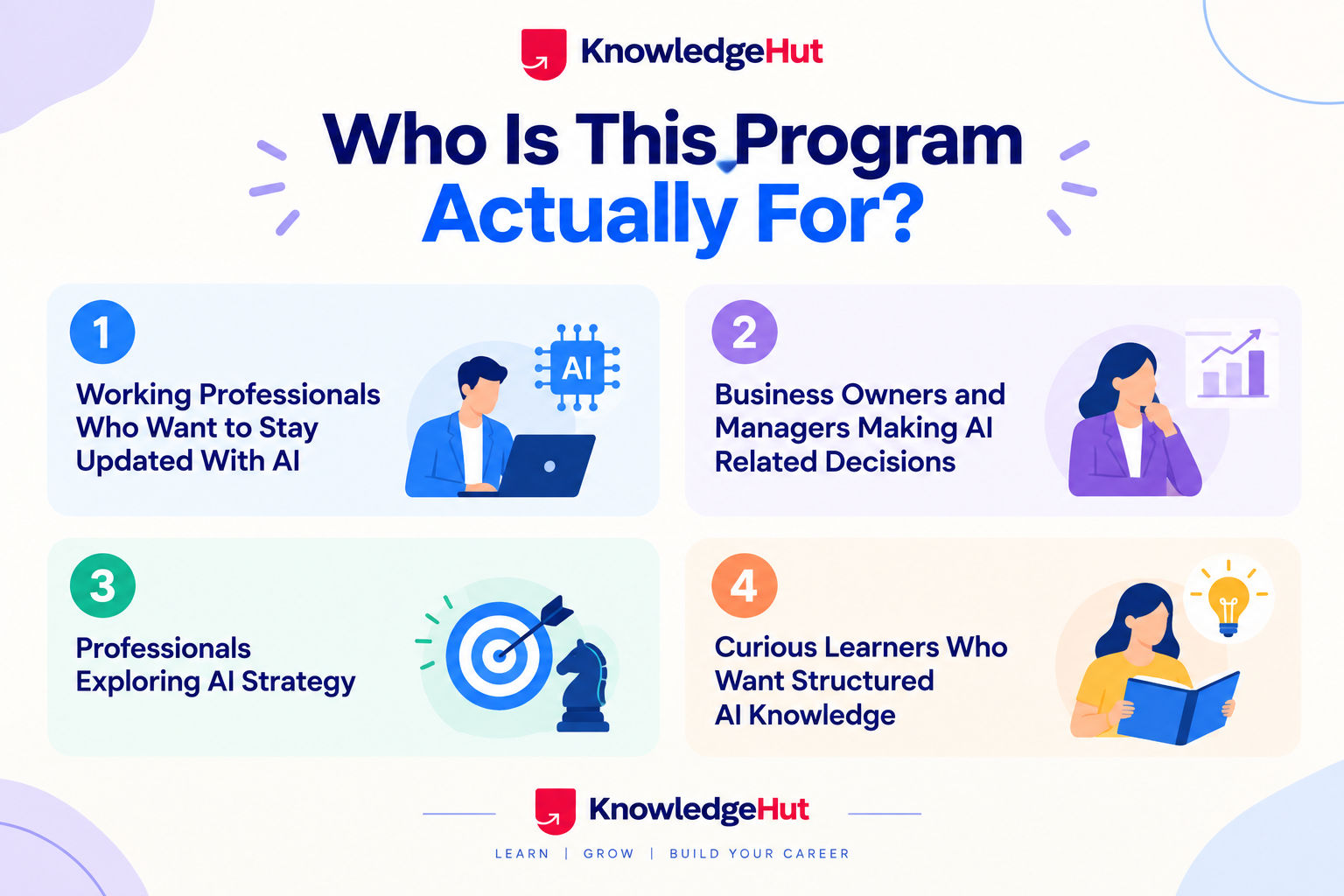
The MIT Open Learning Universal AI Program may be less suitable for someone who is already deeply involved in machine learning engineering or AI research and wants advanced technical training.
For such learners, a more specialised technical program may be a better fit. But for someone looking for a structured introduction to AI, the balance between concepts, applications, and broader implications can make the MIT Universal AI Course worth considering.
This is also important when asking Are MIT online courses worth it? The answer depends heavily on the learner’s existing knowledge and what they expect from the program.
Professionals interested in applying AI to product strategy can also explore the PG Certificate in AI Powered Product and Design Thinking, which covers AI applications across product management, customer discovery, prototyping, strategy, and growth.
What Will You Actually Learn?
The MIT Universal AI Program focuses on helping learners understand AI rather than simply teaching them how to use individual AI tools. The curriculum covers both the fundamentals and the wider impact of the technology.
Learners can expect to explore:
• How machine learning works at a foundational level
• Differences between narrow AI and general AI
• Large language models at a conceptual level
• AI applications across industries
• AI ethics and algorithmic bias
• Automation and its wider implications
The program also places attention on questions that often receive less attention in basic AI courses, particularly ethics, bias, and the social impact of automation.
The MIT Universal AI Fundamentals of Programming and Machine Learning angle makes the learning journey useful for people who want to understand the foundations before moving into more advanced topics.
By the end of the learning experience, the goal is to be better prepared to:
• Discuss AI concepts with more confidence
• Evaluate AI tools more critically
• Understand where AI can add value
• Recognise limitations and risks
• Think about AI from both a technical and business perspective
For people researching MIT Universal AI Program Worth It, the practical usefulness of this knowledge may matter more than simply completing another online certificate.
Professionals exploring different ways to build AI skills can compare MIT Open Learning AI Program vs Self-Study to understand the differences in learning structure, flexibility, cost, and practical exposure.
The MIT Name: Does It Actually Matter Here?
The MIT Universal AI name is naturally one of the biggest reasons people consider the program. MIT has a strong reputation in education and technology, so the institution behind a course can influence how learners perceive its value.
The MIT Open Learning Universal AI program benefits from being associated with the broader MIT learning ecosystem. This can make the credential more noticeable on a resume or professional profile.
However, the MIT name should not be viewed as the only reason to enrol.
The real value also comes from:
• The structure of the curriculum
• The quality of the concepts covered
• The relevance of the material
• The learner’s ability to apply what is taught
• How the program fits existing career goals
This is particularly important when considering MIT Universal AI Program Worth It from a career perspective. A recognised name can add credibility, but the practical value still depends on what the learner does with the knowledge afterward.
So, MIT Universal AI Brand New may sound appealing from a discovery standpoint, but the better question is whether the actual curriculum and learning experience match the intended outcome.
Build a stronger foundation in AI by exploring 6 AI Concepts Worth Learning First, Inspired by MIT Open Learning's AI Program, from core AI principles to practical applications.
Is the Time Commitment Realistic?
Time commitment is an important factor when evaluating the MIT Universal AI Program Worth It, especially for working professionals.
The program is positioned as something that can be completed alongside other responsibilities. Based on the overview, participants may spend around 8 to 12 hours per week, depending on how deeply they engage with the material.
That can work well for learners balancing:
• Full time employment
• Family responsibilities
• Other professional commitments
• Ongoing education
The actual effort can vary depending on how quickly someone works through the content and how much time is spent reviewing concepts.
Learners should also be realistic about the schedule. Setting aside dedicated study time may be more effective than trying to fit the program into short gaps throughout the day.
For someone exploring MIT Learn Universal AI, consistency may matter more than completing every module as quickly as possible.
Professionals comparing advanced AI learning options can explore the AI Masters Program to understand the curriculum, skills, projects, and career opportunities associated with structured AI education.
What Does It Cost and Is It Worth the Price?
Cost is another major consideration when deciding MIT Universal AI Program Worth It. Program fees can change, so the current pricing should always be checked before enrolment.
The overview suggests that programs at this level can range from a few hundred dollars to more than a thousand dollars, depending on the offering.
The value becomes easier to judge when compared with alternatives.
For example:
• A traditional university AI course may cost considerably more
• A generic online course may cost very little
• A specialised program may provide more technical depth
• An MIT Open Learning program may sit somewhere between these options
The right question is not simply whether the fee is high or low. It is whether the learning outcomes justify the investment for the intended career or personal goal.
For someone looking for an MIT Universal AI Course, the potential value may come from structured learning, institutional credibility, and a broader understanding of AI rather than from technical specialisation alone.
The return can be different for every learner. Someone using the knowledge to support career growth, business decisions, or an AI related project may see more practical value than someone expecting a standalone certificate to create an immediate career change.
Explore What Makes a University-Backed AI Program Different (Featuring MIT Open Learning) to understand how structured AI learning, curriculum, and institutional backing can shape the learning experience.
Honest Things to Consider Before Enrolling
No AI program will be the right fit for everyone, and the MIT Universal AI Program has some limitations worth considering before enrolling.
One consideration is the learning format. Learners who strongly prefer live interaction, classroom discussion, and constant instructor support may find a more independent format less engaging.
Other factors to think about include:
• Preferred learning style
• Existing AI knowledge
• Desired level of technical depth
• Available weekly study time
• Career goals
• Budget
The program may also feel introductory to experienced developers, data scientists, or machine learning professionals who already have strong technical knowledge.
For someone aiming to become a machine learning engineer or AI researcher, the MIT Open Learning Universal AI program may provide a foundation but not the full technical depth required for those careers.
That distinction matters when considering MIT Universal AI Program Worth It. It may be more useful as a structured foundation than as a complete AI career pathway.
What Kind of Learner May Benefit Most?
The program may suit someone who:
• Wants a structured introduction to AI
• Needs AI knowledge for business or professional decisions
• Wants to understand AI without advanced mathematics
• Is exploring AI before committing to deeper technical study
It may be less suitable for learners who:
• Already have advanced AI expertise
• Want intensive model development training
• Need deep programming and mathematical instruction
• Are specifically preparing for research focused roles
This is also why Are MIT online courses worth it should be answered based on the learner’s starting point rather than the institution’s reputation alone.
Conclusion
So, is MIT Universal AI Program worth it? It can be a useful option for professionals, managers, and curious learners who want a structured understanding of AI without immediately diving into advanced technical training.
The MIT Universal AI Program is best viewed as a foundation. Those looking for deeper engineering or research skills may need additional technical training afterward. Before enrolling, compare the curriculum, learning format, time commitment, cost, and career goals to decide whether it fits the intended outcome.
Have A Query? Get in Touch With Our Customer Support | upGrad KnowledgeHut
Frequently Asked Questions
1. Does the MIT Universal AI Program give academic credit or a degree?
No. The MIT Universal AI Program is a noncredit, nondegree learning program and does not confer academic standing. It provides digital certificates for eligible completed modules and courses instead.
2. What certificate do you receive after completing the MIT Universal AI Program?
The program offers Module, Course, and Program Certificates, depending on what is completed. Certificates are digital, and the Universal AI Program Certificate is currently available through the Program Bundle.
3. Can you take individual Universal AI courses instead of the full program?
Yes. Most Foundations Courses and Vertical Courses can be purchased individually, so completing the entire program is not required to take those courses. Individual modules, however, cannot be purchased separately.
4. Is the first Universal AI course really free to take?
Yes. Foundations Course 1: Fundamentals of Programming and Machine Learning is available for free enrollment. It allows learners to explore the content and structure before purchasing other program components, but it does not provide a certificate.
5. How long do you have access to the MIT Universal AI Program after enrolling?
A purchased Universal AI program or individual course includes a one year active subscription period. After that, learners retain access to the content they purchased as it existed during the subscription, but they cannot complete new coursework or earn additional certificates.
6. What happens to your certificates if your Universal AI subscription ends?
Certificates earned during the active subscription remain part of the learner's completed credentials. However, once the subscription ends, learners cannot complete additional coursework or earn new certificates for that content.
7. Can you use ChatGPT or other AI tools while completing Universal AI coursework?
No. MIT Learn does not allow external LLMs such as ChatGPT, Google Bard, or Claude to complete Universal AI coursework. Instead, learners can use AskTIM, MIT Learn's AI assistant, for explanations and guidance while completing their own work.
8. What is AskTIM, and how does it help learners in Universal AI?
AskTIM is the AI tutor available within the Universal AI learning platform. It can explain lecture concepts, answer questions, provide guidance on coursework, and help learners navigate their learning journey.
9. How is the Universal AI Program different from a traditional MIT online course?
Universal AI is designed as a self paced, asynchronous learning program rather than a traditional degree or credit bearing MIT course. It combines lectures, knowledge checks, guided exercises, assignments, hands-on activities, and AskTIM support.
10. Does completing Universal AI make you an MIT alum?
No. Completing Universal AI does not grant MIT alumni status. MIT states that alumni designation is reserved for people who have completed an undergraduate or graduate degree from MIT.
For someone evaluating MIT Universal AI Program Worth It, these details are important because the program is a professional, noncredit learning experience rather than a degree or academic credential.
1639 articles published
KnowledgeHut is an outcome-focused global ed-tech company. We help organizations and professionals unlock excellence through skills development. We offer training solutions under the people and proces...
Get Free Consultation
By submitting, I accept the T&C and
Privacy Policy