
- Blog Categories
- Project Management
- Agile Management
- IT Service Management
- Cloud Computing
- Business Management
- BI And Visualisation
- Quality Management
- Cyber Security
- DevOps
- Most Popular Blogs
- PMP Exam Schedule for 2025: Check PMP Exam Date
- Top 60+ PMP Exam Questions and Answers for 2025
- PMP Cheat Sheet and PMP Formulas To Use in 2025
- What is PMP Process? A Complete List of 49 Processes of PMP
- Top 15+ Project Management Case Studies with Examples 2025
- Top Picks by Authors
- Top 170 Project Management Research Topics
- What is Effective Communication: Definition
- How to Create a Project Plan in Excel in 2025?
- PMP Certification Exam Eligibility in 2025 [A Complete Checklist]
- PMP Certification Fees - All Aspects of PMP Certification Fee
- Most Popular Blogs
- CSM vs PSM: Which Certification to Choose in 2025?
- How Much Does Scrum Master Certification Cost in 2025?
- CSPO vs PSPO Certification: What to Choose in 2025?
- 8 Best Scrum Master Certifications to Pursue in 2025
- Safe Agilist Exam: A Complete Study Guide 2025
- Top Picks by Authors
- SAFe vs Agile: Difference Between Scaled Agile and Agile
- Top 21 Scrum Best Practices for Efficient Agile Workflow
- 30 User Story Examples and Templates to Use in 2025
- State of Agile: Things You Need to Know
- Top 24 Career Benefits of a Certifed Scrum Master
- Most Popular Blogs
- ITIL Certification Cost in 2025 [Exam Fee & Other Expenses]
- Top 17 Required Skills for System Administrator in 2025
- How Effective Is Itil Certification for a Job Switch?
- IT Service Management (ITSM) Role and Responsibilities
- Top 25 Service Based Companies in India in 2025
- Top Picks by Authors
- What is Escalation Matrix & How Does It Work? [Types, Process]
- ITIL Service Operation: Phases, Functions, Best Practices
- 10 Best Facility Management Software in 2025
- What is Service Request Management in ITIL? Example, Steps, Tips
- An Introduction To ITIL® Exam
- Most Popular Blogs
- A Complete AWS Cheat Sheet: Important Topics Covered
- Top AWS Solution Architect Projects in 2025
- 15 Best Azure Certifications 2025: Which one to Choose?
- Top 22 Cloud Computing Project Ideas in 2025 [Source Code]
- How to Become an Azure Data Engineer? 2025 Roadmap
- Top Picks by Authors
- Top 40 IoT Project Ideas and Topics in 2025 [Source Code]
- The Future of AWS: Top Trends & Predictions in 2025
- AWS Solutions Architect vs AWS Developer [Key Differences]
- Top 20 Azure Data Engineering Projects in 2025 [Source Code]
- 25 Best Cloud Computing Tools in 2025
- Most Popular Blogs
- Company Analysis Report: Examples, Templates, Components
- 400 Trending Business Management Research Topics
- Business Analysis Body of Knowledge (BABOK): Guide
- ECBA Certification: Is it Worth it?
- Top Picks by Authors
- Top 20 Business Analytics Project in 2025 [With Source Code]
- ECBA Certification Cost Across Countries
- Top 9 Free Business Requirements Document (BRD) Templates
- Business Analyst Job Description in 2025 [Key Responsibility]
- Business Analysis Framework: Elements, Process, Techniques
- Most Popular Blogs
- Best Career options after BA [2025]
- Top Career Options after BCom to Know in 2025
- Top 10 Power Bi Books of 2025 [Beginners to Experienced]
- Power BI Skills in Demand: How to Stand Out in the Job Market
- Top 15 Power BI Project Ideas
- Top Picks by Authors
- 10 Limitations of Power BI: You Must Know in 2025
- Top 45 Career Options After BBA in 2025 [With Salary]
- Top Power BI Dashboard Templates of 2025
- What is Power BI Used For - Practical Applications Of Power BI
- SSRS Vs Power BI - What are the Key Differences?
- Most Popular Blogs
- Data Collection Plan For Six Sigma: How to Create One?
- Quality Engineer Resume for 2025 [Examples + Tips]
- 20 Best Quality Management Certifications That Pay Well in 2025
- Six Sigma in Operations Management [A Brief Introduction]
- Top Picks by Authors
- Six Sigma Green Belt vs PMP: What's the Difference
- Quality Management: Definition, Importance, Components
- Adding Green Belt Certifications to Your Resume
- Six Sigma Green Belt in Healthcare: Concepts, Benefits and Examples
- Most Popular Blogs
- Latest CISSP Exam Dumps of 2025 [Free CISSP Dumps]
- CISSP vs Security+ Certifications: Which is Best in 2025?
- Best CISSP Study Guides for 2025 + CISSP Study Plan
- How to Become an Ethical Hacker in 2025?
- Top Picks by Authors
- CISSP vs Master's Degree: Which One to Choose in 2025?
- CISSP Endorsement Process: Requirements & Example
- OSCP vs CISSP | Top Cybersecurity Certifications
- How to Pass the CISSP Exam on Your 1st Attempt in 2025?
- Most Popular Blogs
- Top 7 Kubernetes Certifications in 2025
- Kubernetes Pods: Types, Examples, Best Practices
- DevOps Methodologies: Practices & Principles
- Docker Image Commands
- Top Picks by Authors
- Best DevOps Certifications in 2025
- 20 Best Automation Tools for DevOps
- Top 20 DevOps Projects of 2025
- OS for Docker: Features, Factors and Tips
- More
- Agile & PMP Practice Tests
- Agile Testing
- Agile Scrum Practice Exam
- CAPM Practice Test
- PRINCE2 Foundation Exam
- PMP Practice Exam
- Cloud Related Practice Test
- Azure Infrastructure Solutions
- AWS Solutions Architect
- IT Related Pratice Test
- ITIL Practice Test
- Devops Practice Test
- TOGAF® Practice Test
- Other Practice Test
- Oracle Primavera P6 V8
- MS Project Practice Test
- Project Management & Agile
- Project Management Interview Questions
- Release Train Engineer Interview Questions
- Agile Coach Interview Questions
- Scrum Interview Questions
- IT Project Manager Interview Questions
- Cloud & Data
- Azure Databricks Interview Questions
- AWS architect Interview Questions
- Cloud Computing Interview Questions
- AWS Interview Questions
- Kubernetes Interview Questions
- Web Development
- CSS3 Free Course with Certificates
- Basics of Spring Core and MVC
- Javascript Free Course with Certificate
- React Free Course with Certificate
- Node JS Free Certification Course
- Data Science
- Python Machine Learning Course
- Python for Data Science Free Course
- NLP Free Course with Certificate
- Data Analysis Using SQL
- Home
- Blog
- Business Intelligence And Visualization
- Is Power BI with AI a Good Career Skill in 2026?
Is Power BI with AI a Good Career Skill in 2026?
Updated on Sep 22, 2026 | 0.7k+ views
Share:
Table of Contents
View all
Quick Overview
- Yes, Power BI with AI is a relevant career skill in 2026, as Power BI continues to support dashboards, reporting, data analysis, and AI assisted insights across business functions.
- Power BI skills are evolving beyond dashboard creation, with professionals increasingly working with data modelling, AI generated insights, pattern identification, and intelligent reporting workflows.
- The key skills include Power BI fundamentals, data and business understanding, AI awareness, communication, and continuous learning, which can support roles such as Data Analyst, BI Developer, Data Consultant, and Analytics Specialist.
- This guide tells you about why Power BI with AI remains relevant in 2026, the skills to develop, industries and career roles using these skills, and how AI is changing Power BI based analytics.
Build practical data visualization and analytics skills with Microsoft Power BI Training, covering data preparation, modeling, interactive reports, dashboards, and AI powered features.
Last Few Days to Save Up To 90% on Career Transformation
Ends December 1 – Don't Miss Out!
Why Power BI Remains Popular in 2026
Is Power BI relevant in 2026? Yes. Power BI continues to be widely used for turning business data into dashboards, reports, and visual insights. Its easy interface allows teams to analyse information without depending entirely on complex coding.
Businesses use Power BI to:
• Track business and sales performance
• Understand customer behaviour
• Monitor operations
• Compare trends and patterns
• Share insights across teams
• Connect data from multiple sources
The growing use of Power BI AI features has added another layer of value. Organisations increasingly want analytics tools that can do more than display historical data. They also want help with finding patterns, generating insights, summarising information, and supporting faster decisions.
These Power BI AI capabilities make the platform useful for modern analytics workflows. For professionals wondering is Power BI worth learning in 2026, the combination of business intelligence and AI makes the skill relevant across a wide range of data driven roles.
Also Read: How Long Does It Take to Learn Power BI with AI Features?
How the Power BI Role Has Changed Over Time
Power BI work was once focused mainly on connecting data, cleaning datasets, creating visualisations, and sharing reports. Those responsibilities are still important, but expectations have expanded as analytics has become more closely connected with artificial intelligence.
Today, professionals are expected to do more than explain what happened. They are increasingly expected to understand why it happened, identify patterns, and help teams decide what to do next.
The evolution of Power BI 2026 features and capabilities has introduced more AI supported functionality, including:
• Automated insights
• Natural language interaction with data
• Faster data summarisation
• Pattern identification
• More intelligent data analysis
• AI assisted reporting workflows
The role has therefore moved beyond traditional reporting. Professionals now need to combine data understanding with business thinking and practical AI knowledge.
This is also changing how to use AI with Power BI. Instead of treating AI as a separate technology, organisations can bring AI supported analysis into existing reporting and decision making workflows.
Skills You Need to Build in 2026
Building a career with Power BI is not only about knowing how to create dashboards. Professionals need a combination of technical knowledge, analytical thinking, business understanding, and communication skills.
1. Strong Power BI Fundamentals
A solid understanding of Power BI remains essential. Professionals should be comfortable with:
• Data cleaning
• Data modelling
• Dashboard creation
• Report development
• Data visualisation
• Report sharing and collaboration
2. Data Thinking and Business Understanding
Technical knowledge is more useful when it is connected to a real business question. Professionals should be able to understand what the data means and how it relates to business performance.
This includes:
• Identifying useful metrics
• Understanding business goals
• Finding meaningful trends
• Connecting insights with decisions
• Explaining the business impact of findings
3. Basic AI Awareness
Professionals working with Power BI do not need to become AI specialists, but a practical understanding of AI is becoming increasingly useful.
Basic AI awareness can help professionals:
• Understand AI generated insights
• Recognise model limitations
• Review AI based outputs
• Use AI tools responsibly
• Apply AI to analytics workflows
4. Communication and Storytelling Skills
Data only becomes useful when people can understand it. Power BI professionals need to explain findings clearly to business users, managers, and decision makers.
Good communication helps professionals:
• Explain complex findings simply
• Highlight important trends
• Present insights clearly
• Connect data with business goals
• Support better decisions
5. Curiosity and Continuous Learning
Power BI and AI continue to evolve, which makes continuous learning important. New tools, workflows, and Power BI AI features can change how analytics teams work.
Professionals should regularly explore:
• New Power BI capabilities
• AI supported analytics
• Automation tools
• Data modelling techniques
• Emerging AI workflows
Also Read: Power BI Skills in Demand
What Makes Power BI with AI a Future Ready Skill?
Data continues to play an important role in business decision making, but the growing volume of information also creates a need for faster and smarter analysis. This is where Power BI with AI becomes particularly useful.
Businesses can use AI supported analytics to:
• Identify trends faster
• Find unusual patterns
• Reduce manual reporting work
• Improve customer understanding
• Support forecasting
• Speed up decision making
The combination of analytics and AI can make professionals more versatile because they can work with both business intelligence and intelligent data tools.
This is an important factor for anyone asking is Power BI good for future. The value comes not only from knowing the platform, but from understanding how its analytics and AI capabilities can solve practical business problems.
Professionals can also explore a Power BI with AI course to build skills across reporting, analytics, automation, and AI supported decision making.
Explore upGrad KnowledgeHut’s Business Intelligence and Visualization Courses to build practical skills in data analytics, reporting, dashboards, and AI powered business insights.
Industries Hiring Power BI and AI Professionals
Demand for data driven decision making has created opportunities for Power BI and AI professionals across a wide range of industries. The specific responsibilities can differ, but the need to understand, analyse, and communicate data remains common.
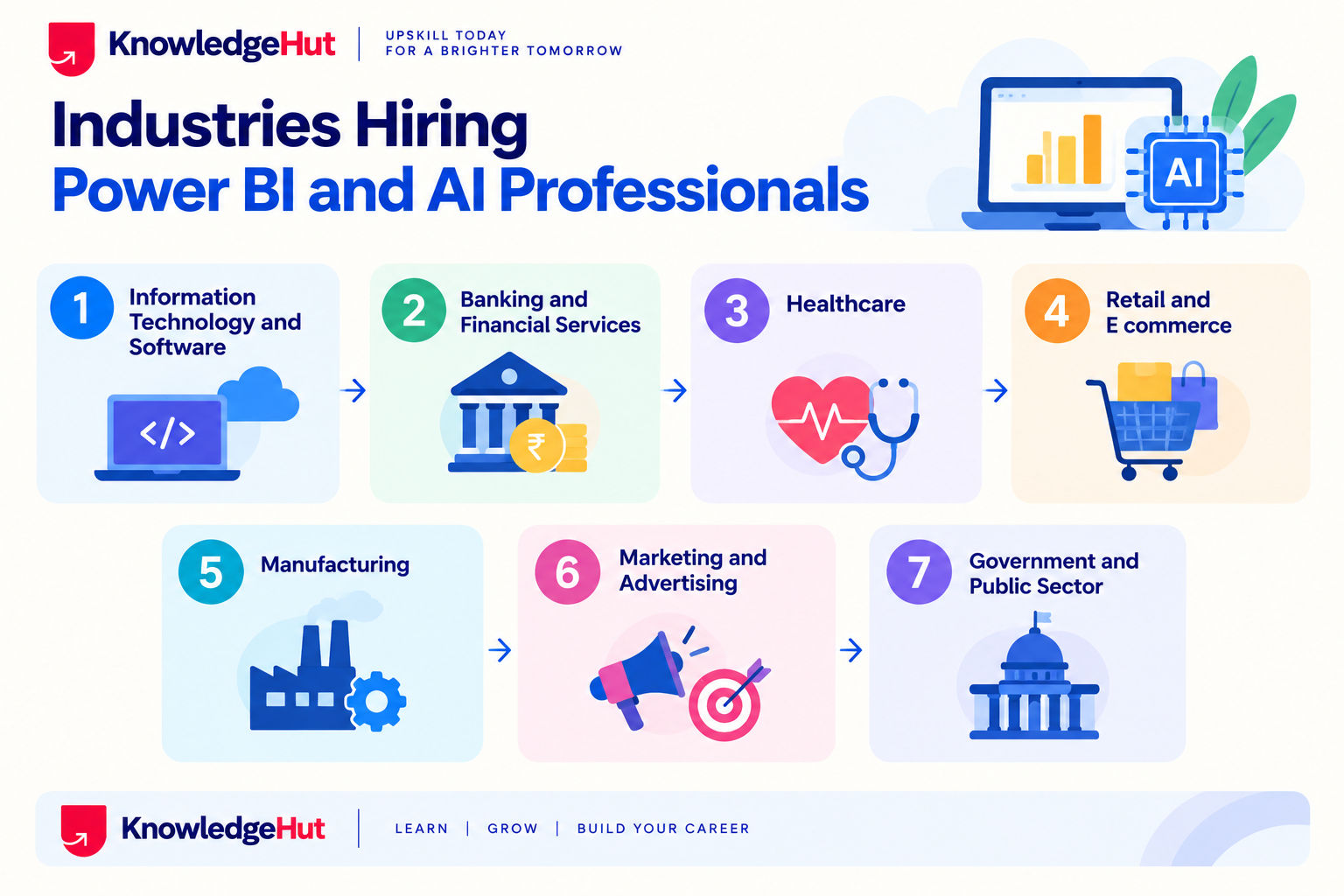
1. Information Technology and Software
Technology companies use business intelligence to track performance, understand product data, monitor operations, and support business decisions.
Professionals may work on:
• Business dashboards
• Product analytics
• Operational reporting
• Data modelling
• AI supported insights
2. Banking and Financial Services
Financial organisations work with large volumes of customer, transaction, and operational data. Power BI can help make this information easier to analyse and communicate.
AI can also support areas such as:
• Pattern identification
• Risk analysis
• Customer insights
• Performance monitoring
• Forecasting
3. Healthcare
Healthcare organisations generate large amounts of operational and patient related data. Analytics can help teams monitor performance, understand trends, and improve planning.
Power BI may support:
• Operational dashboards
• Performance reporting
• Resource analysis
• Trend monitoring
4. Retail and E commerce
Retail businesses depend heavily on customer and sales data. Power BI can help teams understand buying patterns, sales performance, and product demand.
Common analytics areas include:
• Customer behaviour
• Sales reporting
• Product performance
• Demand trends
• Campaign analysis
5. Manufacturing
Manufacturing organisations use analytics to monitor production, quality, inventory, and operational performance.
Power BI can provide visibility into:
• Production metrics
• Operational efficiency
• Inventory levels
• Quality indicators
• Performance trends
6. Marketing and Advertising
Marketing teams use data to understand campaign performance, audience behaviour, and return on investment.
Professionals can use Power BI for:
• Campaign dashboards
• Customer analysis
• Performance tracking
• Marketing reporting
• Trend analysis
7. Government and Public Sector
Government organisations manage large datasets across public services, finance, operations, and planning. Business intelligence tools can help make these datasets easier to understand and share.
Power BI can support:
• Service performance reporting
• Operational dashboards
• Resource planning
• Data driven decision making
Also Read: Benefits of Power BI
Career Roles Available in 2026
The combination of Power BI, analytics, and AI has expanded the range of roles available to professionals. The opportunities are no longer limited to traditional reporting positions.
Professionals can work across data analysis, business intelligence, consulting, advanced analytics, and AI supported reporting.
1. Data Analyst
Data analysts use Power BI to prepare, analyse, and present data through dashboards and reports. AI can help them identify trends and generate insights more efficiently.
The role increasingly involves:
• Data analysis
• Dashboard development
• Performance reporting
• Trend identification
• AI supported insights
2. Business Intelligence Developer
BI developers focus on data models, dashboards, reporting systems, and data accuracy.
With the growth of AI, they may also work with:
• Intelligent reporting
• Automated insights
• Advanced analytics
• AI supported data workflows
3. Data Consultant
Data consultants help organisations solve business problems using data. They work closely with stakeholders to understand requirements and translate them into useful analytics solutions.
Their work can include:
• Data analysis
• Dashboard development
• Business reporting
• AI supported insights
• Decision support
4. Analytics Specialist
Analytics specialists work with larger datasets and more advanced analysis. Depending on the role, they may use AI techniques to identify patterns and support forecasting or other analytical tasks.
Important skills can include:
• Advanced data analysis
• Statistical thinking
• AI awareness
• Data visualisation
• Business interpretation
5. AI Enabled Reporting Specialist
This is an emerging type of analytics role focused on combining reporting with AI assisted capabilities.
Responsibilities may include:
• Automating reporting workflows
• Using AI generated insights
• Improving dashboard efficiency
• Supporting intelligent data analysis
• Reviewing AI outputs
6. Data Translator
Data translators connect technical analytics teams with business users. Their role is to make insights understandable and useful for decision makers.
They may focus on:
• Explaining analytical findings
• Understanding business requirements
• Translating data into actions
• Communicating AI supported insights
• Helping teams use analytics effectively
Conclusion
Is Power BI relevant in 2026? Yes. Power BI remains useful as its analytics capabilities continue to expand with AI, automation, and intelligent insights.
Learning Power BI along with AI, data analysis, and communication skills can support career growth across analytics, BI, consulting, and data focused roles. The key is to keep updating skills as Power BI AI features and business needs evolve.
Have A Query? Get in Touch With Our Customer Support | upGrad KnowledgeHut
Frequently Asked Questions (FAQs)
1. Will AI replace Power BI developers and data analysts?
AI can automate parts of reporting, data preparation, and dashboard creation, but it does not remove the need for human judgement. Professionals still need to understand business requirements, data quality, modelling, and how insights should be used. A Power BI with AI Career Skill combines technical knowledge with business and analytical thinking.
2. Is Power BI still worth learning if AI can create dashboards automatically?
Yes. AI can speed up dashboard creation, but professionals still need to define the right metrics, validate data, and interpret results. Learning Power BI alongside AI can therefore remain valuable. A Power BI with AI Career Skill also helps professionals adapt to AI assisted analytics workflows.
3. What Power BI skills cannot be easily replaced by AI?
Skills such as data modelling, business understanding, critical thinking, data validation, stakeholder communication, and insight interpretation remain important. AI can assist with repetitive tasks, but context and judgement still matter. These capabilities strengthen a Power BI with AI Career Skill.
4. How much DAX is still needed when using AI with Power BI?
DAX remains useful because AI generated formulas still need to be reviewed, adjusted, and validated. Professionals should understand core DAX concepts rather than rely completely on generated formulas. This makes DAX an important part of a practical Power BI with AI Career Skill.
5. Do Power BI professionals need to learn Python and SQL along with AI?
Python and SQL can complement Power BI by strengthening data preparation, analysis, automation, and database skills. They are not mandatory for every Power BI role, but they can expand the range of tasks a professional can handle. Together, these skills can strengthen a Power BI with AI Career Skill.
6. Can beginners learn Power BI with AI without a data analytics background?
Yes. Beginners can start with Power BI fundamentals such as data cleaning, visualisation, dashboards, and basic modelling before adding AI capabilities. A gradual learning path makes the process easier and helps build a solid Power BI with AI Career Skill.
7. What should Power BI professionals learn after mastering dashboards and reports?
The next step can include advanced data modelling, DAX, Power Query, AI features, automation, SQL, Python, and Microsoft Fabric. The right combination depends on the target role and existing skills. Expanding beyond dashboards can build a more complete Power BI with AI Career Skill.
8. How can Power BI professionals use Copilot without compromising data accuracy?
AI generated outputs should always be reviewed against the underlying data and semantic model. Professionals should check calculations, filters, context, and the accuracy of generated insights before sharing them. Careful validation is essential for using a Power BI with AI Career Skill responsibly.
9. Which Power BI AI features should professionals learn in 2026?
Professionals can prioritise AI capabilities that support natural language analysis, automated insights, report assistance, summarisation, and AI assisted development. The most useful features will depend on the role and reporting environment. Learning relevant Power BI with AI Career Skill capabilities can improve productivity without replacing core analytics knowledge.
10. Is Power BI with AI better for career growth than traditional Power BI skills?
Traditional Power BI skills remain the foundation, while AI adds new ways to analyse data and automate parts of reporting. Combining both can broaden the range of tasks a professional can handle. A Power BI with AI Career Skill is therefore best viewed as an extension of core Power BI and analytics expertise.
1639 articles published
KnowledgeHut is an outcome-focused global ed-tech company. We help organizations and professionals unlock excellence through skills development. We offer training solutions under the people and proces...
Get Free Consultation
By submitting, I accept the T&C and
Privacy Policy