
- Home
- Blog
- Web Development
- What is System Engineer? Skills, Salary, Responsibilities
What is System Engineer? Skills, Salary, Responsibilities
Updated on Mar 17, 2026 | 0.6k+ views
Share:
Table of Contents
View all
- Who is a System Engineer?
- Who is a System Engineer and What Does They Do?
- Roles and Responsibilities of a System Engineer
- How to Become a System Engineer?
- Essential Skills of System Engineer
- Job Description of a System Engineer
- Systems Engineer Career Path
- Why to Become a Systems Engineer?
- What is the Average Salary of a Systems Engineer?
- Systems Engineer Work Environment
- In Conclusion
Systems engineering is a diverse field of information technology engineering and engineering management that focuses on the design and administration of composite systems throughout their life cycles. In the complex digital world, the systems engineer is critical because they identify the customer's or stakeholder demands and a system's fundamental performance in the early phases of a service or product development cycle.
Let's explore what is system engineer? They will manage many teams, testing, and product or system development analysis. You can enroll in a Back-End Developer course focusing on professional advancement in technology. Please continue reading to learn more about what is system engineer and what does a system engineer do.
Who is a System Engineer?
The definition of a system engineer is that they are specialists who examine what is wrong with a system and determine how to solve it, which may include building new solutions from scratch. They are also responsible for advising clients on the necessary hardware and software to guarantee their computer system fits their demands.
There are two basic groups of systems engineering processes:
Technical Process: This area includes most technical difficulties and resolutions, including computer system and network integration.
Management Process: This includes coordinating and managing technical efforts throughout their duration.
Who is a System Engineer and What Does They Do?
System engineers are experts in the design, management, and analysis of composite systems. They ensure everything is in place and operating properly to offer the greatest possible result. They are extremely important in the realm of information technology. They serve as the main communication between different teams within a company.
Consider them to be the conductor of an orchestra, in charge of maintaining the musicians at an appropriate level to produce melodic outputs.
The major purpose of a system engineer is to evaluate system performance and make modifications to provide a smooth production system for the organization. System engineers must deal with work procedures and risk management tools for the systems to function properly.
Roles and Responsibilities of a System Engineer
If you're wondering what does a systems engineers do, let us help. The following are a few roles and responsibilities of a system engineer:
- Manages and controls all installed systems and equipment for the firm to ensure compliance with company policies and standard operating procedures (SOP).
- Serves in coordinating many teams testing and assessing for the creation of design and the best output implementation.
- Implements configure and test software platforms, software applications, and system management software.
- Ensures that systems and infrastructure are always available.
- Executes warranty and support tasks.
- Evaluates current systems and give technical guidance to IT support personnel.
- Plans and executes system automation as needed for increased efficiency.
- Oversees the creation of specialized software and hardware needs.
- Collaborates with other experts to achieve high-quality outputs within the framework of the organization's rules, policies, and procedures.
- Deals with work processes, optimization methodologies, and risk management tools in assigned projects to ensure effective completion following stakeholder needs.
How to Become a System Engineer?
Systems engineers design and operate designs for many types of systems across industries. Many businesses that use technology require a systems engineer to maintain, update, and improve systems.
A. Certification
Many people who want to be systems engineers first get a degree in a computer-related subject, then get further certifications like Full Stack Developer certification or do a related internship and develop an interest in systems engineering through this job.
B. Education
At the tertiary level, systems engineering can be studied; however, many students choose a larger field at this point, and most systems engineers have some relevant degrees. Almost all roles in specialized systems engineering require a few years of related expertise. The following degrees can help you become a system engineer:
- Bachelor / Master of Computer Science
- Bachelor / Master of Information Technology
- Bachelor / Master of Electrical and Electronics Engineering
- Bachelor / Master of Mechanical Engineering
- Bachelor / Master of Electrical Engineering
- Bachelor / Master of Computer Engineering
- Bachelor / Master of Electrical, Electronics, and Communications Engineering
- Bachelor / Masters of Telecommunications Engineering
- Bachelor / Master of Computer Systems Networking and Telecommunications
- Bachelor / Master of Computer Software Engineering
- Bachelor / Master of Business Administration and Management, General
- Bachelor / Master of Physics
Essential Skills of System Engineer
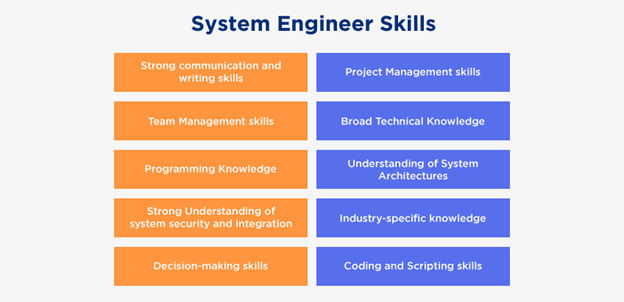
Source: System Engineer Skills
The following are the skills required for the system engineer:
1. Strong Communication and Writing Skills
A system engineer requires excellent written communication abilities, including spelling and punctuation. You must leave no space for spelling and grammatical errors when working as a systems engineer.
Furthermore, it is obvious that in your role, you will frequently be expected to communicate with people at various levels, such as members, managers, or clients. So, always retain your communication and interpersonal abilities at a high level.
2. Project Management Skills
Project management skills are required to plan, manage, execute, and complete projects. Because project managers help, assign and prioritize tasks, manage resources, assess problems, report progress, and analyze project performance, they must have both hard and soft skills.
3. Team Management skills
Team management is the capacity of an individual or organization to manage and organize a group of people to complete a job. Team management entails collaboration, communication, goal formulation, and performance evaluations. These abilities may guarantee that everyone on the team is on the same page and that each team member understands what is expected of them at work.
4. Broad Technical Knowledge
Systems engineers work closely with engineering specialists from several domains. It is critical to immerse oneself in IT details to stay on the same level and successfully incorporate your thoughts. By giving technical skills training to your staff, you are building confidence in their capacity to accomplish their everyday jobs to the best of their abilities.
5. Programming Knowledge
In this digital age, all systems engineers should be skilled in a programming language. These abilities enable you to design complicated systems. They assist you in organizing your information and developing documentation and reports at a much faster and more accurate speed. They may also assist you in better analyzing your data. These abilities can assist you in organizing information so that you can analyze it more quickly and easily.
6. Understanding of System Architectures
A system architecture is a conceptual model that defines the structure and behavior of a system from several perspectives. A thorough understanding of system architectures enables a systems engineer to create solutions that meet requirements. It improves predictability in software system qualities and offers a reusable model.
7. Strong Understanding of System Security and Integration
System security and integration make it possible for complicated data to flow smoothly. It enables the smooth transmission of information and encourages improved responsiveness across all systems. A strong grasp of system security and integration enables systems engineers to speed up project processes while ensuring consistency throughout an organization.
8. Industry-specific Knowledge
System engineers must be well-versed in industry-specific knowledge based on the fundamental systems and equipment required by multinational companies, as well as their principal goods and services. They handle all parts of engineering, and a thorough grasp of your industry effectively leads to choices and planning.
9. Decision-making Skills
Whatever strategies or combinations of tactics a systems engineer choose, they must be adaptable in their decision-making process. They are involved in an overview of all types of engineering. Therefore, making proper selections is critical. Decisions may make or destroy a project, which is why you should practice making them.
10. Coding and Scripting Skills
The job of a systems engineer in creating system patches necessitates a thorough comprehension of coding abilities. Furthermore, because creating, updating, and maintaining systems is part of their job, their work is closely related to that of software developers. To achieve this requirement, they must be proficient in scripting.
11. Problem-Solving Skills
Another necessary talent is problem-solving, as dealing with complicated challenges is important to the job of a systems engineer. The variety of issues that may arise is not predicted nor has universal remedies. When the nature of the difficulties is unique, a one-size-fits-all strategy will be ineffective.
12. Team Coordination skills
Systems engineers collaborate with several engineering teams. Every teammate's ultimate aim is the same, but it is also critical for the team to be on the same page and discover common ground. Thus, to be successful in systems engineering, coordination skills can interconnect the various aspects of a system.
Job Description of a System Engineer
A system engineer is a member of a skilled team of engineers that deliver mission-critical infrastructure while maintaining the greatest standards of availability, performance, and security. Systems engineers with a background in IT, computer systems integration, or systems engineering, and analysis are qualified.
Looking to enhance your coding skills? Get a Python certification and unlock endless possibilities! Dive into the world of programming with Python and watch your career soar. Don't miss out, start your journey today!
Systems Engineer Career Path
The career path for systems engineer typically begins with a strong educational foundation in engineering, computer science, or a related field. Entry-level positions often involve working under the guidance of senior engineers, focusing on specific aspects of system design and analysis. As experience is gained, systems engineers can move into more specialized roles or take on leadership positions.
Certifications such as Certified Systems Engineering Professional (CSEP) or obtaining a master's degree in systems engineering can enhance career prospects. Advanced positions may include roles like senior systems engineer, systems architect, or project manager. The career path of a systems engineer is dynamic and offers numerous avenues for growth, allowing professionals to continuously develop their skills and expertise.
Why to Become a Systems Engineer?
Becoming a systems engineer is a rewarding career choice for those who enjoy problem-solving, have a knack for technical expertise, and thrive in collaborative environments. Systems engineers play a crucial role in designing, implementing, and maintaining complex systems that integrate various components and technologies. This profession offers diverse opportunities across industries such as aerospace, information technology, healthcare, and manufacturing. The demand for skilled systems engineers continues to grow, providing job security and competitive salaries. For individuals passionate about improving processes and ensuring system reliability, the role of a systems engineer offers both challenges and rewards.
What is the Average Salary of a Systems Engineer?
It's a job that allows you to solve problems, explore ideas, and construct systems to resolve an issue or achieve a goal. According to Glassdoor, the average salary for a systems engineer is $110599 per year.
The following are the top companies looking for system engineers, along with their salary ranges.
| Company name | Salary Range |
| Deloitte | $103K -$146K/yr |
| Northrop Grumman | $100K-$139K/yr |
| Lockheed Martin | $108K-$151K/yr |
| Amazon | $150K-$240K/yr |
| Allowed | $70K-$100K/yr |
| Firstlight | $78K – 100K/yr |
| Boeing | $110K-$150K/yr |
| TCS | $91K-$127K/yr |
| Meta | $210K-$315K/yr |
| VMware | $191K-$275K/yr |
| Wells Fargo | $116K-$161K/yr |
| Siemens | $104K-$147K/yr |
| Apple | $199K-$293K/yr |
| GM | $106K-$145K/yr |
Source - Glassdoor
Systems Engineer Work Environment
The work environment of a systems engineer is diverse and can vary significantly depending on the industry and specific job role. Systems engineers may work in office settings, collaborating with multidisciplinary teams, or in more hands-on environments like manufacturing plants and testing facilities. They often interact with other engineers, project managers, and stakeholders to ensure that all system components work seamlessly together.
A systems engineer must be adept at both technical and interpersonal skills, as the role requires detailed analysis, documentation, and effective communication. The use of advanced software tools for simulation, modeling, and project management is common, and staying updated with the latest technological advancements is essential. The work environment is typically fast-paced, challenging, and rewarding, offering systems engineers the opportunity to make significant contributions to the success of their projects and organizations.
In Conclusion
System engineers are in high demand in India as well as abroad. As a result, there are several prospects for system engineers. They play a critical function in organizations. Choosing a career as a system engineer may be the best decision for you in terms of financial stability and job security.
You can enroll in Web Development Courses Online with a Certificate. These courses are beneficial in the field of web development because they not only teach you the steps of designing and updating websites, but they also improve other skills such as critical thinking, innovation, and precision.
1639 articles published
KnowledgeHut is an outcome-focused global ed-tech company. We help organizations and professionals unlock excellence through skills development. We offer training solutions under the people and proces...
Get Free Consultation
By submitting, I accept the T&C and
Privacy Policy