
How to Become a Product Marketing Manager in 2026
Updated on Sep 13, 2026 | 18 min read | 6.55K+ views
Share:
Table of Contents
View all
- What are the step-by-step criteria for becoming a product marketing manager in 2026?
- What is the role of a product marketing manager?
- What qualifications do you need to become a product marketing manager?
- What skills are needed by product marketing managers?
- Product marketing manager salary in 2026
- Conclusion
Quick Overview
- A Product Marketing Manager (PMM) is responsible for connecting a product with its target market through market research, product positioning, messaging, and go to market strategies.
- Becoming a Product Marketing Manager in 2026 typically involves building a foundation in marketing and product management, developing core product marketing & design thinking skills, and gaining relevant cross functional experience.
- Relevant certifications in product management, digital marketing, and AI driven marketing can add value to a Product Marketing Manager’s profile.
- This guide explains the step-by-step path to becoming a Product Marketing Manager, the qualifications and skills required, relevant experience and certifications, key responsibilities, and the expected salary in 2026.
Build smarter product strategies with AI-Powered Product Management and learn how AI can support research, prioritization, and decision making.
Master the Right Skills & Boost Your Career
Avail your free 1:1 mentorship session
What are the step-by-step criteria for becoming a product marketing manager in 2026?
Becoming a Product Marketing Manager requires a mix of marketing knowledge, product understanding, customer insight, and practical experience. There is no single path into the role, but building the right skills and gaining hands-on exposure can make the transition more achievable.
The following steps outline a practical path for developing the skills, experience, portfolio, and qualifications needed to move into Product Marketing in 2026:
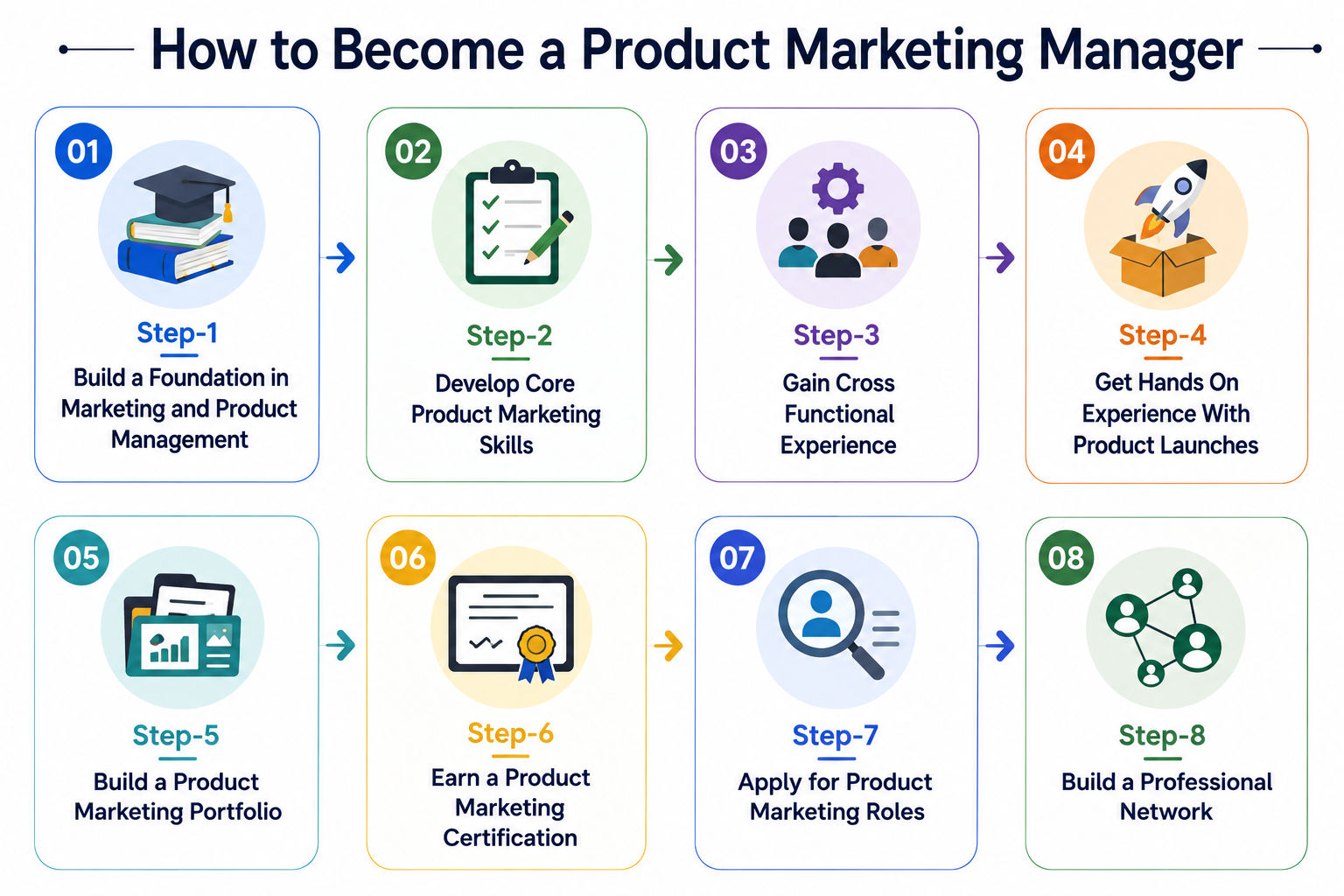
Step 1: Build a Foundation in Marketing and Product Management
Begin by looking at the fundamental aspects of how products are created, marketed, positioned, and sold.
Useful areas to understand include:
- Marketing fundamentals
- Product lifecycle
- Customer research
- Market segmentation
- Product strategy
- Sales processes
- Business fundamentals
Step 2: Develop Core Product Marketing Skills
To understand how to become a Product Marketing Manager, the next thing to do is acquire the skills that are specific to the role.
Focus on:
- Product positioning
- Messaging
- Buyer personas
- Competitive research
- Go to market planning
- Sales enablement
- Customer insights
- Performance measurement
Step 3: Gain Cross Functional Experience
Product marketing means working in conjunction with a number of different teams rather than being confined to the marketing department alone.
Gain exposure to:
- Product teams
- Sales teams
- Customer success
- Design
- Engineering
- Market research
Step 4: Get Hands On Experience With Product Launches
Launching products gives people practical experience in the application of product marketing skills.
Look for opportunities to contribute to:
- Launch planning
- Product messaging
- Customer research
- Sales materials
- Campaign planning
- Launch performance tracking
Step 5: Build a Product Marketing Portfolio
A portfolio provides employers with evidence of practical thinking and execution.
It can include:
- Positioning documents
- Buyer personas
- Competitive analysis
- Go to market plans
- Messaging frameworks
- Launch strategies
- Product marketing case studies
Step 6: Earn a Product Marketing Certification
Certifications can help demonstrate structured knowledge in marketing and product management, especially for professionals transitioning into Product Marketing.
Relevant courses include:
- PG Certificate in AI Powered Product and Design Thinking
- AI-Driven Digital Marketing Training
- CIM Foundation Certificate in Professional & Digital Marketing
These certifications can complement practical experience, but they do not guarantee a Product Marketing Manager role or salary increase. Employers also assess product understanding, marketing skills, business impact, experience, and the ability to apply knowledge in real situations.
Step 7: Apply for Product Marketing Roles
When the essential skills and experience have been acquired, begin applying for jobs that are relevant.
Possible entry points include:
- Associate Product Marketing Manager
- Product Marketing Specialist
- Product Marketing Analyst
- Marketing Manager
- Growth Marketing roles with product exposure
Step 8: Build a Professional Network
Networking allows professionals to find out how product marketing teams function and to identify relevant opportunities.
Useful activities include:
- Connecting with Product Marketing Managers
- Joining industry communities
- Attending product and marketing events
- Participating in professional discussions
- Learning from experienced practitioner
Also Read: Types of Product Managers: Roles, Skills & Career Paths.
What is the role of a product marketing manager?
A Product Marketing Manager links the product with the market. This role includes understanding customers, spotting market opportunities, setting the position of the product, creating messaging, and assisting the teams in communicating the value of the product.
For someone who is researching how to become a Product Marketing Manager, it is important to understand the day-to-day responsibilities since the role involves analytical, strategic, creative and communication skills.
Product Marketing Manager Roles and Responsibilities
A Product Marketing Manager may be responsible for:
- Conducting market research
- Understanding customer needs
- Creating buyer personas
- Developing product positioning
- Building product messaging
- Planning go to market strategies
- Supporting product launches
- Creating sales enablement materials
- Tracking product marketing performance
- Monitoring competitors
Build practical Agile skills with the Best Agile Management Certification Training Courses and advance in Agile project management.
What qualifications do you need to become a product marketing manager?
No single qualification ensures that a person will be accepted into Product Marketing; instead, employers typically seek a mix of education, knowledge of marketing, an understanding of products, practical experience, and good communication skills.
When people who are looking into how to become a Product Marketing Manager consider their qualifications, they should see them as only one element of their overall career profile.
1. Educational Background
Relevant educational backgrounds can include:
- Marketing
- Business administration
- Management
- Communications
- Economics
- Technology or related fields
2. Relevant Certifications and Training
Certifications can be used to show that one has structured knowledge and to aid in making a career change.
Relevant training can cover:
- Product marketing
- Digital marketing
- Product management
- Market research
- Go to market strategy
- Marketing analytics
The Product Management Certification could be seen as part of this learning pathway, especially for those professionals who wish to develop a structured knowledge of product management.
3. Product Marketing Knowledge and Skills
A strong Product Marketing Manager should understand how to:
- Research markets
- Identify customer needs
- Position products
- Build messaging
- Plan launches
- Support sales teams
- Measure marketing performance
4. Transferable Skills from Other Careers
People from a variety of different backgrounds are able to move into Product Marketing.
Transferable experience may come from:
- Digital marketing
- Sales
- Product management
- Business analysis
- Customer success
- Market research
- Consulting
Learn How to Become a Product Manager with a step by step guide covering essential skills, experience, and career development.
What skills are needed by product marketing managers?
The kind of skills needed in order to understand how one can become a Product Marketing Manager is not limited to conventional marketing; the position demands a solid knowledge of customers, products, markets, business objectives, and performance data.
The key skills include:
1. Market Research and Customer Insights
Product Marketing Managers must understand what customers want and the reasons why they make purchasing decisions.
Important capabilities include:
- Customer interviews
- Market research
- Trend analysis
- Customer feedback analysis
- Segmentation
2. Buyer Persona Development
Buyer personas enable teams to get a better understanding of different customer groups and what their needs are.
A useful persona can cover:
- Customer goals
- Pain points
- Buying motivations
- Decision factors
- Common objections
3. Product Positioning and Messaging
It determines the way in which a product should be perceived in the market.
Strong messaging should communicate:
- The problem being solved
- The value provided
- Key differentiators
- Relevant customer benefits
4. Go to Market Strategy
A go-to-market strategy sets out the way in which a product will reach and engage the target market.
It can cover:
- Target audience
- Positioning
- Pricing
- Distribution
- Launch channels
- Sales enablement
- Marketing campaigns
5. Competitive Analysis
Product Marketing Managers should understand how competing products are positioned.
Competitive analysis can examine:
- Product capabilities
- Pricing
- Target customers
- Messaging
- Market positioning
- Competitive strengths
6. Sales Enablement and Communication
Product marketing provides sales teams with information and materials which make it easier to explain and sell the products.
This can include:
- Sales presentations
- Battlecards
- Product guides
- FAQs
- Product messaging
7. Data Analytics and Performance Measurement
Data enables Product Marketing Managers to determine if their strategies are working.
Important measures can include:
- Lead generation
- Conversion
- Product adoption
- Campaign performance
- Customer engagement
- Revenue impact
Learn How to Become a Digital Product Manager in 2026 and build the skills needed to succeed in modern digital product roles.
Product marketing manager salary in 2026
Based on the Glassdoor salary, the average Product Marketing Manager salary is ₹16.0L per year. This represents the reported average base pay for the role.
Actual earnings can vary depending on experience, company, industry, location, responsibilities, and professional skills. The ₹16.0L figure should therefore be viewed as a salary benchmark rather than a fixed amount for every Product Marketing Manager.
Also read: Product Manager Salary in India.
Conclusion
To understand how to become a Product Marketing Manager, focus on building marketing, product, customer research, positioning, analytics, and communication skills.
The career can suit professionals from marketing, sales, product, or business backgrounds. The best next step is to gain practical experience, build a portfolio, strengthen relevant skills, and demonstrate measurable business impact
Contact our upGrad KnowledgeHut experts for personalized guidance on choosing the right course, career path, and certification to achieve your goals.
Frequently Asked Questions (FAQs)
1. How can someone become a Product Marketing Manager without a marketing degree?
Product Marketing Manager does not always require a specific marketing degree. Backgrounds in business, sales, product management, communications, or related fields can also provide a strong starting point when combined with relevant skills and experience.
2. Can a Product Marketing Manager transition into Product Management?
Yes. Professionals following can develop strong customer, market, and product knowledge that also supports Product Management. Additional skills in product strategy, prioritization, roadmapping, and product development can help with the transition.
3. What entry level roles can lead to a Product Marketing Manager career?
Roles such as Marketing Specialist, Product Marketing Associate, Sales or Business Development, and Customer Success can provide relevant experience. These positions can help build customer understanding, communication, research, and product knowledge needed to learn.
4. How much prior work experience is usually needed before becoming a Product Marketing Manager?
There is no fixed experience requirement because companies differ in their expectations. Relevant experience in marketing, sales, product, research, or customer facing roles can help professionals progress toward.
5. How can professionals prove Product Marketing skills without direct PMM experience?
A portfolio can demonstrate practical skills through positioning documents, competitive analysis, buyer personas, launch plans, and messaging exercises. This can help candidates show capability even before securing a formal Product Marketing Manager role.
6. What should a Product Marketing Manager portfolio contain to stand out?
A strong portfolio can include market research, buyer personas, product positioning, messaging, competitive analysis, and go to market plans. Each project should explain the reasoning behind decisions and the expected business impact.
7. How can professionals transition from sales to Product Marketing?
Sales professionals already understand customer needs, objections, buying behavior, and communication. Adding skills in market research, positioning, messaging, competitive analysis, and go to market planning can make the transition toward more practical.
8. How can professionals transition from Product Management to Product Marketing?
Product Managers already understand customers, products, roadmaps, and business goals. To move toward Product Marketing, they should strengthen skills in positioning, messaging, competitive research, launch planning, and market communication.
9. What does a Product Marketing Manager career path look like after the first role?
Career progression can move from Associate or Specialist roles into Product Marketing Manager, Senior Product Marketing Manager, and leadership positions. Greater responsibility for strategy, launches, markets, and business outcomes usually accompanies progression.
10. How should candidates prepare for a Product Marketing Manager interview?
Candidates should be prepared to discuss customer research, positioning, messaging, competitive analysis, go to market strategy, and product launches. Practical examples from past work or portfolio projects can help demonstrate the skills involved in.
1639 articles published
KnowledgeHut is an outcome-focused global ed-tech company. We help organizations and professionals unlock excellence through skills development. We offer training solutions under the people and proces...
Get Free Consultation
By submitting, I accept the T&C and
Privacy Policy
Ready to learn about Agile Certifications Roadmap?