
Release Train Engineer vs Release Manager: Key Differences
Updated on Oct 06, 2023 | 9 min read | 6.86K+ views
Share:
Table of Contents
View all
Releasing the apt software updates at the right time is essential to run an organization smoothly. It ensures that the organization is staying put with the latest trends and making the necessary pivot to keep up in the game! To manage all these tasks, the companies hire release managers. These professionals check and manage the entire software development life cycle.
There is another position that often gets confused with this managerial role, which is release engineer. Though the two terms sound similar, their work responsibilities are entirely different. Release engineers communicate with stakeholders to manage the risks involved in a software release. In this article, we will discuss about release train engineer vs release manager in detail to help you get better clarity.
Master the Right Skills & Boost Your Career
Avail your free 1:1 mentorship session
Who is a Release Train Engineer (RTE)?
Release train engineers are the coaches in the agile release framework. They guide the teams and work to deliver value through ART procedures. These experts are also responsible for communicating with the stakeholders and assisting in management-related tasks. Some of the roles these experts play are:
- Managing the environment within an organization to ensure smoother release.
- Building reliable pipelines to switch code into viable products.
- Solely focusing on the technicalities involved in product delivery.
Who is a Release Manager?
As the name suggests, these are the experts who manage everything right from the planning phase till the time of deployment. They also plan short test runs to get feedback, ensuring everything is happening as planned. Some of the roles these experts play are:
- They are responsible for scheduling, planning and controlling the software development process.
- Manage the teams to ensure timely delivery of services.
- Defining the strategic use of tools and techniques to ensure quality releases.
Release Train Engineer Vs Release Manager: Comparison
| Parameter |
Release Manager |
Release Train Engineer |
|---|---|---|
| Focus |
Focus is on coordinating with the teams to ensure smooth operations |
Focus is on overseeing the development life cycle |
| Tasks Involved |
They manage and plan the entire software development schedule. |
Manage the technical aspects involved in meeting the company goals |
| Technical Knowledge |
Managers do not have expert technical knowledge |
RTE has thorough knowledge of the programing languages and other technical tools. |
| Level in an Organization |
As it is a managerial position, these people are from middle to higher management. |
Release engineers also hold a strong position in the higher management. |
| Abilities |
Fair understanding of the managerial tools and techniques for smoother pivot. |
Fair understanding of technical tools required to turn goals into reality. |
| Pre-Requisites |
To enter this domain, one should have a renowned degree in computer science with an advanced business management program. |
Release engineers should have a post-graduate degree in computer science and expert understanding of coding languages. |
| Salary |
Average salary of a release manager is $ 109,000. |
Average salary of a RTE is $82,000. |
Difference Between Release Train Engineer and Release Manager
Let us discuss the parameters we listed in the table about safe rte vs release manager in detail.
1. Release Train Engineer vs Release Manager: Focus
The release managers focus on people and processes. They give the plan of action that the teams working on a project would follow to meet their goals. Furthermore, they ensure that every team follows the decided processes religiously and achieves the targets within budgetary limits.
On the other hand, release train engineers are solely focused on the technical aspects. They plan the entire software development life cycle, deciding the tools and techniques they can use. Furthermore, these experts are responsible for communicating with the stakeholders and assisting the managerial team.
2. Release Train Engineer vs Release Manager: Tasks Involved
A release manager ensures that the release is planned according to the client's requirements and set budget. Their tasks also involve scheduling test runs and taking feedback to ensure that the project is on the right track.
Tasks of an RTE include engineering and releasing the new solutions. They manage the teams distributed globally and ensure everybody works in coordination with the other. Furthermore, these experts design and develop code that binds various applications in a product development pipeline.
3. Release Train Engineer vs Release Manager: Technical Knowledge
Release managers do not really require any technical know-how. Their job is to ensure smoother and more efficient management for which no programming language is mandatory. Thus, they do not have to understand any coding language or a tool with advanced technology to deliver the best of their work.
On the other hand, the release train engineer is a hardcore technology enthusiast. These experts have a thorough knowledge of one or many coding languages. Moreover, these experts often keep enrolling on certification programs that train them in the latest tools and technologies that can add value to their work. SAFe Release Train Engineer training will come to the rescue in facilitating PI planning and foster continuous exploration.
4. Release Train Engineer vs Release Manager: Level in Organization
Release managers rank from middle to upper management level in an organization. They have teams and an individual working under them, and their primary role is to ensure everyone delivers their best work.
On the other hand, RTE is in the middle management as they might have to do the groundwork. However, they also have a chance to reach the upper management level after gaining proper experience in their domain. It is interesting to note here that an RTE can also work as a manager, but it is not the other way around.
5. Release Train Engineer vs Release Manager: Abilities
Release managers have a fair understanding of how to build and test frameworks. Additionally, they help organizations standardize their software delivery process. The release managers can manage the software development environment to make timely and quality deliveries of projects possible.
The abilities of RTE include finding the latest tools and applications that can automate tasks and deliver a satisfactory final product. They also manage the resources well to ensure the quality or client requirement is met under a set budget.
6. Release Train Engineer vs Release Manager: Pre-Requisites
To become a release manager, one has to come from a business management background. Additionally, fair knowledge of technology is definitely an advantage. Moreover, you can also plan to do a certification program to help you build a promising career in this domain.
RTEs are professionals with a deeper understanding of code and programming languages. So, to become one, you should come from a technical background. Complete a renowned degree in computer science, and you can complete a certification program too to avail excellent opportunities.
7. Release Train Engineer vs Release Manager: Salary
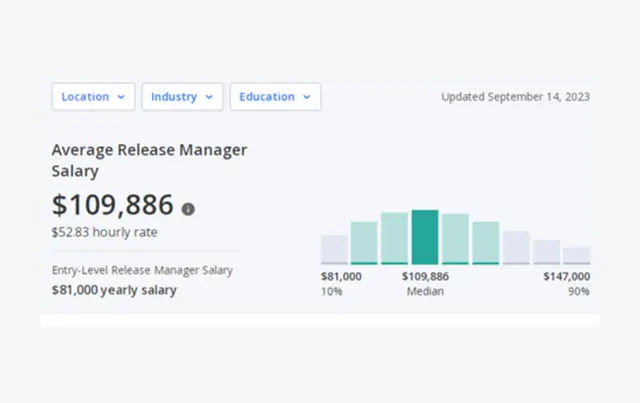
The average salary of a release manager is $109,000. You may start from $81000. After a few years of experience, it can increase up to $ 147,000.
Zippia
The average salary of a release train engineer is $82,000. You may start from $ 50,000. After a few years of experience, it can increase up to $133,000.

Zippia
How are They Similar?
We have discussed significant dissimilarities under release manager vs release train engineer. However, there are some similarities between the experts working in these positions. Let us discuss some of the similarities.
- Both these professionals aim to achieve the company goals. Their primary focus is upgrading the existing system and making necessary changes to boost company growth.
- Release managers or release train engineers communicate with the teams and the stakeholders for smoother operations.
- Qualified release train engineer can become a successful release manager after a formal Agile certification course for immersive, customizable courses designed by leaders.
- They both tackle risks and other issues associated with projects. Furthermore, they find solutions for those risks and ensure smooth functioning.
- They actively involve themselves in handling resources to ensure projects get completed within the set budget.
So, apart from the differences between safe release train engineer v/s release manager, these are a few aspects where they have a similarity.
What Should You Choose Between Release Train Engineer and Release Manager?
Whether you should choose to become a release train engineer or release manager depends on your interest. Moreover, it also depends on the educational background to which you belong. So, if you are from a technical educational background, you can choose to become a release train engineer. On the other hand, going for a release manager as a career option will be wise if you are from a managerial or business management background.
The right way to decide is to learn the difference between a release train engineer and a release manager. Then, you can plan your educational journey accordingly to reach your career goals. Make sure you add a certification program to your resume to excel and do better professionally. o
Conclusion
Release manager and release train engineer are both very fruitful domains. You can choose to work in any of these trades and expect a monetarily safe and secure professional career. The demand for professionals working in both these fields is ever-increasing.
It means you can grab the best work opportunities if you have the right skills and meet the employer's expectations. The right way to begin is to gather detailed information about these job roles. Moving on, get details about agile release train engineers v/s release managers to understand the difference in their professional responsibilities.
Once you have all the details, explore the Knowledgehut SAFe Release Train Engineer training courses. Choose one certification course that can train you, and you are ready to design a long, fruitful career.
Frequently Asked Questions (FAQs)
1. Is a release train engineer the same as a release manager?
These two positions are not entirely the same. However, they do have some similarities, like the common aim of achieving company growth goals.
2. What is the major difference between RTE and release manager?
RTE focuses on the technical part of a product development cycle. However, the release manager focuses on people and policies.
3. How do the roles of an RTE and a Release Manager differ in an Agile or SAFe (Scaled Agile Framework) environment?
In an agile framework, the tasks are divided into phases. For example, the RTE would have to complete the development at different levels. At the same time, a release manager will have to conduct short test runs frequently before jumping to the next phase.
4. What are the key performance indicators (KPIs) commonly associated with the roles of RTEs and Release Managers?
The key performance indicators associated with RTE and release manager roles are:
- Company revenue growth
- Timely delivery of product
- Customer satisfaction
1639 articles published
KnowledgeHut is an outcome-focused global ed-tech company. We help organizations and professionals unlock excellence through skills development. We offer training solutions under the people and proces...
Get Free Consultation
By submitting, I accept the T&C and
Privacy Policy
Ready to learn about Agile Certifications Roadmap?