
Release Train Engineer (RTE) Career Path for 2026
Updated on Sep 10, 2026 | 10 min read | 6.61K+ views
Share:
Table of Contents
View all
Quick Overview
- The Release Train Engineer Career Path typically moves from Agile or project delivery experience to Scrum Master or similar roles, then to multi team coordination, program level Agile experience, and finally an RTE position.
- Professionals can enter the RTE career path from backgrounds such as Scrum Master, Agile Coach, Project Manager, Program Manager, or software and engineering leadership.
- Building skills in facilitation, stakeholder management, dependency management, risk management, PI Planning, and SAFe is essential for progressing toward an RTE role.
- After becoming an RTE, the RTE career roadmap can lead to Senior RTE, SAFe Practice Consultant, Enterprise Agile Coach, Agile Transformation Leader, or Lean Portfolio Management roles.
- This guide covers the key entry routes, steps to become an RTE in 2026, essential skills, relevant certifications, and career progression after becoming a Release Train Engineer.
Ready to advance your RTE career? Build practical SAFe skills with upGrad KnowledgeHut SAFe Release Train Engineer Certification Training.
Master the Right Skills & Boost Your Career
Avail your free 1:1 mentorship session
What is the Release Train Engineer career path?
Release Train Engineer career path is defined as the career path in which a person is transitioned from being an agile practitioner at the team level to an agile practitioner at the enterprise level. Release Train Engineer (RTE) acts as the servant leader and the primary facilitator of an Agile Release Train (ART), which enables various Agile teams to work together.
Most individuals are not RTEs right out of college. They develop experience in Agile Delivery, Scrum Master role, Agile Facilitation, Stakeholder Communication and Program Management prior to assuming the role. As they advance in their career, they develop the skillset to orchestrate large initiatives and facilitate Agile transformation.
By following the below RTE career path, an individual can progress from being a team manager to being an Agile program manager.
Agile/Project Experience → Scrum Master/Agile Delivery Role → Multi Team & Cross Functional Experience → Program Level Agile Experience → SAFe RTE Certification → Release Train Engineer → Senior RTE/Solution Train Engineer/Agile Coach → Enterprise Agile Leadership
Also Read: Release Train Engineer vs Project Manager
Which Roles Commonly Lead to a Release Train Engineer Career?
The most common entry points include Scrum Master, Agile Coach, Project/Program Manager, or Software Development/Engineering Leadership.
1. Scrum Master to Release Train Engineer
One of the most popular entry paths into the RTE career is the Scrum Master to Release Train Engineer path. A Scrum Master will have an understanding of Agile ceremonies and team dynamics; therefore, moving to a program-level role comes naturally.
Who should pursue this path?
Professionals that:
- Enjoy facilitating meetings
- Coach teams
- Facilitate agile ceremonies
- Manage dependencies
2. Agile Coach to Release Train Engineer
Agile Coaches have great experience coaching teams, leaders, and organizations. This can be an advantageous background for being an RTE as RTEs need to influence others without actually managing them.
An Agile Coach who builds competencies in the areas of program execution, delivery management, dependency, risk and planning can easily make the transition to an RTE.
Who should pursue this path?
Professionals that:
- Provide organizational coaching
- Implement agile transformations
- Mentor leaders
3. Project Manager or Program Manager to Release Train Engineer
The Project and Program Manager typically have useful experience in planning, stakeholder management, risk management, and delivery coordination.
But becoming an RTE also involves a lot of knowledge of Agile thinking and SAFe methodologies. Hence, the Program Manager needs to gain Agile facilitation and coaching experience.
Who should choose this path?
This path will be good for those professionals who like:
- Stakeholder management
- Program coordination
- Cross functional leadership
- Risk management
- Delivery planning
4. Software Development and Engineering Leadership Path
Those who work as developers, technical leaders, engineering managers or deal with DevOps or release management can also go from this profession to the RTE.
The technical experience will help them to understand technical dependencies, technical challenges, and technical risks in the process of delivery. At the same time, they will need to gain facilitation and communication experience.
Who should choose this path?
This path will be good for those professionals who like:
- Technical delivery
- Engineering operations
- DevOps and release management
- Cross functional collaboration
How to become a Release Train Engineer in 2026?
Getting to this position requires some planning and effort. In this section, a career roadmap for RTEs is presented to help professionals create the appropriate foundation.
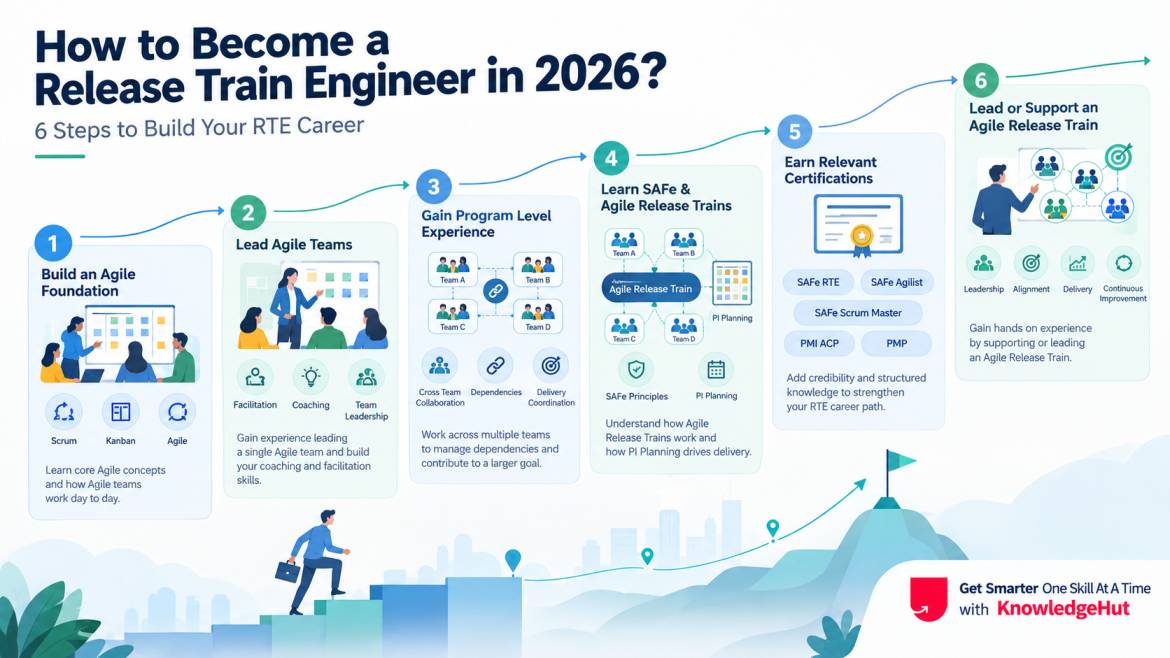
Step 1. Build a strong Agile foundation
The very first step in the career roadmap of an RTE is learning Agile frameworks like Scrum, Kanban, or Lean. Understanding Agile principles will provide the foundation for future leadership roles. Take part in Agile ceremonies and learn how to work as part of an Agile team.
Step 2. Get experience as a leader of an Agile team
Before being appointed as an RTE, the candidate needs to get leadership experience in different positions such as Scrum Master, Team Lead, Delivery Lead, and Agile Coach in order to develop facilitation and coaching skills. It is a vital step within the RTE career journey since leadership skills are one of the key factors in the RTE role.
Step 3. Gain experience in delivering the program
This step is one of the most crucial in your RTE career roadmap because the main task of the Release Train Engineers involves work not only with one team but also coordination of several teams at the program level.
Acquire skills and knowledge of dealing with interteam dependencies, risks, artifacts, and stakeholders’ expectations through working with different teams. Take part in processes such as PI planning, ART sync, system demonstrations, and reviews at program level wherever possible.
Step 4. Learn about SAFe Principles and Agile Release Trains
As most positions that require RTE experience are covered by the SAFe framework, it is necessary to learn about agile release trains, PIs, value streams, and Lean-Agile principles. It is one of the main steps in the RTE career path.
Step 5. Earn relevant certifications
Relevant certifications will help bring some credibility and structured knowledge into the RTE career path. The best certifications to pursue are the following:
- SAFe Release Train Engineer
- SAFe Agilist
- SAFe Scrum Master
- PMI Agile Certified Practitioner (PMI ACP)
- Project Management Professional (PMP)
Step 6. Lead or support an Agile Release Train
The final step in the RTE career path is to gain real-life ART experience. You need to participate in PI Planning, manage dependencies, conduct program events, monitor risks, and facilitate the delivery flow.
Planning your Release Train Engineer career path? Strengthen your Agile and leadership skills with upGrad KnowledgeHut Agile Management Courses.
Skills you need to progress into an RTE role
Below are the skills that distinguish the aspiring professionals from the ones who are truly prepared to be successful on the Release Train Engineer career path.
1. Leadership & facilitation
RTEs spend most of their time leading teams and stakeholders towards common goals.
Important skills include:
- Group facilitation
- Servant leadership
- Conflict resolution
- Coaching
- Decision making
2. Program and delivery management
To become a successful RTE, professionals need to make sure large projects are well-coordinated and on schedule.
Key capabilities include:
- Dependency management
- Risk management
- Delivery planning
- Metrics analysis
- Stakeholder alignment
- Escalation management
3. SAFe and systems thinking
Professionals will need to have comprehensive knowledge about the overall environment of Agile to move forward along the RTE career roadmap.
Important areas include:
- Agile Release Trains
- PI Planning
- Lean Agile
- Value Streams
- Flow Optimization
- Continuous Improvement
Also Read: How to Run a SAFe PI Planning Workshop
Release Train Engineer career progression after becoming an RTE
The Release Train Engineer career path is not over even after becoming an RTE. There are several leadership roles that one can consider once they acquire experience.
1. Senior Release Train Engineer
The Senior RTE usually works with larger Agile Release Trains and coaches new RTEs. This level requires organizational clout and strategic involvement.
2. SAFe Program Consultant (SPC)
SAFe Program Consultants assist organizations to implement and scale up SAFe practices. Most individuals leverage this stage of the RTE career path for transforming from operational to transformative leadership.
3. Enterprise Agile Coach
The Enterprise Agile Coach works outside individual teams or ARTs and helps organizations with their Agile ways of working. It can be considered as a good move for RTEs who like coaching and organizational changes.
4. Agile Transformation Leader
Some professionals use their experience as RTEs to enter the field of Agile transformation leadership. Such positions require people to focus on organizational agility, agile operating model, agile leadership, and value delivery.
5. Lean Portfolio Management Leader
Another direction that can be considered is Lean Portfolio Management, which will put more emphasis on strategy, investments, portfolio, and value delivery.
Also Read: Agile Best Practices for an Effective Team
Conclusion
In 2026, the Release Train Engineer career path is a practical progression from Agile delivery experience to program level leadership. Building experience across multiple teams, strengthening facilitation and stakeholder management skills, and learning SAFe can help you move into the RTE role.
From there, opportunities can expand into Senior RTE, Enterprise Agile Coach, SPC, or Agile transformation leadership. The key is to combine relevant certification with hands-on experience coordinating teams and improving delivery at scale.
Have A Query? Get in Touch With Our Customer Support | upGrad KnowledgeHut
Frequently Asked Questions (FAQs)
1. How do I become a Release Train Engineer?
Start with Agile delivery experience, usually as a Scrum Master, Agile Coach, Project Manager, or similar role. Build experience coordinating multiple teams, managing dependencies, facilitating PI Planning, and working with stakeholders. Learning SAFe and earning an RTE certification can then strengthen your readiness for the role.
2. How does an RTE career progress?
An RTE can progress from managing one Agile Release Train to handling larger and more complex programs. With experience, common options include Senior RTE, SAFe Practice Consultant, Solution Train Engineer, Enterprise Agile Coach, or Agile Transformation Leader. The direction depends on whether you prefer delivery, coaching, or organizational transformation.
3. Can a Scrum Master become an RTE?
Yes, Scrum Masters are one of the most common routes into an RTE role. The key step is moving beyond individual team support and gaining experience with multiple teams, cross team dependencies, PI Planning, risks, and program level stakeholders. Strong facilitation and leadership skills also help make the transition.
4. What is the difference between an RTE and Scrum Master career?
A Scrum Master primarily supports one Agile team, while an RTE coordinates multiple teams within an Agile Release Train. Scrum Master career growth often moves toward Senior Scrum Master or Agile Coach roles, while the RTE path can lead toward Senior RTE, Enterprise Agile Coach, or transformation leadership.
5. How many years of experience do you need to become an RTE?
There is no fixed number of years required to become an RTE. What matters more is experience with Agile delivery, multiple teams, program coordination, PI Planning, dependencies, risks, and stakeholders. Having around 5 or more years of relevant experience can be useful, but program level exposure is more important than simply meeting a year count.
6. Which certification is best for an RTE?
The SAFe Release Train Engineer certification is the most directly relevant certification for an RTE role because it focuses specifically on leading Agile Release Trains. SAFe Agilist and SAFe Scrum Master can build foundational knowledge, while PMP or PMI ACP can complement an existing project or Agile background.
7. What metrics should an RTE understand?
An RTE should understand metrics that show delivery progress, predictability, quality, and flow across the Agile Release Train. Important examples include PI Objectives achievement, Predictability Measure, velocity, throughput, cycle time, lead time, defects, dependencies, and risks. The goal is to use metrics to identify problems and improve delivery, not just report numbers.
8. What is the difference between RTE and Agile Coach career progression?
An RTE primarily focuses on coordinating delivery across an Agile Release Train, while an Agile Coach focuses more broadly on improving Agile practices, teams, leaders, and organizational behavior. RTE progression can lead toward Senior RTE or Solution Train Engineer, whereas Agile Coaches often progress toward Enterprise Agile Coach or transformation leadership.
9. How long does it take to become an RTE?
The timeline depends on your starting role, and the amount of program level experience you already have. A Scrum Master with strong multi team experience may transition sooner than someone starting without Agile delivery experience. For most professionals, the journey involves building team level experience first and then developing program level leadership capabilities.
10. Is Release Train Engineer a good career in 2026?
Yes, RTE can be a strong career choice for professionals who enjoy large scale Agile delivery, facilitation, stakeholder management, and cross functional leadership. The role also provides pathways into Senior RTE, Agile coaching, SAFe consulting, and enterprise transformation. Its value is strongest in organizations that actively use Agile Release Trains and scaled Agile practices.
1639 articles published
KnowledgeHut is an outcome-focused global ed-tech company. We help organizations and professionals unlock excellence through skills development. We offer training solutions under the people and proces...
Get Free Consultation
By submitting, I accept the T&C and
Privacy Policy
Ready to learn about Agile Certifications Roadmap?