
Top 7 Scrum Templates for an Agile Team
Updated on Jun 23, 2025 | 7 min read | 5.5K+ views
Share:
Table of Contents
View all
As the complexity of projects increases, adopting project management frameworks has become the norm for most companies. In this regard, Scrum is one of the most widely used ones. It enables managers to break down large projects into smaller bits, which allows them to monitor and manage all their aspects more effectively.
This helps each team member focus on their specific tasks, resulting in fewer errors and faster project completions. Additionally, project managers can use scrum templates to ensure that the scrum workflow accurately follows the framework.
Read on to learn more about scrum templates, their importance, examples and more.
Master the Right Skills & Boost Your Career
Avail your free 1:1 mentorship session
What are Scrum Templates?
Scrum templates are pre-formatted documents that can assist teams in planning and organizing their tasks within the Scrum framework. Members can view their assigned tasks and provide updates on their status, while managers and product owners can get a clear idea of how the overall project is running.
Overall, the design of a scrum template makes sure that the software development team has a collective understanding of the tasks that need to be accomplished and the procedure for doing so.
For instance, product backlogs help teams list down the tasks that the developer team needs to complete for a specific product or project. Sprint backlogs provide teams with a list of all the tasks that they need to complete during a particular sprint cycle.
Moreover, meeting agendas help teams and stakeholders communicate to each other their work progress, any hurdles they may be facing and their solutions.
Importance of Scrum Templates for an Agile Team
The importance of scrum templates for Agile Teams is as follows:
- Tracking Ownership of Items: For efficient sprint delivery, tracking the ownership of tasks across team members is essential. In this regard, scrum templates can help project managers assign tasks to members, track their progress, identify any blockers and provide solutions for the same.
- Enables Detailed Sprint Planning: Scrum templates can also help project managers plan each and every detail in sprints and yet maintain a high level of flexibility. For example, when there is a change in the priority of a backlog item or in team capacity, managers can take the appropriate steps for the desired outcome.
- Facilitates a Structured Planning Approach: These templates enable project managers to plan their scrums in a structured manner. May it be planning out future sprints, tracking backlog items to their respective owners or setting target dates, managers can monitor all the aspects of a project with ease.
Important Elements of a Scrum Template
Here are the key elements of a scrum template:
- To-Do: As the name suggests, to-do contains a list of tasks and sub-tasks on which team members are yet to start their work. Usually, they are represented on scrum templates excel in the form of sticky notes or cards and contain details like owner names and due dates.
- Stories: This part contains the user stories in the ongoing sprint backlog, which the project manager needs to divide into tasks.
- Work in Progress: The work-in-progress section represents all those tasks and sub-tasks on which the team is currently working.
- Done: Done contains all those tasks which have been completed.
- On Hold: On Hold contains tasks and subtasks that the team does not need to complete in the current sprint, but they might have to work on them in future sessions.
- In Review: In Review contains all those tasks that have been completed from the team's end but need to be quality tested before delivery.
Top Scrum Templates for an Agile Team
Listed below are some of the top scrum templates that managers can use for organizing project workflows:
1. Agile Scrum Management Template
The Agile Scrum Management template contains all the crucial Scrum workflow elements. It covers all the aspects of scrum management from a broader perspective. Project managers can track sprints, backlogs and retrospectives along with performing test management. This template also contains 30 unique status update options and 6 different project views.
Pro Tip - Agile Project Management online courses allow you to learn the use of multiple free scrum templates which can be really handy when you become a project manager.
2. Scrum Board Template
This template forms an additional view of the Agile Management Template. It provides a visual representation of each task that the team needs to complete, track their progress and monitor each of their status.
The scrum user story template comes with a simple design consisting of rows and columns. However, it is versatile enough to be usable across a wide array of industries and use cases.
3. Agile Scrum Backlog Template
The Agile Scrum Backlog Template enables the development team to efficiently track the scrum backlogs. This makes it easier for them to take note of which tasks and subtasks have been completed and the status of those that are yet to be finished.
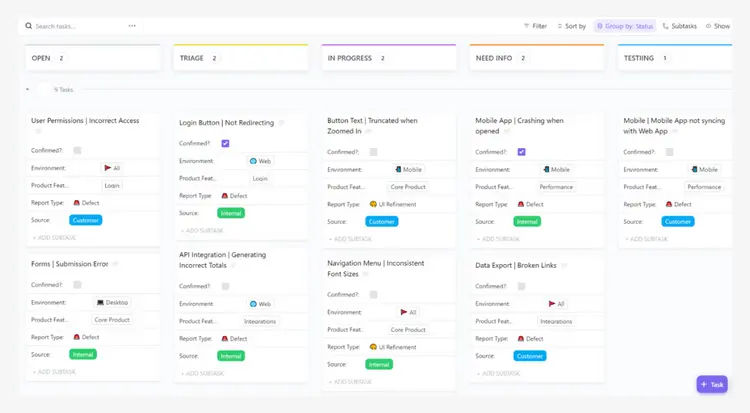
4. Agile Scrum Bugs Priority Template
In Agile, development teams usually prioritize bugs depending on their impact on the project. This template helps them label bugs as per their severity, decide which one needs their immediate attention and keep track of the items that are yet to be resolved.
clickup
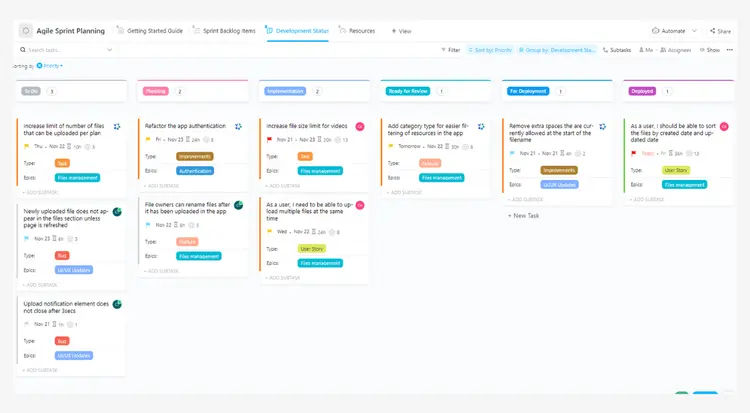
5. Scrum Sprint Planning Template
Before each sprint cycle, there is a sprint planning phase. It allows the management to plan tasks in such a way that the team can achieve its goals and the project moves forward in a streamlined manner.
The scrum project plan template facilitates just that. It enables stakeholders to view the sprint goals, tasks that are yet to be finished and other vital information that is necessary for the sprint's success.
clickup
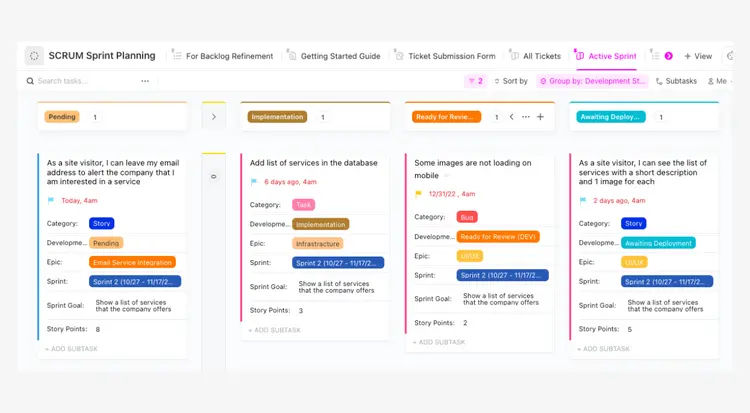
6. Scrum Active Sprint Template
The Scrum Active Sprint Template displays information on the currently active sprints. It organizes them into several columns like ‘pending’, ‘implementation’, ‘read for review’, ‘awaiting deployment’, etc., which allows stakeholders to know their current status.
clickup
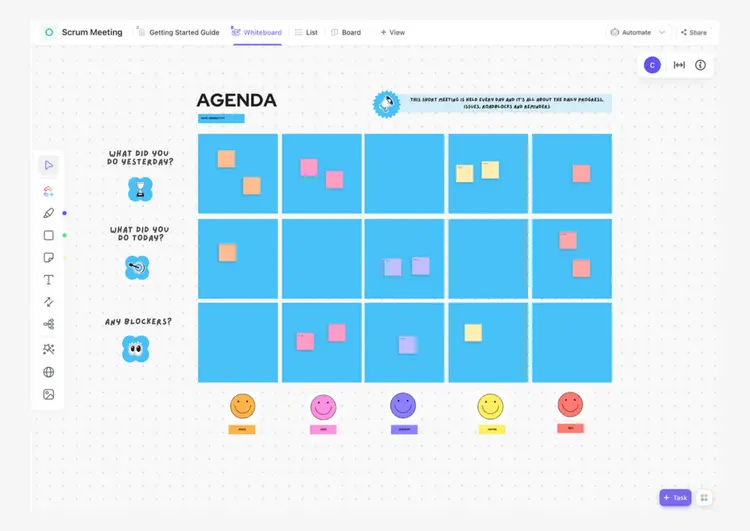
7. Scrum Meeting Template
Team members often work from different locations and even different time zones. Thus, it may not be possible for such individuals to frequently take part in meetings. The Scrum Meeting Template allows team members to post what they did yesterday, what they are going to do today and if they are facing any blockers.
Stakeholders can then view these inputs at any time and take action as needed. Project managers can also use the daily standup meeting template for this purpose.
clickup
Conclusion
These are only some of the scrum documentation templates that Scrum Masters use while organizing their teams’ workflows. Apart from this, they have to perform several other tasks, which puts this job role in high demand across various industries. What’s more, they have an average salary of $115,547 per annum and are hired by top companies across India.
Interested in opting for this servant leader role?
Why not learn Agile Project Management and take your career to new heights?
We have several certification courses that can help upgrade your current skill set. By opting for them, you can apply for various other roles that are associated with the Scrum Master position.
Enroll in KnowledgeHut Agile Project Management online courses today and take the first step towards your new career path!
Kindly try to incorporate the below keywords, Since they have high keywords search volume.
Frequently Asked Questions (FAQs)
1. What is a template in Agile?
In Agile, scrum template process involves pre-formatted tools that allow stakeholders to plan and organize their tasks as per the Scrum project management framework. It enables them to efficiently monitor every task, identify and provide solutions for blockers, and stay on track with the project goals.
2. What are the 4 rules of Scrum?
The four basic rules of scrum are collaboration, self-organization, time-boxing and value-based prioritization.
3. What is Kanban vs. Scrum template?
Kanban is essentially a visual project management method that stakeholders can use to manage their workflows. In contrast, Scrum is a project management methodology for complex projects. Here, team members structure and manage their tasks via a system of principles, rules and practices.
1639 articles published
KnowledgeHut is an outcome-focused global ed-tech company. We help organizations and professionals unlock excellence through skills development. We offer training solutions under the people and proces...
Get Free Consultation
By submitting, I accept the T&C and
Privacy Policy
Ready to learn about Agile Certifications Roadmap?