
- Blog Categories
- Project Management
- Agile Management
- IT Service Management
- Cloud Computing
- Business Management
- BI And Visualisation
- Quality Management
- Cyber Security
- DevOps
- Most Popular Blogs
- PMP Exam Schedule for 2025: Check PMP Exam Date
- Top 60+ PMP Exam Questions and Answers for 2025
- PMP Cheat Sheet and PMP Formulas To Use in 2025
- What is PMP Process? A Complete List of 49 Processes of PMP
- Top 15+ Project Management Case Studies with Examples 2025
- Top Picks by Authors
- Top 170 Project Management Research Topics
- What is Effective Communication: Definition
- How to Create a Project Plan in Excel in 2025?
- PMP Certification Exam Eligibility in 2025 [A Complete Checklist]
- PMP Certification Fees - All Aspects of PMP Certification Fee
- Most Popular Blogs
- CSM vs PSM: Which Certification to Choose in 2025?
- How Much Does Scrum Master Certification Cost in 2025?
- CSPO vs PSPO Certification: What to Choose in 2025?
- 8 Best Scrum Master Certifications to Pursue in 2025
- Safe Agilist Exam: A Complete Study Guide 2025
- Top Picks by Authors
- SAFe vs Agile: Difference Between Scaled Agile and Agile
- Top 21 Scrum Best Practices for Efficient Agile Workflow
- 30 User Story Examples and Templates to Use in 2025
- State of Agile: Things You Need to Know
- Top 24 Career Benefits of a Certifed Scrum Master
- Most Popular Blogs
- ITIL Certification Cost in 2025 [Exam Fee & Other Expenses]
- Top 17 Required Skills for System Administrator in 2025
- How Effective Is Itil Certification for a Job Switch?
- IT Service Management (ITSM) Role and Responsibilities
- Top 25 Service Based Companies in India in 2025
- Top Picks by Authors
- What is Escalation Matrix & How Does It Work? [Types, Process]
- ITIL Service Operation: Phases, Functions, Best Practices
- 10 Best Facility Management Software in 2025
- What is Service Request Management in ITIL? Example, Steps, Tips
- An Introduction To ITIL® Exam
- Most Popular Blogs
- A Complete AWS Cheat Sheet: Important Topics Covered
- Top AWS Solution Architect Projects in 2025
- 15 Best Azure Certifications 2025: Which one to Choose?
- Top 22 Cloud Computing Project Ideas in 2025 [Source Code]
- How to Become an Azure Data Engineer? 2025 Roadmap
- Top Picks by Authors
- Top 40 IoT Project Ideas and Topics in 2025 [Source Code]
- The Future of AWS: Top Trends & Predictions in 2025
- AWS Solutions Architect vs AWS Developer [Key Differences]
- Top 20 Azure Data Engineering Projects in 2025 [Source Code]
- 25 Best Cloud Computing Tools in 2025
- Most Popular Blogs
- Company Analysis Report: Examples, Templates, Components
- 400 Trending Business Management Research Topics
- Business Analysis Body of Knowledge (BABOK): Guide
- ECBA Certification: Is it Worth it?
- Top Picks by Authors
- Top 20 Business Analytics Project in 2025 [With Source Code]
- ECBA Certification Cost Across Countries
- Top 9 Free Business Requirements Document (BRD) Templates
- Business Analyst Job Description in 2025 [Key Responsibility]
- Business Analysis Framework: Elements, Process, Techniques
- Most Popular Blogs
- Best Career options after BA [2025]
- Top Career Options after BCom to Know in 2025
- Top 10 Power Bi Books of 2025 [Beginners to Experienced]
- Power BI Skills in Demand: How to Stand Out in the Job Market
- Top 15 Power BI Project Ideas
- Top Picks by Authors
- 10 Limitations of Power BI: You Must Know in 2025
- Top 45 Career Options After BBA in 2025 [With Salary]
- Top Power BI Dashboard Templates of 2025
- What is Power BI Used For - Practical Applications Of Power BI
- SSRS Vs Power BI - What are the Key Differences?
- Most Popular Blogs
- Data Collection Plan For Six Sigma: How to Create One?
- Quality Engineer Resume for 2025 [Examples + Tips]
- 20 Best Quality Management Certifications That Pay Well in 2025
- Six Sigma in Operations Management [A Brief Introduction]
- Top Picks by Authors
- Six Sigma Green Belt vs PMP: What's the Difference
- Quality Management: Definition, Importance, Components
- Adding Green Belt Certifications to Your Resume
- Six Sigma Green Belt in Healthcare: Concepts, Benefits and Examples
- Most Popular Blogs
- Latest CISSP Exam Dumps of 2025 [Free CISSP Dumps]
- CISSP vs Security+ Certifications: Which is Best in 2025?
- Best CISSP Study Guides for 2025 + CISSP Study Plan
- How to Become an Ethical Hacker in 2025?
- Top Picks by Authors
- CISSP vs Master's Degree: Which One to Choose in 2025?
- CISSP Endorsement Process: Requirements & Example
- OSCP vs CISSP | Top Cybersecurity Certifications
- How to Pass the CISSP Exam on Your 1st Attempt in 2025?
- Most Popular Blogs
- Top 7 Kubernetes Certifications in 2025
- Kubernetes Pods: Types, Examples, Best Practices
- DevOps Methodologies: Practices & Principles
- Docker Image Commands
- Top Picks by Authors
- Best DevOps Certifications in 2025
- 20 Best Automation Tools for DevOps
- Top 20 DevOps Projects of 2025
- OS for Docker: Features, Factors and Tips
- More
- Agile & PMP Practice Tests
- Agile Testing
- Agile Scrum Practice Exam
- CAPM Practice Test
- PRINCE2 Foundation Exam
- PMP Practice Exam
- Cloud Related Practice Test
- Azure Infrastructure Solutions
- AWS Solutions Architect
- IT Related Pratice Test
- ITIL Practice Test
- Devops Practice Test
- TOGAF® Practice Test
- Other Practice Test
- Oracle Primavera P6 V8
- MS Project Practice Test
- Project Management & Agile
- Project Management Interview Questions
- Release Train Engineer Interview Questions
- Agile Coach Interview Questions
- Scrum Interview Questions
- IT Project Manager Interview Questions
- Cloud & Data
- Azure Databricks Interview Questions
- AWS architect Interview Questions
- Cloud Computing Interview Questions
- AWS Interview Questions
- Kubernetes Interview Questions
- Web Development
- CSS3 Free Course with Certificates
- Basics of Spring Core and MVC
- Javascript Free Course with Certificate
- React Free Course with Certificate
- Node JS Free Certification Course
- Data Science
- Python Machine Learning Course
- Python for Data Science Free Course
- NLP Free Course with Certificate
- Data Analysis Using SQL
- Home
- Blog
- Artificial Intelligence
- Is Microsoft Agentic AI Worth Learning in 2026?
Is Microsoft Agentic AI Worth Learning in 2026?
Updated on Oct 08, 2026 | 458 views
Share:
Table of Contents
View all
Quick Overview:
- Microsoft Agentic AI: It is worth learning in 2026 for professionals targeting AI engineering, automation, cloud, or Microsoft technology roles, especially as enterprises adopt AI agents for real business workflows.
- Key skills: Learning involves generative AI and LLM fundamentals, agent development, APIs, tool integration, Python or C#, RAG, MCP, security, and evaluation.
- Microsoft platforms: Copilot Studio is a practical starting point for low code agents, while Azure AI Foundry and Microsoft Agent Framework support deeper development and enterprise applications.
- This guide explains the skills, platforms, career opportunities, enterprise applications, and learning path for Microsoft Agentic AI in 2026.
Professionals exploring Microsoft Agentic AI can also consider Applied Agentic AI to build practical skills in AI agents, autonomous workflows, tool use, and real-world AI applications.
What is Microsoft agentic AI?
Microsoft agentic AI refers to Microsoft's ecosystem for building AI agents that can reason through tasks, use tools, work with knowledge, and take actions. Depending on the platform, these agents can be created with low code tools or developed with code and managed cloud services.
The approach is broader than simply asking an LLM to generate an answer. A modern agent can combine:
• A language model
• Business knowledge
• Tools and APIs
• Memory and context
• Workflows
• Security controls
• Evaluation and monitoring
Microsoft Copilot Studio, for example, supports agents that can use enterprise knowledge, connectors, REST APIs, MCP servers, workflows, and even other agents.
For learners, Microsoft agentic AI is therefore less about one product and more about understanding how Microsoft's tools work together to build useful enterprise AI systems.
How Microsoft agentic AI works
A typical agent starts with a goal or user request and then decides what information or action is needed.
The workflow may involve:
• Understanding the request
• Retrieving relevant context
• Choosing a tool
• Calling an API or service
• Processing the result
• Continuing the workflow
• Returning or delivering the outcome
Microsoft's managed Foundry Agent Service supports this model with agent runtime, tools, model selection, observability, identity, security, and publishing capabilities.
This makes the ecosystem relevant for organisations that want agents to interact with real business systems rather than remain isolated chat experiences.
Also read: What is Microsoft Agentic AI and How Does It Work?
What Microsoft agentic AI platforms and frameworks should you learn?
There is no single Microsoft agent platform that every learner needs to master. The right starting point depends on whether you want low code development, enterprise AI engineering, or deeper multi agent development.
Understanding the role of each platform makes Microsoft agentic AI easier to learn without trying to study everything at once.
1. Microsoft Copilot Studio
Copilot Studio is a strong starting point for people who want to create agents with less traditional coding. Microsoft provides agents that can work with business knowledge, workflows, connectors, APIs, and MCP servers.
It can be useful for:
• Business users
• Automation professionals
• Product and operations teams
• Citizen developers
• Technical professionals building internal agents
You can use Copilot Studio to create knowledge based agents, support experiences, workflow driven agents, and agents that connect with business applications.
For beginners, this can be one of the easiest entry points into Microsoft agentic AI because the focus is on building useful agents rather than starting with complex code.
2. Azure AI Foundry
Microsoft now positions Foundry as a unified Azure platform for enterprise AI development, and its Foundry Agent Service is designed to build, deploy, and scale AI agents. It supports both more declarative agent creation and code based hosted agents, as well as multiple models and tools.
Professionals working with Microsoft agentic AI at an enterprise level should understand areas such as:
• Agent deployment
• Model selection
• Tool integration
• Identity and access
• Monitoring
• Evaluation
• Production scaling
3. Microsoft Agent Framework
Microsoft Agent Framework is the current code based framework for building AI agents and workflows. Microsoft describes it as the direct successor to AutoGen and Semantic Kernel, combining agent abstractions with enterprise capabilities such as state management, telemetry, middleware, and explicit multi agent workflows.
It supports:
• Python
• C#
• Tools
• Memory and persistence
• Multi agent workflows
• Human in the loop
• RAG
• Security
• Background agents
• Hosting and integrations
4. Copilot and AI agents
Microsoft Copilot and AI agents are related but not identical concepts. Copilots are designed around AI assistance within Microsoft products and experiences, while agents can be built to perform more specific tasks, use tools, and act on behalf of users or organisations.
Copilot Studio can extend Microsoft experiences with custom agents and enterprise knowledge, while Foundry provides a broader development and runtime environment for production agents.
For Microsoft agentic AI, understanding this difference helps learners choose the right development path instead of treating every Microsoft AI product as the same thing.
Professionals interested in applying Microsoft Agentic AI to real-world products can explore the PG Certificate in AI Powered Product and Design Thinking to build skills in AI-driven product strategy, customer needs, prototyping, and decision-making.
What skills are needed to learn Microsoft agentic AI?
The required skills depend on how technical you want your role to be. Low code agent development can be learned with less programming, while code based agent engineering requires stronger software and AI skills.
A good learning path for Microsoft agentic AI should build fundamentals first and then add agent specific capabilities.
1. Generative AI and large language model fundamentals
Start with a practical understanding of:
• Generative AI
• Large language models
• Prompt design
• Context windows
• Model limitations
• Embeddings
• Retrieval augmented generation
• Model evaluation
2. AI agent development and tool integration
The next step is learning how agents actually take action.
Focus on:
• Tool calling
• API integration
• Function execution
• Agent instructions
• Memory
• State management
• Workflow design
• Agent evaluation
3. Python and C# programming skills
Python and C# are useful for code based Microsoft agent development. Microsoft Agent Framework provides support for both languages.
You do not need advanced programming on day one, but developers should become comfortable with:
• Functions and classes
• APIs
• JSON
• Authentication
• Error handling
• Asynchronous programming
• Debugging
4. APIs, MCP, and multi agent orchestration
Modern agents often need to connect with external tools and services.
Useful topics include:
• REST APIs
• MCP
• Tool schemas
• Authentication
• Agent handoffs
• Multi agent orchestration
• Workflow execution
5. AI governance, security, and observability
Enterprise AI needs more than functionality. Professionals also need to understand how agents are secured, evaluated, monitored, and governed.
Build knowledge of:
• Identity and access control
• Data protection
• Prompt injection risks
• Tool permissions
• Logging and tracing
• Evaluation
• Human approval
• Responsible AI
Also read: Which Microsoft Tools Are Used for Agentic AI Development?
Is Microsoft agentic AI worth learning in 2026?
For many professionals, Microsoft agentic AI is worth learning because Microsoft's tools cover a wide range of enterprise use cases, from low code business automation to code based agent development and managed production deployment.
The value depends on your career direction, though. Someone focused only on basic AI prompting may not need the full ecosystem, while an AI engineer, cloud professional, automation specialist, or developer working with Microsoft technologies may benefit significantly.
Career opportunities in Microsoft agentic AI
Learning the ecosystem can support roles such as:
• AI Engineer
• AI Application Developer
• AI Automation Engineer
• Cloud AI Engineer
• AI Solutions Architect
• Agentic AI Developer
• AI Platform Engineer
• Intelligent Automation Specialist
Enterprise applications of Microsoft agentic AI
Enterprise use cases can include:
• Employee support agents
• Customer service automation
• Knowledge assistants
• Workflow automation
• Research and information retrieval
• Business process automation
• Developer productivity
• Multi step internal operations
Microsoft agentic AI skills and industry demand
The strongest demand is likely to be for people who can connect AI with real business systems.
Employers may value combinations such as:
• AI and LLM knowledge
• Python or C#
• Cloud computing
• API integration
• Agent orchestration
• RAG
• MCP
• Security
• Monitoring and evaluation
Professionals looking to complement Microsoft Agentic AI skills with a strong data foundation can explore the Post Graduate Certification Program in Data Analytics and Applied AI to build expertise in analytics, AI, and data-driven decision-making.
How to start learning Microsoft agentic AI?
A practical learning path should move from simple agent creation to deeper development and production concepts. There is no need to learn every framework at once.
Start with one platform, build a few useful workflows, and then move into code based development when you need greater control.
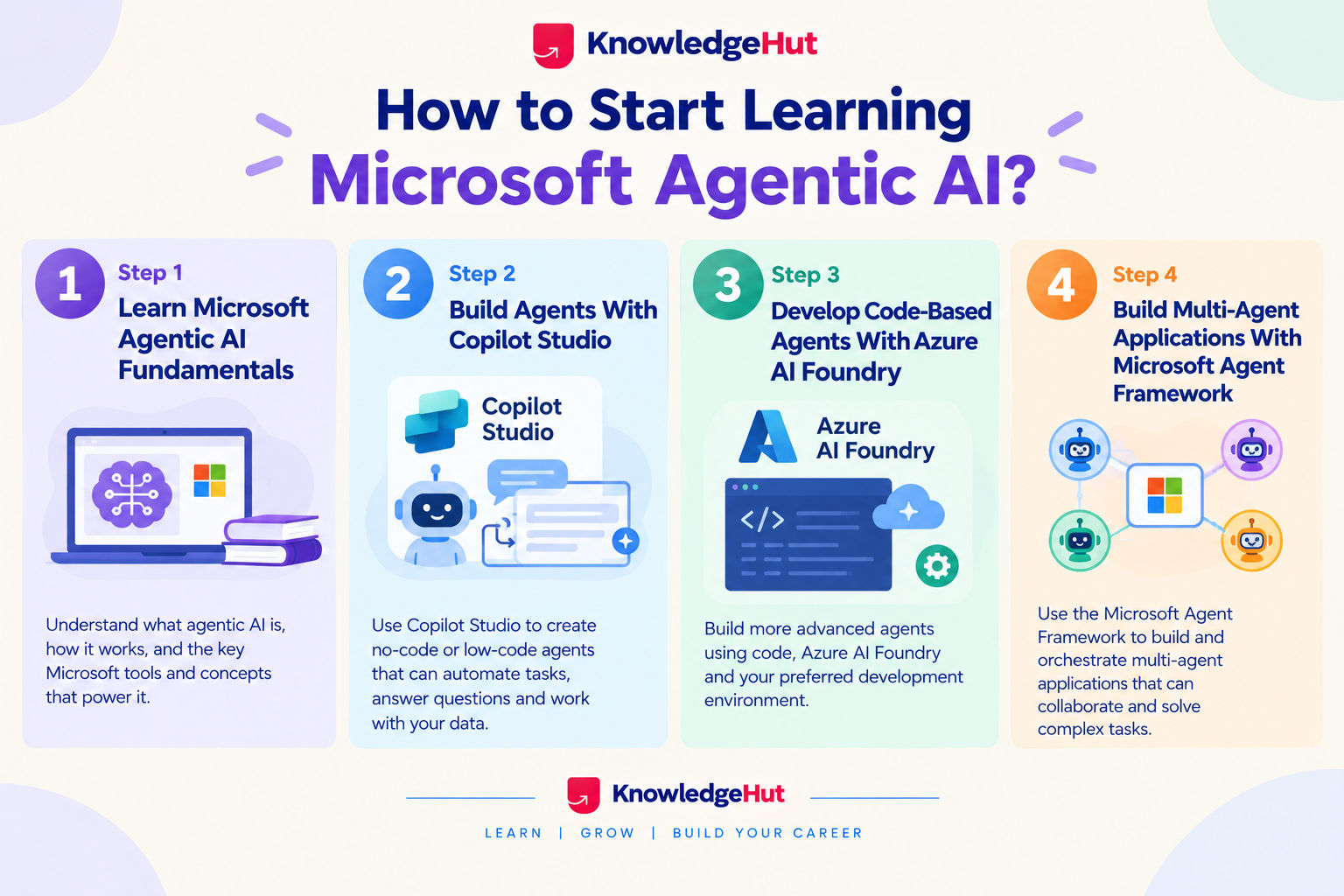
Step-1 Learn Microsoft agentic AI fundamentals
Begin with:
• Generative AI basics
• LLM concepts
• AI agents
• Tool use
• RAG
• Agent evaluation
• Responsible AI
Step-2 Build agents with Copilot Studio
Copilot Studio is a practical place to start if you want to learn low code agent development.
Focus on:
• Creating agents
• Adding knowledge sources
• Connecting actions
• Using workflows
• Testing responses
• Publishing agents
Step-3 Develop code based agents with Azure AI Foundry
Once you are comfortable with agent concepts, move into Foundry for deeper enterprise development.
Learn how to:
• Select models
• Configure tools
• Build hosted agents
• Add identity and security
• Monitor agent behaviour
• Evaluate outputs
• Deploy and scale agents
Step-4 Build multi agent applications with Microsoft Agent Framework
For developers who want deeper control, Agent Framework is a useful next step.
Start with:
• Single agents
• Tool calling
• Conversations and memory
• Workflows
• Multi agent orchestration
• Human in the loop
• Hosting
Also read: Microsoft Agentic AI Careers
Conclusion
Microsoft agentic AI is worth learning in 2026 for professionals who want to work in enterprise AI, automation, cloud, or AI engineering. It is especially relevant when the target workplace already uses Microsoft technologies and needs agents that can connect with real business systems.
Start with Copilot Studio for low code development, move to Microsoft Foundry for managed enterprise AI, and learn Microsoft Agent Framework when deeper coding and orchestration are needed. The key decision is not whether to learn every Microsoft AI tool, but which layer matches the role you want next.
Have A Query? Get in Touch With Our Customer Support | upGrad KnowledgeHut
Frequently Asked Questions (FAQs)
1. Which Microsoft agentic AI platform should beginners learn first: Agent Builder, Copilot Studio, or Microsoft Foundry?
For beginners, Agent Builder is the simplest option for creating personal or small team agents with little or no coding. Copilot Studio is better for broader audiences, workflows, and custom integrations, while Microsoft Foundry is suited to more advanced and production oriented development.
In Microsoft agentic AI, choose the platform based on your technical level, audience, complexity, and need for control.
2. Can you learn Microsoft agentic AI without coding or an Azure background?
Yes, especially when starting with Agent Builder or Copilot Studio, where agents can be created with little or no traditional coding. More advanced paths such as Foundry and Agent Framework require stronger technical knowledge.
So, learning Microsoft agentic AI does not require an Azure background on day one, but technical skills become more important as you move into advanced development.
3. How much Python or C# do you actually need for Microsoft agentic AI?
You do not need advanced programming to begin with low code agent tools. For code based development, basic Python or C# skills in functions, APIs, JSON, authentication, error handling, and asynchronous programming provide a useful foundation.
Microsoft Agent Framework currently supports both Python and C#, making these skills useful for deeper Microsoft agentic AI development.
4. How much does it cost to build and run Microsoft agentic AI agents in 2026?
There is no single fixed cost because expenses depend on the platform, models, usage, tools, hosting, and scale of the agent. Microsoft recommends matching the technology choice with cost, effort, customization, and expected return.
For Microsoft agentic AI, estimate both development costs and ongoing model, platform, monitoring, and infrastructure usage before moving to production.
5. Which Microsoft agentic AI certification is worth getting in 2026?
The right credential depends on the role. Microsoft currently offers AI Agent Builder Associate (AB-620) for developers and advanced builders working with Copilot Studio, while the Agentic AI Business Solutions Architect Expert (AB-100) is aimed at solution architects and broader enterprise AI strategy.
For Microsoft agentic AI, choose the certification that matches the work you want to perform rather than selecting the most advanced credential.
6. Is Microsoft agentic AI knowledge transferable outside the Microsoft ecosystem?
Yes. Microsoft Agent Framework supports multiple model and service providers, including Microsoft Foundry, Anthropic, OpenAI, Ollama, and others. It also supports integrations with tools and MCP servers.
This means Microsoft agentic AI can provide transferable skills in agent design, tool use, orchestration, evaluation, and workflows beyond a single Microsoft product.
7. When should you choose Copilot Studio instead of Microsoft Foundry for an AI agent?
Choose Copilot Studio when you need low code development, business workflows, broader organisational users, or custom integrations without building everything from scratch. Choose Foundry when you need greater control, custom development, enterprise scale, and more advanced agent engineering.
The best Microsoft agentic AI platform depends on the required complexity, customization, audience, governance, and deployment model.
8. How do you move a Microsoft AI agent from prototype to production?
Production readiness requires more than getting an agent to return a correct response. Teams need evaluation, tracing, monitoring, security, identity, deployment controls, and ongoing optimisation. Microsoft Foundry provides observability and evaluation capabilities designed to help move agents from prototype to production.
For Microsoft agentic AI, testing and observability should be built into the development process rather than added after deployment.
9. What should you learn before Microsoft Agent Framework: RAG, MCP, APIs, or multi-agent systems?
Start with LLM and agent fundamentals, then learn APIs and tool calling before moving into RAG, MCP, workflows, and multi-agent orchestration. This creates a stronger understanding of how agents receive context, use tools, and coordinate tasks.
For Microsoft agentic AI, the learning order should move from core agent concepts to integrations and then more advanced orchestration. Microsoft Agent Framework combines agents, tools, MCP, memory, workflows, and integrations.
10. Can Microsoft agentic AI skills help you get an AI engineer or automation job without becoming a machine learning engineer?
Yes. Many agent roles focus on application development, automation, integrations, cloud, workflows, and enterprise solutions rather than training machine learning models from scratch. Microsoft's current AI agent credentials target developers, app makers, consultants, and solution architects across these paths.
Building practical projects and combining Microsoft agentic AI with programming, APIs, cloud, security, and evaluation skills can make the profile stronger for these roles.
1639 articles published
KnowledgeHut is an outcome-focused global ed-tech company. We help organizations and professionals unlock excellence through skills development. We offer training solutions under the people and proces...
Get Free Consultation
By submitting, I accept the T&C and
Privacy Policy