
- Blog Categories
- Project Management
- Agile Management
- IT Service Management
- Cloud Computing
- Business Management
- BI And Visualisation
- Quality Management
- Cyber Security
- DevOps
- Most Popular Blogs
- PMP Exam Schedule for 2025: Check PMP Exam Date
- Top 60+ PMP Exam Questions and Answers for 2025
- PMP Cheat Sheet and PMP Formulas To Use in 2025
- What is PMP Process? A Complete List of 49 Processes of PMP
- Top 15+ Project Management Case Studies with Examples 2025
- Top Picks by Authors
- Top 170 Project Management Research Topics
- What is Effective Communication: Definition
- How to Create a Project Plan in Excel in 2025?
- PMP Certification Exam Eligibility in 2025 [A Complete Checklist]
- PMP Certification Fees - All Aspects of PMP Certification Fee
- Most Popular Blogs
- CSM vs PSM: Which Certification to Choose in 2025?
- How Much Does Scrum Master Certification Cost in 2025?
- CSPO vs PSPO Certification: What to Choose in 2025?
- 8 Best Scrum Master Certifications to Pursue in 2025
- Safe Agilist Exam: A Complete Study Guide 2025
- Top Picks by Authors
- SAFe vs Agile: Difference Between Scaled Agile and Agile
- Top 21 Scrum Best Practices for Efficient Agile Workflow
- 30 User Story Examples and Templates to Use in 2025
- State of Agile: Things You Need to Know
- Top 24 Career Benefits of a Certifed Scrum Master
- Most Popular Blogs
- ITIL Certification Cost in 2025 [Exam Fee & Other Expenses]
- Top 17 Required Skills for System Administrator in 2025
- How Effective Is Itil Certification for a Job Switch?
- IT Service Management (ITSM) Role and Responsibilities
- Top 25 Service Based Companies in India in 2025
- Top Picks by Authors
- What is Escalation Matrix & How Does It Work? [Types, Process]
- ITIL Service Operation: Phases, Functions, Best Practices
- 10 Best Facility Management Software in 2025
- What is Service Request Management in ITIL? Example, Steps, Tips
- An Introduction To ITIL® Exam
- Most Popular Blogs
- A Complete AWS Cheat Sheet: Important Topics Covered
- Top AWS Solution Architect Projects in 2025
- 15 Best Azure Certifications 2025: Which one to Choose?
- Top 22 Cloud Computing Project Ideas in 2025 [Source Code]
- How to Become an Azure Data Engineer? 2025 Roadmap
- Top Picks by Authors
- Top 40 IoT Project Ideas and Topics in 2025 [Source Code]
- The Future of AWS: Top Trends & Predictions in 2025
- AWS Solutions Architect vs AWS Developer [Key Differences]
- Top 20 Azure Data Engineering Projects in 2025 [Source Code]
- 25 Best Cloud Computing Tools in 2025
- Most Popular Blogs
- Company Analysis Report: Examples, Templates, Components
- 400 Trending Business Management Research Topics
- Business Analysis Body of Knowledge (BABOK): Guide
- ECBA Certification: Is it Worth it?
- Top Picks by Authors
- Top 20 Business Analytics Project in 2025 [With Source Code]
- ECBA Certification Cost Across Countries
- Top 9 Free Business Requirements Document (BRD) Templates
- Business Analyst Job Description in 2025 [Key Responsibility]
- Business Analysis Framework: Elements, Process, Techniques
- Most Popular Blogs
- Best Career options after BA [2025]
- Top Career Options after BCom to Know in 2025
- Top 10 Power Bi Books of 2025 [Beginners to Experienced]
- Power BI Skills in Demand: How to Stand Out in the Job Market
- Top 15 Power BI Project Ideas
- Top Picks by Authors
- 10 Limitations of Power BI: You Must Know in 2025
- Top 45 Career Options After BBA in 2025 [With Salary]
- Top Power BI Dashboard Templates of 2025
- What is Power BI Used For - Practical Applications Of Power BI
- SSRS Vs Power BI - What are the Key Differences?
- Most Popular Blogs
- Data Collection Plan For Six Sigma: How to Create One?
- Quality Engineer Resume for 2025 [Examples + Tips]
- 20 Best Quality Management Certifications That Pay Well in 2025
- Six Sigma in Operations Management [A Brief Introduction]
- Top Picks by Authors
- Six Sigma Green Belt vs PMP: What's the Difference
- Quality Management: Definition, Importance, Components
- Adding Green Belt Certifications to Your Resume
- Six Sigma Green Belt in Healthcare: Concepts, Benefits and Examples
- Most Popular Blogs
- Latest CISSP Exam Dumps of 2025 [Free CISSP Dumps]
- CISSP vs Security+ Certifications: Which is Best in 2025?
- Best CISSP Study Guides for 2025 + CISSP Study Plan
- How to Become an Ethical Hacker in 2025?
- Top Picks by Authors
- CISSP vs Master's Degree: Which One to Choose in 2025?
- CISSP Endorsement Process: Requirements & Example
- OSCP vs CISSP | Top Cybersecurity Certifications
- How to Pass the CISSP Exam on Your 1st Attempt in 2025?
- Most Popular Blogs
- Top 7 Kubernetes Certifications in 2025
- Kubernetes Pods: Types, Examples, Best Practices
- DevOps Methodologies: Practices & Principles
- Docker Image Commands
- Top Picks by Authors
- Best DevOps Certifications in 2025
- 20 Best Automation Tools for DevOps
- Top 20 DevOps Projects of 2025
- OS for Docker: Features, Factors and Tips
- More
- Agile & PMP Practice Tests
- Agile Testing
- Agile Scrum Practice Exam
- CAPM Practice Test
- PRINCE2 Foundation Exam
- PMP Practice Exam
- Cloud Related Practice Test
- Azure Infrastructure Solutions
- AWS Solutions Architect
- IT Related Pratice Test
- ITIL Practice Test
- Devops Practice Test
- TOGAF® Practice Test
- Other Practice Test
- Oracle Primavera P6 V8
- MS Project Practice Test
- Project Management & Agile
- Project Management Interview Questions
- Release Train Engineer Interview Questions
- Agile Coach Interview Questions
- Scrum Interview Questions
- IT Project Manager Interview Questions
- Cloud & Data
- Azure Databricks Interview Questions
- AWS architect Interview Questions
- Cloud Computing Interview Questions
- AWS Interview Questions
- Kubernetes Interview Questions
- Web Development
- CSS3 Free Course with Certificates
- Basics of Spring Core and MVC
- Javascript Free Course with Certificate
- React Free Course with Certificate
- Node JS Free Certification Course
- Data Science
- Python Machine Learning Course
- Python for Data Science Free Course
- NLP Free Course with Certificate
- Data Analysis Using SQL
- Home
- Blog
- Business Intelligence And Visualization
- What Is Context Engineering? How It Differs from Prompt Engineering
What Is Context Engineering? How It Differs from Prompt Engineering
Updated on Oct 21, 2026
Share:
Table of Contents
View all
Quick Overview
- Context engineering is the process of selecting, organizing, and managing the instructions, data, memory, conversation history, and tools an AI model needs to generate accurate and relevant responses.
- Context Engineering vs Prompt Engineering: Prompt engineering focuses on improving the instructions given to an AI model, while context engineering manages the broader information available to help the model complete a task.
- Context Engineering Techniques: Key techniques include managing memory, retrieving relevant information, connecting tools and APIs, compressing context to reduce token usage, and isolating information across agents and tasks.
- Prompt Engineering Techniques: Role prompting, zero-shot and few-shot prompting, chain-of-thought prompting, providing clear instructions, adding constraints, and specifying output formats help guide AI responses toward the desired result.
- This guide explains how context engineering works, how it differs from prompt engineering, its core techniques, and the best practices for improving AI response quality, reliability, efficiency, and security.
Professionals looking to build AI systems that go beyond simple prompts can explore Applied Agentic AI to learn how AI agents use context, memory, tools, and multi-step workflows to perform complex tasks more effectively.
Last Few Days to Save Up To 90% on Career Transformation
Ends December 1 – Don't Miss Out!
What is context engineering?
Context engineering is the process of selecting, organizing, and managing the information an AI model receives before it generates a response. It goes beyond writing a good prompt by ensuring the model has the right instructions, relevant data, conversation history, and tools to complete a task.
While a prompt tells an AI model what to do, context engineering helps determine what information the model needs to do it well. This is especially important for AI applications that handle complex requests, remember previous interactions, or work across multiple steps.
How context engineering works in LLMs and AI agents
Large language models (LLMs) generate responses based on the information available in their context window. This window can contain instructions, user messages, retrieved documents, tool results, and other relevant information.
Context engineering involves managing these inputs so the model can respond accurately and consistently.
Key activities include:
- Preparing instructions: Defining the task, expected output, and constraints.
- Adding relevant information: Providing documents, facts, and conversation history related to the request.
- Managing memory: Retaining useful information from previous interactions when needed.
- Connecting tools: Giving AI agents access to external systems, databases, or APIs.
- Updating context: Replacing outdated or irrelevant information as the task progresses.
Why context engineering matters for AI applications
Even a capable AI model can produce incomplete or inaccurate responses when it receives insufficient, outdated, or conflicting information. Context engineering helps reduce these problems by improving the quality of the information available to the model.
It matters because it can help teams:
- Improve response relevance and consistency.
- Reduce irrelevant information that distracts the model.
- Support more reliable use of company documents and internal knowledge.
- Manage token usage and the costs associated with processing large amounts of text.
- Maintain useful information across longer conversations and multi step tasks.
- Reduce the risk of acting on incorrect or untrusted information.
Also read: Prompt Engineering Frameworks Explained
Context engineering vs. prompt engineering
Context engineering and prompt engineering are closely related, but they solve different problems. Prompt engineering focuses on how instructions are written, while context engineering manages the broader information environment in which the model operates.
Understanding the difference helps teams decide whether they need to improve their instructions, change the information supplied to the model, or do both.
Key differences between context engineering and prompt engineering
Factor |
Prompt engineering |
Context engineering |
| Main focus | Improving instructions given to an AI model | Managing all relevant information available to the model |
| Key components | Prompts, task instructions, formatting rules, and constraints | Prompts, memory, retrieved data, conversation history, and tools |
| Primary goal | Help the model understand what to do | Help the model access the right information to complete the task |
| Data management | May use information included directly in the prompt | Can retrieve, filter, update, and organize information dynamically |
| Typical complexity | Often suited to individual requests or defined workflows | Particularly useful for applications with changing data or multiple steps |
| Common challenge | Ambiguous instructions or unclear expectations | Irrelevant, missing, outdated, or conflicting context |
When to use context engineering instead of prompt engineering
The two approaches are not mutually exclusive. Most useful AI applications benefit from both, but the level of context management required depends on the task.
Prompt engineering may be sufficient when:
- The task is simple and clearly defined.
- All required information fits into a short instruction.
- The output format and expected response are predictable.
- The application does not need external data or persistent memory.
Context engineering becomes more important when:
- The AI must answer questions using internal company documents.
- Responses depend on previous conversations or user preferences.
- Information changes frequently and must be retrieved when needed.
- An AI agent uses tools to complete several actions.
- The system must distinguish between trusted instructions and untrusted external content.
Professionals looking to build more effective AI applications can explore the PG Certificate in Applied Generative Engineering & LLM Applications to develop practical skills in LLMs, context management, prompt engineering, and building context-aware AI solutions.
What are the core techniques of context engineering?
Effective context engineering involves controlling what information enters the model, how that information is organized, and when it should be updated or removed. The techniques used depend on the application's complexity, data sources, and reliability requirements.
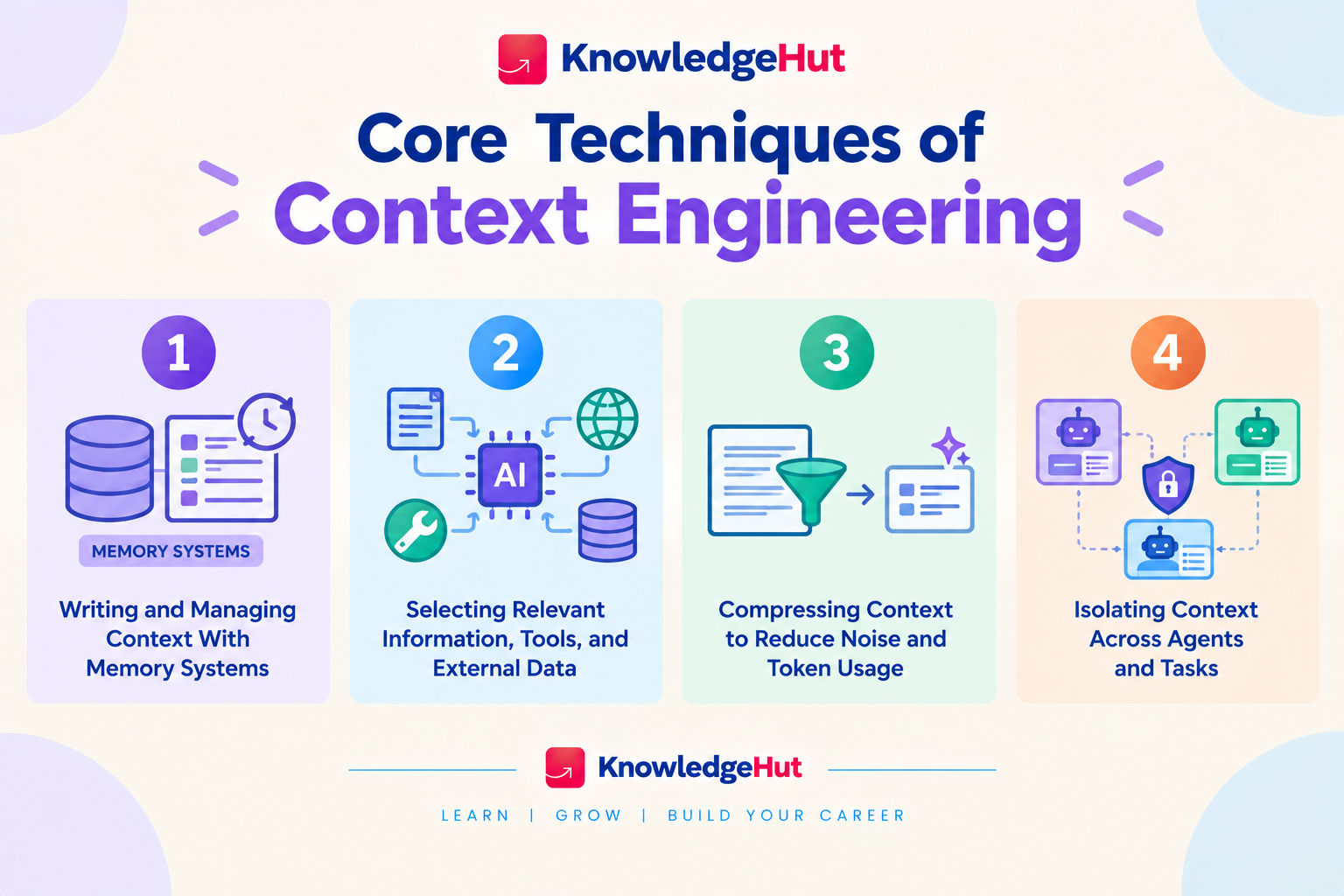
1. Writing and managing context with memory systems
Memory systems help AI applications retain useful information across interactions instead of treating every request as completely new.
Common approaches include:
- Conversation memory: Retains relevant details from the current conversation.
- Long term memory: Stores selected information that may be useful in future interactions.
- Task state: Tracks completed steps, pending actions, and important decisions.
- Summarized memory: Preserves key points without retaining an entire conversation.
2. Selecting relevant information, tools, and external data
Context engineering requires more than collecting data. It involves choosing the information that is useful for the current task.
This can include:
- Retrieving relevant sections from documents or knowledge bases.
- Selecting data based on the user's question and the task's requirements.
- Connecting approved tools and APIs when external information is needed.
- Filtering duplicate, unrelated, or outdated information.
- Checking whether retrieved information is reliable and current.
3. Compressing context to reduce noise and token usage
AI models have limits on how much information they can process in a single context window. Large amounts of conversation history, documents, and tool outputs can consume that space quickly.
Context compression helps preserve useful information while removing unnecessary detail.
Common techniques include:
- Summarizing lengthy conversations.
- Removing repeated instructions and duplicate content.
- Extracting key facts instead of passing entire documents.
- Keeping important constraints, decisions, and unresolved questions.
- Removing information that no longer supports the current task.
4. Isolating context across agents and tasks
When multiple agents or tasks operate within the same AI system, sharing all available information can create confusion and increase security risks.
Context isolation means giving each agent or task access to the information it actually needs.
It can help teams:
- Keep task instructions separate from unrelated conversation history.
- Prevent one agent from using another agent's incomplete or irrelevant findings.
- Limit access to sensitive information.
- Separate trusted system instructions from user supplied or retrieved content.
- Maintain clear records of decisions and task progress.
Also read: Prompt Engineering vs Fine-Tuning
How does context engineering work in AI agents?
AI agents use context to understand a task, decide what to do next, interact with tools, and evaluate the results of their actions. Context engineering helps manage this information throughout the process.
Instead of preparing context only once, an agent may need to update it after every important action. This allows it to work with new information while keeping the original objective and constraints in view.
1. Managing system prompts, conversation history, and memory
An AI agent's context may contain several types of information, each serving a different purpose.
- System instructions: Define the agent's role, boundaries, and operating rules.
- Conversation history: Provides relevant details about the ongoing interaction.
- Memory: Retains selected information from previous interactions.
- Task state: Records progress, completed steps, and outstanding actions.
- Tool outputs: Supplies information returned by external systems.
2. Retrieving relevant information using RAG
Retrieval augmented generation (RAG) allows an AI system to retrieve relevant information from an external knowledge source before generating a response.
A typical RAG workflow includes:
- The user submits a question.
- The system searches a knowledge base for relevant information.
- The most useful passages are selected.
- Those passages are added to the model's context.
- The model generates a response using the available information.
3. Selecting tools and external data dynamically
AI agents may need different tools depending on the request. One task might require searching a document collection, while another may need a database query or an API call.
Dynamic tool selection allows an agent to choose an appropriate tool based on the task and available information.
A well designed process should:
- Make tool descriptions and capabilities clear.
- Restrict access to approved tools.
- Provide only the necessary tool results to the model.
- Validate inputs and outputs where appropriate.
- Require authorization for sensitive or consequential actions.
4. Managing context across multi step tasks
Longer tasks require an AI agent to maintain a consistent understanding of its objective while processing new information at each stage.
A practical approach is to preserve a compact record of:
- The original goal and key constraints.
- Actions already completed.
- Important findings and decisions.
- Current task status.
- Remaining steps and unresolved issues.
Also read: Prompt Engineering for Beginners
What are the best practices for effective context engineering?
Good context engineering is an ongoing process rather than a one time configuration. Teams should regularly review the information supplied to the model, test how context affects responses, and improve the system based on actual performance.
1. Keep context relevant and up to date
Outdated or unrelated information can lead to incorrect conclusions. Context should reflect the current task and the most reliable information available.
Useful practices include:
- Refreshing data when its accuracy depends on recent updates.
- Removing irrelevant details from previous interactions.
- Checking the source and date of retrieved information.
- Updating memory when important facts change.
- Preserving the original task requirements throughout the workflow.
2. Prioritize important information within the context window
A context window can hold only a limited amount of information. Even when a large window is available, filling it with unnecessary content can make information harder to manage.
Prioritize information in this order where appropriate:
- Essential system instructions and safety constraints.
- The user's current request and expected outcome.
- Facts and documents directly relevant to the task.
- Important decisions and task progress.
- Supporting details needed to complete the work.
3. Remove redundant data and summarize long conversations
Repeated instructions, duplicate documents, and lengthy conversation histories can waste tokens without improving the response.
To keep context manageable:
- Summarize completed discussions and preserve key decisions.
- Remove duplicate information.
- Retain unresolved questions and essential constraints.
- Replace lengthy tool outputs with relevant findings.
- Keep the original source available when the summary needs verification.
4. Separate conflicting instructions and untrusted data
AI systems may receive information from users, documents, websites, and external tools. Some of this content may contain inaccurate claims or instructions that conflict with the system's rules.
Effective context engineering should distinguish trusted instructions from information that the model is expected to analyze.
Important safeguards include:
- Keeping system instructions separate from retrieved content.
- Treating external documents as data rather than automatically following instructions inside them.
- Resolving conflicting information through clear rules.
- Checking sources before relying on important claims.
- Restricting tool permissions and requiring approval for sensitive actions.
5. Evaluate context quality and AI output reliability
A well designed context setup should be tested against realistic tasks rather than judged only by how organized it looks.
Teams can evaluate performance by measuring:
- Accuracy: Does the model produce correct and supported answers?
- Relevance: Does it use information related to the current task?
- Consistency: Does it follow instructions across repeated or multi step tasks?
- Efficiency: Does it avoid unnecessary retrieval and token usage?
- Reliability: Does it handle missing, conflicting, or outdated information appropriately?
- Security: Does it respect access restrictions and avoid following untrusted instructions?
Professionals looking to improve AI-driven decision-making can explore the Post Graduate Certification Program in Data Analytics and Applied AI to develop skills in data analytics, applied AI, and using relevant data to generate more accurate and actionable insights.
Conclusion
Context engineering helps AI applications deliver more relevant and reliable results by providing the right information, memory, and tools at the right time. While prompt engineering may be enough for simple tasks, complex AI workflows often need both approaches. The key is to keep context relevant, accurate, and efficient to improve output quality and control costs.
Have A Query? Get in Touch With Our Customer Support | upGrad KnowledgeHut
Frequently Asked Questions (FAQs)
1. Is there a course that teaches context engineering?
Yes, upGrad KnowledgeHut offers courses that cover key concepts related to context engineering, including LLM applications, context management, memory systems, RAG, and AI agents. Although these courses are not exclusively focused on context engineering, they can help learners develop relevant skills:
- PG Certificate in Applied Generative Engineering & LLM Applications covers LLM applications and related concepts such as retrieval augmented generation.
- Applied Agentic AI Certification focuses on building AI agents, with topics including memory, tool usage, context windows, and retrieval.
- Generative AI and Prompt Engineering covers context management, context windows, and context aware prompting.
2. What are Anthropic agents?
Anthropic agents are AI powered systems built using Anthropic's Claude models that can perform tasks, use tools, and work through multiple steps. They can retrieve information, interact with external systems, and complete tasks with varying levels of human oversight. Context engineering helps these agents use relevant instructions, data, and tool outputs effectively.
3. What is Anthropic mainly used for?
Anthropic develops AI models, including Claude, for tasks such as writing, coding, research, data analysis, and business automation. Its models can also support AI agents that interact with tools and external information sources. Context engineering can help developers build applications that use Claude with relevant data and instructions.
4. What are the top 3 AI agents?
There is no single ranking of the top AI agents because their usefulness depends on the task. Claude based agents, OpenAI powered agents, and Microsoft Copilot based agents are options for different coding, research, productivity, and business workflows. Context engineering helps improve their effectiveness by providing relevant information and managing task instructions.
5. Can you give me some examples of AI agents?
Common examples include customer support agents that answer questions, research agents that gather information, and coding agents that help write or debug software. Other agents can schedule tasks, analyze business data, or retrieve information from company documents. Context engineering helps these systems maintain relevant information and make better decisions across multiple steps.
6. Is there a free context engineering course available?
Yes, free tutorials, technical guides, and learning resources are available for context engineering. Resources from AI model developers and open source communities can help learners understand context windows, memory, RAG, and agent workflows. Check whether a course includes practical exercises, since hands-on projects help reinforce these concepts.
7. Is context engineering better than prompt engineering?
Neither approach is universally better because they solve different problems. Prompt engineering improves the instructions given to an AI model, while context engineering manages the broader information it uses, including memory, retrieved data, and tool outputs. Simple tasks may need only prompt engineering, whereas complex AI applications often benefit from both.
8. What is the difference between loop engineering and context engineering?
Loop engineering generally refers to designing and refining repeated cycles of actions, feedback, testing, and improvement, although the term can vary by context. Context engineering focuses on selecting and managing the information an AI model receives to complete a task. In AI agent workflows, the two can work together: context informs each step, while the loop helps evaluate and refine results.
9. What are the four pillars of context engineering?
There is no universally accepted framework defining exactly four pillars of context engineering. A practical way to understand it is through four areas: context selection, context management, context retrieval, and context evaluation. Together, these help ensure that an AI model receives relevant information, uses it effectively, and produces reliable outputs.
10. How can I learn context engineering?
Start by learning LLM fundamentals, prompt engineering, and context window limitations. Then explore RAG, memory systems, context compression, and tool integration before building a small AI application. Practice evaluating how different context choices affect accuracy, relevance, token usage, and reliability.
1640 articles published
KnowledgeHut is an outcome-focused global ed-tech company. We help organizations and professionals unlock excellence through skills development. We offer training solutions under the people and proces...
Get Free Consultation
By submitting, I accept the T&C and
Privacy Policy