
- Blog Categories
- Project Management
- Agile Management
- IT Service Management
- Cloud Computing
- Business Management
- BI And Visualisation
- Quality Management
- Cyber Security
- DevOps
- Most Popular Blogs
- PMP Exam Schedule for 2025: Check PMP Exam Date
- Top 60+ PMP Exam Questions and Answers for 2025
- PMP Cheat Sheet and PMP Formulas To Use in 2025
- What is PMP Process? A Complete List of 49 Processes of PMP
- Top 15+ Project Management Case Studies with Examples 2025
- Top Picks by Authors
- Top 170 Project Management Research Topics
- What is Effective Communication: Definition
- How to Create a Project Plan in Excel in 2025?
- PMP Certification Exam Eligibility in 2025 [A Complete Checklist]
- PMP Certification Fees - All Aspects of PMP Certification Fee
- Most Popular Blogs
- CSM vs PSM: Which Certification to Choose in 2025?
- How Much Does Scrum Master Certification Cost in 2025?
- CSPO vs PSPO Certification: What to Choose in 2025?
- 8 Best Scrum Master Certifications to Pursue in 2025
- Safe Agilist Exam: A Complete Study Guide 2025
- Top Picks by Authors
- SAFe vs Agile: Difference Between Scaled Agile and Agile
- Top 21 Scrum Best Practices for Efficient Agile Workflow
- 30 User Story Examples and Templates to Use in 2025
- State of Agile: Things You Need to Know
- Top 24 Career Benefits of a Certifed Scrum Master
- Most Popular Blogs
- ITIL Certification Cost in 2025 [Exam Fee & Other Expenses]
- Top 17 Required Skills for System Administrator in 2025
- How Effective Is Itil Certification for a Job Switch?
- IT Service Management (ITSM) Role and Responsibilities
- Top 25 Service Based Companies in India in 2025
- Top Picks by Authors
- What is Escalation Matrix & How Does It Work? [Types, Process]
- ITIL Service Operation: Phases, Functions, Best Practices
- 10 Best Facility Management Software in 2025
- What is Service Request Management in ITIL? Example, Steps, Tips
- An Introduction To ITIL® Exam
- Most Popular Blogs
- A Complete AWS Cheat Sheet: Important Topics Covered
- Top AWS Solution Architect Projects in 2025
- 15 Best Azure Certifications 2025: Which one to Choose?
- Top 22 Cloud Computing Project Ideas in 2025 [Source Code]
- How to Become an Azure Data Engineer? 2025 Roadmap
- Top Picks by Authors
- Top 40 IoT Project Ideas and Topics in 2025 [Source Code]
- The Future of AWS: Top Trends & Predictions in 2025
- AWS Solutions Architect vs AWS Developer [Key Differences]
- Top 20 Azure Data Engineering Projects in 2025 [Source Code]
- 25 Best Cloud Computing Tools in 2025
- Most Popular Blogs
- Company Analysis Report: Examples, Templates, Components
- 400 Trending Business Management Research Topics
- Business Analysis Body of Knowledge (BABOK): Guide
- ECBA Certification: Is it Worth it?
- Top Picks by Authors
- Top 20 Business Analytics Project in 2025 [With Source Code]
- ECBA Certification Cost Across Countries
- Top 9 Free Business Requirements Document (BRD) Templates
- Business Analyst Job Description in 2025 [Key Responsibility]
- Business Analysis Framework: Elements, Process, Techniques
- Most Popular Blogs
- Best Career options after BA [2025]
- Top Career Options after BCom to Know in 2025
- Top 10 Power Bi Books of 2025 [Beginners to Experienced]
- Power BI Skills in Demand: How to Stand Out in the Job Market
- Top 15 Power BI Project Ideas
- Top Picks by Authors
- 10 Limitations of Power BI: You Must Know in 2025
- Top 45 Career Options After BBA in 2025 [With Salary]
- Top Power BI Dashboard Templates of 2025
- What is Power BI Used For - Practical Applications Of Power BI
- SSRS Vs Power BI - What are the Key Differences?
- Most Popular Blogs
- Data Collection Plan For Six Sigma: How to Create One?
- Quality Engineer Resume for 2025 [Examples + Tips]
- 20 Best Quality Management Certifications That Pay Well in 2025
- Six Sigma in Operations Management [A Brief Introduction]
- Top Picks by Authors
- Six Sigma Green Belt vs PMP: What's the Difference
- Quality Management: Definition, Importance, Components
- Adding Green Belt Certifications to Your Resume
- Six Sigma Green Belt in Healthcare: Concepts, Benefits and Examples
- Most Popular Blogs
- Latest CISSP Exam Dumps of 2025 [Free CISSP Dumps]
- CISSP vs Security+ Certifications: Which is Best in 2025?
- Best CISSP Study Guides for 2025 + CISSP Study Plan
- How to Become an Ethical Hacker in 2025?
- Top Picks by Authors
- CISSP vs Master's Degree: Which One to Choose in 2025?
- CISSP Endorsement Process: Requirements & Example
- OSCP vs CISSP | Top Cybersecurity Certifications
- How to Pass the CISSP Exam on Your 1st Attempt in 2025?
- Most Popular Blogs
- Top 7 Kubernetes Certifications in 2025
- Kubernetes Pods: Types, Examples, Best Practices
- DevOps Methodologies: Practices & Principles
- Docker Image Commands
- Top Picks by Authors
- Best DevOps Certifications in 2025
- 20 Best Automation Tools for DevOps
- Top 20 DevOps Projects of 2025
- OS for Docker: Features, Factors and Tips
- More
- Agile & PMP Practice Tests
- Agile Testing
- Agile Scrum Practice Exam
- CAPM Practice Test
- PRINCE2 Foundation Exam
- PMP Practice Exam
- Cloud Related Practice Test
- Azure Infrastructure Solutions
- AWS Solutions Architect
- IT Related Pratice Test
- ITIL Practice Test
- Devops Practice Test
- TOGAF® Practice Test
- Other Practice Test
- Oracle Primavera P6 V8
- MS Project Practice Test
- Project Management & Agile
- Project Management Interview Questions
- Release Train Engineer Interview Questions
- Agile Coach Interview Questions
- Scrum Interview Questions
- IT Project Manager Interview Questions
- Cloud & Data
- Azure Databricks Interview Questions
- AWS architect Interview Questions
- Cloud Computing Interview Questions
- AWS Interview Questions
- Kubernetes Interview Questions
- Web Development
- CSS3 Free Course with Certificates
- Basics of Spring Core and MVC
- Javascript Free Course with Certificate
- React Free Course with Certificate
- Node JS Free Certification Course
- Data Science
- Python Machine Learning Course
- Python for Data Science Free Course
- NLP Free Course with Certificate
- Data Analysis Using SQL
- Home
- Blog
- Cloud Computing
- SAP Modules: A Beginners Guide
SAP Modules: A Beginners Guide
Updated on Nov 27, 2024 | 6 min read | 1.75K+ views
Share:
Table of Contents
View all
SAP is among the biggest producers of enterprise management software worldwide. The company's ERP (enterprise resource planning) software is its most famed product. SAP S/4HANA, the most recent version, allows for artificial intelligence and machine learning. It processes large amounts of data using the newest technology, notably in-memory computing.
All company operations, including supply chain and human resources management, are supported by SAP's integrated applications. SAP claims to have the largest cloud portfolio of any supplier. There are over 230 million cloud users and more than 100 products that span every aspect of corporate operations. SAP modules or solutions are used by about seven out of ten enterprises worldwide.
Comprehending every SAP module in the portfolio could appear difficult and intimidating. This article offers a list of SAP modules for both technical and functional users. It will also provide assistance in navigating between the many SAP platforms. Read on to find out more!
Master the Right Skills & Boost Your Career
Avail your free 1:1 mentorship session
What are SAP modules?
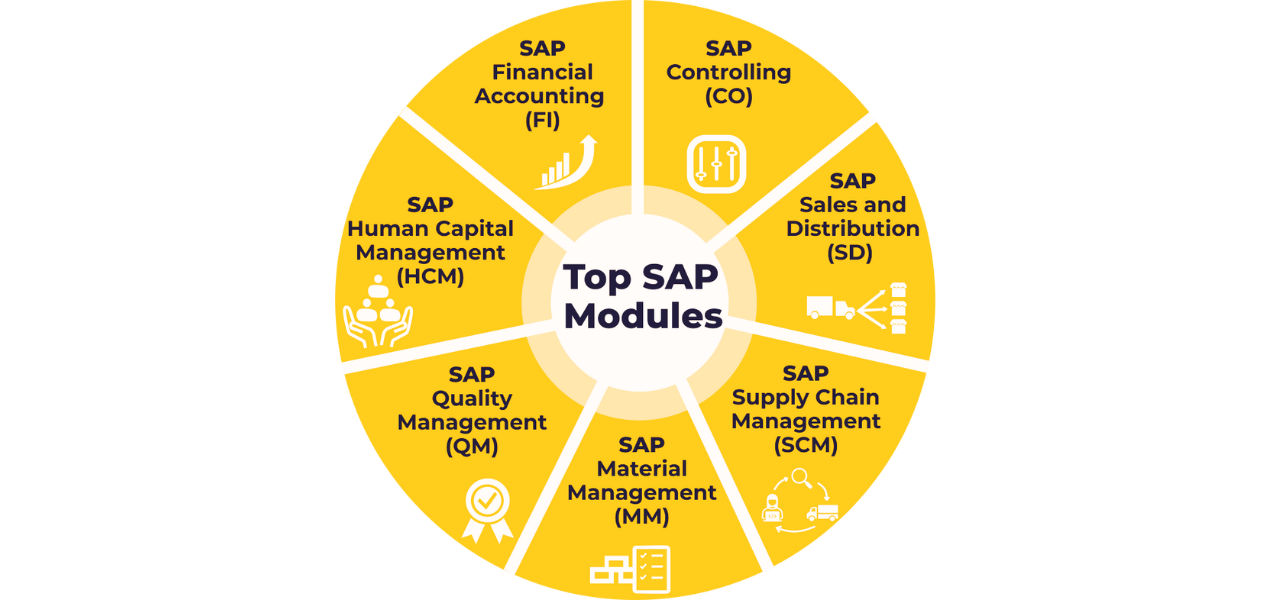
SAP provides a large number of software modules. They address different company requirements and procedures. From accounting and finance to supply chain management and human resources, SAP modules provide all-inclusive solutions. They address nearly every aspect of a company's operations and smooth integrations for maximized corporate performance.
Source: abusinesstech
These are some of the SAP ERP system's primary functional and technological modules.
- SAP Project Systems
- SAP Production Planning
- SAP Financial Accounting
- SAP Plant Maintenance
- SAP Solution Manager
- SAP Controlling
- SAP Basis
What Does SAP Do?
SAP helps companies of all sizes operate more profitably and efficiently:
- Integrates business procedures. Business process mapping, design, and platform integration are all made possible by SAP software.
- Enhances decision-making. Businesses can make better decisions by using real-time operational data from SAP software.
- Automates procedures. Payroll, invoicing, and order entry are just a few of the crucial procedures that SAP software can automate.
- Better collaboration. It is enhanced by SAP software's ability to combine numerous corporate operations into a single system. It facilitates better communication across departments.
- Adapts to new requirements. SAP software is scalable to accommodate expanding companies' needs.
- Enhances the client experience. Integrates customer data across all touch points. SAP software assists companies in providing a more individualized and consistent customer experience.
Types of SAP Modules
There are two primary SAP modules types: functional and technical.
- Functional modules offer a front-end interface for corporate functions such as human resources, business intelligence, and order processing.
- On SAP's back end, technical modules are utilized to manage upgrades, development, and your environment.
List of SAP Functional Modules
The SAP functional modules and their fundamental features will be discussed first. SAP functional modules help organizations streamline and manage business operations. Below are the main SAP functional modules, explained:
- SAP Financial Accounting (FI): This module manages an organization’s financial transactions, including general ledger, accounts receivable/payable, and financial reporting. It ensures compliance with financial regulations and standards. It is one of the popular SAP modules in demand.
- SAP Controlling (CO): Focused on cost management, CO helps monitor, plan, and analyze internal costs and budgets, providing insights for profitability analysis and operational efficiency.
- SAP Sales and Distribution (SD): Handles sales processes, order management, pricing, and distribution. It integrates with inventory and financial modules to ensure efficient order processing and revenue tracking.
- SAP Material Management (MM): Manages procurement and inventory processes, including purchase orders, goods receipt, and material valuation. It streamlines supply chain operations. It is amongst the most sought after SAP ERP modules in the Infrastructure and Real Estate sector.
- SAP Production Planning (PP): Supports production processes like demand planning, scheduling, and manufacturing execution. It ensures efficient production cycles and resource utilization.
- SAP Human Capital Management (HCM): Covers HR operations, including employee recruitment, payroll processing, performance management, and employee lifecycle management.
- SAP Customer Relationship Management (CRM): Focuses on customer data, interactions, and service management. It helps improve customer engagement and optimize sales strategies.
- SAP Supply Chain Management (SCM): Streamlines logistics, demand planning, and fulfillment processes. It enhances supply chain visibility and ensures timely delivery. It is one of the popular SAP logistics modules.
- SAP Plant Maintenance (PM): Manages equipment maintenance, inspection, and repair schedules. It minimizes downtime and improves operational efficiency.
- SAP Project Systems (PS): Helps plan and manage projects, including resource allocation, budgeting, and tracking progress. It integrates with other modules for seamless SAP project management.
- SAP Quality Management (QM): Ensures quality control in production and procurement processes. It helps monitor and maintain product and process standards.
- SAP Enterprise Asset Management (EAM): Focuses on managing an organization’s physical assets, ensuring optimal utilization and maintenance.
List of SAP Technical Modules
SAP technical modules focus on the technological and development aspects of SAP systems. They ensure that the software's back-end and programming environments function effectively.
- SAP ABAP (Advanced Business Application Programming): ABAP is the core programming language for customizing and developing SAP applications. It allows developers to create reports, interfaces, enhancements, and modifications to standard SAP applications.
- SAP Basis: Basis is the system administration module responsible for the technical foundation of SAP systems. It includes tasks like system configuration, database management, performance tuning, and user management.
- SAP HANA (High-Performance Analytic Appliance): HANA is an in-memory database that processes and analyzes data in real time. It supports the development of advanced analytical applications and accelerates the performance of SAP systems.
- SAP NetWeaver: NetWeaver serves as an integration platform, enabling seamless communication between SAP and non-SAP applications. It supports technologies like web services, Java, and .NET for cross-platform development.
- SAP PI/PO (Process Integration/Process Orchestration): This module facilitates the integration of different systems, ensuring smooth communication between SAP and third-party applications. It is critical for businesses operating complex IT landscapes.
- SAP Fiori: Fiori provides a modern, user-friendly interface for SAP applications, focusing on enhancing the user experience. It uses design principles to create responsive and role-based applications.
- SAP BW (Business Warehouse): SAP BW is a data warehousing solution for collecting, transforming, and consolidating data from different sources. It enables advanced analytics and reporting.
- SAP Cloud Platform (SCP): SCP is a Platform-as-a-Service (PaaS) offering for developing, deploying, and managing custom applications in the cloud. It supports SAP and third-party integrations.
- SAP Solution Manager (SolMan): SolMan helps in managing the entire lifecycle of SAP applications. It offers tools for implementation, testing, monitoring, and maintenance.
- SAP Security and GRC (Governance, Risk, and Compliance): This module manages security roles and authorizations, ensuring that SAP systems are secure and compliant with legal regulations.
How to Choose SAP Modules for Your Organization?
Choosing SAP modules for your organization will depend on various factors. Consider the below-mentioned points in the whole process:
- Understand Business Goals: Identify the primary objectives of your organization. Align module selection with these goals, such as finance, logistics, or HR.
- Evaluate Processes: Analyze existing business processes to determine which areas require automation or improvement.
- Industry Relevance: Choose modules designed for your industry, like SAP IS-Retail for retail or SAP IS-Utilities for energy companies.
- Budget Considerations: Assess your budget and prioritize modules offering the highest ROI.
- Employee Skills: Consider the technical expertise of your team. Opt for user-friendly modules or plan for training if needed.
- Scalability Needs: Select modules that can adapt to future growth or expansion.
- Vendor Consultation: Consult with SAP experts or vendors for personalized recommendations.
- Integration Requirements: Ensure chosen modules can integrate seamlessly with existing systems
To sum up
With unparalleled efficiency and integration, SAP is a leader in technological innovation. With its cutting-edge analytics and artificial intelligence capabilities, as well as its core ERP systems, SAP is revolutionizing how organizations function and prosper in the digital era.
Businesses can benefit greatly from using SAP and its modules. It eliminates data silos, reduces manual work, and enables streamlined processes by integrating many departments. With real-time operational visibility, businesses can make data-driven choices, improve customer happiness, and increase productivity.
By selecting SAP and its modules, you are committing to a platform that is ready for the future. It promotes growth, enhances decision-making, and guarantees sustained success in the fast-paced business environment of today.
Frequently Asked Questions (FAQs)
1. Which SAP module is the best?
Your interests, background, and prospects in your desired sector will determine which SAP module works best for you.
2. Does SAP have coding?
SAP involves coding, especially in technical roles. However, not all SAP roles require coding knowledge. SAP’s primary programming language is ABAP (Advanced Business Application Programming). Additionally, Java, SQL, and other languages may be used for development, integration, and customization tasks within SAP systems.
3. What is SAP used for?
SAP software is used to manage all kinds of important corporate operations. SAP helps organizations function more quickly and effectively by automating and integrating critical activities. The central storage of data by SAP software gives many company processes accurate and real-time insight into operations.
4. Is SAP a high-paying job?
The average salary for SAP positions is often higher than the average for the IT sector. This is a result of the specialist nature of the work and the strong demand for SAP expertise.
5. What is SAP basic type?
SAP Basic Type is a predefined data structure used in EDI and ALE to format and organize messages for data exchange between systems, such as purchase orders or invoices.
243 articles published
Kingson Jebaraj is a highly respected technology professional, recognized as both a Microsoft Most Valuable Professional (MVP) and an Alibaba Most Valuable Professional. With a wealth of experience in...
Get Free Consultation
By submitting, I accept the T&C and
Privacy Policy