
- Blog Categories
- Project Management
- Agile Management
- IT Service Management
- Cloud Computing
- Business Management
- BI And Visualisation
- Quality Management
- Cyber Security
- DevOps
- Most Popular Blogs
- PMP Exam Schedule for 2026: Check PMP Exam Date
- Top 60+ PMP Exam Questions and Answers for 2026
- PMP Cheat Sheet and PMP Formulas To Use in 2026
- What is PMP Process? A Complete List of 49 Processes of PMP
- Top 15+ Project Management Case Studies with Examples 2026
- Top Picks by Authors
- Top 170 Project Management Research Topics
- What is Effective Communication: Definition
- How to Create a Project Plan in Excel in 2026?
- PMP Certification Exam Eligibility in 2026 [A Complete Checklist]
- PMP Certification Fees - All Aspects of PMP Certification Fee
- Most Popular Blogs
- CSM vs PSM: Which Certification to Choose in 2026?
- How Much Does Scrum Master Certification Cost in 2026?
- CSPO vs PSPO Certification: What to Choose in 2026?
- 8 Best Scrum Master Certifications to Pursue in 2026
- Safe Agilist Exam: A Complete Study Guide 2026
- Top Picks by Authors
- SAFe vs Agile: Difference Between Scaled Agile and Agile
- Top 21 Scrum Best Practices for Efficient Agile Workflow
- 30 User Story Examples and Templates to Use in 2026
- State of Agile: Things You Need to Know
- Top 24 Career Benefits of a Certifed Scrum Master
- Most Popular Blogs
- ITIL Certification Cost in 2026 [Exam Fee & Other Expenses]
- Top 17 Required Skills for System Administrator in 2026
- How Effective Is Itil Certification for a Job Switch?
- IT Service Management (ITSM) Role and Responsibilities
- Top 25 Service Based Companies in India in 2026
- Top Picks by Authors
- What is Escalation Matrix & How Does It Work? [Types, Process]
- ITIL Service Operation: Phases, Functions, Best Practices
- 10 Best Facility Management Software in 2026
- What is Service Request Management in ITIL? Example, Steps, Tips
- An Introduction To ITIL® Exam
- Most Popular Blogs
- A Complete AWS Cheat Sheet: Important Topics Covered
- Top AWS Solution Architect Projects in 2026
- 15 Best Azure Certifications 2026: Which one to Choose?
- Top 22 Cloud Computing Project Ideas in 2026 [Source Code]
- How to Become an Azure Data Engineer? 2026 Roadmap
- Top Picks by Authors
- Top 40 IoT Project Ideas and Topics in 2026 [Source Code]
- The Future of AWS: Top Trends & Predictions in 2026
- AWS Solutions Architect vs AWS Developer [Key Differences]
- Top 20 Azure Data Engineering Projects in 2026 [Source Code]
- 25 Best Cloud Computing Tools in 2026
- Most Popular Blogs
- Company Analysis Report: Examples, Templates, Components
- 400 Trending Business Management Research Topics
- Business Analysis Body of Knowledge (BABOK): Guide
- ECBA Certification: Is it Worth it?
- Top Picks by Authors
- Top 20 Business Analytics Project in 2026 [With Source Code]
- ECBA Certification Cost Across Countries
- Top 9 Free Business Requirements Document (BRD) Templates
- Business Analyst Job Description in 2026 [Key Responsibility]
- Business Analysis Framework: Elements, Process, Techniques
- Most Popular Blogs
- Best Career options after BA [2026]
- Top Career Options after BCom to Know in 2026
- Top 10 Power Bi Books of 2026 [Beginners to Experienced]
- Power BI Skills in Demand: How to Stand Out in the Job Market
- Top 15 Power BI Project Ideas
- Top Picks by Authors
- 10 Limitations of Power BI: You Must Know in 2026
- Top 45 Career Options After BBA in 2026 [With Salary]
- Top Power BI Dashboard Templates of 2026
- What is Power BI Used For - Practical Applications Of Power BI
- SSRS Vs Power BI - What are the Key Differences?
- Most Popular Blogs
- Data Collection Plan For Six Sigma: How to Create One?
- Quality Engineer Resume for 2026 [Examples + Tips]
- 20 Best Quality Management Certifications That Pay Well in 2026
- Six Sigma in Operations Management [A Brief Introduction]
- Top Picks by Authors
- Six Sigma Green Belt vs PMP: What's the Difference
- Quality Management: Definition, Importance, Components
- Adding Green Belt Certifications to Your Resume
- Six Sigma Green Belt in Healthcare: Concepts, Benefits and Examples
- Most Popular Blogs
- Latest CISSP Exam Dumps of 2026 [Free CISSP Dumps]
- CISSP vs Security+ Certifications: Which is Best in 2026?
- Best CISSP Study Guides for 2026 + CISSP Study Plan
- How to Become an Ethical Hacker in 2026?
- Top Picks by Authors
- CISSP vs Master's Degree: Which One to Choose in 2026?
- CISSP Endorsement Process: Requirements & Example
- OSCP vs CISSP | Top Cybersecurity Certifications
- How to Pass the CISSP Exam on Your 1st Attempt in 2026?
- Most Popular Blogs
- Top 7 Kubernetes Certifications in 2026
- Kubernetes Pods: Types, Examples, Best Practices
- DevOps Methodologies: Practices & Principles
- Docker Image Commands
- Top Picks by Authors
- Best DevOps Certifications in 2026
- 20 Best Automation Tools for DevOps
- Top 20 DevOps Projects of 2026
- OS for Docker: Features, Factors and Tips
- More
- Agile & PMP Practice Tests
- Agile Testing
- Agile Scrum Practice Exam
- CAPM Practice Test
- PRINCE2 Foundation Exam
- PMP Practice Exam
- Cloud Related Practice Test
- Azure Infrastructure Solutions
- AWS Solutions Architect
- IT Related Pratice Test
- ITIL Practice Test
- Devops Practice Test
- TOGAF® Practice Test
- Other Practice Test
- Oracle Primavera P6 V8
- MS Project Practice Test
- Project Management & Agile
- Project Management Interview Questions
- Release Train Engineer Interview Questions
- Agile Coach Interview Questions
- Scrum Interview Questions
- IT Project Manager Interview Questions
- Cloud & Data
- Azure Databricks Interview Questions
- AWS architect Interview Questions
- Cloud Computing Interview Questions
- AWS Interview Questions
- Kubernetes Interview Questions
- Web Development
- CSS3 Free Course with Certificates
- Basics of Spring Core and MVC
- Javascript Free Course with Certificate
- React Free Course with Certificate
- Node JS Free Certification Course
- Data Science
- Python Machine Learning Course
- Python for Data Science Free Course
- NLP Free Course with Certificate
- Data Analysis Using SQL
What Is the PDCA Cycle? Steps, Examples and When to Use It
Updated on Nov 10, 2026 | 2 views
Share:
Table of Contents
View all
Quick Overview
- The PDCA cycle is a four-step continuous improvement method that helps organizations identify problems, test solutions, evaluate results, and make necessary changes. Also known as the Deming cycle or Shewhart cycle, it follows the steps Plan, Do, Check, and Act.
- Steps of the PDCA cycle: Plan involves identifying the problem and setting measurable goals; Do means testing the proposed solution; Check focuses on measuring and evaluating results; and Act involves standardizing successful changes or revising the approach.
- When should you use the PDCA cycle? Use it to solve recurring problems, improve process and product quality, reduce operational waste and delays, and test proposed changes on a small scale before implementing them across an organization.
- This guide explains what the PDCA cycle is, its purpose and four steps, practical examples across industries, when to use it, and how to implement it effectively through measurable goals, root cause analysis, team responsibilities, and regular performance reviews.
Professionals looking to apply continuous improvement in AI-driven product environments can explore AI Powered Product Management to learn how AI supports product planning, performance analysis, experimentation, and data-driven decision-making.
Master Right Skills & Boost Your Career
Avail your free 1:1 mentorship session
What is the PDCA cycle?
The PDCA cycle is a four step continuous improvement method used to identify problems, test solutions, evaluate results, and make necessary changes. It follows a repeating process of planning an improvement, putting it into practice, checking its effectiveness, and acting on the findings.
Also known as the Deming cycle or Shewhart cycle, it helps organizations improve the way they work through small, measurable changes. Instead of assuming that a solution will work, teams test it and use actual results to decide what to do next.
The main characteristics of the PDCA cycle include:
- Continuous improvement: Encourages teams to review and improve processes regularly.
- Data based decisions: Uses measurable results rather than assumptions.
- Structured problem solving: Breaks improvement work into four manageable steps.
- Flexibility: Can be applied to individual tasks, team processes, or organization wide operations.
- Repeatable approach: Allows teams to build on previous improvements through repeated cycles.
What is the purpose of the PDCA cycle?
The main purpose of the PDCA cycle is to help organizations improve processes in a planned and measurable way. It makes problem solving more systematic and helps teams understand whether a change has actually delivered the expected results.
Its key purposes include:
- Finding the cause of problems: Helps teams look beyond visible symptoms and identify what is creating an issue.
- Improving efficiency: Highlights unnecessary steps, delays, and activities that affect productivity.
- Maintaining quality: Encourages regular checks to ensure that processes meet expected standards.
- Reducing risks: Allows teams to test changes on a smaller scale before applying them widely.
- Supporting better decisions: Gives teams evidence to decide whether to continue, change, or stop an improvement.
Professionals looking to apply the PDCA cycle within structured process improvement initiatives can explore Lean Six Sigma Green Belt Training to develop skills in process analysis, waste reduction, root cause identification, and continuous improvement.
What are the four steps of the PDCA cycle?
The PDCA cycle has four connected steps: Plan, Do, Check, and Act. Each step has a specific role in the improvement process. Once the fourth step is complete, the findings can be used to begin another cycle and identify further opportunities for improvement.
Plan: Identify the problem and create an improvement plan
The Plan stage is where teams identify an issue, understand its causes, and decide what needs to change. A clear plan helps everyone understand the problem and the result they want to achieve.
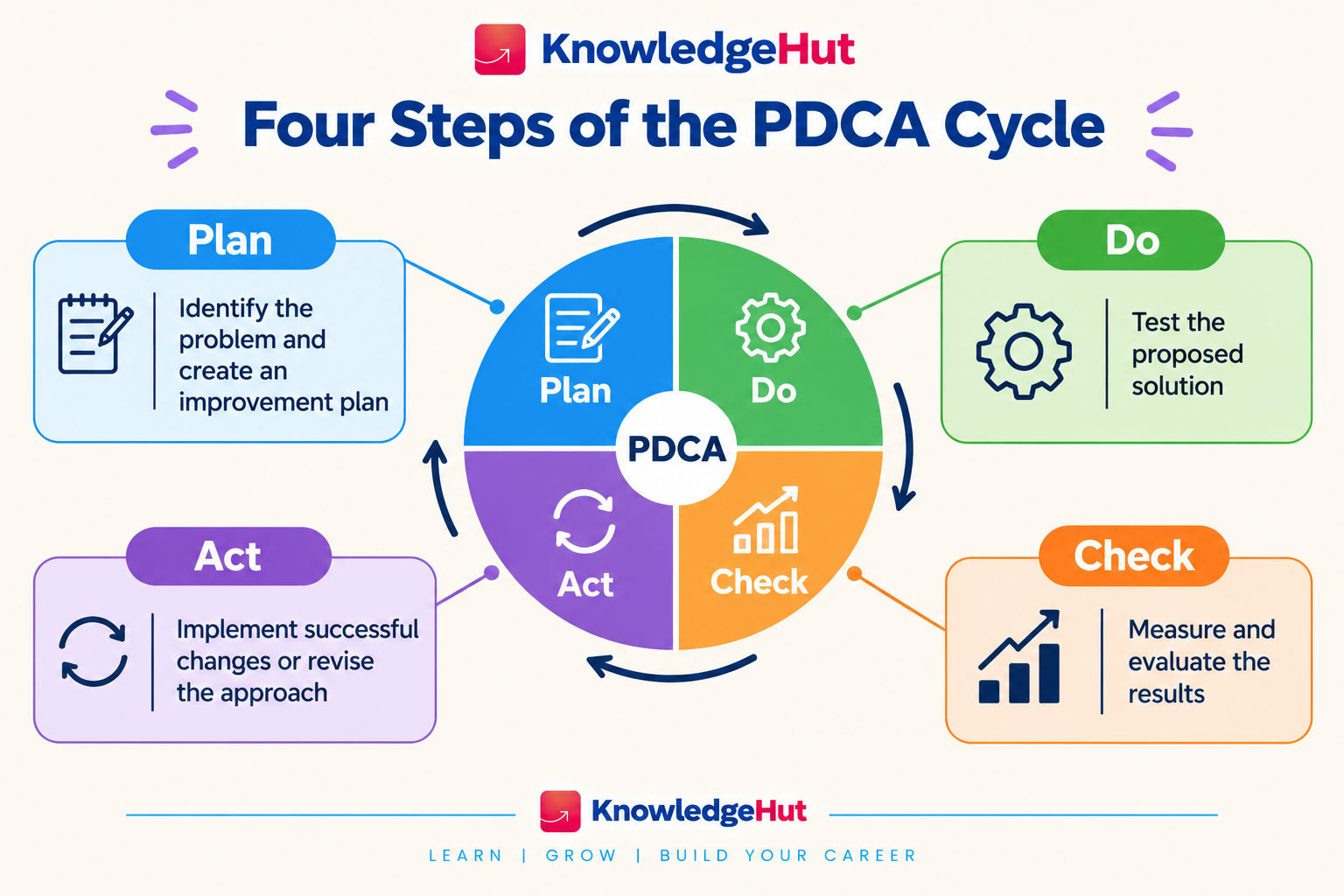
Teams should focus on the following activities:
- Define the problem: Describe what is going wrong and where it is happening.
- Identify the root cause: Collect relevant information to understand why the problem exists.
- Set measurable goals: Decide what successful improvement should look like.
- Develop a solution: Identify practical actions that could address the problem.
- Assign responsibilities: Decide who will handle each activity and when it should be completed.
Do: Test the proposed solution
The Do stage involves putting the improvement plan into action. Rather than immediately changing an entire process, teams often begin with a small trial to understand how the proposed solution works in practice.
Important activities include:
- Implementing the planned change on a limited scale.
- Informing the people involved about their responsibilities.
- Recording observations and collecting relevant data.
- Identifying unexpected issues during implementation.
- Documenting what works and what needs attention.
Check: Measure and evaluate the results
In the Check stage, teams compare the actual results with the goals defined during the Plan stage. This helps them understand whether the change has solved the problem or whether further adjustments are needed.
Teams can evaluate the results by:
- Comparing performance before and after the change.
- Reviewing the data collected during implementation.
- Checking whether the improvement goals were achieved.
- Identifying unexpected outcomes or new problems.
- Gathering feedback from employees or other stakeholders.
Act: Implement successful changes or revise the approach
The Act stage focuses on what the team should do after reviewing the results. If the change has delivered the expected improvement, it can become part of the standard process. If it has not worked, the team should revise the approach and try again.
The main activities include:
- Standardize successful changes: Include effective improvements in regular work procedures.
- Communicate the results: Share findings and updated processes with relevant teams.
- Address remaining issues: Identify areas where further improvement is required.
- Revise unsuccessful solutions: Adjust the plan based on what the team learned.
- Start another cycle: Identify the next improvement opportunity.
Organizations looking to bring AI into their continuous improvement initiatives can consider the PG Certificate in Applied Generative Engineering & LLM Applications to develop the expertise needed to build and implement LLM-powered solutions for real-world business challenges.
What are some practical examples of the PDCA cycle?
The PDCA cycle can be applied across different industries because most organizations need to improve quality, reduce delays, and solve recurring problems. The following examples show how its four steps work in different settings.
1. PDCA cycle example in manufacturing
A manufacturing company notices that a production line is generating more defective products than expected. The team uses the PDCA cycle to identify the cause and improve product quality.
- Plan: Review defect records and identify possible causes, such as incorrect machine settings or inconsistent raw materials.
- Do: Test adjusted machine settings on one production line.
- Check: Compare the defect rate before and after the adjustment.
- Act: If defects decrease, apply the improved settings to other production lines. Otherwise, investigate other possible causes.
2. PDCA cycle example in project management
A project team frequently misses deadlines because tasks are not assigned clearly and progress updates are inconsistent. The team uses the PDCA cycle to improve project coordination.
- Plan: Identify where delays occur and create a clearer task allocation and reporting process.
- Do: Test the updated process with one project team.
- Check: Review task completion rates, missed deadlines, and team feedback.
- Act: Make the updated process standard if it improves delivery. Otherwise, revise the workflow.
3. PDCA cycle example in healthcare
A hospital wants to reduce the time patients spend waiting for routine appointments. The management team reviews the appointment process to find opportunities for improvement.
- Plan: Examine appointment records and identify scheduling gaps or delays.
- Do: Test a revised appointment scheduling process in one department.
- Check: Compare patient waiting times before and after the change.
- Act: Extend the improved process if waiting times decrease, or adjust the scheduling approach if delays continue.
4. PDCA cycle example in software development
A software development team receives repeated reports of bugs after releasing new updates. It decides to improve its testing process.
- Plan: Review bug reports and identify gaps in the existing testing workflow.
- Do: Introduce an additional testing stage for a selected software release.
- Check: Compare the number of bugs reported after release.
- Act: Make the additional testing stage part of the regular workflow if it reduces bugs. Otherwise, review the testing strategy.
Also read: Six Sigma Process Owner
When should you use the PDCA cycle?
The PDCA cycle is useful when a team needs a structured way to improve an existing process or address a problem. It works particularly well when changes can be tested, measured, and refined over time.
You can use it in the following situations:
1. To identify and solve recurring problems
When the same problem appears repeatedly, the PDCA cycle helps teams investigate its underlying cause instead of repeatedly fixing its symptoms.
It is useful when:
- The same operational issue occurs across different teams.
- Employees regularly report similar process challenges.
- Existing solutions provide only temporary relief.
- Teams need a systematic way to prevent the problem from returning.
2. To improve processes and product quality
Organizations can use the PDCA cycle to review existing workflows and identify ways to improve quality. It helps teams evaluate whether process changes are producing consistent results.
It can be useful for:
- Reducing product defects and service errors.
- Improving customer satisfaction.
- Making work processes more consistent.
- Reviewing quality standards and performance.
3. To reduce operational waste, costs, and delays
The PDCA cycle can help identify activities that consume unnecessary time, money, or resources. Teams can test improvements and measure whether they reduce operational waste.
Common areas of application include:
- Reducing repeated or unnecessary tasks.
- Improving resource allocation.
- Identifying delays in approval processes.
- Minimizing material waste and rework.
- Improving coordination between departments.
4. To test process changes before implementing them at scale
When a proposed change could affect several teams or departments, testing it on a smaller scale can help reduce implementation risks.
The PDCA cycle is useful when:
- A new workflow needs to be evaluated.
- An organization plans to introduce a new tool or process.
- A proposed change requires employee feedback.
- The impact of an improvement is not yet clear.
The Generative AI and Prompt Engineering program can help professionals understand how to use AI tools to identify process improvements, streamline repetitive tasks, and support each stage of the PDCA cycle.
How to implement the PDCA cycle effectively
Using the PDCA cycle effectively requires clear goals, reliable information, team involvement, and regular evaluation. Each stage should be connected to the same improvement objective so that the process leads to measurable results.
1. Set measurable improvement goals
Start by defining what the team wants to improve. A general goal such as improving efficiency is difficult to measure. A specific target makes it easier to evaluate progress.
Follow these practices:
- Define the problem in clear terms.
- Set a realistic and measurable target.
- Decide which performance indicators will be tracked.
- Establish a timeframe for reviewing progress.
- Make sure everyone understands the expected outcome.
2. Identify root causes and plan solutions
Once the goal is clear, investigate why the problem is occurring. Avoid choosing a solution before understanding the factors responsible for the issue.
Teams can:
- Review available records and performance data.
- Speak with employees who work directly with the process.
- Use root cause analysis to identify contributing factors.
- Compare possible solutions based on effort and expected impact.
- Select an approach that can be tested within the available resources.
3. Assign responsibilities and track performance
Improvement work becomes easier to manage when everyone knows their role. Assigning responsibilities also helps teams track progress and identify delays during implementation.
To maintain accountability:
- Assign a person to each major activity.
- Set deadlines for completing planned actions.
- Share progress updates with relevant team members.
- Maintain records of changes and observations.
- Track the performance indicators defined during planning.
4. Review results and standardize successful improvements
The final implementation step is to evaluate the outcome and decide what should happen next. Teams should use the collected data to determine whether the change has achieved its intended purpose.
If the results are positive:
- Document the improved process.
- Update relevant procedures and guidelines.
- Communicate the change to everyone involved.
- Monitor performance to ensure that the improvement continues.
Conclusion
The PDCA cycle is suitable for organizations and teams that want to solve recurring problems, improve quality, and make decisions based on measurable results. It is especially useful when a process can be tested and improved gradually.
However, it may not be the best standalone approach when an urgent issue requires immediate action or when a problem needs a larger transformation strategy. The most important factor is having a clearly defined problem and reliable ways to measure improvement. Start with a manageable change, evaluate its impact, and use the findings to decide what should happen next.
Have A Query? Get in Touch With Our Customer Support | upGrad KnowledgeHut
Frequently Asked Questions (FAQs)
1. Are Kaizen and PDCA the same?
No, Kaizen and PDCA are related but not the same. Kaizen is a philosophy of continuous improvement, while the PDCA cycle is a structured four-step method used to implement and evaluate improvements. PDCA often supports Kaizen initiatives.
2. Is PDCA a part of Kaizen?
Yes, the PDCA cycle is commonly used to put Kaizen principles into practice. Teams use Plan, Do, Check, and Act to identify problems, test solutions, measure results, and standardize improvements. It helps make continuous improvement systematic.
3. Is Kaizen better than Six Sigma?
Neither approach is universally better. Kaizen focuses on continuous, incremental improvements involving employees, while Six Sigma uses data-driven methods to reduce defects and process variation. The right choice depends on the problem and improvement goals.
4. Is Six Sigma still relevant in 2026?
Yes, Six Sigma remains relevant in industries such as manufacturing, healthcare, finance, and logistics. Organizations continue to use it to improve process quality, reduce defects, and control variation. It is also frequently combined with Lean practices.
5. What has replaced Six Sigma?
No single methodology has replaced Six Sigma. Organizations continue to use approaches such as Lean, Agile, Kaizen, and data-driven process improvement alongside Six Sigma. The PDCA cycle also remains useful for testing changes and improving processes continuously.
6. Does anyone use Six Sigma anymore?
Yes, many organizations still use Six Sigma to improve operational efficiency and quality. Its tools, including DMAIC, statistical analysis, and root cause analysis, remain useful for solving complex process problems. Some businesses integrate them with Lean and continuous improvement methods.
7. Why did Six Sigma fail in some organizations?
Six Sigma initiatives can fail because of weak leadership support, inadequate training, poor project selection, and an excessive focus on certification. They may also struggle when employees do not participate or improvements are not sustained. Consistent monitoring, including the PDCA cycle, can help address these challenges.
8. Is PDCA Lean or Six Sigma?
PDCA is a continuous improvement method used in both Lean and Six Sigma. In Lean, it supports waste reduction and process improvement. In Six Sigma, it can help test changes and monitor results, although DMAIC is the more established Six Sigma problem-solving framework.
9. Why does Kaizen fail?
Kaizen can fail when organizations lack management commitment, employee involvement, or a clear improvement process. Treating it as a one-time activity rather than an ongoing practice also limits its impact. Using the PDCA cycle helps teams track progress and sustain improvements.
10. Is Kaizen outdated?
No, Kaizen is still relevant because organizations continue to need consistent process improvement, waste reduction, and employee participation. Its principles can be applied across manufacturing, healthcare, technology, and service industries. Modern teams often combine Kaizen with Agile and Lean practices.
11. What are the 14 principles of Edward Deming?
W. Edwards Deming's 14 principles are management guidelines for improving quality and organizational performance. They emphasize consistency of purpose, continuous improvement, leadership, employee training, teamwork, and eliminating fear. The PDCA cycle complements these principles by providing a practical method for continuous improvement.
1664 articles published
KnowledgeHut is an outcome-focused global ed-tech company. We help organizations and professionals unlock excellence through skills development. We offer training solutions under the people and proces...
Get Free Career Counselling
By submitting, I accept the T&C and
Privacy Policy