
Top 10 AI Tools for Product Launch Planning
Updated on Aug 27, 2026 | 0.5k+ views
Share:
Table of Contents
View all
Quick Overview
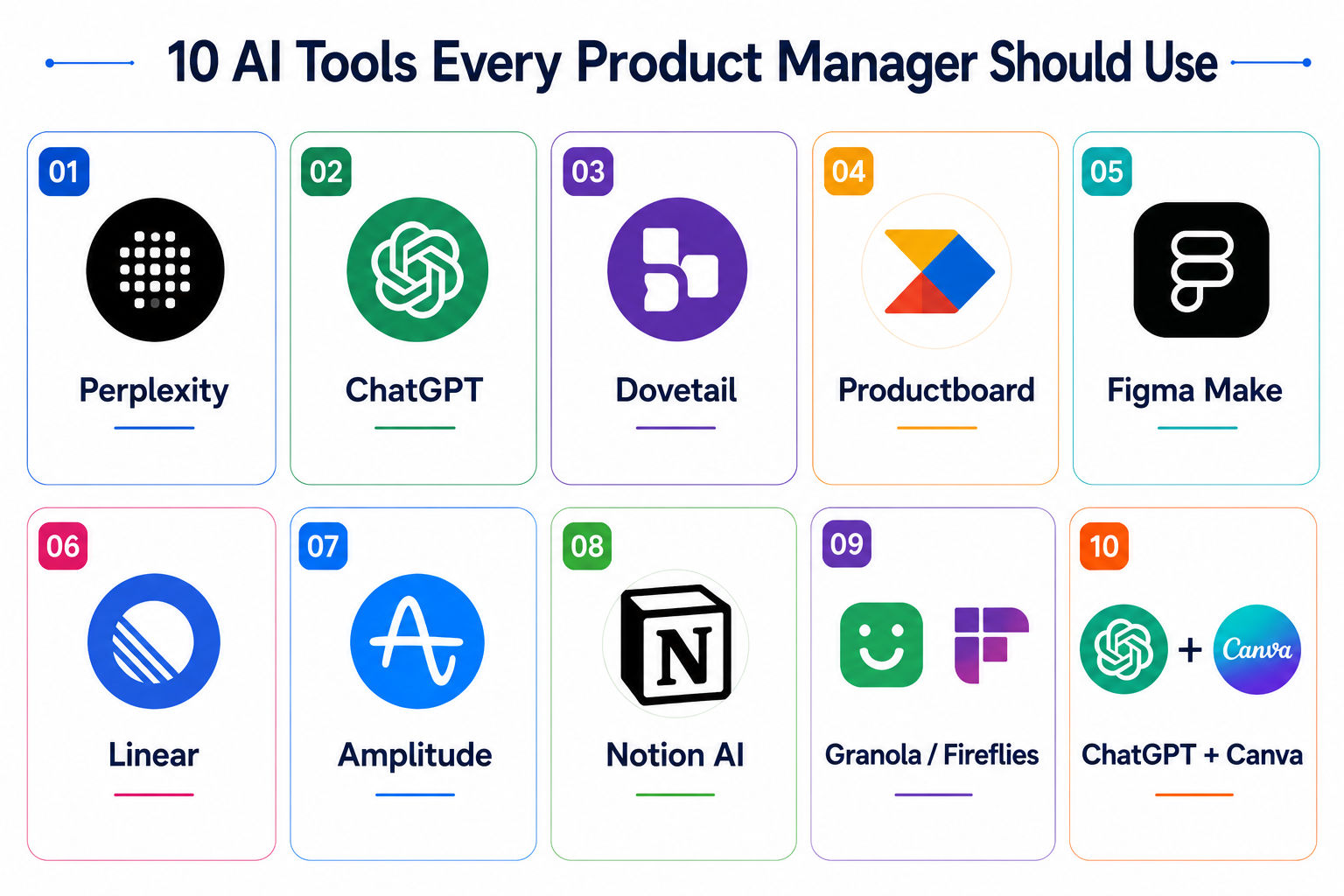
- Top 10 AI tools for product launch planning: Perplexity, ChatGPT, Dovetail, Productboard, Figma Make, Linear, Amplitude, Notion AI, Granola, and Fireflies.
- AI tools can simplify market research, strategy, planning, prototyping, execution, analytics, and launch content.
- The right AI tool depends on launch goals, features, integrations, security, budget, and team requirements
- In this guide, learn how to choose the right AI tools, create a product launch plan with AI, and address common challenges such as accuracy, security, cost, and human oversight.
Build advanced product ownership skills with A-CSPO® Certification and strengthen the ability to lead product strategy in Agile environments.
Top 10 AI tools for Product Launch Planning
Different stages of a product launch need different types of support. Rather than relying on one platform for everything, teams can combine specialized tools based on their workflow.
The tools work best when they complement each other rather than replacing the entire launch workflow.
1. Perplexity
Perplexity is useful in the research phase when a product manager needs up-to-date information about the market, the competitors, or the industry.
Key features
- AI powered web research
- Source backed answers
- Deep research
- Multi source synthesis
- Research report generation
Pros
- Useful for fast market research
- Provides cited sources
- Helpful for competitor analysis
- Can synthesize large amounts of information
Cons
- Research still needs human verification
- Source quality can vary
- Not a complete product management platform
2. ChatGPT
ChatGPT can assist with various stages of launch planning, starting with strategy and brainstorming, and continuing through research, positioning, the preparation of PRDs, and finally launch planning.
Key features
- Strategy brainstorming
- Market research
- PRD drafting
- Competitive analysis
- Launch planning
- Content creation
Pros
- Flexible across multiple launch tasks
- Useful for structured brainstorming
- Can help turn research into plans
- Supports product strategy workflows
Cons
- Outputs require review
- Quality depends on context and prompts
- Does not replace product judgment
3. Dovetail
Dovetail is intended for the purpose of customer research and customer intelligence and can assist teams in converting interviews, feedback, and other customer signals into actionable insights.
Key features
- AI research analysis
- Customer feedback synthesis
- Themes and trends
- Search across research
- Insight documentation
Pros
- Strong customer research focus
- Helps organize scattered feedback
- Supports evidence-based product decisions
- Useful for identifying recurring customer themes
Cons
- More specialized than general AI tools
- Value depends on having usable customer research data
- May be more than needed for very small launches
4. Productboard
Productboard enables Product Managers to link customer needs with product priorities and roadmaps.
Key features
- Product roadmapping
- Customer feedback management
- Prioritization
- Product objectives
- AI assisted insights
Pros
- Strong product management focus
- Connects feedback with roadmap decisions
- Useful for prioritization
- Helps align stakeholders
Cons
- More specialized than general planning tools
- May require setup and process adoption
- Best suited to teams with established product workflows
5. Figma Make
Figma Make can assist product and design teams in turning their ideas into working prototypes and in exploring various product directions prior to development.
Key features
- AI generated prototypes
- Natural language prompts
- Design context
- Visual editing
- Interactive prototypes
Pros
- Fast concept validation
- Keeps design and prototyping connected
- Supports iterative exploration
- Useful for stakeholder demonstrations
Cons
- Prototype quality still needs review
- Complex product behavior may require manual refinement
- Production requirements can go beyond prototyping
6. Linear
Linear can assist with the execution phase by helping teams organize their product work, issues, priorities, and delivery tasks.
Key features
- Issue tracking
- Project planning
- Team workflows
- Product development coordination
- AI assisted workflows
Pros
- Clean product development workflow
- Useful for cross functional teams
- Helps connect planning with execution
- Suitable for fast moving product teams
Cons
- Primarily focused on execution
- Less suited to early market research
- Requires a defined team workflow
7. Amplitude
Amplitude can assist with the analytics phase by helping teams understand product behaviour and to measure the way that customers interact with the product.
Key features
- Product analytics
- Funnel analysis
- Behavioral analysis
- Retention analysis
- Product performance measurement
Pros
- Strong focus on product behavior
- Useful for launch performance tracking
- Helps connect usage with outcomes
- Supports data driven decisions
Cons
- Requires meaningful product data
- Analytics setup can take time
- Insights still require product interpretation
8. Notion AI
Notion AI can assist with the documentation aspect of launch planning by helping teams to organize information, produce documents, and summarize the project material.
Key features
- Documentation
- AI writing assistance
- Summarization
- Knowledge organization
- Team collaboration
Pros
- Useful for centralized launch documentation
- Flexible workspace
- Easy to adapt to different team workflows
- Helpful for summarizing information
Cons
- Broad rather than launch specific
- Requires good information organization
- Teams may need separate tools for specialized product tasks
9. Granola and Fireflies
Granola and Fireflies can assist with meetings by converting conversations into notes, summaries, and actionable information.
Key features
- AI meeting notes
- Summaries
- Action items
- Conversation capture
- Searchable meeting information
Pros
- Reduces manual note taking
- Helps capture launch decisions
- Useful for stakeholder meetings
- Makes follow up easier
Cons
- Meeting summaries still need review
- Accuracy can vary by conversation quality
- Does not replace dedicated project management
10. ChatGPT and Canva
ChatGPT and Canva can assist teams during the launch content phase by helping them get from having ideas to producing usable marketing materials.
Key features
- Launch messaging
- Content ideation
- Copy drafting
- Visual asset creation
- Presentation and social content
Pros
- Speeds up content production
- Useful for multiple launch channels
- Supports rapid iteration
- Helpful for small marketing teams
Cons
- Brand consistency needs review
- AI generated content may require editing
- Visual assets still need human approval
Build practical Agile skills with the Best Agile Management Certification Training Courses and advance your Agile career.
How to choose the right AI tools for Product Launch Planning
The AI tools that should be used when planning a product launch need to match the team's real launch process; a tool which appears powerful on its own might not provide much value if it results in another disconnected workflow.
1. Product Launch Goals and Use Cases
The first step is to determine which section of the launch process requires improvement.
Consider whether the main need is:
- Market research
- Customer insight
- Strategy
- Prototyping
- Execution
- Analytics
- Documentation
- Content creation
2. AI Capabilities and Integrations
Make sure that the tool is compatible with the systems that the team currently uses.
Look for:
- APIs
- Integrations
- Data connections
- Export options
- Workflow automation
- Collaboration features
3. Ease of Use and Team Collaboration
AI tools ought to serve in reducing friction rather than adding another layer of complexity.
Consider:
- Learning curve
- Team adoption
- Collaboration
- Sharing
- Permissions
- Workflow fit
4. Data Security and Privacy
Planning for a launch usually includes carrying out customer research, referring to strategy documents, using product information, and dealing with business sensitive data.
Review:
- Data handling
- Access controls
- Storage
- Privacy policies
- Workspace permissions
- Enterprise security options
5. Scalability and Cost
A tool which is effective for one Product Manager might not function just as well for a team that is expanding.
Consider:
- Number of users
- Usage limits
- AI credits
- Subscription costs
- Integration costs
- Scaling requirement
6. Accuracy and Human Oversight
AI ought to assist in making product decisions rather than making important decisions without them being reviewed.
Teams should validate:
- Market research
- Customer insights
- Product recommendations
- Analytics
- Launch messaging
- Generated content
Turn ideas into market ready products with Idea to Product Launch with Gen AI and learn how AI can support research, planning, and launch execution.
How to use AI tools to create a Product Launch Planning
It is most effective to use AI tools when carrying out product launch planning as part of a connected process, each tool being used for a particular stage while the Product Manager retains the responsibility for prioritization and making the final decisions.
1. Defining Launch Objectives and Success Metrics
The first step is to clarify what results the launch is expected to achieve.
Possible goals include:
- Product adoption
- Revenue
- Customer acquisition
- Activation
- Retention
- Market awareness
2. Building the Launch Timeline
Create milestones around:
- Product readiness
- Testing
- Marketing preparation
- Sales enablement
- Content production
- Launch
- Post launch analysis
3. Assigning Tasks and Responsibilities
Launch plans should clearly identify:
- Task
- Owner
- Deadline
- Dependency
- Status
4. Creating Launch Messaging and Content
AI can help create initial versions of:
- Product messaging
- Email copy
- Social posts
- FAQs
- Sales materials
- Launch announcements
5. Identifying Launch Risks and Dependencies
AI can help teams think through risks related to:
- Product readiness
- Customer adoption
- Technical dependencies
- Marketing execution
- Support capacity
- Competitive response
6. Tracking Launch Progress and Performance
Once the launch has taken place, the teams should combine the execution data with the product analytics.
Track:
- Launch milestones
- Adoption
- Engagement
- Conversion
- Retention
- Customer feedback
Learn how Product Managers use AI for product discovery to uncover customer insights, validate ideas, analyze markets, and make faster product decisions.
Challenges of using AI tools for Product Launch Planning
The most effective AI tools available for product launch planning can still give rise to new risks if teams rely on them without carrying out sufficient review and consideration.
1. Accuracy and Hallucination Risk
AI is capable of producing wrong market information, assumptions, summaries, or recommendations.
Important outputs should be checked against:
- Primary sources
- Customer research
- Product data
- Internal documentation
2. Data Privacy and Security
It is advisable for teams not to put sensitive product, customer, or strategic information into tools unless they have a clear understanding of how that information will be handled.
3. Over Reliance on AI Recommendations
Although AI can propose priorities and strategies, it does not have ownership of the business context.
Product Managers still need to evaluate:
- Customer impact
- Business strategy
- Feasibility
- Risk
- Timing
4. Integration With Existing Product Tools
Relying on a large number of independent tools can result in redundant work and scattered information.
Teams should check if the AI tool in question integrates with the existing launch workflow before introducing it.
5. Maintaining Human Decision Making
While AI can speed up research, writing, analysis, and coordination, the final decision regarding a product and its launch should still be left to responsible members of the team.
Learn How to Build an AI Product Roadmap and align AI initiatives with product goals, customer needs, priorities, and business outcomes.
Conclusion
The best AI tools for product launch planning are not necessarily the ones with the most features. The better choice is the tool that solves a specific launch problem and fits naturally into the team's existing workflow.
The key decision is to choose tools based on launch goals, integrations, data security, usability, cost, and the level of human oversight required rather than trying to automate the entire launch process at once.
Contact our upGrad KnowledgeHut experts for personalized guidance on choosing the right course, career path, and certification to achieve your goals.
Frequently Asked Questions (FAQs)
1. How can Product Managers combine multiple AI tools into one product launch workflow?
Start by assigning each tool in a clear role, such as research, planning, execution, analytics, or content creation. Connect tools where possible and keep core launch information in one central workspace. This reduces fragmented data and repeated work.
2. How can teams avoid duplicating work across different AI launch tools?
Define which tool owns each type of information and task before starting the launch. Use integrations, shared documents, and a central launch plan to prevent teams from recreating the same research, content, or tasks on multiple platforms.
3. Which AI tool is best for managing the entire product launch in one place?
There is no single best tool for every launch. The right choice depends on team size, workflow, integrations, and required capabilities. A centralized project or product management platform may work best when coordination is the main priority.
4. How can AI tools help predict launch risks before launch day?
AI can analyze timelines, dependencies, workloads, historical information, and project progress to identify potential risks. It can flag delays, missing tasks, or resource constraints early, so teams can address them before they affect the launch.
5. How can AI tools help estimate whether a product launch is likely to succeed?
AI can analyze factors such as customer research, historical performance, market signals, adoption data, and campaign metrics. These insights can help estimate launch potential, but they should support business judgment rather than guarantee success.
6. Can AI tools automatically adjust a launch plan when timelines or dependencies change?
Some AI-enabled planning tools can identify affected tasks and suggest changes when timelines or dependencies shift. However, significant changes should still be reviewed by the Product Manager before deadlines, priorities, or responsibilities are changed.
7. How can Product Managers use AI tools for post launch analysis and learnings?
AI can summarize launch performance, customer feedback, product usage, campaign results, and support data. It can help identify patterns, explain what worked or failed, and turn those findings into actions for future launches.
8. How should teams decide which launch tasks should remain human controlled?
Tasks involving major business decisions, sensitive data, customer impact, pricing, positioning, or risk should generally remain under human control. AI can assist with research and recommendations, while accountable team members make the final decisions.
9. How can AI tools support product launch planning when customer data is limited?
AI can still help with market research, competitor analysis, hypothesis generation, planning, and content creation when customer data is limited. However, teams should clearly separate assumptions from validated customer insights and avoid treating AI-generated findings as confirmed evidence.
10. What is the best AI tool stack for a small product team with a limited budget?
A small team can start with a few tools covering the most important stages, such as research, planning, execution, analytics, and content. Choosing tools that integrate well and offer multiple capabilities can reduce both subscription costs and workflow complexity.
1639 articles published
KnowledgeHut is an outcome-focused global ed-tech company. We help organizations and professionals unlock excellence through skills development. We offer training solutions under the people and proces...
Get Free Consultation
By submitting, I accept the T&C and
Privacy Policy