
Top Benefits of Scrum for Software Development Teams in 2026
Updated on Jul 28, 2026 | 174 views
Share:
Table of Contents
View all
Master the Right Skills & Boost Your Career
Avail your free 1:1 mentorship session
Quick Overview
- Scrum helps software development teams deliver faster, improve quality, and adapt quickly through short Sprint cycles.
- It improves collaboration, transparency, and early feedback, helping teams reduce risks and deliver greater customer value.
- Regular customer feedback keeps development aligned with business needs.
- In this guide, you'll learn the top benefits of Scrum for software development teams in 2026 and how to maximize them.
Before diving into the changing responsibilities of Scrum Masters, it's worth understanding how CSM® Certification Training helps build the core skills required for the role.
Key Advantages Scrum Brings to Development Teams
The growing popularity of Scrum is not based on theory alone. Organizations continue to adopt it because it produces measurable improvements in delivery, collaboration, quality, and customer satisfaction. Understanding the Top Benefits of Scrum for Software Development helps teams appreciate why Scrum remains relevant in 2026.
1. Faster Product Delivery
One of the biggest reasons companies choose Scrum is its ability to deliver working software more quickly.
Instead of spending months building an entire application before release, Scrum divides work into short Sprints. Each Sprint produces a usable product increment that can be reviewed, tested, and improved immediately.
Example
A startup developing a food delivery application can release essential ordering features within the first few Sprints instead of waiting until every planned feature is complete. Early customer feedback helps the team improve future releases while already serving real users.
This ability to shorten development cycles is one of the Top Benefits of Scrum for Software Development, particularly for organizations competing in rapidly changing markets
2. Better Collaboration Across Teams
Successful software projects depend on effective communication.
Scrum encourages developers, Product Owners, Scrum Masters, and stakeholders to collaborate throughout the project instead of working in isolated departments.
Daily Scrum meetings help everyone stay informed about progress, upcoming work, and potential blockers.
Example
A Product Owner identifies a new customer request during a Sprint Review. Instead of waiting for the next project phase, the team discusses the request, updates the Product Backlog, and considers it during the following Sprint Planning session.
Improved collaboration remains one of the Top Benefits of Scrum for Software Development because it creates stronger alignment between technical teams and business objectives.
3. Improved Product Quality
Delivering software quickly has little value if quality suffers.
Scrum improves software quality by encouraging continuous testing, regular reviews, and early defect detection throughout development.
Rather than leaving testing until the end of the project, Scrum teams verify functionality during every Sprint. Problems are identified early when they are easier and less expensive to resolve.
Example
During a Sprint Review, users discover that a newly developed reporting feature is difficult to navigate. Because the issue is identified early, developers improve the interface before additional features depend on it.
Consistently improving quality is among the Top Benefits of Scrum for Software Development, helping organizations reduce production defects and increase customer confidence.
4. Greater Flexibility to Changing Requirements
Customer expectations rarely remain constant throughout a project.
Business priorities evolve; competitors introduce new features, and market conditions change unexpectedly.
Scrum is designed to handle these changes without disrupting the entire project.
Backlog refinement sessions allow Product Owners to reorder priorities regularly based on business value.
Example
A financial services company receives new regulatory requirements through development. Instead of restarting the project, the Product Owner adjusts backlog priorities, so compliance features are delivered during upcoming Sprints.
The ability to respond quickly to change continues to be one of the Top Benefits of Scrum for Software Development, especially in industries where requirements evolve frequently.
5. Higher Customer Satisfaction
Customer involvement is built directly into Scrum.
Rather than waiting until project completion, customers and stakeholders regularly review product increments and provide feedback throughout development.
This ongoing collaboration helps ensure the final product reflects actual user needs rather than assumptions made months earlier.
6. Increased Transparency
Transparency is one of the core principles of Scrum.
Everyone involved in the project should understand current priorities, Sprint progress, completed work, and upcoming objectives.
Scrum achieves this through Product Backlogs, Sprint Backlogs, Sprint Reviews, and visible task boards.
Instead of relying on lengthy status reports, stakeholders can easily understand project progress by reviewing Sprint outcomes.
Greater visibility also helps identify risks before they become major obstacles.
This transparency is one of the Top Benefits of Scrum for Software Development because it supports better decision making across technical and business teams.
7. Better Risk Management
Every software project involves uncertainty.
Technical challenges, changing priorities, resource constraints, and customer feedback all introduce potential risks.
Scrum reduces these risks by delivering software in small increments rather than one large release.
Regular reviews allow teams to identify problems early, while short Sprint cycles provide opportunities to adjust plans quickly.
Continuous adaptation prevents small issues from growing into expensive project failures.
Example
A development team discovers performance issues during an early Sprint instead of shortly before product launch. Addressing the issue immediately prevents delays that could have affected the entire release schedule.
Managing uncertainty effectively remains one of the Top Benefits of Scrum for Software Development.
8. Stronger Team Accountability
Scrum encourages shared ownership rather than individual responsibility alone.
Teams commit to Sprint Goals together and work collectively to achieve them.
Instead of assigning blame when challenges occur, Scrum encourages collaboration, problem solving, and continuous improvement.
Self-managing teams also gain greater ownership of their work because they participate in planning and decision making throughout each Sprint.
This culture of accountability improves motivation and encourages better collaboration.
9. Improved Predictability
Reliable delivery is important for both development teams and stakeholders.
Scrum improves predictability through consistent Sprint durations, velocity tracking, and regular delivery patterns.
Over time, teams develop a better understanding of how much work they can realistically complete during each Sprint.
This helps Product Owners make informed planning decisions while giving stakeholders greater confidence in delivery timelines.
10. Continuous Learning and Improvement
One of the defining characteristics of Scrum is its commitment to continuous improvement.
Sprint Retrospectives encourage teams to reflect on what worked well, what challenges they encountered, and what changes could improve future Sprints.
Continuous improvement remains one of the Top Benefits of Scrum for Software Development because it supports sustainable long-term success.
Read: 8 Best Scrum Master Certifications to Pursue in 2026 to compare the leading options.
Real World Examples of Scrum Benefits
The advantages of Scrum become even clearer when applied to real software development projects. Organizations of different sizes use Scrum to solve practical challenges, improve collaboration, and deliver better products. These examples highlight the Top Benefits of Scrum for Software Development in action.
1. Startup Launching a Minimum Viable Product Faster
Startups often have limited budgets and tight deadlines. Waiting several months for a complete product can delay customer feedback and increase business risk.
By using Scrum, a startup can divide development into short Sprints and release a Minimum Viable Product with core features much earlier. Customer feedback collected after each Sprint helps the team decide which features deserve further investment.
Example
A health technology startup planned to build an application with twenty features. Instead of waiting until everything was complete, the team released the first version with appointment booking, user registration, and notifications after three Sprints. Early customer feedback revealed that users wanted online consultations before several planned features. The Product Owner adjusted the backlog, allowing the team to deliver greater customer value without delaying the launch.
2. Enterprise Reducing Release Delays
Large organizations often manage multiple development teams working on interconnected products. Traditional planning can create long release cycles and delayed feedback.
Scrum encourages regular Sprint Reviews, cross functional collaboration, and continuous planning, making it easier to identify delays before they affect the entire project.
A global software company, for example, can coordinate several Scrum teams through shared Sprint planning and regular stakeholder reviews. Instead of discovering integration problems shortly before release, teams resolve issues throughout development.
3. SaaS Company Improving Customer Satisfaction
Software as a Service company relies heavily on customer retention.
Using Scrum, development teams release updates regularly instead of waiting for large annual upgrades. Customers receive improvements more frequently, while feedback collected during each release influences future priorities.
This continuous delivery model helps products evolve according to customer expectations rather than internal assumptions.
4. Financial Technology Team Managing Regulatory Changes
Financial technology companies frequently face changing compliance requirements.
With Scrum, Product Owners can reprioritize backlog items whenever new regulations appear. Development teams then address compliance changes during upcoming Sprints without disrupting the entire project roadmap.
Also Read: Certified Scrum Master (CSM) Future: Trends & Predictions
Common Software Development Challenges Scrum Helps Solve
Software projects rarely fail because developers lack technical knowledge. More often, projects struggle because of poor communication, changing priorities, delayed feedback, and limited visibility.
The Top Benefits of Scrum for Software Development include addressing many of these challenges through structured collaboration and continuous improvement.
1. Scope Changes
Changing business priorities often affects software projects.
Instead of treating every new request as an emergency, Scrum uses a prioritized Product Backlog where changes are evaluated and scheduled based on business value.
This approach prevents unnecessary disruption while ensuring important work receives appropriate attention.
2. Communication Gaps
Miscommunication between developers, Product Owners, testers, and stakeholders often delays projects.
Daily Scrum meetings, Sprint Reviews, and regular collaboration reduce misunderstandings by encouraging frequent communication throughout development.
3. Delayed Testing
Testing software only at the end of development increases the likelihood of expensive defects.
Scrum encourages continuous testing during every Sprint, allowing teams to detect and resolve issues much earlier.
Unclear Priorities
Without clear priorities, development teams may spend valuable time working on features that provide limited business value.
The Product Owner continuously prioritizes backlog items, so teams always focus on the highest value of work.
4. Slow-Release Cycles
Traditional development approaches often delay software releases until every feature is complete.
Scrum delivers working software incrementally, allowing organizations to release valuable functionality much sooner.
5. Poor Stakeholder Visibility
Stakeholders need regular insight into project progress.
Sprint Reviews and transparent task boards provide ongoing visibility without requiring lengthy status reports.
6. Low Team Morale
Long projects with limited feedback can reduce motivation.
Scrum promotes shared ownership, celebrates completed Sprint Goals, and encourages continuous improvement, helping teams remain engaged throughout development.
If you're building a long-term Agile career, read Career Path of a Certified Scrum Master: Certifications & Job Roles to explore progression opportunities beyond the Scrum Master role.
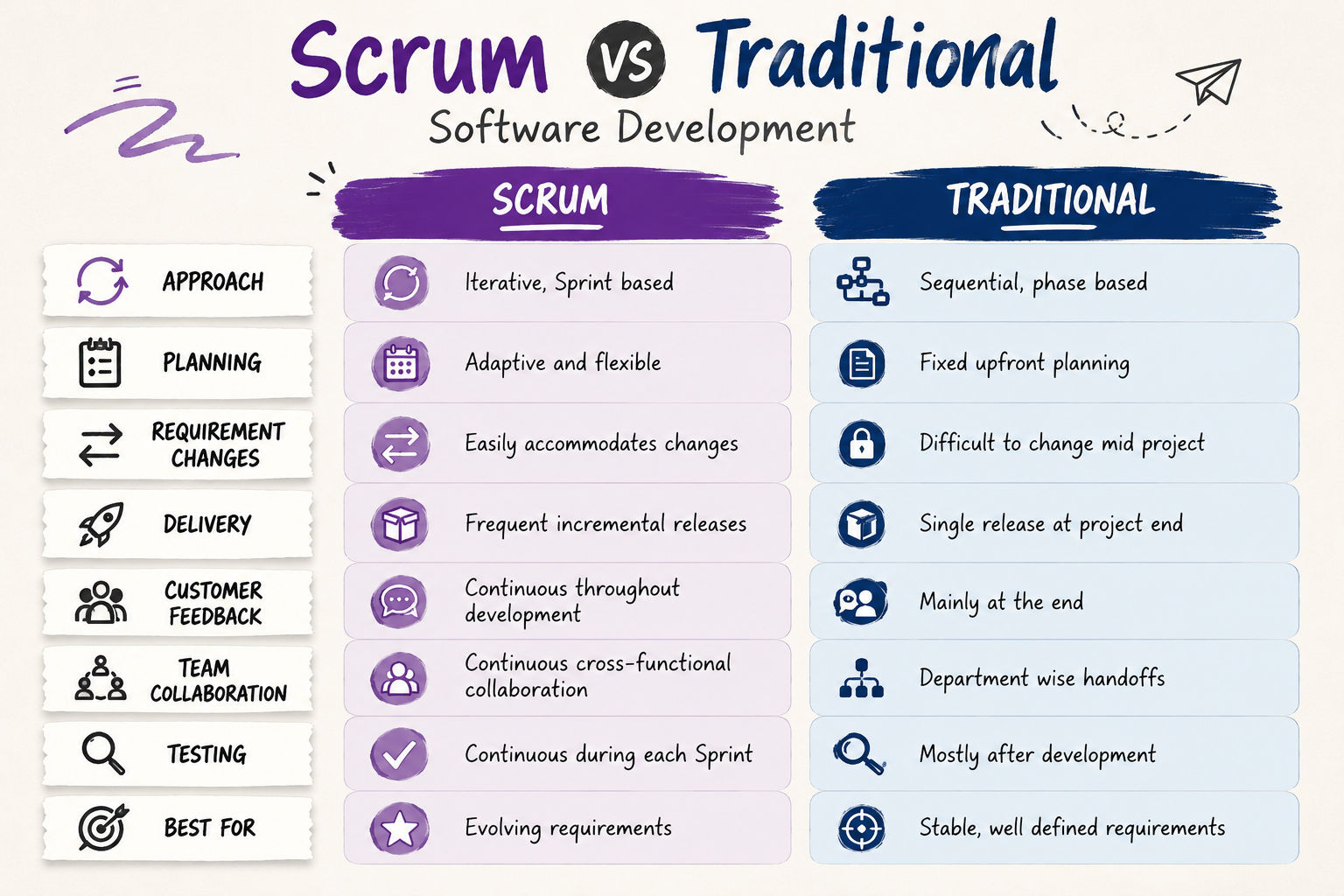
Scrum vs Traditional Software Development
Best Practices to Maximize Scrum Benefits
Simply adopting Scrum does not guarantee success. Teams achieve the greatest value when they consistently apply Scrum principles and continuously improve their ways of working.
1. Maintain a Well Prioritized Product Backlog
A clear and regularly updated backlog helps teams focus on the most valuable work.
Product Owners should review priorities frequently based on customer feedback and business objectives.
2. Set Clear Sprint Goals
Every Sprint should have a meaningful objective that aligns the team around a shared outcome.
Clear Sprint Goals improve focus and help developers make better decisions throughout the Sprint.
3. Encourage Cross Functional Collaboration
Successful Scrum teams collaborate across different areas of expertise.
Developers, testers, designers, Product Owners, and Scrum Masters should work together rather than operating as separate groups.
4. Conduct Meaningful Retrospectives
Sprint Retrospectives should result in practical improvements instead of repeating the same discussions.
Teams should select achievable action items and review progress during future Sprints.
5. Involve Stakeholders Regularly
Regular stakeholder participation during Sprint Reviews improves transparency and ensures development remains aligned with business priorities.
6. Track Agile Metrics
Metrics such as Sprint Goal achievement, velocity trends, cycle time, and customer feedback help teams evaluate progress and identify opportunities for improvement.
Metrics should support learning rather than individual performance measurements.
7. Invest in Scrum Training
Continuous learning strengthens Scrum adoption.
Providing training for Product Owners, Scrum Masters, and development teams helps everyone understand their responsibilities and apply Scrum practices consistently.
Following these practices allows organizations to experience the Top Benefits of Scrum for Software Development more consistently over time.
While AI is changing Agile practices, the right certification still matters. Explore the Best Agile Management Certification Training Courses to find the best fit for your career goals.
Conclusion
The Top Benefits of Scrum for Software Development continue to make it one of the most effective frameworks for modern software teams in 2026. By promoting faster delivery, stronger collaboration, continuous customer feedback, and regular improvement, Scrum enables organizations to build software that responds quickly to changing business needs.
Beyond improving delivery speed, Scrum creates an environment where teams work together with greater transparency, shared accountability, and a focus on delivering customer value.
Contact our upGrad KnowledgeHut experts for personalized guidance on choosing the right course, career path, and certification to achieve your goals.
Frequently Asked Questions
What are the biggest benefits of Scrum software development teams?
Scrum enables teams to deliver software faster, improve collaboration, enhance product quality, and respond quickly to changing customer needs. It also encourages continuous learning and process improvement through regular feedback.
Is Scrum suitable for all software projects?
Scrum is ideal for projects with evolving requirements, frequent customer feedback, and iterative delivery. Projects with fixed scope and minimal changes may be better suited to traditional project management approaches.
How does Scrum improve software quality?
Scrum improves quality through continuous testing, frequent code reviews, regular stakeholder feedback, and early identification of issues. This helps teams fix problems before they become costly.
Why is Scrum better than traditional project management?
Scrum provides greater flexibility by allowing teams to adapt to changing priorities throughout the project. It also encourages customer involvement, faster delivery, and continuous improvement.
How long does it take to see Scrum benefits?
Most teams experience better communication and collaboration within the first few Sprints. Long term benefits, such as improved predictability and higher team performance, typically develop over several months.
Can remote software teams use Scrum effectively?
Yes. With clear communication, collaborative tools, and well facilitated virtual Scrum events, remote teams can successfully apply Scrum and maintain high productivity.
How is AI changing Scrum in 2026?
AI helps automate routine tasks such as Sprint reporting, meeting summaries, backlog organization, and progress tracking. This allows Scrum teams to focus more on collaboration, problem solving, and delivering customer value.
Which metrics should Scrum teams track?
Important metrics include Sprint Goal achievement, Sprint velocity, cycle time, lead time, customer satisfaction, escaped defects, and Retrospective action completion. Tracking these metrics helps teams measure progress and identify improvement areas.
1639 articles published
KnowledgeHut is an outcome-focused global ed-tech company. We help organizations and professionals unlock excellence through skills development. We offer training solutions under the people and proces...
Get Free Consultation
By submitting, I accept the T&C and
Privacy Policy
Ready to learn about Agile Certifications Roadmap?