
CSM vs PSM vs SSM: Which Scrum Master Cert Fits Your Goal?
Updated on Jul 28, 2026 | 208 views
Share:
Table of Contents
View all
Quick Overview
- CSM, PSM, and SSM are valuable Scrum Master certifications, but the best choice depends on your career goals, learning style, and work environment.
- CSM is ideal for beginners; PSM suits experienced professionals seeking knowledge validation, and SSM is best for those working in SAFe based enterprises.
- They differ in training requirements, exam format, renewal, and enterprise focus, with no single certification being the best for everyone.
- In this guide, you'll learn the key differences between CSM, PSM, and SSM, compare costs and career opportunities, and choose the certification that best fits your goals.
"If you're planning to advance your Agile career, the AI-Empowered SAFe® Scrum Master (6.0) course equips you with the knowledge to facilitate high performing teams in enterprise environments."
Master the Right Skills & Boost Your Career
Avail your free 1:1 mentorship session
Key Differences Between CSM, PSM, and SSM
When evaluating CSM vs PSM vs SSM, it helps to look beyond the certification names. Although all three validate Scrum knowledge, they were created with different objectives in mind. Understanding these differences makes it easier to select the certification that matches your career ambitions.
Certification Philosophy
Each certification follows a different learning philosophy.
Certified ScrumMaster (CSM) focuses on guided learning. Candidates attend instructor led training where experienced trainers explain Scrum concepts, facilitate discussions, and provide practical examples before taking the certification exam.
Professional Scrum Master (PSM) emphasizes knowledge validation. There is no mandatory training requirement, allowing professionals with existing Scrum experience to study independently and demonstrate their understanding through a challenging assessment.
SAFe Scrum Master (SSM) prepares professionals to work in Enterprise Agile environments. Instead of focusing only on one Scrum team, it introduces Agile Release Trains, Program Increment Planning, Lean Agile principles, and collaboration across multiple teams.
For example, someone planning to work in a global enterprise using the SAFe framework will often benefit more from SSM than from a certification designed solely around team level Scrum.
This difference in philosophy is one of the biggest factors when comparing CSM vs PSM vs SSM.
Training Requirements
Training requirements vary significantly across these certifications.
CSM requires candidates to complete accredited instructor-led training before becoming eligible for the certification exam. This structured approach benefits beginners who prefer guided learning and interaction with experienced instructors.
PSM does not require mandatory training. Candidates can prepare independently using official learning resources, practical Scrum experience, and self-study materials before attempting the assessment.
SSM also requires accredited training because it introduces Enterprise Agile concepts that extend beyond traditional Scrum practices. The course includes collaborative exercises and real-world scenarios that prepare participants for large scale Agile environments.
Professionals comparing CSM vs PSM vs SSM should consider whether they learn best through classroom instruction or independent study before deciding.
Exam Difficulty
Although all three certifications assess Scrum knowledge, the exam experience is different.
CSM is generally considered beginner friendly because the training prepares candidates specifically for the certification assessment. Most learners complete the exam shortly after finishing the course.
PSM is widely regarded as the most challenging of the three because it emphasizes practical application rather than memorization. Candidates often spend additional time studying Scrum principles and practicing scenario-based questions.
SSM combines Scrum knowledge with Enterprise Agile concepts such as Program Increment Planning, Agile Release Trains, and cross-team collaboration. Candidates should understand both Scrum fundamentals and the SAFe framework before attempting the exam.
When considering CSM vs PSM vs SSM, exam difficulty should not be the only deciding factor. The certification should align with your long-term career objectives rather than simply being easier to earn.
Certification Renewal
Another important difference involves certification validity and ongoing professional development.
CSM requires periodic renewal along with continuing education activities. This encourages professionals to stay current with evolving Scrum practices and maintain active engagement with the Agile community.
PSM certification does not require renewal. Once earned, it remains valid for life, making it attractive for professionals who prefer a one-time certification process.
SSM follows the renewal approach commonly associated with SAFe certifications, encouraging continuous learning and keeping professionals updated on Enterprise Agile practices.
Professionals comparing CSM vs PSM vs SSM often consider renewal requirements alongside career goals and long-term certification costs.
Recognition Across Industries
Industry recognition depends largely on the type of organization rather than the certification itself.
Startups and smaller product companies frequently value CSM because it provides a strong foundation in Scrum and emphasizes practical team facilitation.
Technology companies and organizations seeking professionals with deep Scrum knowledge often recognize PSM because of its rigorous assessment and focus on Scrum principles.
Large enterprises implementing the SAFe framework typically prefer SSM since it prepares professionals to work within Agile Release Trains and large-scale Agile transformations.
Industry Recognition
Industry |
Most Preferred Certification |
| Startups | CSM or PSM |
| Product Companies | PSM |
| IT Services | CSM and SSM |
| Large Enterprises | SSM |
| Government Organizations | CSM or PSM depending on Agile adoption |
For example, a software startup with one Scrum team may prioritize Scrum expertise demonstrated through CSM or PSM. In contrast, a multinational financial institution coordinating dozens of Agile teams is more likely to value SSM because it aligns with Enterprise Agile delivery.
Ultimately, the answer to CSM vs PSM vs SSM depends less on which certification is more recognized overall and more on where you plan to build your career.
"If you're considering SAFe Scrum Master certification, read SAFe Scrum Master (SSM) Certification: Requirements, Benefits to understand the eligibility criteria, certification process, and career advantages."
Which Certification Fits Your Career Goal?
Choosing between CSM vs PSM vs SSM becomes much easier when you start with your career objective instead of comparing certification features. Each certification is designed for a different type of professional, and selecting the right one can accelerate your growth in Agile.
Beginners Entering Agile
If you are completely new to Scrum or Agile, Certified ScrumMaster (CSM) is often the best starting point. Mandatory instructor-led training provides structured learning, practical exercises, and opportunities to ask questions. This approach helps beginners build confidence before taking on Scrum Master responsibilities.
For example, a recent graduate or a professional switching career into Agile may benefit from CSM because of its guided learning experience.
Experienced Scrum Masters
Professionals who already understand Scrum principles and have practical experience often prefer Professional Scrum Master (PSM). Since training is optional, experienced practitioners can prepare independently and validate their knowledge through the certification assessment.
If you have already facilitated Scrum ceremonies or worked in Agile teams, PSM allows you to demonstrate your expertise without attending mandatory classroom training.
Professionals Working in Large Enterprises
If your goal is to work in organizations using the Scaled Agile Framework, SAFe Scrum Master (SSM) is usually the most suitable option. It prepares professionals for Agile Release Trains, Program Increment Planning, enterprise collaboration, and Lean Agile practices.
Someone planning to work in banking, telecommunications, healthcare, or global IT services will often benefit from SSM because these organizations commonly implement Enterprise Agile at scale.
Project Managers Transitioning to Agile
Project Managers already possess planning, stakeholder management, and leadership experience. The right certification depends on the type of organization they intend to join
If transitioning into team level Agile roles, CSM provides an excellent introduction. If moving into enterprise transformation initiatives, SSM offers better preparation for large scale Agile delivery.
Business Analysts
Business Analysts frequently collaborate with Product Owners, development teams, and business stakeholders. CSM provides a strong understanding of Scrum collaboration, while SSM becomes valuable when working within Agile Release Trains and large enterprise environments.
Professionals supporting enterprise products across multiple teams often find SSM more aligned with their responsibilities.
Developers
Developers interested in becoming Scrum Masters should first understand Scrum fundamentals before expanding into Enterprise Agile. CSM offers structured learning, while PSM is a strong choice for developers who already practice Scrum daily and prefer self-paced study.
Agile Coaches
Experienced Agile Coaches often build certifications progressively rather than choosing only one. Many begin with CSM or PSM before pursuing SSM as they move into Enterprise Agile for coaching and organizational transformation.
When comparing CSM vs PSM vs SSM, remember that the best certification is the one that supports your current experience while preparing you for your desired career path.
"If you're planning to build a career in enterprise Agile, SAFe Certifications: List of Best SAFe Certifications 2026 helps you understand the best certification options available in 2026."
Pros and Cons of Each Certification
Each certification has strengths and limitations. Understanding these helps professionals choose the option that best fits their learning style and career plans.
CSM
Pros
- Beginner friendly learning experience.
- Instructor led training with practical guidance.
- Strong recognition across many industries.
- Excellent foundation for Scrum careers.
Cons
- Mandatory training increases overall cost.
- Certification requires periodic renewal.
- Focuses primarily on team level Scrum.
PSM
Pros
- No mandatory training requirements.
- Lifetime certification without renewal.
- Highly respected for validating Scrum knowledge.
- Suitable for experienced Agile professionals.
Cons
- More challenging examination.
- Requires greater self-discipline during preparation.
- Less structured learning for beginners.
SSM
Pros
- Designed for Enterprise Agile environments.
- Covers Agile Release Trains and Program Increment Planning.
- Valuable for professionals working in large organizations.
- Supports progression toward Release Train Engineer and enterprise leadership roles.
Cons
- Best suited for organizations using the SAFe framework.
- Requires accredited training.
- Renewal requirements apply.
Comparing the advantages and limitations of CSM vs PSM vs SSM highlights an important point: there is no universally superior certification. The right choice depends on your learning preferences, career aspirations, and the type of organization where you want to build your Agile career.
"Choosing the right SAFe certification starts with understanding its value. Is SAFe® 4.5 Certification Worth The Price? explains the costs, career benefits, and factors to consider before enrolling."
Which Scrum Master Certification Should You Choose?
If you are still deciding between CSM vs PSM vs SSM, the easiest approach is to match the certification with your experience level, learning style, and long-term career goals. Rather than asking which certification is the best overall, ask which one prepares you for the type of work you want to do.
If your career is moving toward Enterprise Agile, or you plan to work in organizations using the SAFe framework, SSM offers the most relevant preparation. It introduces Agile Release Trains, Program Increment Planning, enterprise collaboration, and Lean Agile practices that go beyond traditional Scrum.
Decision Framework
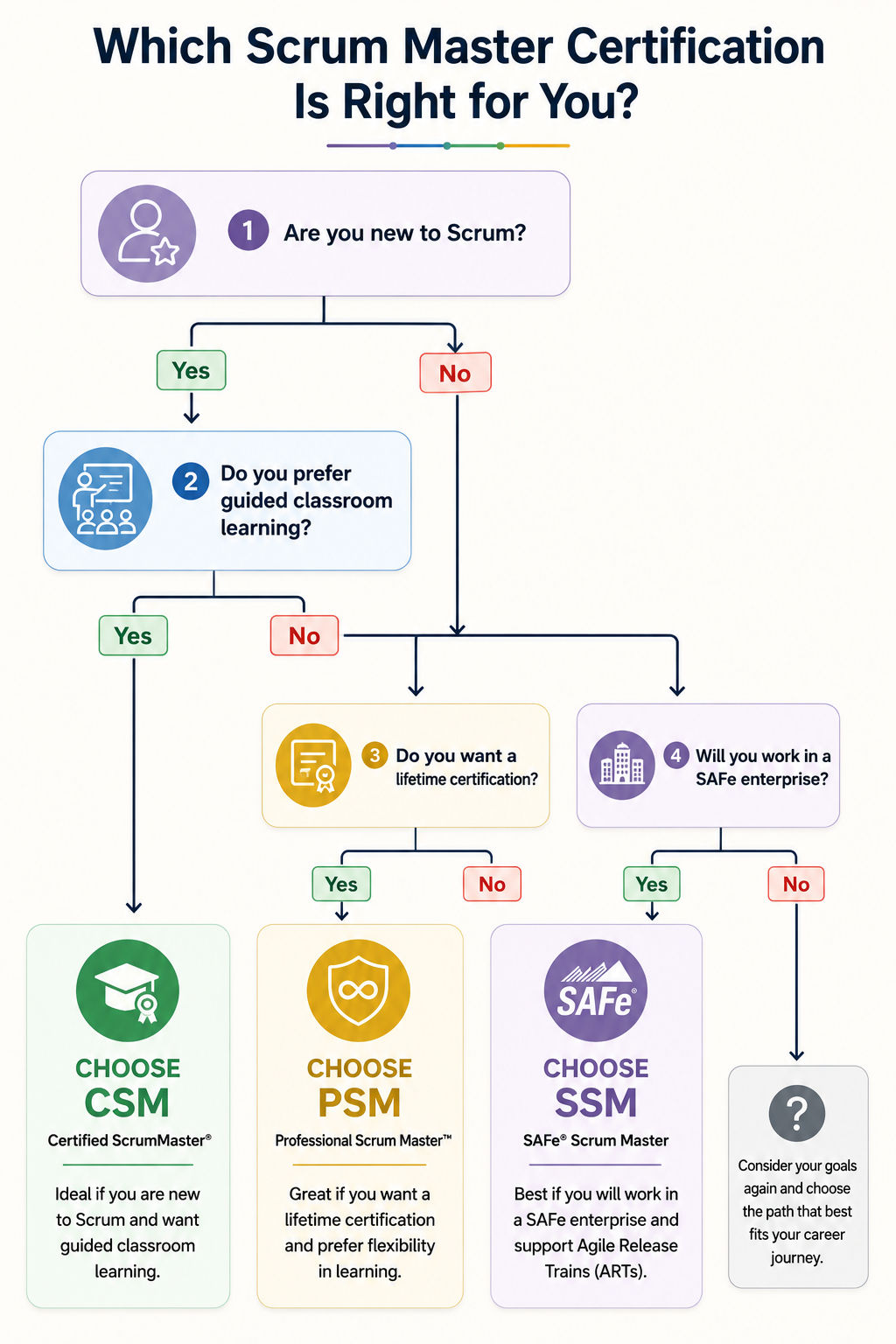
This simple framework helps professionals avoid choosing a certification based solely on popularity. When comparing CSM vs PSM vs SSM, the best decision is the one that supports your next career milestone.
Can You Earn More Than One Certification?
Absolutely. Many Agile professionals earn more than one certification as their careers progress. Each certification develops different capabilities, and together they create a broader understanding of Agile practices across various organizational environments.
For example, someone may begin with CSM while entering Agile, earn PSM after gaining practical experience, and later complete SSM when joining an organization that follows the SAFe framework.
Beyond SSM, many professionals continue their learning journey with advanced certifications such as Release Train Engineer, SAFe Practice Consultant, or Agile Coach certifications. These credentials support career growth into enterprise leadership and Agile transformation roles. Since each follows a different learning path, they are best explored in dedicated guides rather than as part of this comparison.
When evaluating CSM vs PSM vs SSM, remember that the certifications are not mutually exclusive. They can complement one another as your responsibilities expand throughout your career.
"Choosing the right certification can accelerate your Agile career. Explore Best Agile Management Certification Training Courses to understand which programs best match your professional goals."
Conclusion
There is no universal winner in the CSM vs PSM vs SSM comparison because each certification serves a different purpose.
If your goal is to learn Scrum through structured, instructor-led training, CSM provides an excellent foundation and is especially suitable for professionals beginning their Agile journey.
If you plan to build a career in Enterprise Agile or work in organizations using the SAFe framework, SSM prepares you for larger responsibilities involving Agile Release Trains, Program Increment Planning, and cross-team collaboration.
Contact our upGrad KnowledgeHut experts for personalized guidance on choosing the right course, career path, and certification to achieve your goals.
Frequently Asked Questions
Which Scrum Master certification is best for beginners?
For most beginners, Certified ScrumMaster (CSM) is often the easiest starting point because it includes instructor-led training and guided learning. It helps newcomers understand Scrum concepts before taking the certification exam and applying them in real projects.
Is CSM better than PSM?
Neither certification is universally better. CSM is ideal for professionals who prefer structured classroom learning, while PSM is better suited for those who already understand Scrum and want to validate their knowledge through a more challenging assessment. Your choice depends on your experience and career goals.
Which certification is better for Enterprise Agile?
If you plan to work in organizations using the SAFe framework, SAFe Scrum Master (SSM) is generally the best option. It covers Agile Release Trains, Program Increment Planning, enterprise collaboration, and Lean Agile practices that are not included in traditional Scrum certifications.
Is PSM harder than CSM?
Yes, many professionals consider PSM more challenging because it emphasizes practical application and scenario-based questions. Since there is no mandatory training requirement, candidates often spend more time preparing independently before attempting the assessment.
Which Scrum Master certification has the highest industry recognition?
All three certifications are well recognized, but their popularity varies by industry. CSM is widely accepted across many organizations; PSM is respected for its rigorous assessment, and SSM is preferred by enterprises implementing the SAFe framework.
Can I earn both CSM and PSM?
Yes. Many Agile professionals hold both certifications. CSM provides structured learning, while PSM demonstrates deeper Scrum knowledge. Earning both can strengthen your profile and prepare you for a wider range of Scrum Master opportunities.
Is SSM worth pursuing after CSM?
Yes, especially if you plan to work in large organizations practicing Enterprise Agile. After gaining experience as a Scrum Master, SSM helps you develop skills in Program Increment Planning, cross team collaboration, and Agile Release Train coordination.
Which certification offers better career opportunities?
Career opportunities depend more on your skills and experience than the certification itself. CSM is excellent for starting an Agile career; PSM supports professionals seeking stronger Scrum expertise, and SSM opens opportunities in Enterprise Agile environments and leadership roles.
Can Project Managers pursue any of these certifications?
Absolutely. Project Managers often transition successfully into Agile roles through CSM, PSM, or SSM. The best choice depends on whether they plan to work with individual Scrum teams or support Enterprise Agile initiatives across multiple teams.
How should I choose between CSM, PSM, and SSM?
Start by identifying your career objective. Choose CSM if you are new to Scrum and prefer guided learning, PSM if you want to validate existing Scrum expertise, and SSM if your goal is to work in Enterprise Agile using the SAFe framework. The right certification is the one that aligns with your learning style and long-term career path.
1639 articles published
KnowledgeHut is an outcome-focused global ed-tech company. We help organizations and professionals unlock excellence through skills development. We offer training solutions under the people and proces...
Get Free Consultation
By submitting, I accept the T&C and
Privacy Policy
Ready to learn about Agile Certifications Roadmap?