
How to Become a Product Owner from Developer in 2026?
Updated on Sep 13, 2026 | 15 min read | 7.47K+ views
Share:
Table of Contents
View all
Quick Overview
- A developer can transition into a Product Owner role by shifting from a technical delivery mindset toward understanding customer needs, business goals, product vision, and prioritization.
- Transferable developer skills such as technical knowledge, problem solving, product feasibility assessment, engineering collaboration, and understanding of user stories can provide a strong foundation for product ownership.
- Practical experience and certification can support the transition through activities such as backlog refinement, product planning, stakeholder discussions, building a Product Owner portfolio, and earning certifications such as CSPO or PSPO.
- This guide explains how developers can become Product Owners, the skills that transfer to product ownership, how to choose a Product Owner certification, and the common challenges involved in the career transition.
Build AI driven product leadership skills with SAFe® AI-Empowered Product Owner/Product Manager (6.0) and advance in modern product management.
Master the Right Skills & Boost Your Career
Avail your free 1:1 mentorship session
How to become a product owner from developer in 2026? step-by-step criteria
Learning How to Become Product Owner from Developer starts with understanding how product decisions differ from technical implementation. Developers already bring valuable technical knowledge, but they need to build stronger skills around customers, business priorities, product planning, and stakeholder management.
The following steps provide a practical path for making this transition:
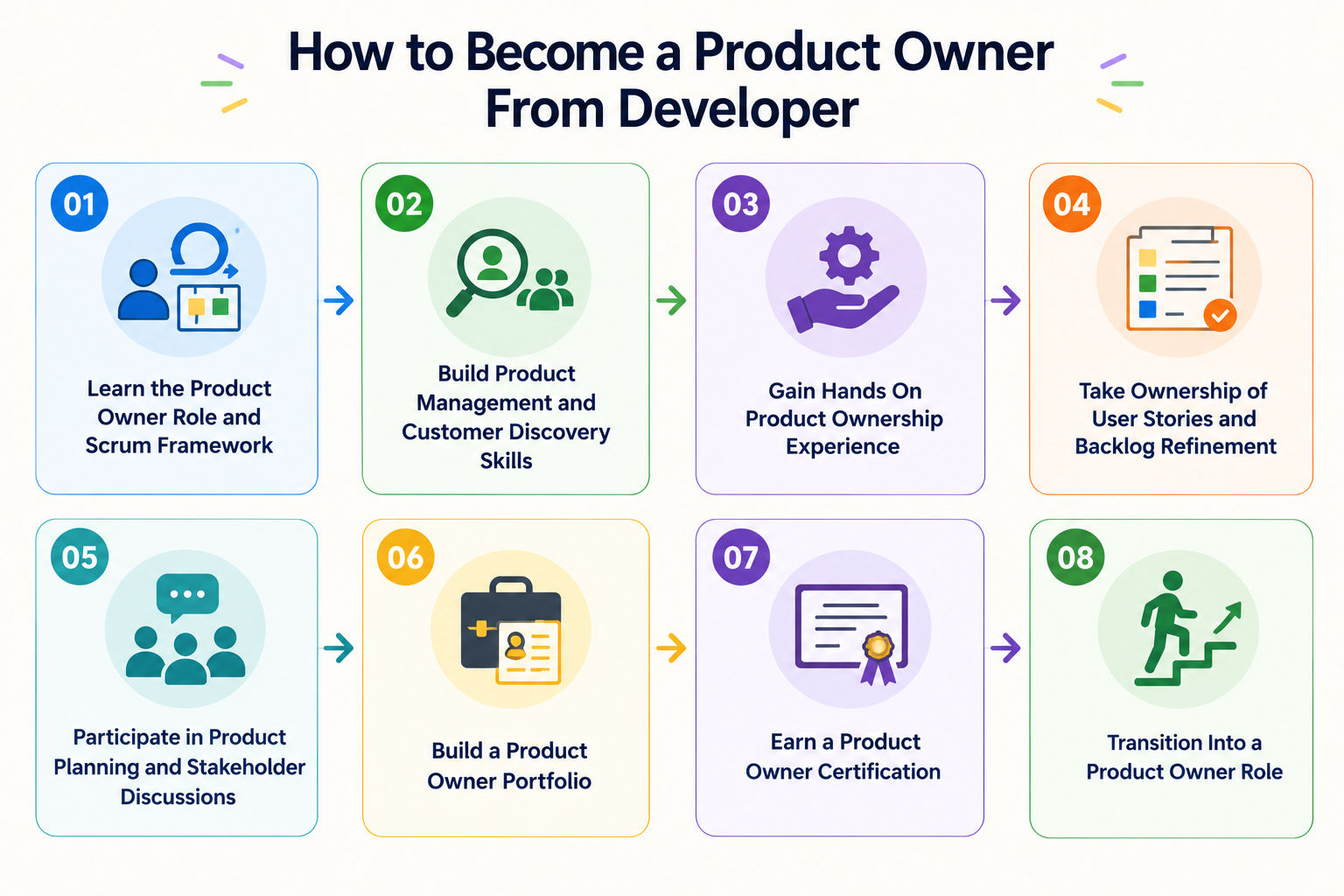
Step 1: Learn the Product Owner Role and Scrum Framework
Start by understanding what a Product Owner is responsible for within a Scrum environment.
Key areas include:
- Product goals
- Product backlog
- Backlog prioritization
- Sprint planning
- User stories
- Stakeholder collaboration
- Customer value
Step 2: Build Product Management and Customer Discovery Skills
Technical knowledge alone is not enough for How to Become Product Owner from Developer. Product Owners also need to understand why a product should be built and whose problem it solves.
Develop skills in:
- Customer discovery
- Market research
- Problem identification
- Product strategy
- Prioritization
- Basic product analytics
Step 3: Gain Hands On Product Ownership Experience
Start taking on small product responsibilities within the current development role.
This can include:
- Joining customer discussions
- Supporting backlog decisions
- Clarifying requirements
- Working with stakeholders
- Participating in product planning
Step 4: Take Ownership of User Stories and Backlog Refinement
User stories and backlog refinement are useful areas where developers can begin building Product Owner experience.
Focus on:
- Writing clear user stories
- Defining acceptance criteria
- Prioritizing backlog items
- Clarifying requirements
- Identifying dependencies
Step 5: Participate in Product Planning and Stakeholder Discussions
Product Owners need to communicate with people beyond the engineering team.
Developers transitioning into product ownership should participate in:
- Product planning
- Customer discussions
- Business meetings
- Roadmap conversations
- Stakeholder reviews
Step 6: Build a Product Owner Portfolio
A portfolio can demonstrate practical product ownership skills before making the transition.
It can include:
- Product requirements
- User stories
- Acceptance criteria
- Prioritized backlogs
- Product roadmaps
- Customer discovery notes
- Product case studies
Step 7: Earn a Product Owner Certification
Certification can provide structured knowledge of Scrum and Product Ownership, particularly for developers moving into a new role.
Relevant upGrad KnowledgeHut’s agile courses include:
- Certified Scrum Product Owner (CSPO) Certification
- Professional Scrum Product Owner (PSPO) Certification
Certification can support the transition, but it does not replace practical experience. Employers may also consider product knowledge, communication, prioritization, stakeholder management, and demonstrated ownership.
Step 8: Transition Into a Product Owner Role
Once the required skills and experience are developed, developers can begin applying for Product Owner opportunities.
A transition may happen through:
- An internal role change
- Supporting an existing Product Owner
- Moving into an Associate Product Owner position
- Taking ownership of a smaller product area
Similar Reads: How to Become a Product Owner
Can a developer become a product owner?
Yes. Developers already understand software development, technical constraints, delivery processes, and engineering collaboration. These strengths can provide a useful foundation for Product Ownership.
However, How to Become Product Owner from Developer also requires a shift toward customers, business outcomes, prioritization, and product decisions.
Developer to Product Owner Career Transition
The transition often begins gradually rather than through an immediate change in job title.
A developer can build experience by taking greater responsibility for:
- Requirements
- Prioritization
- Customer needs
- Backlog management
- Stakeholder communication
- Product planning
Explore the Technical Product Owner Job Description, including key responsibilities, essential skills, and career requirements.
Which developer skills transfer to product ownership?
A major advantage of How to Become Product Owner from Developer is that many existing developer skills can be carried into the new role. The main challenge is learning how to apply those skills from a product rather than implementation perspective.
The following skills are particularly relevant for a Product Owner:
1. Technical Knowledge and Engineering Collaboration
Developers already understand:
- Software architecture
- Development workflows
- Technical constraints
- Engineering dependencies
- Delivery challenges
2. Problem Solving and Analytical Thinking
Developers regularly solve complex problems and evaluate different technical approaches.
These skills can support:
- Product prioritization
- Root cause analysis
- Trade off decisions
- Requirement evaluation
- Product problem solving
3. Understanding Product Feasibility
Technical experience helps Product Owners understand what is practical within available time, resources, and technology.
This can improve conversations around:
- Scope
- Dependencies
- Technical debt
- Delivery timelines
- Feature feasibility
4. Communication With Development Teams
Developers transitioning into Product Ownership already understand engineering terminology and workflows.
This can make it easier to:
- Clarify requirements
- Discuss trade offs
- Resolve ambiguity
- Align technical teams
- Support delivery decisions
5. User Story and Acceptance Criteria Knowledge
Developers who already work with user stories and acceptance criteria have a useful foundation for Product Ownership.
The next step is learning to write them from the perspective of:
- Customer value
- Product outcomes
- Business priorities
- User needs
Explore the Top 8 Product Owner Certifications in 2026 and find the right certification to advance a product ownership career.
How to choose a product owner certification as a developer?
Certification can help developers build structured knowledge and demonstrate commitment to Product Ownership. The right certification should complement practical experience and the developer's career goals.
These certifications include:
CSPO Certification
Certified Scrum Product Owner (CSPO) Certification can help professionals develop knowledge of Scrum and the Product Owner role.
It can be relevant for developers looking to strengthen their understanding of:
- Product ownership
- Product backlog
- Customer needs
- Scrum practices
- Product value
PSPO Certification
Professional Scrum Product Owner (PSPO) Certification can provide structured learning around Product Ownership and product value within Scrum.
It can help developers build knowledge in areas such as:
- Product vision
- Product value
- Product backlog management
- Stakeholder collaboration
- Product decision making
Learn How to Become a Product Owner Without Prior Experience Using CSPO and build the skills needed to start a product ownership career.
Common challenges when moving from developer to product owner
The transition in How to Become Product Owner from Developer can involve a significant change in mindset. Technical expertise remains useful, but Product Owners need to consider broader customer and business priorities.
Some challenges include:
1. Staying Too Focused on Technical Solutions
Developers are trained to think about how something can be built. Product Owners need to first understand whether it should be built.
The focus should move from:
How can this be developed?
to:
What problem should this solve, and why does it matter?
2. Difficulty Prioritizing Customer and Business Needs
Technical feasibility is only one part of product prioritization.
Product Owners also need to consider:
- Customer value
- Business impact
- Urgency
- Market needs
- Product strategy
3. Moving Away from Coding
Developers may find it difficult to reduce their focus on coding because implementation is familiar and measurable.
Product Ownership shifts attention toward:
- Decisions
- Priorities
- Stakeholders
- Customers
- Outcomes
4. Managing Conflicting Stakeholder Expectations
Different stakeholders may want different outcomes.
Product Owners need to:
- Listen to competing needs
- Explain priorities
- Communicate trade offs
- Align teams around product goals
5. Balancing Technical Debt with New Features
Product Owners need to balance customer facing improvements with technical health.
Decisions may involve:
- Technical debt
- Reliability
- Performance
- New features
- Maintenance work
Explore the Product Owner Future in 2026 and Beyond and discover the trends, skills, and challenges shaping the role.
Conclusion
The transition from developer to Product Owner is an expansion of responsibilities, not a complete career change. Technical knowledge provides a strong foundation, while customer discovery, prioritization, stakeholder management, and product planning help complete the transition.
The key shift is moving from building solutions to deciding what should be built and why. Practical experience, a portfolio, and relevant certification can further support the move into Product Ownership.
Contact our upGrad KnowledgeHut experts for personalized guidance on choosing the right course, career path, and certification to achieve your goals.
Frequently Asked Questions (FAQs)
1. How much developer experience is needed before moving into a Product Owner role?
There is no fixed experience requirement for How to Become Product Owner from Developer. Developers with experience in software delivery, Agile teams, requirements, and stakeholder collaboration may already have a useful foundation. The right time depends on product exposure and readiness to take broader ownership.
2. Can a developer become a Product Owner without previous business experience?
Yes. How to Become Product Owner from Developer does not always require prior business experience. Developers can build business understanding through customer discovery, product planning, prioritization, and stakeholder discussions while continuing to use their technical strengths.
3. How can developers gain Product Owner experience without changing jobs first?
Developers can start by taking part in backlog refinement, customer discussions, requirement clarification, and product planning. This is a practical way to work toward How to Become Product Owner from Developer without immediately changing roles.
4. How should developers explain their technical background during a Product Owner interview?
The technical background should be connected to product outcomes rather than only coding tasks. For How to Become Product Owner from Developer, highlight engineering collaboration, technical feasibility, problem solving, trade offs, and understanding of customer and business needs.
5. What should developers remove from their resume when applying for Product Owner roles?
The resume should avoid focusing heavily on programming tasks that do not demonstrate product impact. For How to Become Product Owner from Developer, emphasize backlog work, requirements, stakeholder collaboration, customer understanding, prioritization, and contributions to product outcomes.
6. How can developers build product thinking while still working in development?
Developers can participate in customer research, backlog prioritization, product planning, roadmap discussions, and product analytics. These activities help build the product mindset required for How to Become Product Owner from Developer while remaining in a technical role.
7. Can developers become Product Owners in non technical industries?
Yes. Technical knowledge remains useful, but Product Ownership also depends on customer understanding, prioritization, communication, and business knowledge. Developers can apply the principles of How to Become Product Owner from Developer across industries by learning the relevant domain.
8. How can developers learn customer discovery and market research for Product Ownership?
Developers can build these skills through customer interviews, feedback analysis, market research, and product discovery activities. Practical exposure helps support How to Become Product Owner from Developer by shifting the focus from technical solutions toward customer problems and needs.
9. What are the signs that a developer is ready to become a Product Owner?
Signs include enjoying customer problems, making prioritization decisions, communicating with stakeholders, and thinking about business outcomes beyond technical implementation. These are important indicators when considering How to Become Product Owner from Developer.
10. Is moving from Developer to Product Owner a good long term career move?
It can be a strong career move for developers who enjoy product decisions, customer interaction, prioritization, and broader business responsibility. How to Become Product Owner from Developer is especially relevant for those who want to use their technical background while moving toward product leadership and strategy.
1639 articles published
KnowledgeHut is an outcome-focused global ed-tech company. We help organizations and professionals unlock excellence through skills development. We offer training solutions under the people and proces...
Get Free Consultation
By submitting, I accept the T&C and
Privacy Policy
Ready to learn about Agile Certifications Roadmap?