
How to Become a Product Owner Without Prior Experience Using CSPO
Updated on Jul 30, 2026 | 184 views
Share:
Table of Contents
View all
Quick Overview:
- To become a Product Owner without prior experience using CSPO, start with a CSPO certification to build a foundation in Scrum, Product Ownership, backlog management, and stakeholder collaboration.
- Leverage transferable skills from business analysis, project coordination, operations, customer service, or marketing to demonstrate relevant Product Owner capabilities.
- Build practical experience through mock Product Backlogs, user stories, product roadmaps, prioritisation exercises, and product case studies.
- Develop a Product Owner-focused resume and portfolio that showcases Agile knowledge, product thinking, stakeholder management, and measurable business impact.
- This guide explains the step-by-step roadmap to becoming a Product Owner using CSPO, including the essential skills to develop, practical experience to gain, and a 90-day action plan for preparing entry-level Product Owner opportunities.
"Build a strong foundation for a Product Owner career with CSPO Certification Training from upGrad KnowledgeHut, followed by practical projects and portfolio development."
Master the Right Skills & Boost Your Career
Avail your free 1:1 mentorship session
Step-by-Step Roadmap to Become a Product Owner Using CSPO
Starting a career as a Product Owner can feel challenging, especially without direct experience. A CSPO certification provides a strong starting point by teaching the fundamentals of Scrum and product ownership.
A structured roadmap provides a clear path to developing Product Owner skills through CSPO learning, practical experience, and career preparation.
Step 1: Learn the Basics of Agile and Scrum
Before enrolling in a CSPO course, spend some time learning how Agile teams work. Product Owners play an important role in Scrum, so understanding the basics is essential.
Focus on learning:
- Scrum roles and responsibilities
- Agile values and principles
- Scrum events such as Sprint Planning, Sprint Review, and Retrospectives
- Product backlogs and user stories
Reading the Scrum Guide and exploring real Scrum examples can make these concepts easier to understand.
Step 2: Earn a CSPO Certification
Once the basics are clear, the next step is completing a CSPO certification. The training introduces the day-to-day responsibilities of a Product Owner and explains how to work with Scrum teams.
A typical CSPO course covers:
- Product vision
- Product backlog management
- User stories
- Prioritization techniques
- Stakeholder communication
After completing the course, add the certification to a resume and professional networking profiles to strengthen job applications.
Step 3: Develop Product Thinking
A Product Owner does much more than manage a backlog. The role involves understanding customer problems and finding the best solutions.
Start building product thinking by learning how to:
- Identify customer needs
- Prioritize features based on business value
- Measure outcomes instead of focusing only on feature delivery
- Make product decisions using simple prioritization methods such as MoSCoW or RICE
These skills help build confidence when working on real products.
Step 4: Build Practical Experience
Practical experience is just as important as certification. A formal Product Owner job is not the only way to gain experience.
Some simple ways to practice include:
- Creating a sample product backlog
- Writing user stories
- Building a basic product roadmap
- Working on personal or volunteer projects
- Taking part in Agile projects at the workplace
These projects can also become valuable additions to a professional portfolio.
Step 5: Create a Strong Product Owner Resume
A well-written resume should highlight relevant skills and achievements instead of simply listing daily tasks.
Include details such as:
- CSPO certification
- Agile or Scrum experience
- Stakeholder collaboration
- Product backlog or user story experience
- Results and business impact whenever possible
Even experience from roles such as Business Analyst or Project Coordinator can demonstrate transferable skills.
Step 6: Apply for Entry-Level Product Roles
After building knowledge and practical experience, start applying for roles that provide a pathway into Product Ownership.
Good entry-level opportunities include:
- Associate Product Owner
- Junior Product Owner
- Product Analyst
- Business Analyst
- Agile Business Analyst
Look for organizations that use Scrum, encourage continuous learning, and provide opportunities to work with experienced Product Owners. Every project and every role helps build the experience needed for future Product Owner positions.
Why CSPO Is an Ideal Starting Point for Aspiring Product Owners
The Certified Scrum Product Owner (CSPO) certification is a great starting point for aspiring Product Owners. It provides a simple learning path focused on the practical skills needed to manage products, work with Agile teams, and deliver customer value.
Unlike advanced product certifications, CSPO focuses on the fundamentals of Product Ownership, making it suitable for beginners and professionals transitioning into product roles.
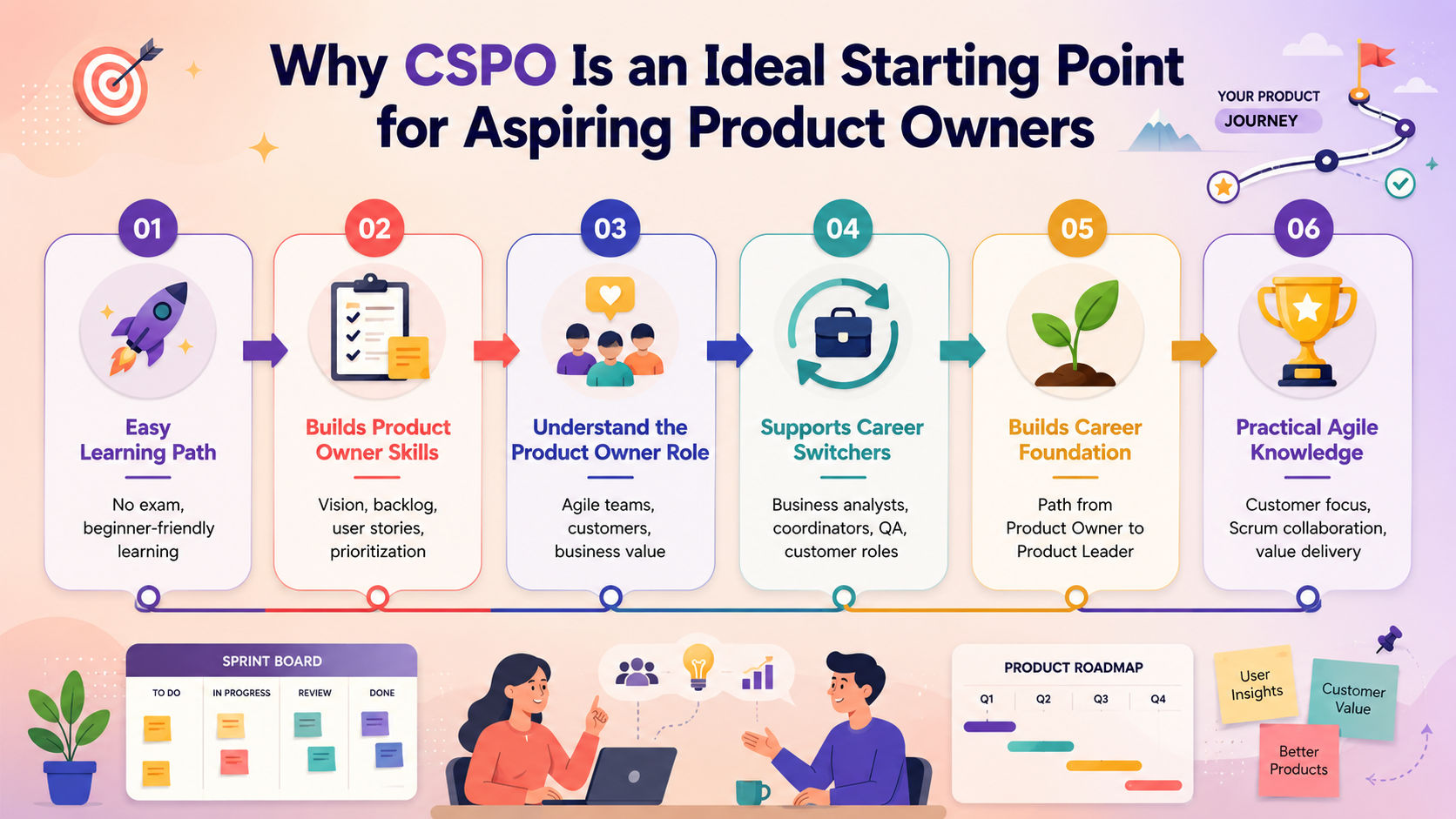
1. Easy Learning Path Without an Exam
One of the biggest advantages of CSPO is its beginner-friendly approach. The certification does not require a formal exam, which allows learners to focus on understanding concepts rather than preparing for a test.
The training focuses on real-world Product Owner responsibilities, including:
- Understanding customer needs
- Defining product goals
- Managing product priorities
- Working with Scrum teams
- Communicating with stakeholders
2. Builds Essential Product Owner Skills
CSPO helps develop the core skills required to perform effectively as a Product Owner.
Key areas covered include:
- Product Vision: Learning how to define product goals and align teams around a shared direction.
- Backlog Management: Understanding how to create, organize, and prioritize product backlogs.
- User Stories: Learning how to capture customer requirements in a clear and useful format.
- Stakeholder Collaboration: Building skills to manage expectations and communicate with different teams.
- Product Prioritization: Making decisions based on customer value and business goals.
4. Helps Beginners Understand the Product Owner Role
Many professionals entering product management are unsure about the daily responsibilities of a Product Owner. CSPO provides clarity by explaining how Product Owners contribute throughout the product lifecycle.
The certification helps learners understand how to:
- Work with Scrum teams
- Balance customer needs and business objectives
- Support Agile product delivery
- Make value-focused decisions
5. Useful for Career Switchers
CSPO is especially helpful for professionals moving into Product Owner roles from different backgrounds.
Existing experience can be connected to Product Ownership skills:
- Business Analysts: Requirements gathering and stakeholder management
- Project Coordinators: Team collaboration and planning
- Customer Success Professionals: Understanding customer problems
- QA Professionals: Improving product quality and user experience
6. Creates a Strong Foundation for Growth
CSPO is not only useful for getting the first Product Owner opportunity. It also creates a foundation for long-term career growth.
After gaining experience, professionals can progress into roles such as:
- Product Owner
- Senior Product Owner
- Product Manager
- Senior Product Manager
- Product Lead
For beginners looking to enter product management, CSPO provides practical knowledge, industry recognition, and the confidence needed to start a Product Owner career.
"Learn the fundamentals of Agile delivery with upGrad KnowledgeHut Agile Management Training and strengthen skills relevant to Product Owner roles."
Essential Skills You Need Alongside CSPO to Become a Product Owner
CSPO provides a strong foundation in Scrum and Product Ownership, but adding a few practical skills can make a candidate more competitive and job-ready.
1. Communication and Stakeholder Management
Product Owners spend a lot of time connecting business teams, customers, and development teams.
Strong communication helps with:
- Explaining product goals clearly
- Managing stakeholder expectations
- Resolving conflicts
- Aligning teams around priorities
The ability to translate business needs into clear requirements is often more valuable than deep technical knowledge.
2. Prioritization Skills
Product Owners need to make decisions about what should be built first and why.
Learning prioritization frameworks such as:
- RICE scoring
- Kano Model
- MoSCoW prioritization
helps in making better backlog decisions and discussing product choices confidently during interviews.
3. Basic Data Literacy
Product decisions become stronger when supported by data.
Understanding basic product metrics, user feedback, and simple analysis helps Product Owners:
- Identify customer needs
- Measure product success
- Make informed decisions
Advanced analytics skills are not required, but comfort with data adds value.
4. Familiarity with Product Tools
Product Owners commonly use tools to manage backlogs, track work, and document decisions.
Useful product tools to learn include:
- Jira
- Trello
- Confluence
Hands-on practice through personal projects can also demonstrate practical experience.
5. User Research Basics
Understanding customers is a key part of Product Ownership.
Basic user research skills help Product Owners:
- Conduct user interviews
- Analyze customer feedback
- Identify user problems
- Create better user stories
Customer-focused thinking helps ensure that products solve real needs.
6. Business and Market Awareness
Product Owners need to understand how products create value for customers and businesses.
Knowledge of:
- Target users
- Competitors
- Market trends
- Business goals
helps in making better prioritization decisions and building products that support company objectives.
90-Day Action Plan to Become a Product Owner Using CSPO
Getting a CSPO certification is a good first step toward becoming a Product Owner. However, certification alone is not enough. A successful Product Owner also needs practical experience, product knowledge, and the ability to work with different teams.
This 90-day plan helps build the right foundation, create practical examples, and prepare for Product Owner opportunities.
Days 1-30: Learn Scrum and Complete CSPO Certification
The first month is focused on understanding Agile, Scrum, and the Product Owner role.
Start with the basics:
- Agile principles and values
- Scrum roles and responsibilities
- Scrum events
- Product backlog management
- Sprint planning and delivery
Important resources to study:
- Scrum Guide
- Agile Manifesto
During CSPO training, focus on learning:
- How to create a product vision
- How to write user stories
- How to prioritize backlog items
- How to work with stakeholders
- How Product Owners create customer value
By the end of the first month, a clear understanding of Scrum practices and Product Owner responsibilities should be developed.
Days 31-60: Build Practical Product Experience
After completing CSPO, the next step is to apply the learning through practical work.
Many beginners face the challenge of not having direct Product Owner experience. Creating product examples and working on small projects can help build confidence and demonstrate skills.
Create a Product Case Study
Pick an existing product and analyze:
- Customer problems
- User needs
- Product improvements
- Feature priorities
- Possible solutions
A case study shows the ability to think like a Product Owner and make product decisions.
Create Product Documents
Practice creating common Product Owner deliverables:
- Product backlog
- User stories
- Acceptance criteria
- Product roadmap
These examples can become part of a portfolio and help during interviews.
Get Practical Exposure
Look for opportunities through:
- Volunteer projects
- Startup projects
- Workplace Agile initiatives
- Product management communities
By the end of this phase, practical examples of product thinking, prioritization, and Agile knowledge should be available.
Days 61-90: Prepare for Product Owner Opportunities
The final month focuses on improving job readiness and building a professional presence.
Improve the Resume
Highlight skills related to:
- Agile and Scrum experience
- Stakeholder communication
- Requirements gathering
- User story creation
- Team collaboration
Focus on achievements and results instead of only listing tasks.
Update the LinkedIn Profile
Add important Product Owner keywords such as:
- Product Owner
- Scrum
- Agile
- CSPO
- Backlog management
- User stories
- Product strategy
Add certification details, portfolio projects, and case studies to improve visibility.
Build Industry Connections
Connect with:
- Product Owners
- Scrum Masters
- Agile professionals
- Product communities
Networking can help with learning, guidance, and finding new opportunities.
Prepare for Interviews
Practice common Product Owner questions:
- How are backlog items prioritized?
- How are stakeholder conflicts handled?
- What makes a good user story?
- How is product value measured?
Use portfolio examples to explain decisions and show practical understanding.
Apply for Suitable Roles
Start with roles that can lead to Product Ownership:
- Associate Product Owner
- Junior Product Owner
- Product Analyst
- Business Analyst
- Agile Business Analyst
Conclusion
Becoming a Product Owner without prior experience is achievable through a combination of CSPO certification, practical product skills, and hands-on experience. CSPO provides a strong foundation in Scrum, Product Ownership, Backlog Management, and stakeholder collaboration.
Product case studies, Agile projects, and portfolio work can further demonstrate practical capabilities. A targeted resume and strategic job search can open pathways to Associate Product Owner, Junior Product Owner, and related Agile roles.
Have A Query? Get in Touch With Our Customer Support | upGrad KnowledgeHut
Frequently Asked Questions (FAQs)
Can CSPO help someone move into Product Ownership from a non-Agile role?
Yes, CSPO can help professionals understand how Product Ownership works within a Scrum environment. Existing experience in administration, operations, marketing, sales, customer service, or business functions can then be connected to product-related responsibilities.
How much time is required to become job-ready as a Product Owner after CSPO certification?
Becoming job-ready after CSPO certification depends on existing skills, practical exposure, and learning consistency. A focused three-to-six-month approach with certification, portfolio creation, Agile practice, networking, and interview preparation can help develop the knowledge and confidence required for entry-level Product Owner roles.
Which portfolio projects can demonstrate Product Owner skills without professional experience?
Portfolio projects such as product case studies, sample product backlogs, user stories, acceptance criteria, and product roadmaps can demonstrate Product Owner capabilities. Product improvement analyses, feature prioritization exercises, and customer problem-solving examples can showcase product thinking, decision-making, and Agile understanding to potential employers.
Is CSPO certification sufficient for getting a Product Owner role?
CSPO certification provides essential Scrum and Product Ownership knowledge but may not be sufficient alone for securing a Product Owner role. Practical projects, communication skills, stakeholder management experience, Agile exposure, and a strong resume with measurable achievements can improve career opportunities.
What common mistakes should beginners avoid while transitioning into Product Ownership?
Common mistakes include focusing only on certification, ignoring customer needs, lacking practical examples, and creating resumes without highlighting business impact. Beginners should develop product thinking, practice prioritization techniques, build portfolios, and understand how Product Owners create value through effective decisions.
Which industries offer entry-level Product Owner opportunities?
Entry-level Product Owner opportunities are available across industries including technology, finance, healthcare, education, e-commerce, and telecommunications. Organizations using Agile frameworks often require professionals who can manage customer needs, collaborate with teams, and support product development processes.
Is Product Owner experience mandatory for a first Product Owner job?
Not necessarily. Some entry-level or associate roles may consider candidates with transferable experience, Agile knowledge, relevant projects, and strong product thinking. A portfolio can also provide evidence of practical skills when formal Product Owner experience is limited.
Should beginners apply directly for Product Owner jobs after CSPO?
Direct applications can be worthwhile, particularly for junior or associate positions, but the search should not stop there. Business Analyst, Product Analyst, and other Agile roles can provide relevant experience and create a practical pathway into Product Ownership.
What mistakes should beginners avoid after completing CSPO?
Treating certification as a guarantee of a Product Owner job is a common mistake. Another is focusing only on Scrum terminology without practising product decisions, customer problem-solving, prioritisation, and stakeholder communication.
How can CSPO support long-term Product Owner career growth?
CSPO can establish an early foundation in Scrum and Product Ownership, while continued experience can open opportunities to take on larger products and more strategic responsibilities. Over time, the career path can expand towards Senior Product Owner, Product Manager, or Product Lead roles.
1639 articles published
KnowledgeHut is an outcome-focused global ed-tech company. We help organizations and professionals unlock excellence through skills development. We offer training solutions under the people and proces...
Get Free Consultation
By submitting, I accept the T&C and
Privacy Policy
Ready to learn about Agile Certifications Roadmap?