
Why CSPO Certification Is Important For Your Career
Updated on Jun 24, 2025 | 7 min read | 10.75K+ views
Share:
Table of Contents
View all
This article looks at how and why the CSPO® Certification is increasingly becoming important for today’s Product Owner (PO). The article briefly discusses on the responsibilities of the PO, how the role is becoming mandatory within the organization in today's Agile landscape, what makes a great PO and about the CSPO Certification.
Master the Right Skills & Boost Your Career
Avail your free 1:1 mentorship session
Who is a Product Owner
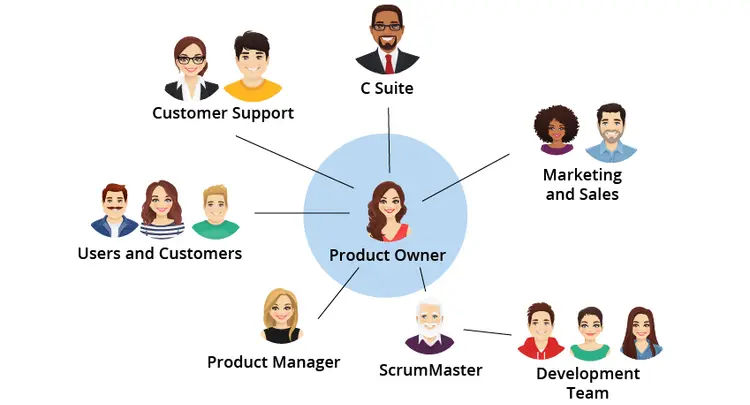
The Product Owner is a member of the Product Management / Business team who works closely with and is a part of the Agile team throughout the Sprints/Iterations. The responsibilities of a Product Owner(PO) spans across the aspects of People, Product and Process.
People
- The PO is a conduit between Business and Engineering teams, acting as the “Voice of the Customer” and “Voice of the Business” to the teams,
- Is one of the members to create the Product vision and constantly communicates the same to the teams, and
- Is able to interact and communicate well with all stakeholders (Customer, Engineering , Sales, Marketing, Support etc.)
Product
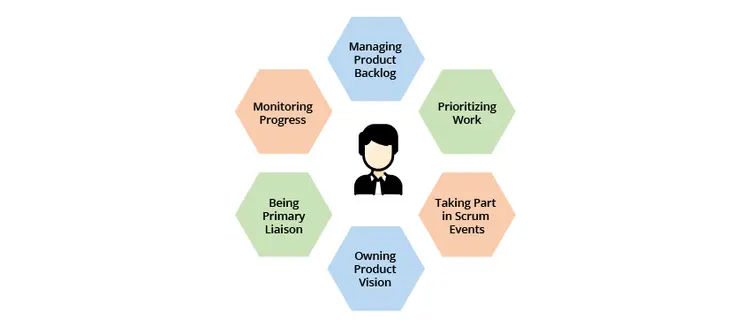
- Defines and maintains the team’s Product backlog,
- Can answer “Why” a requirement has found a place in the product backlog, “Why” it is prioritized and “Why” the Customer wants the features,
- Can provide insights into what customer problem the requirements aim to resolve,
- Can provide Customer Journey Maps, User Personas and Real Life Examples, and
- Can determine the value that the product delivers to stakeholders and identify which product backlog items would deliver the most value.
Process
- Prioritizes the product backlog and is able to provide the reasons and justification of prioritization to the teams,
- Is part of the regular Product Backlog refinements to refine User stories and Acceptance Criteria,
- Is available to the team throughout the iteration and provides continuous feedback,
- Seeks continuous feedback from Customers, and
- Is able to review the features and approve User Stories once they are completed.
Significance of the PO role
Traditionally the Business/Product Management teams have suffered with constant shortage of time and conflicting priorities between dedicating time for Engineering teams and Customer facing responsibilities. Usually, the Customer facing responsibilities understandably end up as the higher priority, leaving very little time for the teams.
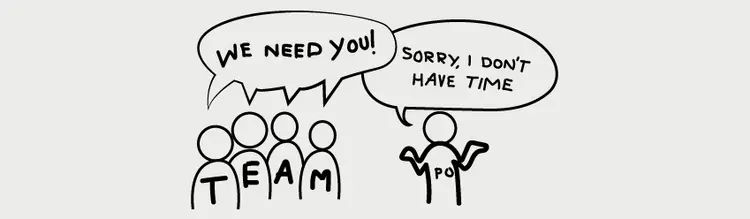
Earlier, the time dedicated by the Product Manager to Engineering teams was very little and elusive, sometimes limited to only email interactions. The Business teams were located at the customer sites and used to visit the Engineering teams occasionally, interacting with them through email or phone calls. As a result, the product and productivity suffered immensely.
With the advent of Scaled Agile Frameworks and industry wide adoption of Agile, the role of the Product Owner has been laid out as a mandate and demands the increase of manpower in Business teams. Dedicated Product Owners are becoming increasingly indispensable and significant within teams. The role of the Product Owner role has come as a big relief for Engineering teams, because they are constantly in touch with the Business stakeholders as well as the team, and can smoothen and streamline communication channels.
POs are often co-located with the Engineering teams, attending Daily (Stand up) Meetings, Refinement meetings, Sprint Review, Demos etc. in person with the team. They are also available anytime for quick feedback and queries doing away with time-zone difference and delays. The POs closely work with their Customer facing counterparts in the various customer locations, serving as the liaison between Business Teams and Engineering teams.

The PO ‘s role is key for the success of the Agile way of working. It has become a “Must Have” role within the Agile landscape rather than a “Good to have” role. This has created a good demand for the PO role in the Software Industry. With the surging demand for POs in the industry, there are many professionals taking up the discipline of Product Management. There are professionals from other functions like QA/Project Management/ Development etc. moving into the Product Management discipline as well.
Who makes a “Great” PO?
Although a PO satisfies all the roles and responsibilities required of his/her role, there are some traits and characteristics that set apart a great PO from the crowd.
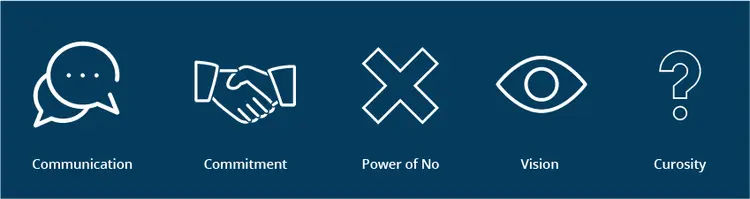
- A great PO has conviction in the Product Vision and knows the priorities of the Business very well, and is able to articulate the same to the Engineering teams.
- Shows commitment in completing the team’s goals by providing early and timely feedback.
- A great PO is excellent in communication, able to understand the nuances of the various stakeholders and speaks in each one’s language (Customer, Engineering, Sales, Marketing, Support etc.)
- Does not take sides but does what is right for the given situation and for the Customers. Is able to say “No” and has the reasons for it.
- Is not a task master who dictates to the team but a great Influencer who has the answers to “what has to be done” and “why it has to be done”.
- Trusts the team to know best on “How” things will be implemented.
- Negotiates well with the team for the Business but is fair in all interactions with the team winning the team’s trust.
- Is always curious in terms of the product implementation but does not interfere in the team’s approach of building the product.
To really excel at the job, the PO has to constantly upskill and sharpen the tools he/she has to offer. The PO is required to have keen knowledge of the various practices and techniques that are being used by his/her peers in the industry, in order to stay ahead of the competition. The PO needs to be part of a “Community of Practice”, grow his/her network outside the organization and be clued into all the relevant trends in the industry.
CSPO Certification
With the growing demand for the PO role in the market, the Industry naturally creates ways to benchmark standards, uphold quality and nourish promising talent. The CSPO Certification is one such mark of standard and quality. It equips the Product Owner to become better at the job and helps certified individuals to stand out in the crowd. The CSPO course and the CSPO community offers the right environment for the Product Owner to excel in his/her job.
The curriculum of the CSPO course online is outlined below for your reference.
Top Cities where Knowledgehut Conduct CSPO Certification Training Course Online
Contents
- Scrum Basics
- Understand the Scrum Framework and workflow so that the PO
- Agile Principles and Scrum Values
- Roles and Responsibilities
- Product Owner role in detail
- Scrum Master role at high level
- Team role at high level
- Product Vision
- Importance of Product Vision
- Creating the Product Vision
- Just enough preparations before creating the Product Vision
- Qualities of Product Vision
- Relationship between Product Vision and Product Road Map
- Estimation
- Estimation Levels and Techniques
- Accuracy is more desirable than Precision in Agile Estimation
- What can go wrong with Estimation
- Difference between Estimating and Committing
- Product Backlog
- Understand what Product Backlog is and is not
- Product Backlog Grooming
- Prioritization
- Importance and Benefits of Prioritizing Product Backlog
- Why everything cannot be Mandatory or Highest Priority
- Who should Prioritize
- Prioritization based on Multiple Factors
- Applying formal approaches to Prioritization
- Giving leeway to teams to sequence work after prioritization
- Release Management
- Goal
- Iterative and collaborative Release Planning
- Quality and Technical Debt
- Releasing Software early and frequently
- Measuring velocity and Release Burndown chart
- Forecasting future releases
- Sprints
- Product Owner’s role in Scrum Meetings
- Collaboration between PO and Scrum Team, between PO and Scrum Master
- Team Commitment
- Understand why Sprints are Timeboxed and Protected from other distractions
- Concept of sustainable pace
Career Prospects and Growth
Existing POs
For people who are already wearing the Product Owner’s hat, the CSPO certification is like one more feather in their resume. Going through this course and certification will fine-tune their skills and help add multiple tools in their toolbox.
Aspiring POs
In certain organizations, there might be team members exhibiting and playing the roles and responsibilities of a Product Owner without the role title. They would have acquired all the necessary skill sets but not the formal official title yet. By attending the CSPO course and earning the CSPO certification they convey their readiness to play the role; and this gives the thrust necessary for their formal recognition into a Product owner’s role.
Salary Aspects
The CSPO certification has global recognition and so will result in an increase in the pay package for a certified professional PO.
What next for an accomplished CSPO?
An accomplished CSPO can further his/her career prospects by taking up the Advanced CSPO course and certification. It will set the stage for the product owner to progress in their career path and play the role in a wider scope. Depending on the Organization type and structure it could be the role of a Product Manager, Product Portfolio Owner/Manager— and for the more adventurous, even the CEO of a startup! Some Product owners might choose to diversify into a Business Analyst role as well.
In conclusion, the CSPO has become a benchmark certification for Product Owners in the Software Industry. It will definitely help existing and aspiring POs to sharpen and upgrade their skillsets. It is also a badge of accomplishment and achievement for a Product Owner, not only to set them as a class apart in their own organization, but also in their wider Product Management community.
Frequently Asked Questions (FAQs)
1. Does CSPO increase salary?
Yes, a Certified Scrum Product Owner (CSPO) certification can lead to higher salaries by enhancing your skills in Agile product management, making you more valuable in product-focused roles. However, salary growth depends on experience, industry, and location.
2. How long is CSPO valid?
The CSPO certification is valid for two years. To maintain it, you need to renew by earning Scrum Education Units (SEUs) and paying a renewal fee.
3. What is the next level of CSPO?
The next levels after CSPO are Advanced Certified Scrum Product Owner (A-CSPO) and Certified Scrum Professional – Product Owner (CSP-PO), which offer deeper Agile product ownership skills.
4. What is the difference between a Product Owner and a product manager?
Both Product Owners (PO) and Product Managers (PM) are vital in product development but have distinct roles. While a PM focuses on strategy, market needs, and vision, a PO handles daily execution within agile teams.
| Aspect | Product Owner (PO) | Product Manager (PM) |
1. Primary Focus
| Manages the product backlog and ensures development aligns with business needs. | Defines product vision, strategy, and market positioning. |
2. Key Responsibilities
| Works closely with Scrum teams, refines user stories, and prioritizes backlog items. | Conducts market research, competitive analysis, and aligns product goals with business objectives.
|
3. Stakeholder Interaction
| Engages with development teams and internal stakeholders to refine requirements. | Collaborates with executives, marketing, sales, and customers to set the product direction. |
4. Decision-Making
| Tactical decision-maker focused on sprint-to-sprint delivery. | Strategic decision-maker responsible for long-term product success.
|
5. Time Horizon
| Short-term, focusing on sprint cycles and immediate development needs. | Long-term, focusing on product lifecycle, growth, and market trends. |
1639 articles published
KnowledgeHut is an outcome-focused global ed-tech company. We help organizations and professionals unlock excellence through skills development. We offer training solutions under the people and proces...
Get Free Consultation
By submitting, I accept the T&C and
Privacy Policy
Ready to learn about Agile Certifications Roadmap?