
- Home
- Blog
- Artificial Intelligence
- AI Masters Curriculum Guide: What You'll Learn and Why It Matters
AI Masters Curriculum Guide: What You'll Learn and Why It Matters
Updated on Jul 30, 2026 | 229 views
Share:
Table of Contents
View all
- AI Masters Curriculum at a Glance
- Course 1: Python Fundamentals for AI
- Course 2: Generative AI & Prompt Engineering
- Course 3: Applied Agentic AI Development
- Why This Curriculum Matters in Today's AI Job Market?
- Industry Tools You'll Learn
- Hands-On Projects That Bring It All Together
- What Skills Will You Walk Away With?
- Who Should Choose This Program?
- Conclusion
Quick Overview
- An Artificial Intelligence Master's curriculum focuses on core technical areas like machine learning, deep learning, natural language processing, and computer vision, enabling learners to build, test, and deploy intelligent systems.
- The program includes 40+ hours of instructor-led training, 80+ hours of self-paced learning, AI labs, assignments, capstone projects, and exposure to industry tools used in real AI development.
- Learners gain in-demand technical skills such as Python, LLMs, RAG, AI agents, workflow automation, and AI solution design while building projects that demonstrate their expertise to employers.
- Whether you're a software developer, data analyst, ML engineer, student, or career switcher, the curriculum is designed to help you transition into high-demand AI roles with job-ready knowledge and a strong portfolio.
Take the next step in your AI career with the Generative AI Masters Program and build a portfolio that stands out.
AI Masters Curriculum at a Glance
Before diving into the details of what this program covers, it helps to zoom out and see the full shape of it. The AI Masters curriculum is built as a progression, each stage adds a new layer of capability on top of the last, taking you from foundational programming all the way to building autonomous, multi-agent AI systems.
Here's the syllabus at a glance:
| Learning Stage | Focus Area | Outcome |
|---|---|---|
| Python Fundamentals | Programming for AI | Build AI applications |
| Generative AI | LLM fundamentals | Generate intelligent content |
| Prompt Engineering | AI interaction | Better AI outputs |
| Agentic AI | Autonomous systems | Multi-agent workflows |
| Projects | Real implementation | Portfolio |
Each stage feeds directly into the next. Python gives you the technical foundation, generative AI introduces you to how modern models actually work, prompt engineering teaches you to get reliable results out of them, and agentic AI pushes you into building systems that can plan and act on their own. Projects tie everything together into work you can actually show employers.
What's Included?
This isn't a lightweight overview course, it's a substantial program with real depth behind it:
- 40+ hours of instructor-led learning
- 80+ hours of self-paced learning
- 150+ quizzes to reinforce concepts as you go
- 30+ AI labs for hands-on practice
- 15+ assignments to apply what you've learned
- 5+ capstone projects for your portfolio
- Specialized certificates upon completion
So if you're wondering how long the curriculum is or how many modules it covers, it spans five major learning stages and well over 100 hours of combined instruction and practice, with built-in checkpoints (quizzes, labs, assignments) throughout to make sure the concepts actually stick before you move forward.
The next sections break down exactly what happens inside each of these five stages, starting with why Python comes first.
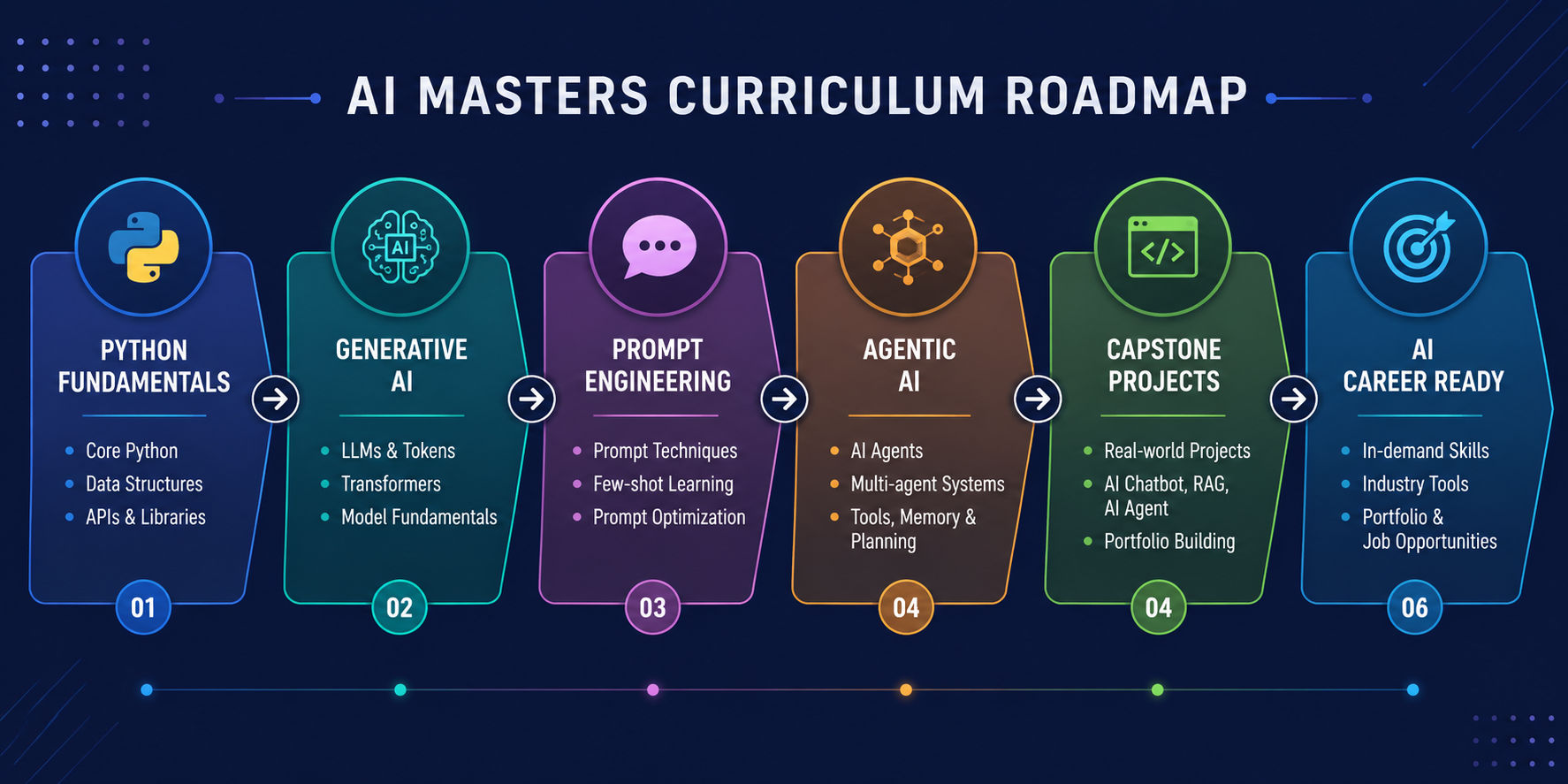
Explore industry-aligned Data Science courses and gain the practical skills needed to launch or advance your career in data, AI, and analytics.
Course 1: Python Fundamentals for AI
Every AI system runs on code, and in AI, that code is almost always Python. That's why this curriculum starts here first.
Why Python Is Essential for AI
Python is the go-to AI language for a few key reasons: it handles automation of repetitive tasks, makes data handling straightforward, powers nearly every major AI library, and supports model development at every stage.
Core Topics Covered
- Variables: store and track data
- Functions: build reusable logic
- Loops: process batches and automate repeated calls
- OOP: understand how AI frameworks are structured
- APIs: connect to AI models like GPT
- File handling: manage datasets and outputs
- Data structures: organize data flowing to and from models
Skills You'll Gain
By the end, you'll be able to read APIs, build scripts, process datasets, and connect AI models into your own workflows, turning Python into your entry point for AI development.
Course 2: Generative AI & Prompt Engineering
This course introduces the tech behind tools like ChatGPT, then teaches you how to get good results from them.
Generative AI Fundamentals
Covers LLMs (models that generate human-like text), tokens (text chunks the model reads), context (how much info it can consider), embeddings (how it represents meaning), and transformers (the architecture behind it all, explained simply).
Prompt Engineering
Covers prompt structure, role prompting, few-shot prompting, conceptual chain-of-thought, and prompt optimization, the skills that turn a raw AI model into a reliable one. This is exactly why ChatGPT alone isn't enough: the model gives you capability, prompt engineering gives you consistency.
Real Business Applications
These skills apply directly to marketing, coding, customer support, HR, documentation, and research.
| Prompt Type | Business Example | Outcome |
|---|---|---|
| Role prompting | Support agent persona | Consistent, on-brand replies |
| Few-shot prompting | Marketing copy templates | Faster, on-tone content |
| Chain-of-thought | Research summarization | More accurate output |
Course 3: Applied Agentic AI Development
This is the biggest differentiator in the program. AI is shifting from simple assistants to autonomous systems that can plan and act on their own.
What Is Agentic AI?
You'll learn the practical differences between traditional AI, AI agents, and multi-agent systems, and how each fits a different kind of problem.
Topics Covered
- AI Agents
- Tool calling
- Memory
- Planning
- Autonomous workflows
Frameworks
You'll get hands-on with CrewAI, LangChain, and LlamaIndex, learning why CrewAI in particular has become a go-to for building coordinated, multi-agent systems in practice.
Traditional Automation vs. AI Agents: traditional automation follows fixed, pre-programmed steps, while AI agents can reason, adapt, and decide their own next actions, making them far more flexible for complex, real-world workflows.
Why This Curriculum Matters in Today's AI Job Market?
AI adoption is moving faster than most companies can hire for, and the skills gap is real. This curriculum is built to close that gap with practical, job-ready expertise rather than surface-level familiarity.
- Generative AI adoption is accelerating across virtually every industry, creating a growing need for people who understand and can work with these tools.
- Demand is rising for AI engineers and developers who can actually build systems, not just discuss AI concepts in theory.
- The market is shifting toward AI agents and enterprise automation, moving beyond simple chatbots into autonomous, multi-step workflows.
- Employers increasingly want project-based proof of skill, not just certificates, they want to see what you've actually built.
- The curriculum is mapped directly to real career tasks, so Python, LLMs, RAG, and AI agents each correspond to actual work you'll do on the job, not abstract classroom exercises.
Curious about where these skills can take you? Explore Microsoft AI Masters Program Graduate Salary & Career Outcomes [2026] to learn about salaries, job roles, and career growth after completing an AI master's program.
Industry Tools You'll Learn
Beyond the core curriculum, you'll get hands-on exposure to the tools actually used by AI teams in industry:
- Programming: Python, GitHub
- LLM Frameworks: LangChain, LlamaIndex
- Vector Databases: Pinecone, ChromaDB, FAISS
- AI Infrastructure: Docker
- AI APIs: OpenAI API
- Multi-Agent Frameworks: CrewAI, AutoGen
Learning these tools alongside the concepts means you graduate with practical, transferable experience, not just theoretical knowledge.
Hands-On Projects That Bring It All Together
Concepts only stick when you apply them, which is why the program is built around real projects:
- AI Chatbot - Applies prompt engineering, LangChain, the OpenAI API, and vector databases.
- Retrieval-Augmented Generation (RAG) System - Covers retrieval, embeddings, and tools like Pinecone, FAISS, and LlamaIndex.
- Autonomous AI Agent - Brings together CrewAI, multi-agent collaboration, and workflow automation.
Each of these projects is portfolio-ready, meaning you can showcase them on GitHub and speak to them directly in interviews.
What Skills Will You Walk Away With?
By the end of the program, your skill set spans three categories:
- Technical Skills: Python, AI APIs, LangChain, LLMs, vector databases
- AI Skills: Prompt engineering, RAG, AI agents, workflow automation
- Professional Skills: Problem solving, AI solution design, deployment thinking
Wondering whether a full master's program is worth it? Compare an AI Masters Program vs Individual AI Certifications to understand the long-term career value, learning depth, and return on investment.
Who Should Choose This Program?
AI skills are valuable across a wide range of technical backgrounds, not just for people already working in machine learning. This program is built to meet learners where they are, whatever stage of their career they're coming from.
- Software developers and Python developers looking to specialize in AI and expand their existing technical skill set.
- Data analysts ready to move beyond analysis into building and deploying AI-powered systems.
- ML engineers and automation engineers wanting hands-on experience with modern LLM and agentic AI frameworks.
- Career switchers with a foundational interest in programming, who want a structured path into AI without needing years of prior experience.
- Students actively preparing for AI careers, looking to build a portfolio of real projects before entering the job market.
Not sure which path fits your goals? Read AI Masters Program vs MBA in AI: Which Is Better for Your Career? to compare curriculum, career opportunities, and the ideal learner profile for each option.
Conclusion
An AI Masters curriculum gives you a clear path from learning Python to building advanced AI applications and autonomous AI agents. With hands-on labs, real-world projects, and industry tools, the program helps you develop practical skills that employers value. Whether you are a developer, data professional, student, or career switcher, this curriculum prepares you to confidently work with modern AI technologies and build a strong portfolio for future AI career opportunities.
Have A Query? Get in Touch With Our Customer Support | KnowledgeHut
Frequently Asked Questions (FAQs)
1. Do I need prior programming experience to join the AI Masters program?
While prior programming experience can be helpful, many learners start with basic or no coding knowledge. Since the curriculum begins with Python fundamentals, it is designed to build foundational skills before progressing to advanced AI concepts, making it accessible to motivated beginners willing to learn consistently.
2. How much time should I dedicate each week to complete the program successfully?
The weekly commitment depends on your learning pace, but most learners benefit from dedicating 6 to 10 hours per week. Consistent study, hands-on practice, and project work help reinforce concepts and ensure steady progress through the curriculum without becoming overwhelming.
3. What hardware or system requirements are needed for the course?
Most coursework can be completed on a modern laptop or desktop with a stable internet connection. For advanced AI projects, cloud-based tools and platforms may reduce the need for high-end hardware, allowing learners to build and test applications efficiently.
4. Will I learn how to deploy AI applications in real-world environments?
Yes, learners typically gain exposure to deployment concepts, workflows, and best practices. Understanding deployment helps bridge the gap between building AI models and making them available for real users, which is an important skill in professional AI development.
5. Can the skills learned in this program be applied to non-technical industries?
Absolutely. AI skills are increasingly valuable in sectors such as healthcare, finance, education, marketing, retail, and human resources. The knowledge gained can help professionals automate tasks, improve decision-making, and create AI-powered solutions within their industries.
6. How do employers evaluate AI portfolios created during the program?
Employers often assess portfolios based on project complexity, practical business relevance, problem-solving ability, and technical implementation. Well-documented projects that demonstrate real-world applications, coding skills, and AI knowledge can significantly strengthen job applications and interviews.
7. Are there opportunities to collaborate with other learners during the program?
Many modern AI training programs encourage peer interaction through discussion forums, project reviews, workshops, or group activities. Collaboration helps learners exchange ideas, solve challenges together, and develop teamwork skills that are highly valued in AI-related roles.
8. How frequently are AI course materials updated to match industry changes?
Quality AI programs regularly update content to reflect evolving tools, frameworks, and industry practices. Since AI technologies change rapidly, ongoing curriculum updates help learners stay aligned with current trends, emerging techniques, and employer expectations.
9. What career roles can learners pursue after completing the program?
Graduates may explore roles such as AI Engineer, Prompt Engineer, Generative AI Specialist, Automation Developer, AI Solutions Consultant, or AI Product Analyst. Career opportunities vary depending on previous experience, technical background, and the strength of completed projects.
10. How can learners continue improving their AI skills after completing the curriculum?
Continuous learning is essential in AI. Graduates can advance by building personal projects, contributing to open-source communities, earning specialized certifications, following industry research, and experimenting with emerging AI tools and frameworks to deepen their expertise over time.
1639 articles published
KnowledgeHut is an outcome-focused global ed-tech company. We help organizations and professionals unlock excellence through skills development. We offer training solutions under the people and proces...
Get Free Consultation
By submitting, I accept the T&C and
Privacy Policy