
- Home
- Blog
- Artificial Intelligence
- AI Masters Program vs Individual AI Certifications: Which Delivers Better ROI?
AI Masters Program vs Individual AI Certifications: Which Delivers Better ROI?
Updated on Jul 29, 2026 | 199 views
Share:
Table of Contents
View all
- AI Master's Program vs Individual AI Certifications
- What is an AI Master's Program?
- What are Individual AI Certifications?
- How to Measure ROI Before Choosing an AI Learning Path
- Skills You Gain from Each Learning Path
- Career Scenarios: Which Option Fits Different Professionals?
- Can You Combine Both Learning Paths?
- Which Learning Path Should You Choose?
- Conclusion
Quick Overview
- Individual AI certifications generally deliver faster ROI, while an AI Master's program offers greater long-term value for research and advanced leadership careers.
- Certifications are more affordable, shorter, and focused on practical, job-ready AI skills, whereas a Master's provides deeper academic knowledge and specialization.
- The right choice depends on your career goals, budget, timeline, and the type of AI role you want to pursue.
- In this guide, you'll learn the differences between AI Master's programs and AI certifications, compare their ROI, and determine which learning path best fits your career goals.
If you're planning to build expertise in artificial intelligence, explore the AI Masters Program to gain industry relevant skills through a structured learning path.
AI Master's Program vs Individual AI Certifications
Both learning paths help you build Artificial Intelligence expertise, but they are designed for different audiences and career objectives. Understanding the AI Master's Program vs Individual AI Certifications comparison begins with recognizing that one focuses on academic depth while the other emphasizes practical, job-reading skills.
An AI Master's Program is a formal postgraduate degree that explores Artificial Intelligence through advanced coursework, research, and comprehensive projects. It is typically intended for learners seeking deep technical expertise or leadership opportunities in research and engineering.
Individual AI certifications are shorter professional learning programs that focus on specific technologies, tools, or practical AI applications. They are designed to help professionals develop relevant skills quickly and apply them immediately in the workplace.
The AI Masters Program vs Individual AI Certifications decision should be based on your career direction rather than assuming one option is always better.
High Level Comparison
Feature |
AI Master's Program |
Individual AI Certifications |
| Duration | One to two years | A few weeks to several months |
| Cost | Higher investment | Lower investment |
| Learning Depth | Comprehensive academic study | Focused practical learning |
| Credential | Master's degree | Professional certificate |
| Best For | Research, advanced engineering, leadership | Working professionals, upskilling, career transitions |
Planning a career in AI? Read Microsoft AI Masters Program Graduate Salary & Career Outcomes [2026] to understand the roles, salaries, and opportunities available to graduates.
What is an AI Master's Program?
An AI Master's Program is designed for learners who want an in depth understanding of Artificial Intelligence. Rather than focusing only on practical implementation, it explores the theories, mathematics, research methods, and engineering concepts that support modern AI systems.
For professionals evaluating AI Master's Program vs Individual AI Certifications, understanding the structure of a Master's Program is essential before comparing its return on investment.
Definition
An AI Master's Program is a postgraduate academic degree awarded by a university after completing advanced coursework and meeting graduation requirements. It combines theoretical knowledge with practical projects and often includes research focused on emerging AI technologies.
Graduates earn a recognized academic qualification that may support careers in advanced engineering, research, higher education, and technical leadership.
Curriculum
The curriculum typically includes Machine Learning, Deep Learning, Natural Language Processing, Computer Vision, AI Ethics, statistics, optimization techniques, and software engineering for AI systems. Many programs also include research projects, capstone assignments, or industry collaborations that encourage students to solve real business problems.
For example, students may build an intelligent recommendation engine or develop a computer vision solution for healthcare diagnostics as part of their capstone project.
Duration
Most AI Master's Programs require one to two years of study depending on the institution and study mode. Universities commonly offer full time, part time, and online options, allowing learners to balance education with personal or professional commitments.
Working professionals often choose flexible online or part-time programs to continue gaining industry experience while studying.
Learning Style
Learning generally combines lectures, assignments, practical laboratories, research activities, team projects, and independent study. Many universities also encourage collaboration with industry partners, giving students exposure to real world AI challenges.
This structured learning environment provides a deeper understanding of concepts rather than focusing only on tool specific implementation.
Who is it Best For?
An AI Master's Program is well suited for fresh graduates planning long term AI careers, engineers seeking advanced technical knowledge, aspiring AI researchers, and professionals interested in technical leadership or research and development positions.
For these learners, the AI Masters Program vs Individual AI Certifications comparison often favors a Master's because of its academic depth and broader technical foundation.
What are Individual AI Certifications?
Individual AI certifications are professional learning programs designed to help learners build practical Artificial Intelligence skills in a relatively short period. Instead of covering every aspect of AI, they focus on specific technologies, tools, or industry applications that professionals can immediately use in their work.
When comparing AI Masters Program vs Individual AI Certifications, certifications stand out for their flexibility, affordability, and direct relevance to current industry needs.
Definition
Individual AI certifications are structured training programs that award professional credentials after learners complete coursework, projects, or assessments. Unlike university degrees, these certifications are typically focused on practical implementation rather than academic research.
Their primary goal is helping learners become productive in real world AI projects as quickly as possible.
Types of Certifications
Professionals can choose from several certification formats depending on their goals. These include vendor certifications from technology companies, professional certificates, university backed certificate programs, immersive bootcamps, and specialized AI courses focused on topics such as Machine Learning, Generative AI, or AI engineering.
For example, a Product Manager may choose a Generative AI certification, while a software engineer may prefer an AI engineering program emphasizing model deployment.
Duration
Most certifications can be completed within a few weeks or several months. Many programs are self paced, allowing learners to study alongside full time employment without committing to a long academic schedule.
This flexibility is one reason many working professionals prefer certifications when evaluating AI Masters Program vs Individual AI Certifications.
Learning Style
Certification programs emphasize practical learning through hands on laboratories, industry projects, coding exercises, case studies, and real business scenarios. Learners spend less time studying theory and more time applying AI techniques using commonly adopted tools and frameworks.
This approach helps professionals develop job-reading skills in a relatively short time.
Who are They Best For?
Individual AI certifications are ideal for working professionals, software engineers, Product Managers, Data Analysts, business leaders, career changers, and anyone looking to add AI skills without taking an extended career break.
For example, an experienced software developer who wants to transition into AI engineering may complete several specialized certifications while continuing full time employment.
The AI Masters Program vs Individual AI Certifications comparison often favors certifications for professionals seeking faster career progression, practical implementation skills, and continuous upskilling in a rapidly evolving field.
How to Measure ROI Before Choosing an AI Learning Path
Choosing between AI Masters Program vs Individual AI Certifications should not be based on tuition fees alone. The true return on investment includes the knowledge you gain, how quickly you can apply it, the career opportunities it creates, and its long term impact on your professional growth.
For some learners, spending more on a Master's Program may deliver greater value over time. For others, a shorter certification that leads to a promotion or career transition within months may offer a stronger return. The key is to evaluate every option using practical criteria rather than focusing on one factor.
Tuition Cost
The total cost of learning is often the first consideration. AI Master's Programs generally require a larger financial investment because they provide a full academic degree over an extended period. Individual AI certifications are usually more affordable, making them accessible to professionals who want to upskill without a significant financial commitment.
A lower cost does not automatically mean better ROI. The value depends on how effectively the learning supports your career goals.
Opportunity Cost
Opportunity cost refers to what you give up while pursuing a learning program. A full time Master's Program may require reducing work hours or taking a career break, while most certification programs allow learners to continue working and earning an income.
For many working professionals comparing AI Masters Program vs Individual AI Certifications, minimizing opportunity cost is an important factor.
Time Commitment
Learning timelines vary significantly. A Master's Program typically takes one to two years, while many AI certifications can be completed in a few weeks or months.
If your goal is to qualify for a new role quickly, certifications may deliver faster results. If you are planning a long term technical career, investing more time in advanced education may be worthwhile.
Salary Growth
Higher salaries depend on much more than a credential. Practical skills, project experience, industry demand, and problem solving ability often influence compensation as much as formal education.
For example, an engineer who completes a specialized Generative AI certification and immediately applies those skills at work may receive a promotion sooner than someone still completing a two year academic program.
Skill Applicability
The best learning investment is one that teaches skills you can use immediately. Certifications often focus on current technologies and industry tools, while Master's Programs provide broader theoretical foundations that remain valuable over the long term.
This balance is one of the biggest considerations in the AI Masters Program vs Individual AI Certifications decision.
Employer Recognition
Many employers value both academic degrees and professional certifications. The importance of each depends on the role. Research positions may emphasize advanced degrees, while product development and engineering teams often prioritize demonstrated skills and project experience.
A strong portfolio frequently strengthens either credential.
Career Advancement
Consider where you want to be five or ten years from now. If your ambition is technical leadership, advanced research, or specialized engineering, a Master's Program may support that path. If your goal is changing roles quickly or adding AI capabilities to your current position, certifications often provide faster career momentum.
Networking
University programs often provide access to professors, research communities, alumni networks, and industry partnerships. Certification programs typically connect learners through online communities, professional cohorts, and instructor-led workshops.
Both networking opportunities can create valuable career connections, although the experience differs.
Learning Flexibility
Working professionals usually need flexible schedules. Certifications often allow learners to study evenings or weekends at their own pace. Master's Programs may also offer online options, but they generally require a larger time commitment and structured academic deadlines.
When evaluating AI Masters Program vs Individual AI Certifications, remember that the highest ROI is not always the option with the lowest cost or the highest salary. The best choice is the one that supports your personal learning goals and long term career aspirations.
Balancing work and learning is possible with the right approach. Read Can Working Professionals Learn AI While Working Full-Time? to discover practical strategies for upskilling without leaving your job.
Skills You Gain from Each Learning Path
A credential alone does not create career opportunities. Employers want professionals who can solve problems, build AI solutions, and contribute to business outcomes. That is why comparing the skills developed through AI Masters Program vs Individual AI Certifications is just as important as comparing costs.
Technical Skills
AI Master's Programs provide broad technical knowledge covering algorithms, optimization, programming, statistics, and advanced computing concepts. Certifications usually focus on applying selected technologies to solve practical business problems.
Professionals looking for immediate workplace skills often appreciate the focused nature of certification programs.
Practical AI Implementation
Certification programs place strong emphasis on building applications, deploying models, and using industry tools. Learners frequently complete hands on projects that simulate real workplace challenges.
For example, a certification learner might develop an AI powered customer support assistant using current frameworks and deployment platforms.
Mathematics
Mathematics plays a much larger role in most Master's Programs. Students explore probability, linear algebra, calculus, and optimization techniques that explain how AI models work internally.
Certification programs generally cover only the mathematical concepts necessary for practical implementation.
Machine Learning
Both learning paths teach Machine Learning, but with different objectives. Master's Programs explain underlying algorithms in greater depth, while certifications emphasize model development, evaluation, and deployment using commonly adopted libraries and frameworks.
Deep Learning
Students pursuing a Master's often study neural network architectures, optimization methods, and research developments in Deep Learning. Certification programs typically focus on building applications using established Deep Learning frameworks rather than exploring every theoretical detail.
Generative AI
Generative AI evolves rapidly, making certifications particularly valuable for professionals who want current industry knowledge. Many certification providers regularly update their content to include new models, prompting techniques, and enterprise applications.
This is an area where AI Masters Program vs Individual AI Certifications often favors certifications because of their ability to adapt quickly to industry changes.
AI Engineering Tools
Certification programs commonly provide experience with modern AI ecosystems, cloud services, deployment pipelines, development frameworks, and collaboration tools used by AI teams.
Master's Programs also introduce these technologies, but their primary emphasis remains broader academic understanding.
Business Applications
Organizations increasingly expect AI professionals to understand business value alongside technical implementation. Certifications frequently include practical case studies showing how AI improves customer experience, productivity, marketing, healthcare, finance, and operations.
Career Scenarios: Which Option Fits Different Professionals?
Every learner starts from a different point. Choosing between AI Masters Program vs Individual AI Certifications becomes easier when you consider your current role and future career goals.
Fresh Graduates
Graduates planning careers in AI research, advanced engineering, or higher education often benefit from a Master's Program because it builds strong theoretical knowledge and academic credibility.
Software Engineers
Software engineers looking to integrate AI into existing development work often achieve faster results through certifications focused on Machine Learning, Generative AI, and AI engineering.
Data Analysts
Analysts who want to transition into AI roles can benefit from certifications that emphasize predictive modeling, Machine Learning, and business analytics before considering a master's Program later.
Project Managers
Project Managers rarely need deep research knowledge. Practical certifications covering AI strategy, implementation, and business applications are usually more relevant for managing AI initiatives.
Product Managers
Product Managers benefit from certifications that explain how AI products are designed, deployed, and measured. Understanding practical implementation helps them collaborate effectively with technical teams.
Business Leaders
Executives and business leaders generally seek strategic AI knowledge rather than advanced programming. Executive focused certifications often provide sufficient understanding without requiring a long academic commitment.
Career Changers
Professionals entering AI from unrelated industries often achieve quicker career transitions through structured certification programs combined with portfolio projects and continuous learning.
Entrepreneurs
Entrepreneurs building AI powered products benefit from practical certifications that teach implementation, product development, and market applications. Later, they may pursue advanced education if deeper technical expertise becomes necessary.
Choosing the right option ultimately depends on where you are today and where you want your career to go tomorrow.
Can You Combine Both Learning Paths?
Choosing between AI Masters Program vs Individual AI Certifications does not have to be an either-or decision. Many successful AI professionals combine both learning paths at different stages of their careers. This approach allows them to build practical skills quickly while continuing to deepen their knowledge over time.
Instead of viewing the two options as competitors, think of them as complementary. Certifications can help you enter the AI field faster, while a Master's Program can strengthen your expertise when your career demands more advanced technical or leadership capabilities.
Certifications Before a Master's
Many professionals begin with AI certifications because they require less time and a smaller financial investment. Certifications help learners develop practical skills, build a portfolio, and gain confidence before deciding whether a Master's Program is the right next step.
For example, a software engineer might complete certifications in Machine Learning and Generative AI, work on AI projects for a few years, and later pursue a Master's Program to move into research or technical leadership.
Master's Followed by Specialized Certifications
Professionals who already hold a Master's degree often continue learning through specialized certifications. Since Artificial Intelligence evolves rapidly, certifications help them stay current with new tools, cloud platforms, and emerging technologies that may not have been covered during their academic studies.
A graduate specializing in Machine Learning may later complete certifications focused on Generative AI, AI engineering, or cloud-based AI deployment to remain competitive in the job market.
Continuous Upskilling
Artificial Intelligence changes quickly, making continuous learning essential regardless of your educational background. New models, frameworks, and business applications emerge regularly, requiring professionals to update their knowledge throughout their careers.
This is one of the strongest arguments in the AI Masters Program vs Individual AI Certifications discussion. A Master's Program builds a strong foundation, while certifications provide an efficient way to keep skills relevant as technology evolves.
Learning Journey
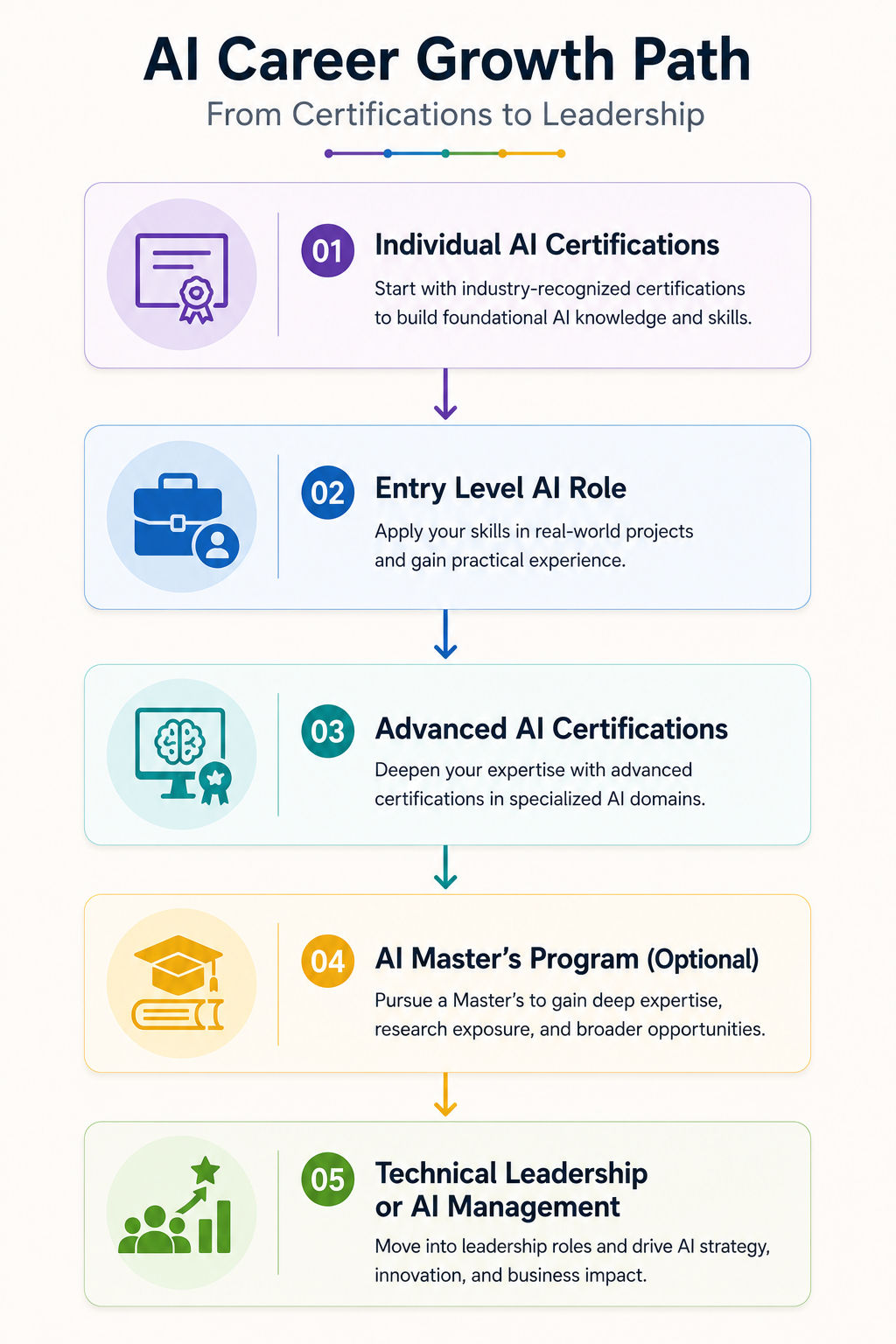
Rather than choosing one path forever, many professionals create a learning journey that combines academic depth with practical industry skills.
Not sure which AI certification is right for you? Read Top AI Certification Courses in 2026 and How to Pick the Right One to compare the leading options based on your experience and career goals.
Which Learning Path Should You Choose?
The best choice depends on your personal circumstances rather than a universal ranking. When comparing AI Masters Program vs Individual AI Certifications, ask yourself what you want your career to look like over the next few years and what resources you can realistically invest.
Choose an AI Master's Program If You
- Want deep technical knowledge and academic credibility.
- Plan to pursue AI research or advanced engineering roles.
- Aspire to technical leadership or research and development positions.
- Can dedicate significant time to structured learning.
- Prefer a comprehensive understanding of Artificial Intelligence.
Choose Individual AI Certifications If You
- Want to learn practical AI skills quickly.
- Are already working and cannot take a long career break.
- Need skills for a promotion or career transition.
- Prefer flexible, self paced learning.
- Want to build a portfolio with real world AI projects.
There is no single winner in the AI Masters Program vs Individual AI Certifications comparison. The right decision depends on your experience, budget, career goals, preferred learning style, and the type of opportunities you want to pursue.
Choosing the right AI course is the first step toward an AI career. Checkout Artificial Intelligence Courses with Certification Online to explore top certification options available online.
Conclusion
The debate around AI Masters Program vs Individual AI Certifications is not about determining which option is universally better. Instead, it is about identifying which learning path delivers the strongest return on investment for your unique situation.
Ultimately, the best ROI comes from selecting the learning path that aligns with your career goals, available time, budget, and preferred learning approach. In many cases, combining both options over the course of your career provides the greatest long-term value.
Contact our upGrad KnowledgeHut experts for personalized guidance on choosing the right course, career path, and certification to achieve your goals.
Frequently Asked Questions
Is an AI Masters Program better than AI certifications?
There is no universal answer. The better option depends on your career goals, desired learning depth, available time, and budget. A Master's Program offers comprehensive academic knowledge, while certifications focus on practical skills that can often be applied immediately in the workplace.
Can AI certifications replace a Master's degree?
For many industry roles, multiple high quality AI certifications combined with hands on projects and work experience can be enough. However, research positions, doctoral studies, and certain advanced technical roles may still prefer candidates with a Master's degree.
Which offers better ROI for working professionals?
Working professionals often achieve better short-term ROI through AI certifications because they are more affordable, take less time to complete, and allow learners to continue earning while studying. They also help professionals quickly apply new skills in their current roles.
Do employers recognize AI certifications?
Yes. Employers increasingly recognize AI certifications from reputable technology companies, universities, and professional learning providers. Certifications supported by practical project experience and a strong portfolio are especially valuable during hiring.
Should beginners start with a Master's Program or AI certifications?
The right starting point depends on career goals. Beginners interested in research or advanced AI engineering may benefit from a Master's Program, while those looking for faster entry into AI careers often begin with foundational certifications and practical projects.
Which learning path is better for career changers?
AI certifications are generally the better choice for career changers because they focus on practical, job ready skills and can be completed in a shorter time. They allow professionals to transition into AI roles without committing to a lengthy academic program.
Are AI Master's Programs more comprehensive than certifications?
Yes. AI Master's Programs usually provide broader coverage of Artificial Intelligence, including mathematics, Machine Learning, Deep Learning, Natural Language Processing, Computer Vision, AI Ethics, and research methods. Certifications typically concentrate on specific tools, technologies, or business applications.
Can I pursue AI certifications after completing a Master's Program?
Absolutely. Many AI professionals continue earning certifications after completing a Master's degree to stay updated with new technologies, cloud platforms, Generative AI tools, and industry best practices. Continuous learning is essential in the rapidly evolving AI field.
How long does it take to complete an AI Master's Program compared to certifications?
An AI Master's Program typically takes one to two years, depending on the university and study format. Individual AI certifications usually take anywhere from a few weeks to several months, making them a faster option for developing new skills.
Can combining a Master's Program and AI certifications improve career opportunities?
Yes. Combining both learning paths gives professionals a strong academic foundation along with current industry skills. Many employers value candidates who demonstrate deep theoretical knowledge, practical implementation experience, and a commitment to continuous learning, making this combination beneficial for long term career growth.
1639 articles published
KnowledgeHut is an outcome-focused global ed-tech company. We help organizations and professionals unlock excellence through skills development. We offer training solutions under the people and proces...
Get Free Consultation
By submitting, I accept the T&C and
Privacy Policy