
- Blog Categories
- Project Management
- Agile Management
- IT Service Management
- Cloud Computing
- Business Management
- BI And Visualisation
- Quality Management
- Cyber Security
- DevOps
- Most Popular Blogs
- PMP Exam Schedule for 2025: Check PMP Exam Date
- Top 60+ PMP Exam Questions and Answers for 2025
- PMP Cheat Sheet and PMP Formulas To Use in 2025
- What is PMP Process? A Complete List of 49 Processes of PMP
- Top 15+ Project Management Case Studies with Examples 2025
- Top Picks by Authors
- Top 170 Project Management Research Topics
- What is Effective Communication: Definition
- How to Create a Project Plan in Excel in 2025?
- PMP Certification Exam Eligibility in 2025 [A Complete Checklist]
- PMP Certification Fees - All Aspects of PMP Certification Fee
- Most Popular Blogs
- CSM vs PSM: Which Certification to Choose in 2025?
- How Much Does Scrum Master Certification Cost in 2025?
- CSPO vs PSPO Certification: What to Choose in 2025?
- 8 Best Scrum Master Certifications to Pursue in 2025
- Safe Agilist Exam: A Complete Study Guide 2025
- Top Picks by Authors
- SAFe vs Agile: Difference Between Scaled Agile and Agile
- Top 21 Scrum Best Practices for Efficient Agile Workflow
- 30 User Story Examples and Templates to Use in 2025
- State of Agile: Things You Need to Know
- Top 24 Career Benefits of a Certifed Scrum Master
- Most Popular Blogs
- ITIL Certification Cost in 2025 [Exam Fee & Other Expenses]
- Top 17 Required Skills for System Administrator in 2025
- How Effective Is Itil Certification for a Job Switch?
- IT Service Management (ITSM) Role and Responsibilities
- Top 25 Service Based Companies in India in 2025
- Top Picks by Authors
- What is Escalation Matrix & How Does It Work? [Types, Process]
- ITIL Service Operation: Phases, Functions, Best Practices
- 10 Best Facility Management Software in 2025
- What is Service Request Management in ITIL? Example, Steps, Tips
- An Introduction To ITIL® Exam
- Most Popular Blogs
- A Complete AWS Cheat Sheet: Important Topics Covered
- Top AWS Solution Architect Projects in 2025
- 15 Best Azure Certifications 2025: Which one to Choose?
- Top 22 Cloud Computing Project Ideas in 2025 [Source Code]
- How to Become an Azure Data Engineer? 2025 Roadmap
- Top Picks by Authors
- Top 40 IoT Project Ideas and Topics in 2025 [Source Code]
- The Future of AWS: Top Trends & Predictions in 2025
- AWS Solutions Architect vs AWS Developer [Key Differences]
- Top 20 Azure Data Engineering Projects in 2025 [Source Code]
- 25 Best Cloud Computing Tools in 2025
- Most Popular Blogs
- Company Analysis Report: Examples, Templates, Components
- 400 Trending Business Management Research Topics
- Business Analysis Body of Knowledge (BABOK): Guide
- ECBA Certification: Is it Worth it?
- Top Picks by Authors
- Top 20 Business Analytics Project in 2025 [With Source Code]
- ECBA Certification Cost Across Countries
- Top 9 Free Business Requirements Document (BRD) Templates
- Business Analyst Job Description in 2025 [Key Responsibility]
- Business Analysis Framework: Elements, Process, Techniques
- Most Popular Blogs
- Best Career options after BA [2025]
- Top Career Options after BCom to Know in 2025
- Top 10 Power Bi Books of 2025 [Beginners to Experienced]
- Power BI Skills in Demand: How to Stand Out in the Job Market
- Top 15 Power BI Project Ideas
- Top Picks by Authors
- 10 Limitations of Power BI: You Must Know in 2025
- Top 45 Career Options After BBA in 2025 [With Salary]
- Top Power BI Dashboard Templates of 2025
- What is Power BI Used For - Practical Applications Of Power BI
- SSRS Vs Power BI - What are the Key Differences?
- Most Popular Blogs
- Data Collection Plan For Six Sigma: How to Create One?
- Quality Engineer Resume for 2025 [Examples + Tips]
- 20 Best Quality Management Certifications That Pay Well in 2025
- Six Sigma in Operations Management [A Brief Introduction]
- Top Picks by Authors
- Six Sigma Green Belt vs PMP: What's the Difference
- Quality Management: Definition, Importance, Components
- Adding Green Belt Certifications to Your Resume
- Six Sigma Green Belt in Healthcare: Concepts, Benefits and Examples
- Most Popular Blogs
- Latest CISSP Exam Dumps of 2025 [Free CISSP Dumps]
- CISSP vs Security+ Certifications: Which is Best in 2025?
- Best CISSP Study Guides for 2025 + CISSP Study Plan
- How to Become an Ethical Hacker in 2025?
- Top Picks by Authors
- CISSP vs Master's Degree: Which One to Choose in 2025?
- CISSP Endorsement Process: Requirements & Example
- OSCP vs CISSP | Top Cybersecurity Certifications
- How to Pass the CISSP Exam on Your 1st Attempt in 2025?
- Most Popular Blogs
- Top 7 Kubernetes Certifications in 2025
- Kubernetes Pods: Types, Examples, Best Practices
- DevOps Methodologies: Practices & Principles
- Docker Image Commands
- Top Picks by Authors
- Best DevOps Certifications in 2025
- 20 Best Automation Tools for DevOps
- Top 20 DevOps Projects of 2025
- OS for Docker: Features, Factors and Tips
- More
- Agile & PMP Practice Tests
- Agile Testing
- Agile Scrum Practice Exam
- CAPM Practice Test
- PRINCE2 Foundation Exam
- PMP Practice Exam
- Cloud Related Practice Test
- Azure Infrastructure Solutions
- AWS Solutions Architect
- IT Related Pratice Test
- ITIL Practice Test
- Devops Practice Test
- TOGAF® Practice Test
- Other Practice Test
- Oracle Primavera P6 V8
- MS Project Practice Test
- Project Management & Agile
- Project Management Interview Questions
- Release Train Engineer Interview Questions
- Agile Coach Interview Questions
- Scrum Interview Questions
- IT Project Manager Interview Questions
- Cloud & Data
- Azure Databricks Interview Questions
- AWS architect Interview Questions
- Cloud Computing Interview Questions
- AWS Interview Questions
- Kubernetes Interview Questions
- Web Development
- CSS3 Free Course with Certificates
- Basics of Spring Core and MVC
- Javascript Free Course with Certificate
- React Free Course with Certificate
- Node JS Free Certification Course
- Data Science
- Python Machine Learning Course
- Python for Data Science Free Course
- NLP Free Course with Certificate
- Data Analysis Using SQL
- Home
- Blog
- Artificial Intelligence
- What Is the A2A (Agent2Agent) Protocol? A2A vs MCP Explained
What Is the A2A (Agent2Agent) Protocol? A2A vs MCP Explained
Updated on Oct 22, 2026
Share:
Table of Contents
View all
Quick Overview
- The A2A protocol is an open standard that enables independent AI agents to communicate, exchange information, delegate tasks, and collaborate across different frameworks and platforms.
- How the A2A Protocol Works: Agents discover each other's capabilities through Agent Cards, exchange messages and task requests, track progress, and receive completed results or error responses using a structured communication process.
- A2A vs MCP: A2A focuses on communication and collaboration between AI agents, while the Model Context Protocol (MCP) connects AI applications to external tools, resources, and data sources. Both protocols can work together in a multi-agent system.
- This guide explains what the A2A protocol is, how it works, its key components and use cases, and how it differs from MCP in building connected AI agents and multi-agent workflows.
To understand how autonomous AI agents communicate, collaborate, and execute complex tasks, explore Applied Agentic AI to build practical knowledge of agent workflows, tool integration, and multi-agent systems.
What is the A2A (Agent2Agent) protocol?
The A2A (Agent2Agent) protocol is an open standard that allows independent AI agents to communicate, share information, and collaborate on tasks. It helps agents built using different frameworks or platforms work together without requiring them to share their internal code, memory, or tools.
Instead of building a separate integration for every AI agent, developers can use the A2A protocol to establish a common way for agents to discover capabilities, exchange messages, and coordinate work.
How the A2A protocol enables communication between AI agents
AI agents are often designed for specific tasks, such as analyzing data, answering questions, or managing business operations. The A2A protocol allows these specialized agents to request help from one another and exchange results.
It supports collaboration through:
- Capability discovery: Identifying which agent can handle a particular task.
- Task delegation: Sending work to another agent with the required instructions and context.
- Information exchange: Sharing messages, files, and structured data.
- Progress tracking: Monitoring tasks that may take time to complete.
Also read: Which Microsoft Tools Are Used for Agentic AI Development?
How does the A2A protocol work?
The A2A protocol follows a structured communication process. One agent discovers another agent's capabilities, sends a request, and receives a response or task update. The receiving agent manages the work and returns its results through the agreed communication mechanism.
The process generally involves the following stages:
- Discover a suitable agent.
- Check its capabilities and communication requirements.
- Send a message or task request.
- Track progress if the task is still running.
- Receive the completed result or an error response.
1. Agent cards for discovering agent capabilities
An Agent Card is a machine-readable description of an AI agent. It helps other agents understand what the agent does, where to contact it, and how to interact with it.
An Agent Card can include:
- Agent name and description.
- Supported skills and capabilities.
- Service endpoint.
- Supported input and output formats.
- Authentication requirements.
- Protocol version and supported interfaces.
2. Client server communication between AI agents
In A2A communication, a client sends a request to a remote agent that acts as the server for that interaction. The remote agent processes the request and returns a response or information about the task's status.
The client and server roles describe the interaction rather than permanently defining what an agent can do. An agent can act as a client when requesting another agent's help and as a server when receiving requests.
This flexible model allows agents developed with different technologies to collaborate through a shared protocol.
3. Task lifecycle, streaming updates, and completion
Some agent requests can be answered immediately, while others involve several processing steps. The A2A protocol provides a task lifecycle to help manage work from submission through completion, failure, cancellation, or other supported terminal states.
For longer tasks, it supports progress updates through mechanisms such as Server Sent Events (SSE). This allows a client to receive updates without repeatedly starting the same request.
Key capabilities include:
- Task tracking: Identifying and checking the status of a task.
- Streaming updates: Receiving progress or output as it becomes available.
- Completion handling: Retrieving the final response or generated artifacts.
- Error handling: Identifying requests that fail or cannot be processed.
4. Secure collaboration without exposing internal agent details
The A2A protocol is designed to let agents collaborate without requiring access to each other's internal implementation. One agent can request a service and receive its output without seeing the other agent's private reasoning, memory, or underlying tools.
However, using the protocol does not automatically make an AI system secure. Organizations still need suitable authentication, authorization, encrypted connections, and data handling policies.
Sensitive information should only be shared when necessary, and access should be limited to the resources each agent needs. These controls help reduce the risk of unauthorized access or unintended data exposure.
Professionals looking to translate emerging AI technologies into practical product solutions can explore the PG Certificate in AI Powered Product and Design Thinking to learn how AI and design thinking support product innovation, user-centric experiences, and smarter product decisions.
What are the key components of the A2A protocol?
The A2A protocol uses a small set of core concepts to make communication between agents more consistent. Agent Cards support discovery, messages carry information, tasks represent units of work, and artifacts contain the results produced by agents.
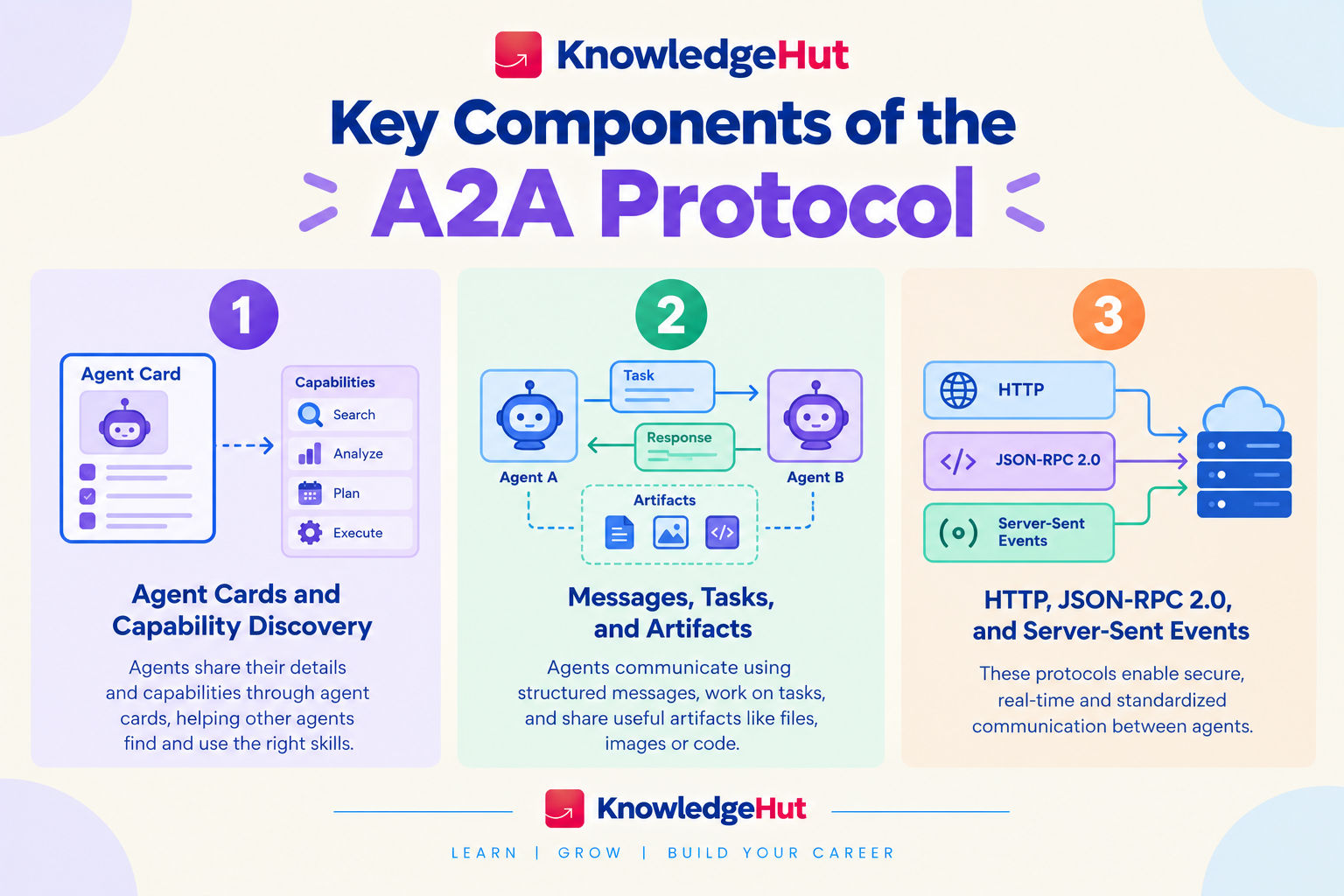
1. Agent Cards and capability discovery
Agent Cards help clients discover and understand remote agents before interacting with them. They describe supported skills, service endpoints, input and output formats, and authentication requirements.
Capability discovery is important because not every agent can handle every request. A client can use the advertised information to select an agent whose capabilities match the task.
Agent Cards may be published through a well-known endpoint or made available through a controlled registry, depending on the implementation and security requirements.
2. Messages, tasks, and artifacts
Messages, tasks, and artifacts have different roles in the communication process.
- Messages: Carry instructions, questions, context, or responses between agents.
- Tasks: Represent a unit of work and its progress through a lifecycle.
- Artifacts: Contain outputs produced during a task, such as documents, structured data, or files.
3. HTTP, JSON RPC 2.0, and Server Sent Events
The A2A protocol uses established web technologies to support communication between independent systems. Its specification includes transport and messaging mechanisms that help developers integrate agents with existing infrastructure.
- HTTP or HTTPS: Provides the underlying web communication channel.
- JSON RPC 2.0: Defines a structured request and response format for supported protocol bindings.
- Server Sent Events (SSE): Supports streaming updates from a server to a client.
- Authentication and authorization mechanisms: Help control who can discover or communicate with an agent.
Also read: Can AI Agents Replace Traditional Automation Tools?
A2A vs. MCP: What is the difference?
A2A and MCP address different parts of the AI integration problem. A2A focuses on communication and collaboration between independent AI agents, while MCP provides a standardized way for AI applications to connect to external tools, resources, and data sources.
They are not competing protocols in every situation. An AI system can use both when it needs to collaborate with other agents and access external capabilities.
Key differences between A2A and MCP
Feature |
A2A protocol |
MCP |
| Primary purpose | Communication between AI agents | Connecting AI applications to tools and data |
| Main interaction | Agent to agent | AI application to MCP server |
| Core capabilities | Agent discovery, delegation, task tracking | Tool discovery, resource access, and tool invocation |
| Typical use | Coordinating multiple agents | Giving an agent access to external capabilities |
| Can they work together? | Yes | Yes |
How A2A and MCP work together
A2A and MCP can be combined to support more capable AI workflows. An agent can use MCP to access the information or tools it needs and use A2A to delegate work to another agent.
A combined architecture may follow this sequence:
- An AI agent receives a request.
- It uses MCP to retrieve relevant information or call an external tool.
- It delegates a specialized task to another agent through A2A.
- The receiving agent completes its work and returns a result.
- The original agent combines the information and responds to the user.
What are the use cases of the A2A protocol?
The A2A protocol is useful when a task requires multiple specialized agents to coordinate their work. Instead of placing every capability inside one system, developers can connect agents that handle different responsibilities and let them exchange requests and results through a common interface.
1. Coordinating specialized AI agents across different platforms
Organizations may use different AI frameworks or vendors for separate business functions. A2A can help these agents communicate without requiring every system to use the same underlying technology.
Potential applications include:
- Research agents collaborating with summarization agents.
- Customer support agents requesting information from specialist agents.
- Data analysis agents sharing findings with reporting agents.
- Planning agents delegating parts of a complex request.
2. Automating multi step business workflows
Business processes often involve several connected activities, and different agents may be suited to different steps. A2A can help coordinate these tasks by supporting delegation, status tracking, and result exchange.
Possible workflows include:
- Reviewing information and preparing a summary.
- Collecting data before generating a report.
- Coordinating document processing and validation.
- Routing requests to agents with the right expertise.
3. Enabling cross platform enterprise AI collaboration
Large organizations often work with systems built by different teams, vendors, and technology providers. The A2A protocol can support collaboration across these environments by providing a common interaction model.
Enterprise use cases may include:
- Connecting agents across departments.
- Coordinating agents hosted on different platforms.
- Integrating specialist agents into existing business applications.
- Tracking long running tasks across connected systems.
Professionals looking to understand how AI agents interact and collaborate can explore Generative AI and Prompt Engineering to learn how to design effective prompts and guide AI systems to generate relevant responses and support multi-step workflows.
What are the benefits and limitations of the A2A protocol?
The A2A protocol can make multi agent systems easier to integrate and coordinate, particularly when agents are built using different technologies. However, it introduces implementation and governance considerations that teams should assess before using it in production.
1. Interoperability across agent frameworks and vendors
One of the main benefits of A2A is interoperability. Agents can communicate through a common protocol without requiring identical internal architectures.
This can help organizations:
- Combine agents built with different frameworks.
- Reduce the need for custom integrations.
- Replace or upgrade individual agents more easily.
- Add specialist capabilities as requirements change.
2. Flexible delegation and long running task support
A2A supports task-based interactions, allowing agents to delegate work and track progress when a request takes time to complete. Streaming updates and other supported mechanisms help clients monitor the status of ongoing tasks.
These capabilities can be useful when workflows involve several steps, external dependencies, or human approval.
They also require careful orchestration. Developers need to handle timeouts, retries, duplicate requests, failed tasks, and cases where an agent returns incomplete or unexpected results.
3. Security, trust, and access control challenges
Connecting agents creates additional communication paths, which can increase security and governance requirements. An agent should not automatically trust another agent simply because it is discoverable or supports A2A.
Organizations should consider:
- Authenticating agents and validating their identities.
- Applying least privilege access to data and services.
- Protecting credentials and sensitive information.
- Checking requests and outputs before taking consequential actions.
- Recording activity for monitoring and auditing.
4. Integration complexity and agent reliability
Although A2A can reduce the need for custom communication interfaces, implementing a reliable multi agent system can still be challenging. Each agent may have different capabilities, response times, limitations, and error patterns.
Teams should plan for:
- Monitoring communication and task status.
- Handling unavailable agents and failed requests.
- Validating responses before passing them to other systems.
- Controlling latency and usage costs.
- Testing the full workflow rather than evaluating each agent in isolation.
Conclusion
The A2A protocol helps AI agents from different platforms communicate, delegate tasks, and collaborate on complex workflows. It is useful for organizations building multi agent systems, while simpler applications may only need MCP for tool access. Before adopting A2A, consider integration complexity, security, and whether multiple agents are necessary for the task.
Have A Query? Get in Touch With Our Customer Support | upGrad KnowledgeHut
Frequently Asked Questions (FAQs)
1. What are the key differences between MCP and A2A?
MCP connects AI applications to tools, data sources, and external services, while the A2A protocol enables AI agents to communicate and delegate tasks to one another. MCP focuses on tool access, whereas A2A focuses on agent collaboration. They complement each other and can be used together in multi agent systems.
2. When should you use A2A vs MCP?
Use the A2A protocol when multiple AI agents need to collaborate, delegate tasks, or coordinate complex workflows across different platforms. Choose MCP when an AI application needs access to tools, databases, APIs, or files. If a system needs both agent collaboration and tool integration, using A2A and MCP together may be the right approach.
3. Can you explain the A2A protocol and how it works?
The A2A protocol is an open communication standard that allows AI agents built with different frameworks to collaborate. Agents can discover each other’s capabilities through Agent Cards, exchange messages, delegate tasks, and share results. It supports task updates and long running operations, allowing agents to coordinate without exposing their internal implementation.
4. Is the A2A protocol over HTTP?
Yes, the A2A protocol uses HTTP for communication between agents. It supports JSON-RPC 2.0 for structured requests and Server-Sent Events (SSE) for streaming updates, depending on the interaction pattern. This allows agents to exchange information and track task progress over standard web infrastructure.
5. Is MCP becoming obsolete?
No, MCP is not becoming obsolete. It addresses a different need from the A2A protocol by helping AI applications connect to tools and data sources. As AI systems evolve, both standards can work together, with MCP supporting tool access and A2A enabling collaboration between agents.
6. Is there a better alternative to MCP?
There is no single alternative that is better for every use case. Options include custom API integrations, function calling, and framework specific tool integrations. The A2A protocol is not a direct replacement for MCP because it focuses on agent to agent communication rather than standardizing connections to tools and data.
7. What are some alternatives to the A2A protocol?
Alternatives include custom REST APIs, message queues, and framework specific agent communication methods. These can work well in systems where developers control the infrastructure but may require more custom integration. The A2A protocol is useful when interoperability between agents built with different frameworks or by different vendors is a priority.
8. Is A2A still relevant?
Yes, the A2A protocol remains relevant for systems that need multiple AI agents to collaborate across platforms. Its value lies in standardizing agent discovery, task delegation, messaging, and status updates. Whether it is necessary depends on the application: a simple AI assistant may not need multiple agents, while complex workflows may benefit from it.
9. Is ChatGPT an agent or an LLM?
ChatGPT is an AI assistant powered by large language models (LLMs), with capabilities that can vary by feature and configuration. An LLM generates or interprets content, while an AI agent can also use tools and take actions to achieve a goal. The A2A protocol could support collaboration between ChatGPT-like agent systems and other compatible agents when the relevant integrations are available.
10. What is the most advanced AI agent right now?
There is no universally accepted “most advanced” AI agent because capabilities vary across reasoning, coding, research, tool use, reliability, and autonomy. Different agents perform better on different tasks, and rankings change as models and products evolve. The A2A protocol does not rank agents; it provides a way for compatible agents to communicate and collaborate.
1645 articles published
KnowledgeHut is an outcome-focused global ed-tech company. We help organizations and professionals unlock excellence through skills development. We offer training solutions under the people and proces...
Get Free Consultation
By submitting, I accept the T&C and
Privacy Policy