
- Home
- Blog
- Artificial Intelligence
- How to Start Freelancing with Generative AI Skills in 2026
How to Start Freelancing with Generative AI Skills in 2026
Updated on Jul 31, 2026 | 369 views
Share:
Table of Contents
View all
Key Highlights
- To start freelancing with generative AI, focus on a high-demand niche, develop a strong portfolio, and use AI to improve both speed and quality.
- An optimized online presence, targeted client outreach, and continuous skill development are essential for building a successful freelance business.
- Follow a practical roadmap to launch your AI freelancing career, from choosing a niche and mastering AI workflows to finding clients, increasing rates, and building a scalable freelance business.
- Discover the most profitable AI freelance services, essential Generative AI tools, and proven strategies to build a strong portfolio and attract clients even without prior freelance experience.
- Learn how to avoid common beginner mistakes, understand the demand and earning potential of AI freelancing in 2026, and build long-term client relationships for consistent income.
- Explore the future of AI freelancing beyond 2026, including AI agents, automation, consulting, and high-growth niches that will shape successful freelance careers in the years ahead.
Ready to build in-demand Generative AI skills before launching your freelance career?
The Generative AI Masters Program from KnowledgeHut provides hands-on training in prompt engineering, LLMs, AI tools, automation, and real-world projects to help you build a portfolio and start offering AI-powered freelance services with confidence.
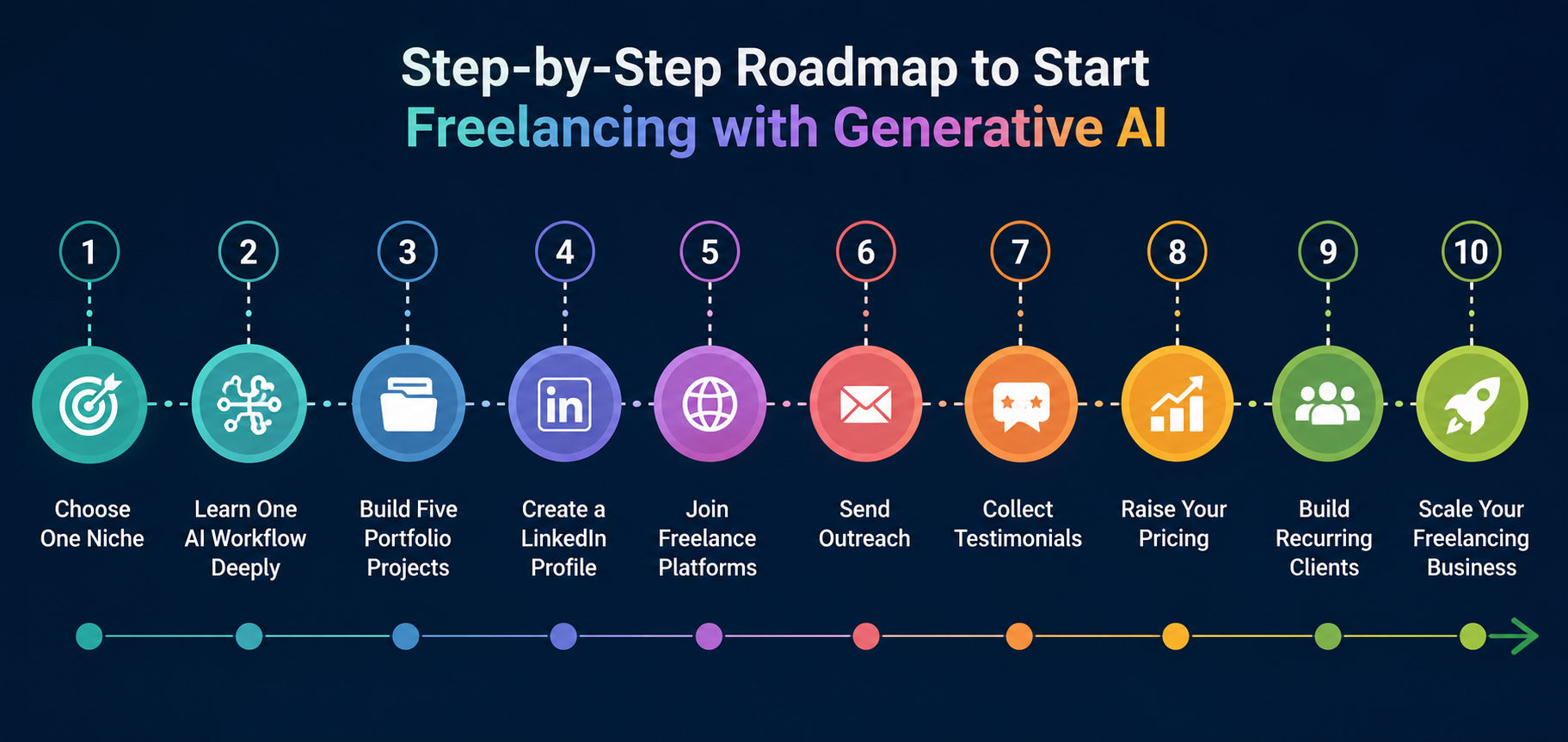
Step-by-Step Roadmap to Start Freelancing with Generative AI
Getting started is less about talent and more about sequencing. Here's the order that actually works:
1. Choose one niche
Pick one specific area to focus on instead of offering every service under the sun. A clear niche helps clients understand exactly what you do and makes you easier to remember, hire, and refer to others.
2. Learn one AI workflow deeply
Instead of dabbling in ten tools, master one workflow completely. Knowing exactly how to get great results from one process makes you more valuable than someone who knows a little about everything but excels at nothing.
3. Build five portfolio projects
You don't need real clients to start. Create five solid sample projects on your own, showing what you can do. This gives potential clients real proof of your skills before you've ever been paid.
4. Create a LinkedIn profile
Set up your profile so it clearly reflects your niche and skills. Your headline, summary, and posts should all point toward the exact service you offer, so the right clients recognize you immediately.
5. Join freelance platforms
Sign up on platforms where clients are already searching for help. This puts you directly in front of people actively looking to hire, saving you the effort of finding leads completely on your own.
6. Send outreach
Don't just wait for clients to find you, reach out first. Message potential clients directly, offer your services clearly, and follow up. Being proactive speeds up getting your first paying projects.
7. Collect testimonials
After finishing work for your first clients, ask them for a short review or feedback. Even small testimonials build trust and make future clients feel more confident choosing to work with you.
8. Raise your pricing
Once you have proof your work gets results, don't be afraid to charge more. Higher prices are easier to justify when you can show real outcomes and positive feedback from past clients.
9. Build recurring clients
Instead of always chasing new one-time gigs, focus on keeping clients long-term. Recurring work brings steady income, saves time on finding new leads, and builds stronger, more trusting business relationships.
10. Scale
Once things are working, turn your process into a repeatable system. This might mean raising rates, hiring help, or automating parts of your work so you can take on more without burning out.
Want to build stronger AI skills before launching your freelance career? Explore KnowledgeHut's Artificial Intelligence Courses to gain hands-on expertise in Generative AI, prompt engineering, automation, and other in-demand AI technologies.
Best Freelance Services Using Generative AI
Service |
What You'll Do |
Skills Required |
|---|---|---|
AI Content Writing |
Blogs, landing pages, SEO articles, product descriptions, emails |
Writing, editing, basic SEO, prompt writing |
AI Copywriting |
Ads, sales pages, captions, scripts |
Persuasive writing, brand voice, prompt writing |
AI Graphic Design |
Social creatives, presentations, brand assets, logos |
Design sense, AI image tools, basic editing |
AI Video Creation |
YouTube videos, shorts, training videos, explainers |
Scriptwriting, basic editing, AI video tools |
AI Research Services |
Competitor analysis, market research, trend reports |
Analytical thinking, clear reporting |
AI Presentation Design |
Pitch decks, investor decks, corporate slides |
Visual storytelling, slide design |
AI Workflow Automation |
Business automations, AI assistants, knowledge systems |
Systems thinking, automation tools |
Prompt Engineering |
Prompt libraries, workflow optimization, custom GPTs |
Strong prompt-writing, testing mindset |
AI Consulting |
Workflow improvements, AI adoption, team training |
Communication, training, broad AI knowledge |
Best Generative AI Tools Worth Learning as a Freelancer
- Writing: ChatGPT or Claude (drafting, editing, and idea generation)
- Image Generation: Canva AI (easy, beginner-friendly visual creation)
- Video: Synthesia (script-to-video with AI avatars, no filming needed)
- Research: Perplexity (fast, source-backed research and fact-checking)
- Coding: Claude Code (AI coding assistant for automation and technical tasks)
- Presentations: Gamma (turns notes into polished slides quickly)
- Automation: Zapier (connects apps and automates repetitive workflows)
- Productivity: Notion AI (organizing notes, tasks, and knowledge in one place)
Worried that learning Generative AI might be too difficult? Find out how hard Generative AI really is to learn, what skills you need to get started, and how beginners can build practical AI expertise faster.
How to Build an AI Freelance Portfolio Without Experience?
- You don't need clients to start: Freelance without experience by creating your own sample projects instead of waiting for someone to hire you first.
- Use personal or mock projects: Volunteer for a cause, or pick a fictional or real small business and solve a realistic problem for them as practice.
- Show before-and-after examples: These are the most persuasive proof of skill since they clearly demonstrate the value and improvement you bring.
- Host your work where it's easy to find: Use GitHub for technical projects, Behance for visual work, or a simple personal website.
- Aim for five strong samples: A small portfolio of quality work beats a large collection of average projects, and link everything from your LinkedIn profile.
Where to Find Freelance Clients?
- Freelance marketplaces like Upwork and Fiverr are still worth using in 2026. Competition and fees have grown, but the platforms remain a solid option for freelancers willing to invest time and treat it as a serious business channel rather than a casual side gig.
- LinkedIn and cold outreach work especially well since building your personal brand and messaging potential clients directly remains one of the most effective ways to grow, with no platform fees or middleman involved.
- Communities like Slack groups, founder communities, and Twitter/X put you in front of business owners directly, often before they even think about posting a job on a marketplace.
- Referrals compound over time. A happy client is often your fastest route to the next one, with zero competition involved.
- Personal branding across all platforms ties everything together, since consistent visibility makes clients trust and remember you.
Winning clients is only half the job, managing projects efficiently is what keeps them coming back. Discover why project management tools are essential for freelancers and how they can help you stay organized, meet deadlines, and grow your freelance business.
Common Mistakes Beginners Make
Starting out, it's easy to make mistakes that quietly cost you clients, credibility, or income before you even realize it. Most of these aren't skill problems, they're process problems, and they're completely avoidable once you know what to watch for.
- Publishing AI output without editing or fact-checking, which leads to hallucinations, copyright issues, and content that reads as generic or unpolished. AI tools are fast, but they aren't always accurate, and clients notice when work feels unrefined or factually shaky.
- Having a weak portfolio or no clear niche, making it hard for clients to see your value or understand exactly what you offer. Trying to appeal to everyone often means you stand out to no one.
- Underpricing your work, which undervalues your skills and makes it harder to raise rates later. Low prices can attract the wrong clients and make it tougher to be taken seriously as you grow.
- Poor communication and overpromising, setting expectations you can't meet and damaging client trust early on. Clear, honest updates matter more to most clients than perfect work delivered without any dialogue.
- Skipping contracts and mishandling revisions, leaving you exposed to scope creep, unpaid work, and unclear project boundaries. A simple contract protects both sides and sets clear rules before problems arise.
Is Freelancing with Generative AI Worth It in 2026?
Yes, demand is growing fast. Businesses, startups, SMEs, and enterprises are adopting AI and outsourcing related work, while the creator economy fuels even more opportunities. Industries like marketing, HR, sales, SaaS, education, ecommerce, healthcare, and finance are actively hiring. Full-time income and even six figures are achievable with experience, though beginners should start with modest, fair pricing
Future of AI Freelancing Beyond 2026
AI freelancing is shifting beyond prompt writing into higher-value services where professionals combine AI tools with industry expertise. Rather than replacing freelancers, AI is creating new opportunities for those who can solve business problems, automate workflows, and deliver strategic outcomes.
Key trends shaping the future include:
- AI agents: Building and managing autonomous AI systems that can handle tasks like customer support, research, and lead generation.
- AI consulting: Helping businesses choose, implement, and optimize AI tools for their specific needs.
- Automation: Creating AI-powered workflows that reduce manual work using platforms like n8n, Make, or Zapier.
- Hybrid human-AI work: Combining AI-generated outputs with human creativity, critical thinking, and quality control.
- AI operations (AIOps): Monitoring, maintaining, and improving AI applications, models, and workflows over time.
- Personal AI assistants: Designing customized AI assistants for entrepreneurs, executives, and teams.
- Vertical AI expertise: Specializing in industries such as healthcare, finance, legal, education, or marketing to offer domain-specific AI solutions.
The biggest advantage in the coming years will not be knowing a single AI tool, it will be continuously learning new technologies, adapting to changing client needs, and developing expertise in a specific niche.
Which niche is easiest?
AI content creation and marketing are the easiest niches for beginners because they require minimal technical skills and have strong demand across industries.
Which niche is best?
The best niche depends on your background. However, AI automation, AI consulting, and vertical AI solutions typically offer the highest long-term demand and earning potential because they solve complex business problems and are harder to replace.
Conclusion
Freelancing with Generative AI is one of the most practical ways to build a future-ready career in 2026. Success comes from choosing the right niche, learning valuable AI tools, creating a strong portfolio, finding clients consistently, and improving your skills over time. As AI continues to evolve, freelancers who combine technical knowledge with creativity, communication, and problem-solving will have the best opportunities. Keep learning, adapt to new trends, and focus on delivering real value to build a sustainable freelance business.
Have A Query? Get in Touch With Our Customer Support | KnowledgeHut
Frequently Asked Questions (FAQs)
1. Do I need any certifications to start freelancing with Generative AI in 2026?
While certifications are not mandatory, they can help establish credibility and demonstrate your expertise to potential clients. Certifications from recognized institutions or AI training programs can strengthen your profile, especially when you are competing with other freelancers and lack extensive client experience.
2. How much should I charge for Generative AI freelance services as a beginner?
Beginners should focus on value-based pricing rather than competing solely on low rates. Research market demand, assess project complexity, and gradually increase pricing as you gain experience, testimonials, and measurable results. A strategic pricing approach helps attract quality clients and supports long-term growth.
3. What legal considerations should AI freelancers be aware of?
AI freelancers should understand contracts, intellectual property rights, data privacy regulations, and client confidentiality requirements. Clearly defining ownership of deliverables, project scope, and payment terms can prevent disputes. Staying informed about evolving AI regulations also helps maintain professional and ethical practices.
4. How can freelancers protect client data when using AI tools?
Protecting client data requires using trusted AI platforms, reviewing privacy policies, and avoiding sharing sensitive information with public AI models without permission. Implementing secure workflows, encryption, and access controls helps ensure compliance with client expectations and industry data protection standards.
5. Can I freelance with Generative AI while working a full-time job?
Yes, many professionals begin AI freelancing as a side business while maintaining full-time employment. Managing workload, reviewing employment agreements for conflicts of interest, and dedicating consistent hours to client projects can help build freelance experience without disrupting your primary career.
6. Which industries are expected to spend the most on AI freelancers in the coming years?
Industries such as healthcare, finance, e-commerce, education, real estate, legal services, and software technology are increasingly investing in AI solutions. These sectors require content creation, automation, research, customer support systems, and specialized AI implementations that create significant freelance opportunities.
7. How can I differentiate myself from thousands of other AI freelancers?
Standing out requires combining AI skills with domain expertise, industry knowledge, and strong communication. Clients often prefer specialists who understand their business challenges rather than generalists. Building a personal brand, showcasing results, and developing unique service offerings can create a competitive advantage.
8. What are the most important soft skills for AI freelancers?
Technical AI knowledge alone is rarely enough for sustainable success. Skills such as communication, project management, problem-solving, critical thinking, negotiation, and client relationship management help freelancers deliver better outcomes, handle expectations effectively, and secure repeat business opportunities.
9. How do clients measure the success of Generative AI projects?
Success is often measured through business outcomes rather than AI usage alone. Metrics may include increased website traffic, higher conversions, time savings, reduced operating costs, improved content production speed, customer engagement, or workflow efficiency improvements directly linked to the project.
10. What income streams can AI freelancers create beyond client work?
Experienced AI freelancers can diversify earnings through digital products, AI templates, prompt libraries, online courses, coaching, memberships, consulting packages, and software solutions. Building multiple revenue streams reduces dependence on one-to-one client work and creates greater financial stability over time.
1639 articles published
KnowledgeHut is an outcome-focused global ed-tech company. We help organizations and professionals unlock excellence through skills development. We offer training solutions under the people and proces...
Get Free Consultation
By submitting, I accept the T&C and
Privacy Policy