
- Home
- Blog
- Artificial Intelligence
- Gen AI for Marketers: How to Use Generative AI Tools in Your Daily Workflow
Gen AI for Marketers: How to Use Generative AI Tools in Your Daily Workflow
Updated on Jul 29, 2026 | 217 views
Share:
Table of Contents
View all
- How to Use Generative AI in Your Daily Marketing Workflow
- Best Generative AI Tools Every Marketer Should Know
- Why Generative AI Matters for Marketers?
- AI Prompt Engineering Use Cases for Marketing
- How to Write Effective AI Prompts for Marketing?
- Marketing Tasks That AI Handles Well vs. Tasks That Still Need Humans
- How Marketers and AI Can Work Better Together?
- Conclusion
Quick Overview
- Generative AI helps marketers improve daily workflows by automating research, content creation, SEO, email marketing, social media, reporting, and other repetitive tasks, allowing them to focus on strategy, creativity, and business growth.
- Generative AI helps marketers save time by streamlining content creation, data analysis, and campaign personalization. Key daily workflows include content ideation, copywriting, and audience research.
- Use Generative AI across the entire marketing workflow, from market research, content planning, content creation, SEO, email marketing, social media, to campaign analysis and reporting.
- Explore the best Generative AI tools for marketers, understand why AI is transforming modern marketing, and master practical prompt engineering use cases along with techniques for writing effective AI prompts.
- Understand which marketing tasks AI handles best versus those requiring human expertise, learn how to mitigate AI risks with human oversight, and prepare for the future of AI-powered marketing.
Looking to sharpen your AI skills? Explore the Generative AI and Prompt Engineering for Professionals course to learn practical prompting and real-world AI workflows.
How to Use Generative AI in Your Daily Marketing Workflow
Not long ago, "using AI in marketing" meant experimenting with a chatbot on the side, mostly out of curiosity. Today, it's closer to a daily habit, something marketers reach for the same way they'd open their email or check analytics.
The shift isn't anecdotal. Generative AI adoption continues to accelerate across industries, with 71% of organizations now regularly using Generative AI in at least one business function, up from 65% a year earlier. As AI moves from experimentation to everyday use, marketers are among the professionals seeing the biggest impact on productivity and efficiency.
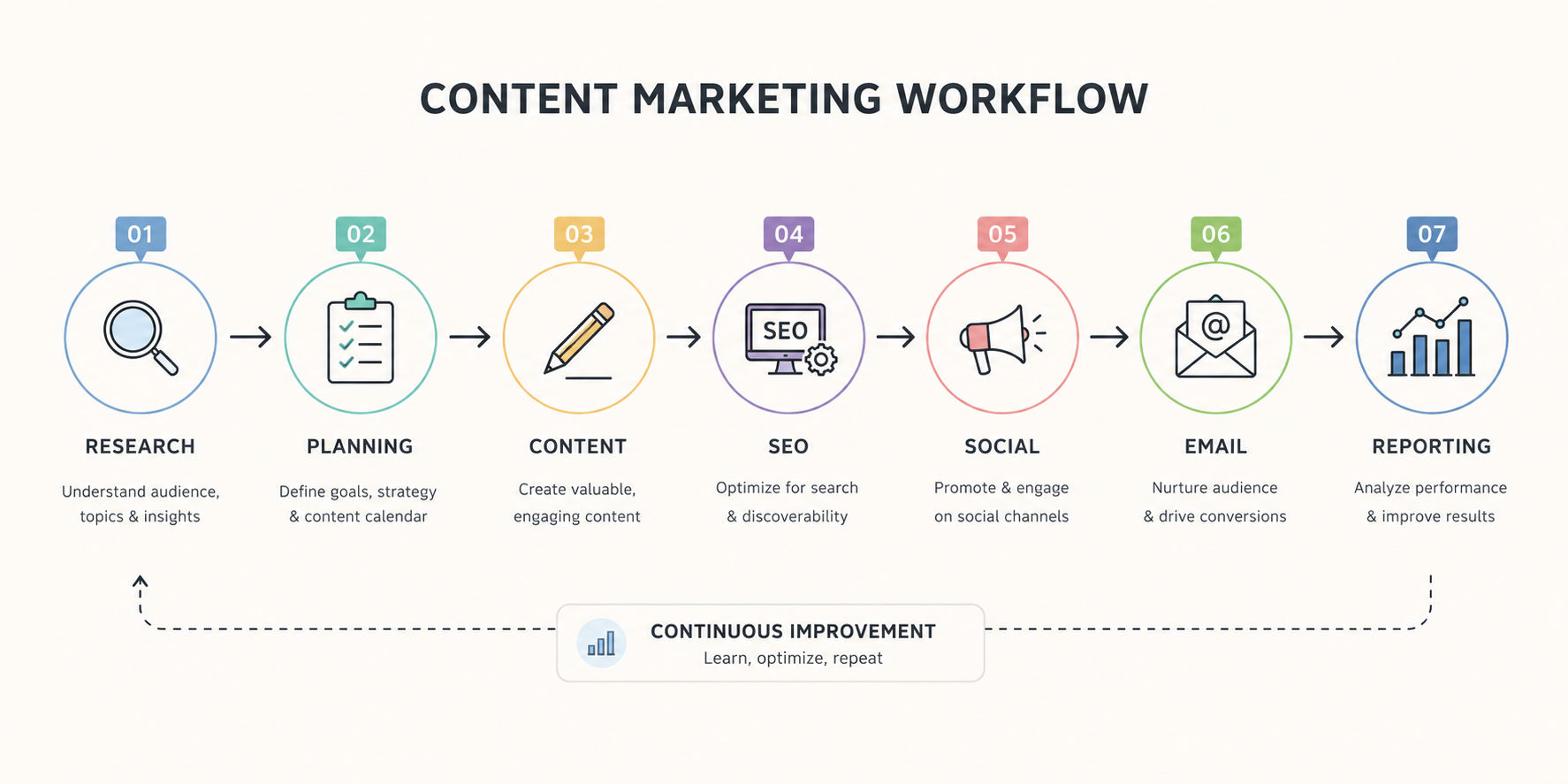
The best way to think about AI isn't as one tool for one job, it's a layer that touches nearly every stage of a marketer's day, from the first cup of coffee to the end-of-week report. Here's how Gen AI for Marketers fits into different stages of a modern marketing workflow.
Market research and audience insights
Instead of manually sifting through forums and reviews, AI can help you spot customer pain points faster, break down what competitors are doing well or poorly, and summarize emerging industry trends in minutes. It's also useful for sketching buyer personas as a starting point to refine with real data.
Content planning and strategy
Staring at a blank content calendar is nobody's favourite Monday activity. AI can brainstorm blog topics, help map out a month's worth of content, suggest campaign angles, and group keywords into clusters, giving your SEO strategy some real structure to build on.
Content creation
This is where most marketers start, and for good reason, AI is genuinely good at producing first drafts of blogs, landing pages, product descriptions, social posts, and ad copy using some of the best AI tools for content creation.
It's also where AI adoption is most visible. Nearly 63% of organizations using Generative AI primarily apply it to text-based content creation, making content generation one of the most common enterprise AI use cases today. The key word is drafts: AI gets you 70% there; editing and polish are still on you
SEO optimization
Meta titles, descriptions, readability tweaks, and internal linking suggestions, AI handles the tedious, repetitive parts of SEO well, freeing you up to focus on higher-level strategy instead of getting stuck fine-tuning every technical detail by hand, page after page.
Email marketing
Subject lines that actually get opened, full email sequences, CTA variations, personalization ideas, AI can generate options quickly, which is especially handy when you're trying to A/B test at scale without spending hours drafting every single variation yourself.
Social media marketing
Different platforms want different things, and AI is decent at adapting tone and format accordingly, writing platform-specific captions, suggesting hashtags, repurposing one piece of content into five, and even scripting short videos to keep your channels consistently active.
Campaign analysis and reporting
Instead of spending an afternoon summarizing a Google Analytics dashboard, AI can pull out key trends, draft a report structure, and highlight where improvements are needed, turning a tedious, time-consuming task into a quick, efficient review you can act on.
Beyond productivity gains, organizations implementing Generative AI are increasingly reporting improvements in revenue growth and cost reduction, highlighting the value of AI-powered analysis and decision support.
Want to go beyond AI tools? Explore Artificial Intelligence courses to build practical skills that can be applied across marketing, business, and technology.
Best Generative AI Tools Every Marketer Should Know
No single AI tool does everything well, smart marketers mix and match based on the task at hand, whether they're using free or paid Generative AI tools. The demand for these tools continues to grow rapidly. Around 66% of marketers worldwide now use AI as part of their day-to-day marketing activities, making AI-powered platforms an increasingly important part of the modern marketing technology stack.
- AI writing and content creation: ChatGPT, Claude, and Gemini are the go-to options for drafting, brainstorming, and refining written content.
- SEO and content optimization: Surfer SEO, Frase, and Clearscope help fine-tune content for search performance.
- Image and creative design: Midjourney, Adobe Firefly, DALL·E, and Canva Magic Studio cover everything from concept art to polished social graphics.
- Video creation: Runway, Synthesia, and Pika are making AI-generated and AI-assisted video far more accessible than it used to be.
- Social media and email: Buffer AI, Hootsuite AI, HubSpot AI, and Mailchimp AI bring generative features directly into the platforms marketers already use.
The right stack depends on your team's needs, but knowing what's out there is the first step to using AI intentionally instead of randomly.
Why Generative AI Matters for Marketers?
AI adoption in marketing isn't slowing down, and there's a simple reason why: it delivers real results. Content gets created faster, teams get more done in less time, and personalization that once took weeks of manual work now happens at scale. This isn't hype, it's a genuine shift in how marketing gets done. The growing adoption of Gen AI for Marketers reflects a broader shift toward AI-assisted marketing strategies that improve efficiency and decision-making.
That shift is reshaping marketing roles too. AI is becoming less of a novelty and more of a daily assistant, quietly handling the repetitive stuff. As a result, marketers are spending less time on pure content production and more time thinking strategically, which means creativity and critical thinking matter more now, not less.
To keep up, marketers need a slightly different toolkit than before: writing good prompts, understanding what AI can (and can't) do well, interpreting data, telling authentic brand stories, and editing AI output with a sharp, human eye.
AI won't replace marketers. Marketers who effectively use AI will have a competitive advantage.
AI Prompt Engineering Use Cases for Marketing
If there's one skill worth investing time in right now, it's prompt engineering, knowing how to ask AI for what you actually need.
- Content marketing: blog outlines, headlines, FAQs, content briefs
- SEO: keyword clustering, meta descriptions, search intent analysis, internal linking
- Social media: LinkedIn posts, Instagram captions, Twitter threads, Reels ideas
- Email marketing: subject lines, welcome sequences, promotional campaigns, follow-ups
- Advertising: Google Ads, Facebook Ads copy, CTA variations, A/B testing ideas
- Research and analysis: competitor summaries, customer personas, SWOT analysis, campaign insights
How to Write Effective AI Prompts for Marketing?
Better prompts produce better outputs, it really is that simple, which is why understanding what a prompt in AI is is an essential first step. A strong prompt usually includes:
- Role (who the AI should act as)
- Objective (what you're trying to achieve)
- Target audience
- Context
- Tone of voice
- Constraints
- Output format
- Examples
Walk through those in order, and your prompts will get sharper fast.
Watch out for common mistakes: Being too vague, skipping context, forgetting to define your audience, asking for too many things at once, or leaving out your brand voice entirely. Each of these leads to generic, forgettable output.
Marketing Tasks That AI Handles Well vs. Tasks That Still Need Humans
AI Can Do |
Human Should Do |
Generate drafts |
Final editing |
Analyze data |
Strategic decisions |
Repurpose content |
Brand messaging |
Summarize research |
Verify accuracy |
AI genuinely excels at brainstorming, drafting, summarizing, repurposing, translation, and basic analytics. But brand positioning, strategic planning, emotional storytelling, relationship building, final editing, and decision-making still need a human hand.
Mitigate Generative AI Risks with Human Oversight
- Fact-check AI outputs: AI can sound confident even when it's wrong. Always verify claims, facts, and figures before they go live.
- Review for bias: AI models learn from existing data, which can carry hidden biases. Check outputs to make sure they're fair and inclusive.
- Verify statistics: Numbers generated or cited by AI aren't always accurate. Cross-check them against original, trustworthy sources before using them anywhere.
- Protect confidential data: Avoid feeding sensitive business, customer, or campaign data into AI tools that aren't secure or company-approved.
- Ensure originality: Run AI-generated content through plagiarism checkers to confirm it's unique and won't create copyright issues down the line.
- Maintain brand consistency: AI doesn't automatically know your brand voice. Review tone, style, and messaging so everything sounds like you.
- Follow ethical AI guidelines: Stay transparent about AI use where relevant, respect data privacy, and follow your industry's evolving AI policies.
How Marketers and AI Can Work Better Together?
As Gen AI for Marketers continues to evolve, success will depend on balancing AI capabilities with human creativity and strategic thinking. The future of marketing isn't AI versus humans, it's AI working alongside humans. The most successful teams won't be the ones that use AI the most, but the ones that know exactly where AI adds value and where human judgment still leads.
- AI as a Marketing Co-Pilot
AI acts less like a replacement and more like a co-pilot, speeding up execution, boosting overall productivity, and offering smarter, data-backed support for the decisions marketers ultimately make themselves.
- Emerging Trends in AI Marketing
Keep an eye on AI agents handling multi-step tasks, hyper-personalization tailored to individuals, multimodal AI blending text and visuals, predictive marketing, and AI-powered search reshaping how people discover content.
- Preparing for the Future
Stay ahead by building AI skills, continuously learning new tools, doubling down on strategy and creativity, experimenting responsibly, and staying adaptable as marketing workflows keep evolving.
The future belongs to marketers who combine AI-powered efficiency with uniquely human creativity, empathy, and strategic thinking.
AI adoption is gaining momentum globally and within India. More than half of Indian enterprises have already deployed AI at scale in marketing and sales functions, demonstrating how AI is becoming a core component of business growth strategies rather than an experimental technology. As adoption continues to mature, marketers who can effectively combine AI capabilities with human creativity will be best positioned for long-term success.
Conclusion
Gen AI for Marketers is changing the way marketers work by making everyday tasks faster, easier, and more efficient. It supports activities such as market research, content creation, SEO, email marketing, social media management, and campaign reporting. While AI can automate repetitive work and improve productivity, human creativity, strategy, and decision-making remain essential. By combining AI tools with strong prompt-writing skills and careful oversight, marketers can achieve better results, save time, and stay competitive in an increasingly AI-driven marketing landscape.
Have A Query? Get in Touch With Our Customer Support | KnowledgeHut
Frequently Asked Questions (FAQs)
1. Do I need coding skills to use Generative AI for marketing?
No. Most Generative AI tools designed for marketers require little to no coding knowledge. Learning prompt engineering, understanding marketing objectives, and knowing how to evaluate AI-generated outputs are generally more important than programming skills for everyday marketing tasks.
2. Can small businesses benefit from Generative AI marketing tools?
Yes. Generative AI enables small businesses to create marketing content, manage social media, write emails, optimize SEO, and analyze campaigns with fewer resources, helping them compete more effectively without large marketing teams.
3. Which marketing channels benefit the most from Generative AI?
Generative AI is widely used across content marketing, SEO, email marketing, social media, paid advertising, video marketing, and customer engagement. The greatest benefits are typically seen in repetitive, content-intensive, and data-driven marketing activities.
4. How can marketers maintain brand consistency when using AI?
Marketers can maintain brand consistency by creating brand voice guidelines, providing AI with detailed context, reviewing all outputs before publishing, and using approved messaging frameworks for campaigns and customer communications.
5. Is AI-generated marketing content good for SEO?
AI-generated content can perform well in search results when it is accurate, original, helpful, and reviewed by human editors. Search engines prioritize high-quality, people-first content regardless of whether AI assisted in its creation.
6. What are the biggest challenges marketers face when adopting Generative AI?
Common challenges include ensuring factual accuracy, maintaining brand voice, protecting sensitive data, managing AI bias, integrating AI into existing workflows, and training teams to use AI effectively and responsibly.
7. How can marketers measure the success of AI-powered marketing initiatives?
Success can be measured using metrics such as content production time, campaign engagement, conversion rates, email open rates, click-through rates, organic traffic, ROI, and overall productivity improvements after implementing AI.
8. Can Generative AI personalize marketing campaigns?
Yes. Generative AI can generate personalized email copy, product recommendations, ad creatives, landing page variations, and customer messaging based on audience segments, behavioral data, and campaign objectives.
9. How often should marketers update their AI skills?
Because AI tools and capabilities evolve rapidly, marketers should continuously learn through hands-on practice, industry updates, and professional training to stay current with new features, prompting techniques, and emerging best practices.
10. What should marketers consider before choosing a Generative AI tool?
Marketers should evaluate factors such as ease of use, content quality, pricing, security, integration with existing marketing tools, collaboration features, customization options, multilingual support, and compliance with organizational policies.
1639 articles published
KnowledgeHut is an outcome-focused global ed-tech company. We help organizations and professionals unlock excellence through skills development. We offer training solutions under the people and proces...
Get Free Consultation
By submitting, I accept the T&C and
Privacy Policy