
- Blog Categories
- Project Management
- Agile Management
- IT Service Management
- Cloud Computing
- Business Management
- BI And Visualisation
- Quality Management
- Cyber Security
- DevOps
- Most Popular Blogs
- PMP Exam Schedule for 2025: Check PMP Exam Date
- Top 60+ PMP Exam Questions and Answers for 2025
- PMP Cheat Sheet and PMP Formulas To Use in 2025
- What is PMP Process? A Complete List of 49 Processes of PMP
- Top 15+ Project Management Case Studies with Examples 2025
- Top Picks by Authors
- Top 170 Project Management Research Topics
- What is Effective Communication: Definition
- How to Create a Project Plan in Excel in 2025?
- PMP Certification Exam Eligibility in 2025 [A Complete Checklist]
- PMP Certification Fees - All Aspects of PMP Certification Fee
- Most Popular Blogs
- CSM vs PSM: Which Certification to Choose in 2025?
- How Much Does Scrum Master Certification Cost in 2025?
- CSPO vs PSPO Certification: What to Choose in 2025?
- 8 Best Scrum Master Certifications to Pursue in 2025
- Safe Agilist Exam: A Complete Study Guide 2025
- Top Picks by Authors
- SAFe vs Agile: Difference Between Scaled Agile and Agile
- Top 21 Scrum Best Practices for Efficient Agile Workflow
- 30 User Story Examples and Templates to Use in 2025
- State of Agile: Things You Need to Know
- Top 24 Career Benefits of a Certifed Scrum Master
- Most Popular Blogs
- ITIL Certification Cost in 2025 [Exam Fee & Other Expenses]
- Top 17 Required Skills for System Administrator in 2025
- How Effective Is Itil Certification for a Job Switch?
- IT Service Management (ITSM) Role and Responsibilities
- Top 25 Service Based Companies in India in 2025
- Top Picks by Authors
- What is Escalation Matrix & How Does It Work? [Types, Process]
- ITIL Service Operation: Phases, Functions, Best Practices
- 10 Best Facility Management Software in 2025
- What is Service Request Management in ITIL? Example, Steps, Tips
- An Introduction To ITIL® Exam
- Most Popular Blogs
- A Complete AWS Cheat Sheet: Important Topics Covered
- Top AWS Solution Architect Projects in 2025
- 15 Best Azure Certifications 2025: Which one to Choose?
- Top 22 Cloud Computing Project Ideas in 2025 [Source Code]
- How to Become an Azure Data Engineer? 2025 Roadmap
- Top Picks by Authors
- Top 40 IoT Project Ideas and Topics in 2025 [Source Code]
- The Future of AWS: Top Trends & Predictions in 2025
- AWS Solutions Architect vs AWS Developer [Key Differences]
- Top 20 Azure Data Engineering Projects in 2025 [Source Code]
- 25 Best Cloud Computing Tools in 2025
- Most Popular Blogs
- Company Analysis Report: Examples, Templates, Components
- 400 Trending Business Management Research Topics
- Business Analysis Body of Knowledge (BABOK): Guide
- ECBA Certification: Is it Worth it?
- Top Picks by Authors
- Top 20 Business Analytics Project in 2025 [With Source Code]
- ECBA Certification Cost Across Countries
- Top 9 Free Business Requirements Document (BRD) Templates
- Business Analyst Job Description in 2025 [Key Responsibility]
- Business Analysis Framework: Elements, Process, Techniques
- Most Popular Blogs
- Best Career options after BA [2025]
- Top Career Options after BCom to Know in 2025
- Top 10 Power Bi Books of 2025 [Beginners to Experienced]
- Power BI Skills in Demand: How to Stand Out in the Job Market
- Top 15 Power BI Project Ideas
- Top Picks by Authors
- 10 Limitations of Power BI: You Must Know in 2025
- Top 45 Career Options After BBA in 2025 [With Salary]
- Top Power BI Dashboard Templates of 2025
- What is Power BI Used For - Practical Applications Of Power BI
- SSRS Vs Power BI - What are the Key Differences?
- Most Popular Blogs
- Data Collection Plan For Six Sigma: How to Create One?
- Quality Engineer Resume for 2025 [Examples + Tips]
- 20 Best Quality Management Certifications That Pay Well in 2025
- Six Sigma in Operations Management [A Brief Introduction]
- Top Picks by Authors
- Six Sigma Green Belt vs PMP: What's the Difference
- Quality Management: Definition, Importance, Components
- Adding Green Belt Certifications to Your Resume
- Six Sigma Green Belt in Healthcare: Concepts, Benefits and Examples
- Most Popular Blogs
- Latest CISSP Exam Dumps of 2025 [Free CISSP Dumps]
- CISSP vs Security+ Certifications: Which is Best in 2025?
- Best CISSP Study Guides for 2025 + CISSP Study Plan
- How to Become an Ethical Hacker in 2025?
- Top Picks by Authors
- CISSP vs Master's Degree: Which One to Choose in 2025?
- CISSP Endorsement Process: Requirements & Example
- OSCP vs CISSP | Top Cybersecurity Certifications
- How to Pass the CISSP Exam on Your 1st Attempt in 2025?
- Most Popular Blogs
- Top 7 Kubernetes Certifications in 2025
- Kubernetes Pods: Types, Examples, Best Practices
- DevOps Methodologies: Practices & Principles
- Docker Image Commands
- Top Picks by Authors
- Best DevOps Certifications in 2025
- 20 Best Automation Tools for DevOps
- Top 20 DevOps Projects of 2025
- OS for Docker: Features, Factors and Tips
- More
- Agile & PMP Practice Tests
- Agile Testing
- Agile Scrum Practice Exam
- CAPM Practice Test
- PRINCE2 Foundation Exam
- PMP Practice Exam
- Cloud Related Practice Test
- Azure Infrastructure Solutions
- AWS Solutions Architect
- IT Related Pratice Test
- ITIL Practice Test
- Devops Practice Test
- TOGAF® Practice Test
- Other Practice Test
- Oracle Primavera P6 V8
- MS Project Practice Test
- Project Management & Agile
- Project Management Interview Questions
- Release Train Engineer Interview Questions
- Agile Coach Interview Questions
- Scrum Interview Questions
- IT Project Manager Interview Questions
- Cloud & Data
- Azure Databricks Interview Questions
- AWS architect Interview Questions
- Cloud Computing Interview Questions
- AWS Interview Questions
- Kubernetes Interview Questions
- Web Development
- CSS3 Free Course with Certificates
- Basics of Spring Core and MVC
- Javascript Free Course with Certificate
- React Free Course with Certificate
- Node JS Free Certification Course
- Data Science
- Python Machine Learning Course
- Python for Data Science Free Course
- NLP Free Course with Certificate
- Data Analysis Using SQL
- Home
- Blog
- Artificial Intelligence
- LLM Engineer Salary in India [2026]: How Much Can You Earn?
LLM Engineer Salary in India [2026]: How Much Can You Earn?
Updated on Oct 01, 2026 | 0.7k+ views
Share:
Table of Contents
View all
Quick Overview
- LLM Engineer salary in India in 2026 averages around ₹8.1 LPA for 0-1 year, ₹11.3 LPA for 1-3 years, ₹15.5 LPA for 3-6 years, and ₹25.1 LPA for 6–9 years of experience.
- Experience and role complexity strongly influence pay, with senior LLM Engineers handling model optimization, inference, production deployment, architecture, and technical leadership earning more than professionals focused mainly on implementation and support.
- RAG, fine-tuning, LLM evaluation, LLMOps, inference optimization, Python, vector databases, cloud infrastructure, and orchestration can strengthen an LLM Engineer's profile for production-focused roles.
- Company type, location, production experience, technical specialization, and compensation structure can create substantial differences in salary, with current 2026 benchmarks showing wide variations across employers and Indian technology markets.
- This guide covers LLM Engineer salary in India by experience, companies, major cities, skills, and the key factors that influence compensation in 2026.
If you want to build practical expertise in LLMs, RAG, AI agents, and production ready AI systems, explore the Applied Agentic AI Certification Course [Best in 2026] to strengthen your skills for advanced AI engineering roles.
What is the LLM Engineer salary in India in 2026?
The annual salary for an LLM Engineer in India varies greatly based on their experience level and nature of work. Entry-level professionals normally perform implementation, data preparation, modeling integration, and support work for artificial intelligence projects, whereas experienced professionals may be responsible for model optimization and deployment.
The average annual salary per experience level is:
| Experience | Avg. Salary (per year) |
| 0 - 1 year | ₹8.1 L/yr |
| 1 - 3 years | ₹11.3 L/yr |
| 3 - 6 years | ₹15.5 L/yr |
| 6 - 9 years | ₹25.1 L/yr |
Source: Ambition box
LLM Engineer salary by experience
Experience affects compensation because the responsibilities associated with LLM engineering become more complex as professionals progress in their careers.
Entry-level LLM Engineer salary
LLM Engineers having 1-3 years of experience can make about ₹11.3 L/yr. The average salary for candidates with experience between 0-1 years is ₹8.1 LPA.
At this level, roles may include creating data, implementing language models, building basic AI programs, testing outputs, and helping in model development.
The candidate can boost his profile by working on projects related to Python, NLP, RAG, API’s for models, vector databases, etc.
Mid-level LLM Engineer salary
The average salary of the 3-6-year experience bracket is ₹15.5 LPA.
The mid-level engineers have more responsibilities for deploying models, their optimization, enhancing performance, and building production-based AI systems. In some cases, they could be engaged in working with clouds, MLOps, tuning, and evaluation systems.
Senior LLM Engineer salary
The professionals having six years or more of experience can get an average salary of ₹25.1 LPA.
The experienced engineers can design artificial intelligence architecture, work on LLM project, improve inference, build production systems, and mentor engineering teams. Compensation at this level depends strongly on technical depth and the scale of the systems being developed.
LLM Engineer salary in top companies
Company type may significantly impact salary packages. Technology firms creating products based on artificial intelligence or having major technology platforms in operation may need employees who have greater knowledge about language models, machine learning, and cloud computing.
The salaries for LLM Engineers with 1-3 years of experience range between:
| Company | Experience (1-3 yrs) | Avg. Salary (per year) |
| 1-3 years | ₹31.7 L/yr | |
| IBM | 1-3 years | ₹18.6 L/yr |
| Deloitte | 1-3 years | ₹15.8 L/yr |
| IQVIA | 1-3 years | ₹14.1 L/yr |
Source: Ambition box
LLM Engineer salary across major Indian cities
The location of work is another criterion that might affect the compensation since metropolitan areas with advanced technological environment have more AI, software, product, and technology companies.
The salaries for LLM Engineers with 1-3 years of experience range between:
| City | Experience (1-3 yrs) | Avg. Salary (per year) |
| Bangalore | 1-3 years | ₹26.2 L - ₹36.2 L |
| Hyderabad | 1-3 years | ₹25.6 L - ₹36.9 L |
| Mumbai | 1-3 years | ₹25.5 L - ₹37.9 L |
| Gurugram | 1-3 years | ₹26 L - ₹37.5 L |
Source : Ambition box
Build stronger skills in generative AI, prompt engineering, and LLM applications to complement your LLM engineering expertise. Explore the Generative AI and Prompt Engineering Course for Professionals to develop practical skills for working with modern AI systems.
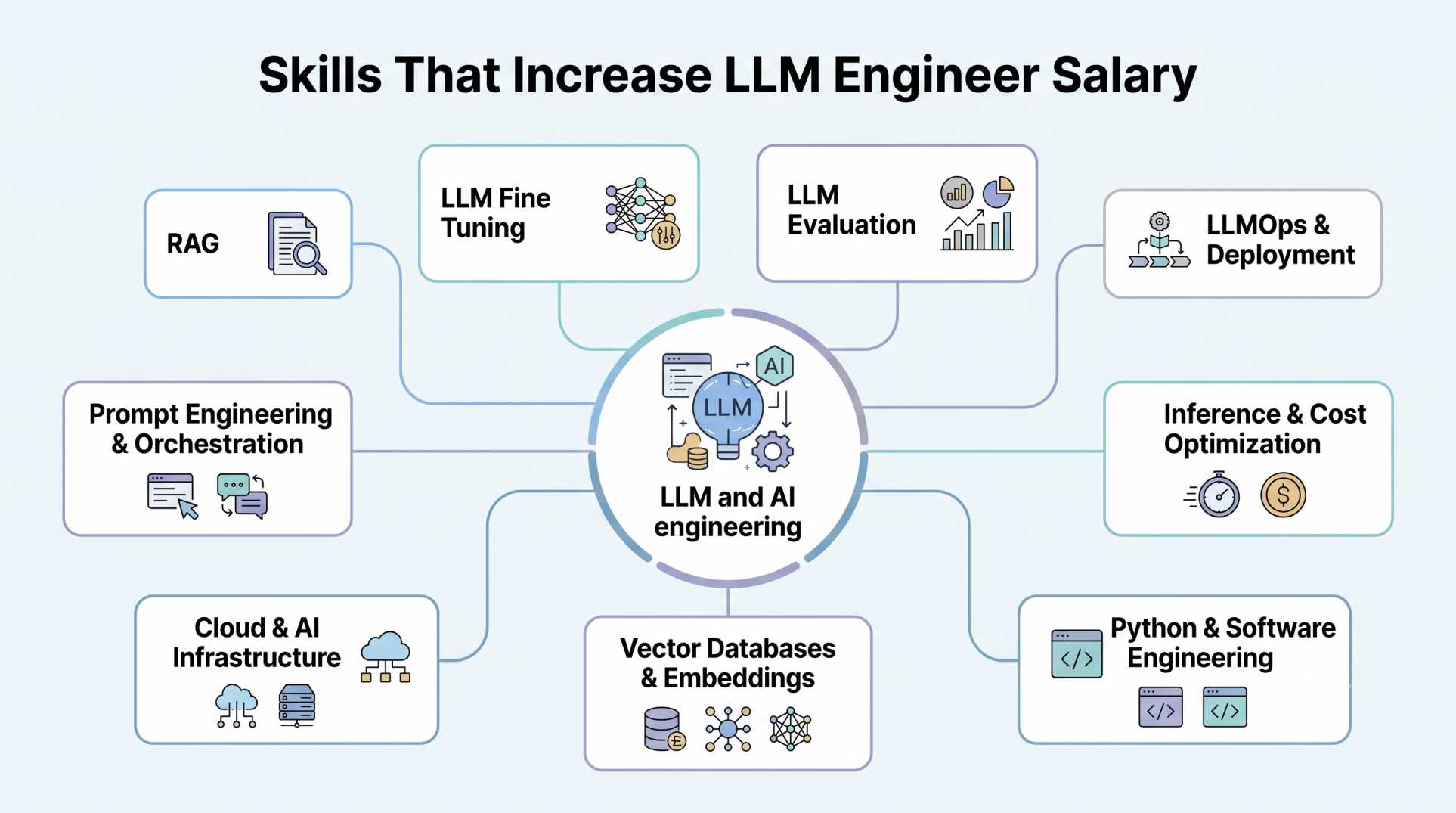
Which skills can increase LLM Engineer salary?
The salary of LLM Engineer may depend on the level of engineering skills and ability to bring AI products from the prototype phase to production. In 2026, the employers will be seeking for engineers capable of developing efficient LLM systems, assessing their effectiveness, deploying, and handling latency and inference cost.
1. Retrieval Augmented Generation (RAG)
RAG is one of the key skills for LLM engineers working on development of applications based on enterprise or domain-specific data. Familiarity with chunking, embeddings, vector databases, hybrid search, retrievals, and re-ranking may assist in handling more complicated production use cases.
2. LLM fine-tuning
Fine-tuning skills can be valuable when prompting or RAG alone cannot meet a particular application's requirements. Knowledge of LoRA, QLoRA, PEFT, dataset preparation, and model evaluation can help engineers customize open-source and other language models for specific tasks.
3. LLM evaluation
Evaluation is becoming an important part of production LLM engineering. Engineers need to measure response quality, retrieval performance, hallucinations, latency, and other application-specific metrics rather than relying only on manual testing.
4. LLMOps and deployment
Experience with deploying, monitoring, and maintaining LLM applications can make an engineer more valuable for production roles. Relevant areas include Docker, Kubernetes, cloud AI platforms, CI/CD, model and prompt versioning, monitoring, and observability.
5. Inference and cost optimization
LLM applications can become expensive and slow at scale. Skills in latency optimization, model serving, quantization, caching, model selection, and inference-cost management can therefore be useful for engineers working on production systems.
6. Python and software engineering
Strong Python and general software engineering fundamentals remain important because LLM Engineers need to build APIs, backend services, data pipelines, integrations, and production applications around models. Current LLM engineering job requirements continue to list Python alongside LLM-specific capabilities.
7. Vector databases and embeddings
Knowing how embeddings and vector search operate will help the engineer develop efficient retrieval systems. Having some experience with vector databases like Pinecone, Weaviate, Qdrant, Milvus, or pgvector may be helpful for developing RAG applications.
8. Cloud and AI infrastructure
Experience in using AWS, Azure, or Google Cloud will be helpful in deploying and scaling the LLM applications. Knowledge of containerization, GPU infrastructure, AI services, and distributed applications will be required in production environments.
9. Prompt engineering and orchestration
Prompt engineering remains relevant, but current roles increasingly expect it alongside broader engineering skills. Structured outputs, function calling, prompt versioning, model routing, and orchestration frameworks such as LangChain or LlamaIndex can support production LLM workflows.
What factors affect LLM Engineer salary in India?
There are various other aspects apart from years of experience that affect the LLM Engineer Salary in India. These include the level of specialization in LLM engineer skills, type of organization, location, project difficulty level, and whether the job requires production engineering or only the modeling phase.
1. Experience
Experience remains an important salary factor, but LLM-specific experience can matter more than total years of software experience. Engineers who have shipped production LLM systems, managed retrieval pipelines, or worked on model evaluation and optimization can qualify for more specialized roles.
2. Technical specialization
Skills such as RAG architecture, fine-tuning, LLM evaluation, inference optimization, and LLMOps can differentiate an engineer from someone whose work is limited to basic API or prompt integration. Current hiring data particularly highlights RAG, parameter-efficient fine-tuning, evaluation, and inference optimization as valuable areas.
3. Company type
Compensation can differ considerably between AI-first startups, product companies, global capability centers (GCCs), large technology companies, and IT services firms. Roles involving advanced LLM systems and production ownership may have different salary structures from general software or AI implementation positions.
4. Location
The location continues to play a role in determining salaries for tech jobs in India. Cities like Bengaluru and Hyderabad have significant representation of AI startups, products companies, and GCCs, but Mumbai and Gurugram have their own market for technology and enterprise recruitment.
5. Scope and complexity of the role
Even if two professionals have the same job titles, their work scope can differ considerably. One person can be responsible for integrating existing LLM API, and the other one may be required to design RAG architecture, model tuning, building evaluation pipeline, optimize inference and production of AI systems. Technical ownership can influence salaries.
5. Production and deployment experience
The experience of bringing the LLM application from development to production might be valuable. Deployment skills, MLOps/LLMOps, monitoring, observability, scalability, latency and cost optimization become especially important if real people use the application.
7. Compensation structure
The advertised salary is not necessarily the total compensation package. Depending on the employer, an offer can include base salary, performance bonus, ESOPs and any other equity as well as benefits. It is especially important if you are comparing offers from startups and technology companies.
Learn how AI and LLM technologies are shaping modern product development, from AI powered features to product strategy and delivery. Explore the AI-Powered Product Management Certification with Microsoft to build practical AI product management skills.
Conclusion
LLM Engineer salary in India in 2026 varies significantly with experience, technical specialization, and the complexity of the systems an engineer handles. Entry level professionals may focus on model integration and application development, while experienced engineers increasingly work on RAG architecture, fine tuning, evaluation, inference optimization, and production deployment.
Skills such as Python, vector databases, cloud infrastructure, and LLMOps can strengthen profiles for specialized LLM engineering roles. Company type, location, and the overall compensation structure can further influence the final package.
Have A Query? Get in Touch With Our Customer Support | upGrad KnowledgeHut
FAQs
1. How much does an LLM Engineer earn in India?
An LLM Engineer in India earns an average of ₹8.1 LPA with 0-1 year of experience, ₹11.3 LPA with 1-3 years, ₹15.5 LPA with 3-6 years, and ₹25.1 LPA with 6-9 years of experience. Actual compensation can vary based on skills, company, location, and role responsibilities.
2. Which LLM skills pay the most?
Skills such as RAG, fine tuning, LLM evaluation, LLMOps, inference optimization, and cloud AI infrastructure can support higher paying LLM engineering roles. Among these, production focused skills such as LLMOps, inference optimization, and advanced RAG involve greater technical responsibility. Strong Python and software engineering skills are also important for applying these capabilities in production systems.
3. Can an LLM Engineer earn ₹50 LPA in India?
A ₹50 LPA salary is possible for an experienced LLM Engineer, but it is above the ₹25.1 LPA average for professionals with 6-9 years of experience. Reaching this level can depend on technical specialization, company, location, and responsibility for large scale production systems.
4. Does RAG experience increase LLM Engineer salary?
RAG experience can strengthen an LLM Engineer's profile, particularly for roles involving production AI applications. Skills such as retrieval pipelines, embeddings, vector databases, hybrid search, and re ranking can help professionals qualify for more specialized LLM engineering responsibilities.
5. What is the salary of an LLM Engineer with 5 years of experience?
An LLM Engineer with five years of experience falls within the 3-6 years experience bracket, where the average salary is ₹15.5 LPA. The actual package can vary based on technical skills, employer, location, and the complexity of the role.
6. What experience is required for a senior LLM Engineer role?
A senior LLM Engineer typically has several years of experience building and deploying AI systems. Professionals with 6-9 years of experience have an average salary of ₹25.1 LPA and may handle AI architecture, LLM projects, inference optimization, production systems, and team mentoring.
7. How to become an LLM Engineer?
Start with Python, NLP, machine learning, and transformer fundamentals, then develop skills in RAG, APIs, vector databases, fine tuning, evaluation, and cloud platforms. Building projects that involve deploying and optimizing LLM applications can help develop practical LLM engineering experience.
8. What is the difference between base salary and total compensation?
Base salary is the fixed annual pay for a role, while total compensation can include base pay, performance bonuses, equity, and other benefits. For example, an offer's total compensation can be higher than its fixed annual salary because of these additional components.
9. What LLM skills are in demand in 2026?
Key LLM skills in demand include RAG, LLM fine tuning, evaluation, LLMOps, inference optimization, Python, vector databases, cloud infrastructure, and prompt orchestration. Employers increasingly look for engineers who can build, evaluate, deploy, and optimize LLM applications rather than only integrate model APIs.
10. Is LLM Engineering a high-paying career in 2026?
LLM Engineering offers increasing compensation with experience and technical responsibility. Average salaries range from ₹8.1 LPA for 0-1 year to ₹25.1 LPA for 6-9 years, while skills such as RAG, fine tuning, LLM evaluation, LLMOps, and inference optimization can support progression into specialized roles.
1639 articles published
KnowledgeHut is an outcome-focused global ed-tech company. We help organizations and professionals unlock excellence through skills development. We offer training solutions under the people and proces...
Get Free Consultation
By submitting, I accept the T&C and
Privacy Policy