
- Blog Categories
- Project Management
- Agile Management
- IT Service Management
- Cloud Computing
- Business Management
- BI And Visualisation
- Quality Management
- Cyber Security
- DevOps
- Most Popular Blogs
- PMP Exam Schedule for 2025: Check PMP Exam Date
- Top 60+ PMP Exam Questions and Answers for 2025
- PMP Cheat Sheet and PMP Formulas To Use in 2025
- What is PMP Process? A Complete List of 49 Processes of PMP
- Top 15+ Project Management Case Studies with Examples 2025
- Top Picks by Authors
- Top 170 Project Management Research Topics
- What is Effective Communication: Definition
- How to Create a Project Plan in Excel in 2025?
- PMP Certification Exam Eligibility in 2025 [A Complete Checklist]
- PMP Certification Fees - All Aspects of PMP Certification Fee
- Most Popular Blogs
- CSM vs PSM: Which Certification to Choose in 2025?
- How Much Does Scrum Master Certification Cost in 2025?
- CSPO vs PSPO Certification: What to Choose in 2025?
- 8 Best Scrum Master Certifications to Pursue in 2025
- Safe Agilist Exam: A Complete Study Guide 2025
- Top Picks by Authors
- SAFe vs Agile: Difference Between Scaled Agile and Agile
- Top 21 Scrum Best Practices for Efficient Agile Workflow
- 30 User Story Examples and Templates to Use in 2025
- State of Agile: Things You Need to Know
- Top 24 Career Benefits of a Certifed Scrum Master
- Most Popular Blogs
- ITIL Certification Cost in 2025 [Exam Fee & Other Expenses]
- Top 17 Required Skills for System Administrator in 2025
- How Effective Is Itil Certification for a Job Switch?
- IT Service Management (ITSM) Role and Responsibilities
- Top 25 Service Based Companies in India in 2025
- Top Picks by Authors
- What is Escalation Matrix & How Does It Work? [Types, Process]
- ITIL Service Operation: Phases, Functions, Best Practices
- 10 Best Facility Management Software in 2025
- What is Service Request Management in ITIL? Example, Steps, Tips
- An Introduction To ITIL® Exam
- Most Popular Blogs
- A Complete AWS Cheat Sheet: Important Topics Covered
- Top AWS Solution Architect Projects in 2025
- 15 Best Azure Certifications 2025: Which one to Choose?
- Top 22 Cloud Computing Project Ideas in 2025 [Source Code]
- How to Become an Azure Data Engineer? 2025 Roadmap
- Top Picks by Authors
- Top 40 IoT Project Ideas and Topics in 2025 [Source Code]
- The Future of AWS: Top Trends & Predictions in 2025
- AWS Solutions Architect vs AWS Developer [Key Differences]
- Top 20 Azure Data Engineering Projects in 2025 [Source Code]
- 25 Best Cloud Computing Tools in 2025
- Most Popular Blogs
- Company Analysis Report: Examples, Templates, Components
- 400 Trending Business Management Research Topics
- Business Analysis Body of Knowledge (BABOK): Guide
- ECBA Certification: Is it Worth it?
- Top Picks by Authors
- Top 20 Business Analytics Project in 2025 [With Source Code]
- ECBA Certification Cost Across Countries
- Top 9 Free Business Requirements Document (BRD) Templates
- Business Analyst Job Description in 2025 [Key Responsibility]
- Business Analysis Framework: Elements, Process, Techniques
- Most Popular Blogs
- Best Career options after BA [2025]
- Top Career Options after BCom to Know in 2025
- Top 10 Power Bi Books of 2025 [Beginners to Experienced]
- Power BI Skills in Demand: How to Stand Out in the Job Market
- Top 15 Power BI Project Ideas
- Top Picks by Authors
- 10 Limitations of Power BI: You Must Know in 2025
- Top 45 Career Options After BBA in 2025 [With Salary]
- Top Power BI Dashboard Templates of 2025
- What is Power BI Used For - Practical Applications Of Power BI
- SSRS Vs Power BI - What are the Key Differences?
- Most Popular Blogs
- Data Collection Plan For Six Sigma: How to Create One?
- Quality Engineer Resume for 2025 [Examples + Tips]
- 20 Best Quality Management Certifications That Pay Well in 2025
- Six Sigma in Operations Management [A Brief Introduction]
- Top Picks by Authors
- Six Sigma Green Belt vs PMP: What's the Difference
- Quality Management: Definition, Importance, Components
- Adding Green Belt Certifications to Your Resume
- Six Sigma Green Belt in Healthcare: Concepts, Benefits and Examples
- Most Popular Blogs
- Latest CISSP Exam Dumps of 2025 [Free CISSP Dumps]
- CISSP vs Security+ Certifications: Which is Best in 2025?
- Best CISSP Study Guides for 2025 + CISSP Study Plan
- How to Become an Ethical Hacker in 2025?
- Top Picks by Authors
- CISSP vs Master's Degree: Which One to Choose in 2025?
- CISSP Endorsement Process: Requirements & Example
- OSCP vs CISSP | Top Cybersecurity Certifications
- How to Pass the CISSP Exam on Your 1st Attempt in 2025?
- Most Popular Blogs
- Top 7 Kubernetes Certifications in 2025
- Kubernetes Pods: Types, Examples, Best Practices
- DevOps Methodologies: Practices & Principles
- Docker Image Commands
- Top Picks by Authors
- Best DevOps Certifications in 2025
- 20 Best Automation Tools for DevOps
- Top 20 DevOps Projects of 2025
- OS for Docker: Features, Factors and Tips
- More
- Agile & PMP Practice Tests
- Agile Testing
- Agile Scrum Practice Exam
- CAPM Practice Test
- PRINCE2 Foundation Exam
- PMP Practice Exam
- Cloud Related Practice Test
- Azure Infrastructure Solutions
- AWS Solutions Architect
- IT Related Pratice Test
- ITIL Practice Test
- Devops Practice Test
- TOGAF® Practice Test
- Other Practice Test
- Oracle Primavera P6 V8
- MS Project Practice Test
- Project Management & Agile
- Project Management Interview Questions
- Release Train Engineer Interview Questions
- Agile Coach Interview Questions
- Scrum Interview Questions
- IT Project Manager Interview Questions
- Cloud & Data
- Azure Databricks Interview Questions
- AWS architect Interview Questions
- Cloud Computing Interview Questions
- AWS Interview Questions
- Kubernetes Interview Questions
- Web Development
- CSS3 Free Course with Certificates
- Basics of Spring Core and MVC
- Javascript Free Course with Certificate
- React Free Course with Certificate
- Node JS Free Certification Course
- Data Science
- Python Machine Learning Course
- Python for Data Science Free Course
- NLP Free Course with Certificate
- Data Analysis Using SQL
- Home
- Blog
- Artificial Intelligence
- What Is Retrieval-Augmented Generation (RAG)? Explained for Non-Engineers
What Is Retrieval-Augmented Generation (RAG)? Explained for Non-Engineers
Updated on Oct 17, 2026 | 389 views
Share:
Table of Contents
View all
- What is retrieval augmented generation (RAG)?
- How does retrieval-augmented generation work?
- What are the key elements of a RAG system?
- What are the benefits of retrieval augmented generation?
- What are the typical use cases of RAG?
- What's the difference between RAG and fine-tuning?
- What are the limitations of retrieval-augmented generation?
Quick Overview
- Retrieval augmented generation (RAG) combines information retrieval with text generation to help LLMs answer questions using relevant external data, including updated company documents and knowledge bases.
- RAG works through four main stages: preparing and indexing data, retrieving relevant information, adding the retrieved context to the prompt, and generating a response.
- Key RAG components include a knowledge base, document chunking, embedding models, a search index or vector database, a retriever, and an LLM.
- RAG supports applications such as customer support chatbots, enterprise knowledge management, research, legal assistance, and technical troubleshooting, but its answers depend on the quality of the retrieved information.
- This guide covers how RAG works, its key components and benefits, common use cases, differences between RAG and fine-tuning, and the limitations of RAG systems.
Explore how retrieval-augmented generation and prompt design work together to improve AI responses with upGrad KnowledgeHut’s Generative AI and Prompt Engineering course.
What is retrieval augmented generation (RAG)?
Retrieval augmented generation is an AI technique that blends information retrieval with text generation. It enables a large language model (LLM) to retrieve relevant external information and use that to generate more accurate answers.
Think of it as giving an AI assistant access to a reference library. Instead of attempting to answer every question from its own knowledge base it can go and look up the relevant information first.
For example an employee might ask the AI chatbot "How many paid leaves can I take this year?" A generic AI model wouldn't know the company's leave policy. With RAG it can go and search the company's HR docs, pull out the relevant policy and use that to answer the question.
RAG doesn't require the underlying language model to be retrained every time a document changes. It can simply use the updated information when the relevant source documents or search index are refreshed.
Also Read: Chunking Strategies for Better RAG Performance
How does retrieval-augmented generation work?
A typical RAG system goes through four main stages. The source documents have to be prepared and indexed prior to the users even beginning to ask questions so that the system can then search them efficiently.
Step 1: Prepare and index the data
Firstly the system gathers information from a range of sources including PDFs, company documents, websites, product manuals and knowledge bases.
The documents are cleaned up and broken down into smaller chunks. This makes it much easier to search for a particular piece of information without having to go through the whole document each time. The system can then take those chunks and convert them into numerical form (i.e. embeddings) which it can store in a searchable index.
Step 2: Retrieve relevant information
When a user submits a question the retrieval system looks through the available information for relevant passages.
For example if you were asked about a company's leave policy the system might pull out the section on annual leave (including eligibility and the rules around approval).
Depending on the setup the system can use keyword search, vector search or a combination of the two to find the relevant information.
Step 3: Augment the prompt with retrieved context
Once the relevant information has been found the system will add it to the prompt that's sent to the language model. The prompt will normally contain the user's question, the retrieved passages and instructions for how to generate the answer.
This gives the model some extra context to work with rather than just relying on its own knowledge.
Step 4: Generate the response
The model uses the question and the retrieved information to produce a natural language answer.
For instance it might explain how many days of annual leave are available and any conditions that are attached to that in the HR policy. It could also give you a reference to the actual document.
The quality of the response is a function of how relevant, accurate and sufficient the retrieved information is in answering the question.
Also Read: Enterprise RAG Architecture: Components, Workflow, and Best Practices
What are the key elements of a RAG system?
A RAG system brings together a number of components. Each of these has a role to play in the preparation of the information, in the retrieval of the relevant content and in the generation of the final response.
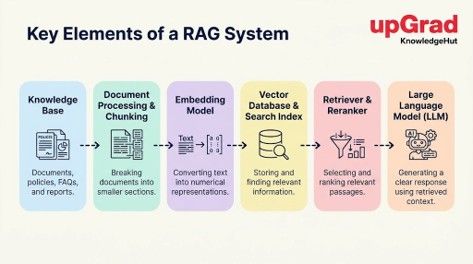
Knowledge base
A knowledge base is the information that the system can retrieve. This can be company policies, product documentation, FAQs, research papers, reports and so on. The usefulness of a RAG system is in part a function of the quality and relevance of that information.
Document processing and chunking
Document processing is the stage where the source information is prepared for retrieval. Chunking is the process of breaking a long document down into smaller chunks which can then be individually searched.
Well designed chunks will have enough context in them so that the retrieved information is useful. Badly chunked sections can end up with the key detail missing or with a fact and its explanation split up.
Embedding model
An embedding model takes text and converts it into a numerical representation which captures aspects of its meaning.
These representations enable the system to find passages that are relevant to a question even if the wording of the question is different. A search for 'leave allowance' might return a passage which is in fact about 'annual paid time off'.
Vector database and search index
A vector database can store the embeddings and then assist in retrieving content based on semantic similarity. A search index can also be used to support keyword based retrieval.
Not every RAG system needs a vector database. Some use conventional search, some use keyword search and some use a mixture of both.
Retriever and reranker
The retriever will find the passages which may answer the user's question. If a reranker is used it will assess the retrieved passages and reorder them by relevance.
This helps the system to prioritise the information which is most likely to be of use in forming a useful answer.
Large language model (LLM)
The LLM produces the final response using the user's question and the retrieved context. It takes the relevant passages and turns them into an answer that is easier to understand.
However, giving context doesn't guarantee correctness. The model could still get it wrong or come to a conclusion that isn't supported.
Build on RAG concepts by exploring how AI agents retrieve information, use tools, and perform multi-step tasks through upGrad KnowledgeHut’s Applied Agentic AI Certification.
What are the benefits of retrieval augmented generation?
Retrieval augmented generation has a number of benefits when an AI application needs to have access to external information.
1. Access to updated information
Organisations can update their documents and refresh their search index without necessarily retraining the LLM at all. The system can then retrieve the revised information when answering questions.
2. More accurate, context-aware responses
Providing relevant passages enables the model to answer questions on the basis of specific evidence rather than just general knowledge. The results are still entirely dependent on the quality of the retrieval and the model's ability to understand the context.
3. Reduced risk of AI hallucinations
AI hallucinations occur when a model generates information that sounds convincing but is incorrect or unsupported. RAG can help to reduce the risk of this to some extent by providing relevant source material, though it can't eliminate hallucinations entirely.
4. Access to private and domain-specific data
A RAG application can pull in information from approved internal documents to help employees find the answer to a question that a general purpose model may not know. Access permissions must be enforced so that users can't retrieve information they're not authorised to see.
5. Better source traceability and verification
Apps can show references to the documents or passages that were used to generate the answer. That makes it much easier for the user to go and check the key assertions against the original source.
6. Updates without retraining the LLM
When the information changes the teams can just update the knowledge base and index. It's far more practical than retraining the model every time a policy, product detail, or document changes.
Also Read: Enterprise Vector Databases
What are the typical use cases of RAG?
Retrieval augmented generation is useful in any scenario where an AI application is required to answer a question based on a defined set of information.
1. Customer support chatbots
Businesses can link their chatbots to product manuals, FAQs, troubleshooting guides and support articles. The customer can then ask their questions in normal language and the chatbot will pull the answer from the relevant documentation.
2. Enterprise knowledge management
Employees often need to search through internal policies, reports, wikis and project documentation. A RAG powered assistant can pull the relevant information and help the employee find the answer without searching all the files manually.
3. Research and document analysis
Researchers and analysts can use RAG systems to find relevant passages across large document collections. The system can also be used to summarise the findings, provided users verify important claims against the original sources.
4. Legal and compliance assistance
Legal teams can use RAG to find the relevant contract clauses, internal policies and regulatory documents. It can assist with research but the legal team will need to check the sources and the interpretations before relying on the results.
5. Technical support and troubleshooting
Technical teams can link their AI assistants to product documentation, error guides and maintenance manuals. The system can then pull the relevant instructions to assist the user in troubleshooting the common issues.
Learn how to identify practical applications of RAG and other AI technologies and turn them into useful AI products with upGrad KnowledgeHut’s AI Product Management course.
What's the difference between RAG and fine-tuning?
RAG and fine tuning can both be used to make an AI application more useful, just in different ways. RAG provides access to external information when a question is asked. Fine tuning on the other hand involves changing the parameters of the model as part of a further training process.
Factor |
Retrieval-augmented generation |
Fine-tuning |
| Main purpose | Supplies relevant external knowledge at query time. | Adapts a model's behaviour via further training. |
| How it works | Retrieves information and adds it to the prompt. | Updates model parameters using training examples. |
| Updating information | Update the knowledge base and index. | Further training may be needed to change learned behaviour or incorporate new information. |
| Best suited for | Current facts, private documents, and source-based answers. | Consistent tone, output formats, and specialized tasks. |
| Source citations | Can provide references to retrieved documents. | Does not inherently provide document-level citations. |
For example, a company that wanted an AI assistant to answer questions about changes to HR policy would benefit from RAG. A company that wanted the model to always output in a particular format would look at fine-tuning.
Also Read: RAG vs Fine-Tuning: Which Approach Should You Choose?
What are the limitations of retrieval-augmented generation?
Although retrieval augmented generation improves access to information it does have its limitations and those need to be considered by any team that is building AI applications that are to be reliable.
1. Poor retrieval quality
If the system retrieves irrelevant or incomplete passages then the model is going to give you a useless answer. Good search, good chunking and good relevance ranking are all important in terms of getting good results.
2. Outdated or inaccurate source data
RAG cannot simply correct incorrect information by retrieving it. If the knowledge base contains out of date policies or incorrect documents then the response that is generated will be wrong.
3. Risk of incorrect or hallucinated responses
Even with the appropriate context an LLM may still get the evidence wrong, may combine facts in a wrong way or may invent details that aren't there. Any important answers should be checked against the source.
4. Data privacy and security concerns
Internal documents may contain confidential information. RAG systems will need appropriate access controls, secure handling of data and mechanisms to prevent exposure of sensitive content.
5. Increased latency and computational costs
Searching documents, retrieving passages, reranking results and processing longer prompts will all increase response time and operating cost. TThe impact depends on the system's design and scale.
6. Complex setup, maintenance, and evaluation
A good system requires appropriate data preparation, indexing, retrieval configuration, monitoring and regular testing. The team needs to assess both the relevance of the passages retrieved and the accuracy of the answers generated.
Conclusion
Retrieval augmented generation (RAG) helps LLMs generate more relevant and context-aware answers by using information from external sources. It enables AI applications to work with updated company documents and domain-specific data without retraining the model whenever information changes.
However, the quality of its responses depends on accurate source data and effective retrieval. Understanding its components, benefits, and limitations helps teams build more reliable AI applications.
Have A Query? Get in Touch With Our Customer Support | upGrad KnowledgeHut
Frequently Asked Questions (FAQs)
1. How does RAG improve LLM responses?
RAG improves LLM responses by retrieving relevant information from external sources and adding it to the prompt before generating an answer. This helps the model provide more context-aware responses based on current, private, or domain-specific data. It can also make answers easier to verify by providing references to source documents.
2. Is ChatGPT a RAG model?
ChatGPT is not inherently a RAG model. It is an AI assistant powered by large language models, and some implementations can use retrieval systems to access external information. Whether RAG is involved depends on the specific ChatGPT feature or system architecture.
3. What are the 5 steps of RAG?
The five steps of RAG are data preparation, document indexing, information retrieval, context augmentation, and response generation. First, documents are cleaned and divided into smaller chunks, which are indexed for searching. When a query arrives, relevant information is retrieved and added to the prompt, allowing the LLM to generate a context-based answer.
4. How does RAG retrieve information from documents?
RAG processes documents into searchable chunks and represents their content using embeddings or other indexing methods. When a user submits a query, the retrieval system searches the indexed content for relevant passages using semantic similarity, keyword matching, or a combination of both. The most relevant passages are then passed to the LLM as context.
5. What happens if RAG retrieves the wrong document?
If RAG retrieves an irrelevant or incorrect document, the LLM may generate an inaccurate or misleading answer based on that information. Retrieval quality can be improved through better document chunking, metadata filters, reranking, and relevance thresholds. If the retrieved information is insufficient, the system can be designed to request clarification or abstain from answering.
6. Does RAG require a vector database?
No, RAG does not always require a vector database. It can retrieve information using keyword search, traditional databases, search engines, or hybrid search systems. Vector databases are commonly used when semantic search based on embeddings is needed, especially across large document collections.
7. What are embeddings in retrieval-augmented generation?
Embeddings are numerical representations of text that capture aspects of its meaning. In RAG, document chunks and user queries can be converted into embeddings so the retrieval system can identify semantically related content, even when the wording differs. These representations are commonly stored in a vector database or another vector search index.
8. What is the role of an LLM in RAG?
The LLM uses the user's query and the retrieved information to generate a relevant, natural-language response. It combines the provided context with its learned language capabilities to explain information, summarize documents, or answer questions. The LLM generates the response, while the retrieval component finds the supporting information.
9. Can RAG build a chatbot using company documents?
Yes, RAG can power a chatbot that answers questions using company documents, such as policies, product manuals, training materials, and internal knowledge bases. The system retrieves relevant passages from authorized documents and provides them to the LLM to generate answers. Access controls should ensure employees retrieve only information they are permitted to view.
10. Does RAG eliminate hallucinations?
No, RAG does not eliminate hallucinations completely. It can reduce the risk by grounding responses in retrieved information, but incorrect retrieval, outdated documents, incomplete context, or errors in generation can still produce false answers. Reliable source data, retrieval evaluation, and response verification help reduce these risks.
1639 articles published
KnowledgeHut is an outcome-focused global ed-tech company. We help organizations and professionals unlock excellence through skills development. We offer training solutions under the people and proces...
Get Free Consultation
By submitting, I accept the T&C and
Privacy Policy