
- Blog Categories
- Project Management
- Agile Management
- IT Service Management
- Cloud Computing
- Business Management
- BI And Visualisation
- Quality Management
- Cyber Security
- DevOps
- Most Popular Blogs
- PMP Exam Schedule for 2025: Check PMP Exam Date
- Top 60+ PMP Exam Questions and Answers for 2025
- PMP Cheat Sheet and PMP Formulas To Use in 2025
- What is PMP Process? A Complete List of 49 Processes of PMP
- Top 15+ Project Management Case Studies with Examples 2025
- Top Picks by Authors
- Top 170 Project Management Research Topics
- What is Effective Communication: Definition
- How to Create a Project Plan in Excel in 2025?
- PMP Certification Exam Eligibility in 2025 [A Complete Checklist]
- PMP Certification Fees - All Aspects of PMP Certification Fee
- Most Popular Blogs
- CSM vs PSM: Which Certification to Choose in 2025?
- How Much Does Scrum Master Certification Cost in 2025?
- CSPO vs PSPO Certification: What to Choose in 2025?
- 8 Best Scrum Master Certifications to Pursue in 2025
- Safe Agilist Exam: A Complete Study Guide 2025
- Top Picks by Authors
- SAFe vs Agile: Difference Between Scaled Agile and Agile
- Top 21 Scrum Best Practices for Efficient Agile Workflow
- 30 User Story Examples and Templates to Use in 2025
- State of Agile: Things You Need to Know
- Top 24 Career Benefits of a Certifed Scrum Master
- Most Popular Blogs
- ITIL Certification Cost in 2025 [Exam Fee & Other Expenses]
- Top 17 Required Skills for System Administrator in 2025
- How Effective Is Itil Certification for a Job Switch?
- IT Service Management (ITSM) Role and Responsibilities
- Top 25 Service Based Companies in India in 2025
- Top Picks by Authors
- What is Escalation Matrix & How Does It Work? [Types, Process]
- ITIL Service Operation: Phases, Functions, Best Practices
- 10 Best Facility Management Software in 2025
- What is Service Request Management in ITIL? Example, Steps, Tips
- An Introduction To ITIL® Exam
- Most Popular Blogs
- A Complete AWS Cheat Sheet: Important Topics Covered
- Top AWS Solution Architect Projects in 2025
- 15 Best Azure Certifications 2025: Which one to Choose?
- Top 22 Cloud Computing Project Ideas in 2025 [Source Code]
- How to Become an Azure Data Engineer? 2025 Roadmap
- Top Picks by Authors
- Top 40 IoT Project Ideas and Topics in 2025 [Source Code]
- The Future of AWS: Top Trends & Predictions in 2025
- AWS Solutions Architect vs AWS Developer [Key Differences]
- Top 20 Azure Data Engineering Projects in 2025 [Source Code]
- 25 Best Cloud Computing Tools in 2025
- Most Popular Blogs
- Company Analysis Report: Examples, Templates, Components
- 400 Trending Business Management Research Topics
- Business Analysis Body of Knowledge (BABOK): Guide
- ECBA Certification: Is it Worth it?
- Top Picks by Authors
- Top 20 Business Analytics Project in 2025 [With Source Code]
- ECBA Certification Cost Across Countries
- Top 9 Free Business Requirements Document (BRD) Templates
- Business Analyst Job Description in 2025 [Key Responsibility]
- Business Analysis Framework: Elements, Process, Techniques
- Most Popular Blogs
- Best Career options after BA [2025]
- Top Career Options after BCom to Know in 2025
- Top 10 Power Bi Books of 2025 [Beginners to Experienced]
- Power BI Skills in Demand: How to Stand Out in the Job Market
- Top 15 Power BI Project Ideas
- Top Picks by Authors
- 10 Limitations of Power BI: You Must Know in 2025
- Top 45 Career Options After BBA in 2025 [With Salary]
- Top Power BI Dashboard Templates of 2025
- What is Power BI Used For - Practical Applications Of Power BI
- SSRS Vs Power BI - What are the Key Differences?
- Most Popular Blogs
- Data Collection Plan For Six Sigma: How to Create One?
- Quality Engineer Resume for 2025 [Examples + Tips]
- 20 Best Quality Management Certifications That Pay Well in 2025
- Six Sigma in Operations Management [A Brief Introduction]
- Top Picks by Authors
- Six Sigma Green Belt vs PMP: What's the Difference
- Quality Management: Definition, Importance, Components
- Adding Green Belt Certifications to Your Resume
- Six Sigma Green Belt in Healthcare: Concepts, Benefits and Examples
- Most Popular Blogs
- Latest CISSP Exam Dumps of 2025 [Free CISSP Dumps]
- CISSP vs Security+ Certifications: Which is Best in 2025?
- Best CISSP Study Guides for 2025 + CISSP Study Plan
- How to Become an Ethical Hacker in 2025?
- Top Picks by Authors
- CISSP vs Master's Degree: Which One to Choose in 2025?
- CISSP Endorsement Process: Requirements & Example
- OSCP vs CISSP | Top Cybersecurity Certifications
- How to Pass the CISSP Exam on Your 1st Attempt in 2025?
- Most Popular Blogs
- Top 7 Kubernetes Certifications in 2025
- Kubernetes Pods: Types, Examples, Best Practices
- DevOps Methodologies: Practices & Principles
- Docker Image Commands
- Top Picks by Authors
- Best DevOps Certifications in 2025
- 20 Best Automation Tools for DevOps
- Top 20 DevOps Projects of 2025
- OS for Docker: Features, Factors and Tips
- More
- Agile & PMP Practice Tests
- Agile Testing
- Agile Scrum Practice Exam
- CAPM Practice Test
- PRINCE2 Foundation Exam
- PMP Practice Exam
- Cloud Related Practice Test
- Azure Infrastructure Solutions
- AWS Solutions Architect
- IT Related Pratice Test
- ITIL Practice Test
- Devops Practice Test
- TOGAF® Practice Test
- Other Practice Test
- Oracle Primavera P6 V8
- MS Project Practice Test
- Project Management & Agile
- Project Management Interview Questions
- Release Train Engineer Interview Questions
- Agile Coach Interview Questions
- Scrum Interview Questions
- IT Project Manager Interview Questions
- Cloud & Data
- Azure Databricks Interview Questions
- AWS architect Interview Questions
- Cloud Computing Interview Questions
- AWS Interview Questions
- Kubernetes Interview Questions
- Web Development
- CSS3 Free Course with Certificates
- Basics of Spring Core and MVC
- Javascript Free Course with Certificate
- React Free Course with Certificate
- Node JS Free Certification Course
- Data Science
- Python Machine Learning Course
- Python for Data Science Free Course
- NLP Free Course with Certificate
- Data Analysis Using SQL
- Home
- Blog
- Artificial Intelligence
- Top AI Specializations Every Professional Should Consider in 2026
Top AI Specializations Every Professional Should Consider in 2026
Updated on Jul 29, 2026 | 452 views
Share:
Table of Contents
View all
Quick Overview
- The top AI specializations in 2026 include Generative AI, Machine Learning, Agentic AI, NLP, Computer Vision, AI Robotics, MLOps & AI Infrastructure, AI Product Management, and AI Leadership & AI Transformation.
- The most in-demand AI specializations focus on practical implementation, especially Generative AI, LLMs, AI Agent Orchestration, and MLOps, enabling professionals to build intelligent workflows and deploy AI systems at scale.
- Explore the top 9 AI specializations in 2026, including Generative AI, Machine Learning, Agentic AI, NLP, Computer Vision, AI Robotics, MLOps, AI Product Management, and AI Leadership, along with their career opportunities.
- Find the best AI specialization for your background by comparing roles based on your profession, required technical and business skills, AI tools, learning roadmap, and estimated learning timeline.
- Learn how to choose the right AI career path, avoid common mistakes, and understand future AI specialization trends beyond 2026 to build a successful, future-ready career.
Follow your learning roadmap with the KnowledgeHut AI Masters Program. Build a strong AI foundation, work on hands-on projects, earn an industry-recognized certification, and prepare for high-demand AI roles across industries.
Top 9 AI Specializations in 2026
1. Generative AI
Generative AI is the type of AI most people already use every day, things like chatbots, AI writing tools, and large language models (LLMs) fall under this category. People who work in this field focus on tasks like prompt engineering (learning how to "talk" to AI models to get better results), building AI-powered apps, and helping companies set up their own GenAI tools.
This career path is great for people who like mixing creativity with technology. You'll find generative AI jobs in all kinds of industries, from marketing to software development, with roles like prompt engineer or GenAI solutions architect. It's not too hard to break into, you don't need a PhD, but you do need a solid understanding of how these AI models actually work behind the scenes. And since more and more companies are adopting GenAI every year, the job outlook for this field looks very strong going forward.
2. Machine Learning
Machine learning is the foundation most other AI specializations are built on. It focuses on predictive models, supervised learning, deep learning, and statistical modeling. If you enjoy math, pattern recognition, and building systems that learn from data, this is likely your specialization.
ML professionals are in demand across nearly every industry, with career opportunities ranging from data scientist to ML engineer and AI researcher. If you're curious about career growth, it's worth exploring the AI research scientist salary alongside other AI roles. It's a more technical path, but it's also one of the most versatile, and these skills transfer easily into other AI fields.
3. Agentic AI
Agentic AI is one of the fastest-growing areas heading into 2026. It covers autonomous AI systems, multi-agent workflows, AI orchestration, tool calling, and reasoning models, essentially, AI that can plan and act rather than just respond.
Because this field is so new, career demand is climbing quickly, making it an excellent time to explore an Agentic AI career path, with significant long-term opportunities for professionals who get in early.
4. Natural Language Processing (NLP)
NLP powers chatbots, translation tools, sentiment analysis, and voice assistants, and it overlaps heavily with LLM development. If you're fascinated by how machines understand human language, this is a natural fit.
5. Computer Vision
Computer vision focuses on teaching machines to interpret visual data. It has major applications in healthcare (medical imaging), retail (inventory and checkout systems), autonomous vehicles, and manufacturing quality inspection. This field tends to appeal to engineers who enjoy tangible, real-world applications of AI.
6. AI Robotics
AI Robotics blends physical AI with industrial automation. It covers robotics combined with AI decision-making, making it ideal for those interested in hardware, automation, and the physical deployment of intelligent systems.
7. MLOps & AI Infrastructure
Someone has to keep AI systems running in production, that’s where MLOps comes in. This specialization covers deployment, model monitoring, CI/CD pipelines, and cloud AI infrastructure making it a natural progression for professionals following a DevOps roadmap with AI. It's a great fit for engineers who enjoy systems work more than model-building itself.
8. AI Product Management
Not everyone building AI products needs to code. AI Product Management focuses on AI strategy, implementation, business use cases, and cross-functional leadership, bridging the gap between technical teams and business goals.
9. AI Leadership & AI Transformation
At the executive level, AI Leadership focuses on strategy, responsible AI, governance, and organizational transformation. This path suits experienced professionals looking to guide how entire companies adopt AI responsibly.
Master practical AI skills with KnowledgeHut's Data Science Courses and prepare for high-demand AI roles.
Which AI Specialization Is Best for You Based on Your Profession?
Your existing background matters a lot when choosing a specialization:
- Software Engineers often gravitate toward Generative AI, Agentic AI, or MLOps, since these build on existing coding skills.
- Data Analysts are well-positioned for Machine Learning or NLP roles.
- Business Analysts and Project Managers may find AI Product Management or AI Leadership a smoother transition.
- Product Managers naturally fit into AI Product Management or GenAI strategy roles.
- Marketing Professionals often start with Generative AI, given its content-creation applications.
- HR Professionals can explore AI-driven analytics or AI transformation roles.
- Fresh Graduates have the flexibility to start anywhere, though Machine Learning or Generative AI provide strong foundational entry points.
- Non-Technical Professionals shouldn't count themselves out, AI Product Management and AI Leadership require little to no coding.
Skills Required for Each AI Specialization
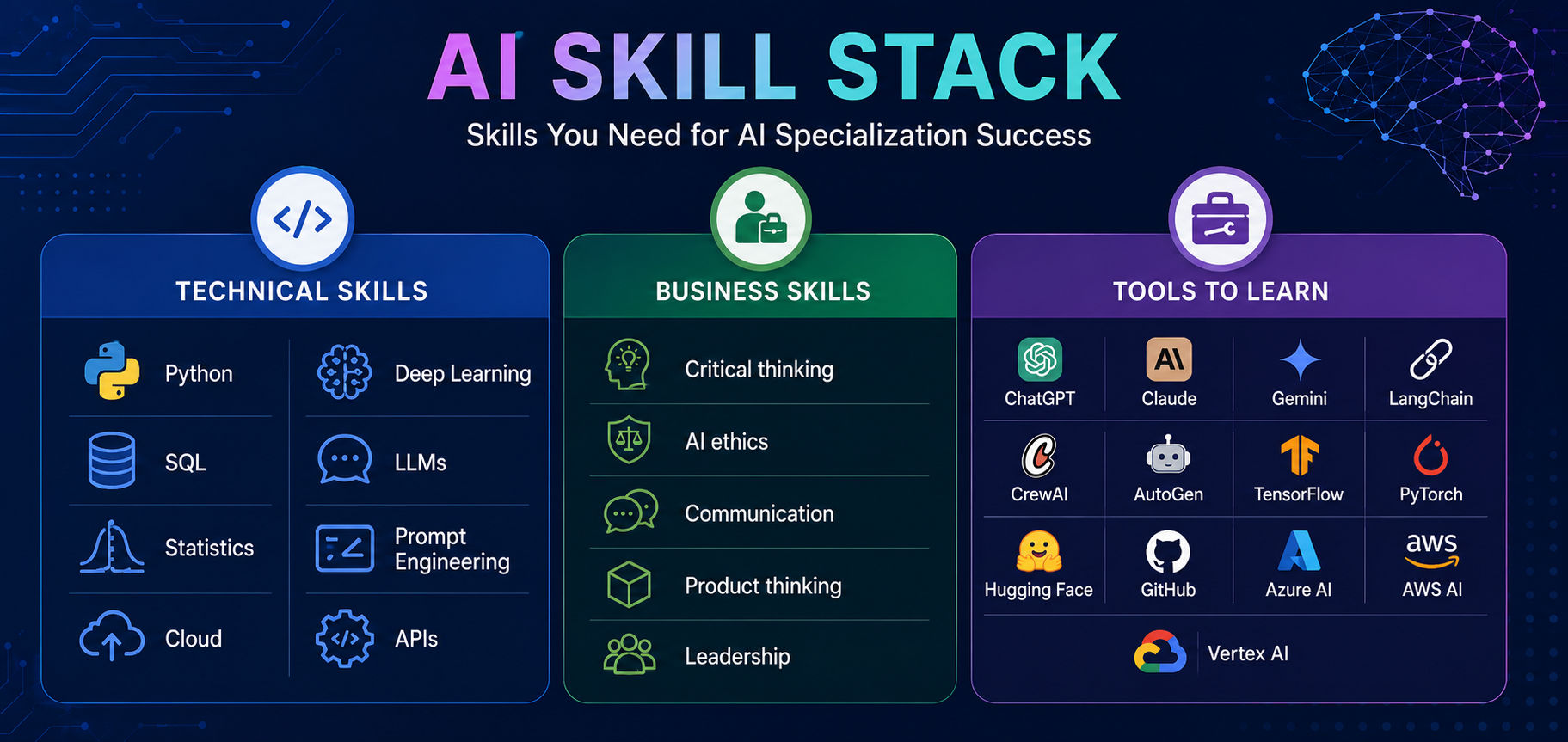
Every AI specialization requires a combination of technical expertise, business skills, and proficiency with industry-standard AI tools and platforms.
Technical Skills
- Python programming
- SQL and database querying
- Statistics and probability
- Machine learning fundamentals
- Deep learning concepts
- Large Language Models (LLMs)
- Prompt engineering
- API integration
- Data preprocessing and analysis
- Cloud computing fundamentals (AWS, Azure, Google Cloud)
- Model deployment and MLOps basics
- AI workflow automation
Business Skills
- Critical thinking and problem-solving
- AI ethics and responsible AI practices
- Business strategy and domain knowledge
- Product thinking
- Data-driven decision-making
- Communication and presentation skills
- Stakeholder management
- Leadership and team collaboration
- Change management
- Project management
AI Tools to Learn
- Generative AI: ChatGPT, Claude, Gemini
- AI Agents & Automation: LangChain, CrewAI, AutoGen
- Machine Learning & Deep Learning: TensorFlow, PyTorch, Hugging Face
- Cloud AI Platforms: Azure AI, AWS AI, Google Vertex AI
- Development & Deployment: Jupyter Notebook, Google Colab, Git/GitHub, Docker
- Vector Databases (for RAG): Pinecone, Chroma, FAISS
- MLOps Tools: MLflow, Weights & Biases (W&B), Kubeflow
Learning Roadmap for Every AI Specialization
No matter which AI path you choose, the journey usually follows the same basic steps:
- Learn AI fundamentals - Understand what AI actually is and how it works
- Learn Python - The main programming language used in AI
- Brush up on math basics - Just enough statistics and math to understand how models work
- Choose your specialization - Pick the AI field that fits you best
- Build projects - Apply what you've learned to real, hands-on work
- Earn a certification - Adds credibility to your skills. As you gain experience, you can also explore AI certifications after 2–3 years of experience to continue advancing your career.
- Build a portfolio - Show off your projects to potential employers
- Do an internship - Get real-world experience
- Land a job - Start your AI career
How long does it take?
- Beginners: 6–12 months
- Technical professionals: 4–8 months
- Experienced engineers: 3–6 months
- Business professionals (AI strategy, GenAI, AI Product Management): 3–6 months
Your timeline depends on where you're starting from, the more technical background you already have, the faster you can move.
How to Choose the Right AI Specialization?
Ask yourself a few honest questions:
- Do you enjoy coding, or would you rather work on strategy?
If you love coding: Generative AI, Machine Learning, or Agentic AI. If you prefer strategy: AI Product Management or AI Leadership. - Are you more business-minded or technically inclined?
Business-minded: AI Product Management, AI Leadership & Transformation. Technically inclined: Machine Learning, NLP, Computer Vision, or MLOps. - Do you want to do research, or focus on implementation?
Research-focused: Machine Learning or Agentic AI. Implementation-focused: Generative AI, Computer Vision, or MLOps. - Are you drawn to enterprise environments or fast-moving startups?
Enterprise: MLOps, AI Infrastructure, AI Leadership. Startups: Generative AI, Agentic AI. - Do you want to build AI systems, or manage and govern them?
Build: Machine Learning, Computer Vision, AI Robotics. Manage/govern: AI Product Management, AI Leadership & Transformation.
Your answers will naturally point you toward a specialization that fits your strengths and interests.
Common Mistakes When Choosing an AI Specialization
Avoid these common pitfalls:
- Following hype instead of your actual interests
- Ignoring fundamentals in favor of flashy tools
- Skipping projects that demonstrate real skill
- Choosing based only on salary, without considering fit
- Learning too many tools without depth in any
- Ignoring domain expertise, which often differentiates candidates more than technical skill alone
Future of AI Specializations Beyond 2026
AI is evolving rapidly, creating new career paths in Agentic AI, AI Governance, AI Safety, Multimodal AI, AI Robotics, AI Infrastructure, and industry-focused AI roles. Professionals should also keep an eye on the future trends in Agentic AI development, as autonomous AI systems continue to evolve. By 2030, 39% of workers' core skills are expected to change, making continuous upskilling essential for professionals.
The demand for AI specialists will continue to grow as organizations expand AI adoption. Jobs requiring AI skills are growing nearly eight times faster than the overall job market, while AI-related roles offer an average 62% wage premium. This makes AI one of the strongest long-term career choices beyond 2026.
Conclusion
Choosing the right AI specialization is about matching your interests, existing skills, and long-term career goals. Whether you prefer coding, data, business strategy, or leadership, there is an AI path that fits your strengths. Build a strong foundation, learn the right tools, work on real projects, and keep upgrading your skills as AI evolves. With the growing demand for AI professionals across industries, starting your learning journey today can help you build a successful and future-ready career.
Have A Query? Get in Touch With Our Customer Support | KnowledgeHut
Frequently Asked Questions (FAQs)
1. Which AI specialization has the highest salary in 2026?
AI salaries vary by location and experience, but roles in Agentic AI, Machine Learning, MLOps, AI Infrastructure, and AI Leadership generally offer the highest pay. Professionals with strong technical skills, real-world project experience, and expertise in enterprise AI systems often earn more than entry-level AI practitioners.
2. Can I switch from one AI specialization to another later?
Yes. Most AI specializations share core skills such as Python, machine learning fundamentals, and cloud computing. Once you build these foundations, transitioning between fields like Machine Learning, Generative AI, MLOps, NLP, or Computer Vision becomes much easier with additional domain-specific learning.
3. Is a master's degree required to work in AI?
No. Many AI professionals enter the field through certifications, online courses, hands-on projects, and practical experience. While advanced research roles may require higher education, most industry positions focus more on demonstrable skills, portfolios, and problem-solving ability than academic qualifications.
4. Which AI specialization has the most remote job opportunities?
Generative AI, Machine Learning, MLOps, AI Product Management, and AI Leadership frequently offer remote or hybrid work options. These roles mainly involve software development, cloud platforms, collaboration tools, and digital workflows, making them well-suited for distributed teams.
5. How important is open-source contribution for an AI career?
Contributing to open-source AI projects helps demonstrate practical skills, teamwork, and coding ability. It strengthens your portfolio, improves your understanding of real-world AI development, and can make your profile more attractive to recruiters, especially if you have limited professional experience.
6. Which programming languages are useful besides Python for AI?
Although Python remains the primary language for AI development, SQL is essential for handling data, while Java, C++, JavaScript, and R are valuable in specific AI domains. The best language depends on your specialization, industry, and the type of AI applications you want to build.
7. Should I specialize in one AI field or learn multiple areas?
Start by building expertise in one specialization before expanding into related areas. A strong foundation in a single domain makes it easier to learn complementary skills later. Professionals with both deep expertise and broad AI knowledge are often more competitive in the job market.
8. What industries hire AI specialists the most?
AI professionals are in demand across healthcare, finance, retail, manufacturing, education, cybersecurity, automotive, logistics, telecommunications, and technology. As AI adoption increases, organizations in nearly every industry are creating roles for specialists who can build, deploy, or manage AI solutions.
9. How can I stay updated with rapidly changing AI technologies?
Follow research publications, technical blogs, developer communities, AI newsletters, webinars, conferences, and open-source projects. Regularly experimenting with new AI tools and frameworks helps you keep your skills relevant and understand emerging trends in the fast-changing AI landscape.
10. How should I prepare for an AI job interview?
Prepare by reviewing AI fundamentals, programming concepts, machine learning algorithms, system design basics, and your own projects. Practice coding challenges, explain your project decisions clearly, and be ready to discuss how you solved real-world problems using AI techniques.
1639 articles published
KnowledgeHut is an outcome-focused global ed-tech company. We help organizations and professionals unlock excellence through skills development. We offer training solutions under the people and proces...
Get Free Consultation
By submitting, I accept the T&C and
Privacy Policy