
- Blog Categories
- Project Management
- Agile Management
- IT Service Management
- Cloud Computing
- Business Management
- BI And Visualisation
- Quality Management
- Cyber Security
- DevOps
- Most Popular Blogs
- PMP Exam Schedule for 2025: Check PMP Exam Date
- Top 60+ PMP Exam Questions and Answers for 2025
- PMP Cheat Sheet and PMP Formulas To Use in 2025
- What is PMP Process? A Complete List of 49 Processes of PMP
- Top 15+ Project Management Case Studies with Examples 2025
- Top Picks by Authors
- Top 170 Project Management Research Topics
- What is Effective Communication: Definition
- How to Create a Project Plan in Excel in 2025?
- PMP Certification Exam Eligibility in 2025 [A Complete Checklist]
- PMP Certification Fees - All Aspects of PMP Certification Fee
- Most Popular Blogs
- CSM vs PSM: Which Certification to Choose in 2025?
- How Much Does Scrum Master Certification Cost in 2025?
- CSPO vs PSPO Certification: What to Choose in 2025?
- 8 Best Scrum Master Certifications to Pursue in 2025
- Safe Agilist Exam: A Complete Study Guide 2025
- Top Picks by Authors
- SAFe vs Agile: Difference Between Scaled Agile and Agile
- Top 21 Scrum Best Practices for Efficient Agile Workflow
- 30 User Story Examples and Templates to Use in 2025
- State of Agile: Things You Need to Know
- Top 24 Career Benefits of a Certifed Scrum Master
- Most Popular Blogs
- ITIL Certification Cost in 2025 [Exam Fee & Other Expenses]
- Top 17 Required Skills for System Administrator in 2025
- How Effective Is Itil Certification for a Job Switch?
- IT Service Management (ITSM) Role and Responsibilities
- Top 25 Service Based Companies in India in 2025
- Top Picks by Authors
- What is Escalation Matrix & How Does It Work? [Types, Process]
- ITIL Service Operation: Phases, Functions, Best Practices
- 10 Best Facility Management Software in 2025
- What is Service Request Management in ITIL? Example, Steps, Tips
- An Introduction To ITIL® Exam
- Most Popular Blogs
- A Complete AWS Cheat Sheet: Important Topics Covered
- Top AWS Solution Architect Projects in 2025
- 15 Best Azure Certifications 2025: Which one to Choose?
- Top 22 Cloud Computing Project Ideas in 2025 [Source Code]
- How to Become an Azure Data Engineer? 2025 Roadmap
- Top Picks by Authors
- Top 40 IoT Project Ideas and Topics in 2025 [Source Code]
- The Future of AWS: Top Trends & Predictions in 2025
- AWS Solutions Architect vs AWS Developer [Key Differences]
- Top 20 Azure Data Engineering Projects in 2025 [Source Code]
- 25 Best Cloud Computing Tools in 2025
- Most Popular Blogs
- Company Analysis Report: Examples, Templates, Components
- 400 Trending Business Management Research Topics
- Business Analysis Body of Knowledge (BABOK): Guide
- ECBA Certification: Is it Worth it?
- Top Picks by Authors
- Top 20 Business Analytics Project in 2025 [With Source Code]
- ECBA Certification Cost Across Countries
- Top 9 Free Business Requirements Document (BRD) Templates
- Business Analyst Job Description in 2025 [Key Responsibility]
- Business Analysis Framework: Elements, Process, Techniques
- Most Popular Blogs
- Best Career options after BA [2025]
- Top Career Options after BCom to Know in 2025
- Top 10 Power Bi Books of 2025 [Beginners to Experienced]
- Power BI Skills in Demand: How to Stand Out in the Job Market
- Top 15 Power BI Project Ideas
- Top Picks by Authors
- 10 Limitations of Power BI: You Must Know in 2025
- Top 45 Career Options After BBA in 2025 [With Salary]
- Top Power BI Dashboard Templates of 2025
- What is Power BI Used For - Practical Applications Of Power BI
- SSRS Vs Power BI - What are the Key Differences?
- Most Popular Blogs
- Data Collection Plan For Six Sigma: How to Create One?
- Quality Engineer Resume for 2025 [Examples + Tips]
- 20 Best Quality Management Certifications That Pay Well in 2025
- Six Sigma in Operations Management [A Brief Introduction]
- Top Picks by Authors
- Six Sigma Green Belt vs PMP: What's the Difference
- Quality Management: Definition, Importance, Components
- Adding Green Belt Certifications to Your Resume
- Six Sigma Green Belt in Healthcare: Concepts, Benefits and Examples
- Most Popular Blogs
- Latest CISSP Exam Dumps of 2025 [Free CISSP Dumps]
- CISSP vs Security+ Certifications: Which is Best in 2025?
- Best CISSP Study Guides for 2025 + CISSP Study Plan
- How to Become an Ethical Hacker in 2025?
- Top Picks by Authors
- CISSP vs Master's Degree: Which One to Choose in 2025?
- CISSP Endorsement Process: Requirements & Example
- OSCP vs CISSP | Top Cybersecurity Certifications
- How to Pass the CISSP Exam on Your 1st Attempt in 2025?
- Most Popular Blogs
- Top 7 Kubernetes Certifications in 2025
- Kubernetes Pods: Types, Examples, Best Practices
- DevOps Methodologies: Practices & Principles
- Docker Image Commands
- Top Picks by Authors
- Best DevOps Certifications in 2025
- 20 Best Automation Tools for DevOps
- Top 20 DevOps Projects of 2025
- OS for Docker: Features, Factors and Tips
- More
- Agile & PMP Practice Tests
- Agile Testing
- Agile Scrum Practice Exam
- CAPM Practice Test
- PRINCE2 Foundation Exam
- PMP Practice Exam
- Cloud Related Practice Test
- Azure Infrastructure Solutions
- AWS Solutions Architect
- IT Related Pratice Test
- ITIL Practice Test
- Devops Practice Test
- TOGAF® Practice Test
- Other Practice Test
- Oracle Primavera P6 V8
- MS Project Practice Test
- Project Management & Agile
- Project Management Interview Questions
- Release Train Engineer Interview Questions
- Agile Coach Interview Questions
- Scrum Interview Questions
- IT Project Manager Interview Questions
- Cloud & Data
- Azure Databricks Interview Questions
- AWS architect Interview Questions
- Cloud Computing Interview Questions
- AWS Interview Questions
- Kubernetes Interview Questions
- Web Development
- CSS3 Free Course with Certificates
- Basics of Spring Core and MVC
- Javascript Free Course with Certificate
- React Free Course with Certificate
- Node JS Free Certification Course
- Data Science
- Python Machine Learning Course
- Python for Data Science Free Course
- NLP Free Course with Certificate
- Data Analysis Using SQL
- Home
- Blog
- Artificial Intelligence
- Generative AI Ethics in 2026: What Every Professional Should Understand
Generative AI Ethics in 2026: What Every Professional Should Understand
Updated on Jul 31, 2026 | 274 views
Share:
Table of Contents
View all
- AI Regulations and Ethical Standards Professionals Should Know in 2026
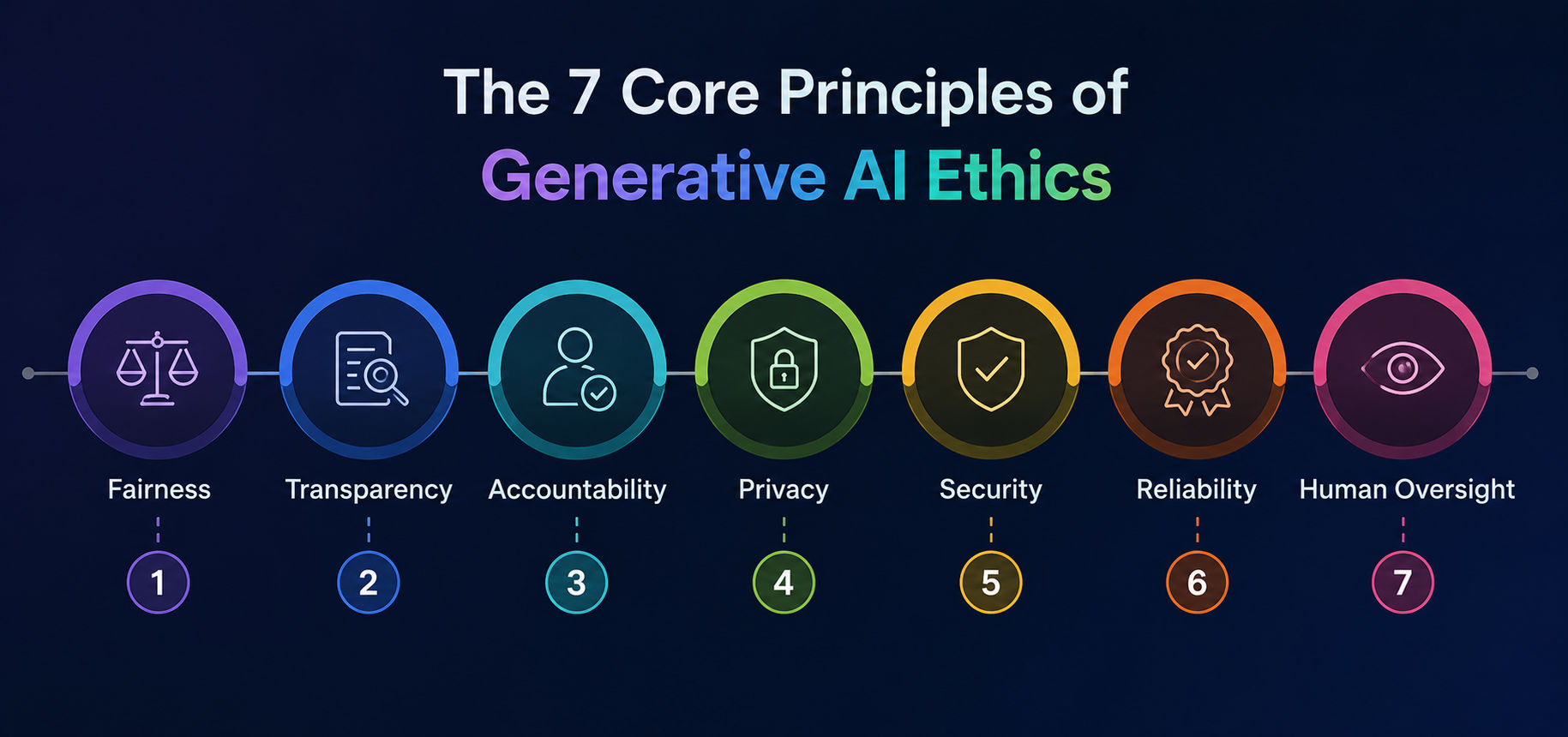
- The 7 Core Principles of Generative AI Ethics
- The Biggest Ethical Risks of Generative AI
- Best Practices for Using Generative AI Responsibly
- Common Myths About Generative AI Ethics
- How Professionals Can Build Ethical AI Skills?
- Why Generative AI Ethics Matters More Than Ever in 2026?
- Conclusion
Key Highlights
- Generative AI ethics refers to the principles and practices that ensure AI is used responsibly, fairly, transparently, and securely while protecting people, data, and organizations.
- Generative AI ethics in 2026 center on core pillars like data privacy, human accountability, and algorithmic transparency.
- Every professional must understand how to manage bias, protect confidential information, and maintain clear disclosure when using AI tools.
- Generative AI ethics is built on seven core principles: fairness, transparency, accountability, privacy, security, reliability, and human oversight. Together, these principles help ensure AI systems are trustworthy, reduce harmful outcomes, and keep people responsible for important decisions.
- The biggest ethical risks include AI bias, hallucinations, privacy breaches, copyright issues, deepfakes, and overreliance on AI. These risks can be reduced through human review, fact-checking, responsible data handling, diverse training data, and clear governance practices.
- Responsible AI use depends on everyday best practices. Professionals should use trusted AI tools, protect confidential information, verify AI-generated content, document AI usage, review outputs for bias, follow organizational policies, and stay updated on evolving AI regulations and standards.
- As AI becomes part of everyday work, ethical AI is everyone's responsibility. Understanding global frameworks, debunking common myths, and building AI literacy, governance awareness, and critical thinking skills will help professionals use Generative AI safely, responsibly, and with greater confidence.
Understanding AI ethics starts with understanding how Generative AI works. If you're ready to build practical AI skills alongside responsible AI practices, explore the Generative AI Foundations Certificate Program.
AI Regulations and Ethical Standards Professionals Should Know in 2026
The regulatory landscape is evolving fast. While specific laws vary by region, most frameworks share a common theme: risk-based oversight, stronger data protection, and industry-specific guidance.
Regulation / Standard |
What It Is? |
Who Needs to Understand It? |
|---|---|---|
EU AI Act |
The world's first comprehensive AI law that regulates AI systems based on their level of risk. |
AI developers, businesses using AI, compliance officers, legal teams, product managers, and organizations operating in or serving the EU. |
GDPR (AI-related) |
A data privacy law that governs how personal data is collected, processed, and used by AI systems. |
AI developers, data scientists, privacy professionals, HR teams, marketers, and any organization handling EU personal data. |
ISO/IEC 42001 |
An international standard for establishing and managing an AI Management System (AIMS). |
Business leaders, AI governance teams, compliance professionals, IT managers, and organizations implementing AI. |
ISO/IEC 23894 |
An international standard that provides guidance for AI risk management throughout the AI lifecycle. |
Risk managers, AI developers, project managers, cybersecurity teams, and governance professionals. |
NIST AI Risk Management Framework (AI RMF) |
A framework that helps organizations identify, assess, and manage AI-related risks. |
AI practitioners, security teams, risk managers, policymakers, and organizations building or deploying AI systems. |
OECD AI Principles |
International principles for developing trustworthy, human-centered, and responsible AI. |
Governments, policymakers, AI developers, business leaders, and organizations adopting responsible AI practices. |
UNESCO Recommendation on the Ethics of AI |
A global ethical framework promoting human rights, fairness, inclusion, and sustainability in AI. |
Governments, educators, researchers, AI developers, ethics committees, and organizations using AI responsibly. |
Council of Europe Framework Convention on AI |
The first international treaty focused on ensuring AI respects human rights, democracy, and the rule of law. |
Governments, legal professionals, regulators, public sector organizations, and multinational companies. |
G7 Hiroshima AI Process |
International guidelines promoting the safe, secure, and trustworthy development of advanced AI systems. |
Governments, AI companies, multinational organizations, policymakers, and technology leaders. |
Colorado AI Act |
A U.S. state law regulating the development and deployment of high-risk AI systems to reduce algorithmic discrimination. |
Organizations operating in Colorado, AI developers, compliance teams, HR professionals, lenders, insurers, and legal advisors. |
For anything compliance-specific to your industry or region, it's worth consulting dedicated legal or governance resources rather than relying on general guidance.
Looking to build your AI skills beyond ethics? Explore KnowledgeHut's Artificial Intelligence Courses to learn Generative AI, Agentic AI, prompt engineering, and other in-demand AI skills through hands-on, industry-focused programs.
The 7 Core Principles of Generative AI Ethics
Think of these as the foundation everything else is built on.
Core Principle |
What Does It Mean? |
Why Does It Matter? |
|---|---|---|
Fairness |
AI shouldn't discriminate based on race, gender, age, or other characteristics |
Prevents unfair or biased outcomes |
Transparency |
Being honest about how AI works and disclosing AI-generated content |
Builds trust in AI systems |
Accountability |
Humans own the outcome, backed by governance and audit trails |
Ensures someone is responsible, not just the AI |
Privacy |
Minimizing data use and respecting consent |
Protects sensitive personal information |
Security |
Guarding against prompt injection, misuse, and data leaks |
Prevents exploitation of AI systems |
Reliability |
Reducing hallucinations through testing and human review |
Ensures AI output can be trusted |
Human Oversight |
AI assists, humans decide, especially on high-risk calls |
Keeps critical judgment in human hands |
Ethics is just one part of AI literacy. Strengthen your understanding by exploring six essential AI concepts every beginner should learn before working with advanced Generative AI tools.
The Biggest Ethical Risks of Generative AI
Principles are great in theory, but let's talk about where things actually go wrong.
- AI bias shows up in hiring tools that unintentionally filter out qualified candidates, healthcare algorithms that misread symptoms in underrepresented groups, and financial models that price risk unfairly.
- Hallucinations, AI confidently making things up; are perhaps the most talked-about risk. This can mean fabricated citations, false information presented as fact, or dangerously incorrect legal advice.
- Copyright and intellectual property questions are murky territory. Whose work trained the model? Who owns AI-generated images, code, or creative writing? These questions are still being sorted out in courts worldwide.
- Privacy and confidential data risks pop up the moment someone pastes customer information, business documents, medical records, or employee data into a public AI tool.
- Deepfakes and misinformation have real-world consequences—political manipulation, identity fraud, and fake media that's increasingly hard to distinguish from reality.
- Overreliance on AI might be the quietest risk of all: a gradual erosion of critical thinking, automation bias, and decision fatigue from constantly checking (or not checking) AI outputs.
Risk |
Impact |
Prevention |
|---|---|---|
Bias |
Unfair decisions |
Diverse training |
Hallucination |
Wrong information |
Fact checking |
Privacy |
Data exposure |
Avoid sensitive inputs |
Copyright |
Legal disputes |
Verify ownership |
Deepfakes |
Misinformation |
Detection tools |
Overreliance |
Poor decisions |
Human review |
Best Practices for Using Generative AI Responsibly
Here's the good news: most of this comes down to habits, not expertise.
- Use trusted, vetted AI tools
- Protect confidential data, never input what you wouldn't want made public
- Always verify outputs before acting on them
- Document how and where AI was used
- Disclose AI-generated content when appropriate
- Review outputs for bias
- Keep humans in the loop for important decisions
- Follow your organization's AI policies
- Stay updated on evolving regulations
- Conduct regular AI risk assessments
Common Myths About Generative AI Ethics
- AI is objective: In reality, AI reflects the data it was trained on and the choices its designers made, so bias can creep in without anyone intending it.
- AI always tells the truth: Generative AI can hallucinate, confidently producing false information, fake citations, or incorrect advice as if it were fact.
- Ethics slows down innovation: Responsible practices actually build the trust needed for wider adoption, making ethical AI a driver of innovation rather than a roadblock.
- Only developers need to worry about AI ethics: Anyone using AI tools, from marketers to HR teams to executives, shares responsibility for how it's applied and what it produces.
- Regulations eliminate all AI risks: Laws and frameworks reduce risk and provide guardrails, but they can't catch every problem, which is why human judgment still matters.
How Professionals Can Build Ethical AI Skills?
- Build AI literacy: Understand AI capabilities, limitations, and how to evaluate AI outputs critically.
- Learn prompt engineering: Create effective prompts and use AI tools responsibly.
- Understand governance and privacy: Learn AI regulations, risk management, security, and data protection basics.
- Practice human oversight: Use AI to support decisions while maintaining human judgment and accountability.
- Collaborate responsibly: Combine AI skills with ethical thinking, security awareness, and cross-functional teamwork.
Learning AI ethics is only one part of becoming AI-ready. If you're planning to enter the field, explore the best way to start a career in Generative AI, including the skills, learning roadmap, and certifications employers value.
Why Generative AI Ethics Matters More Than Ever in 2026?
Just a few years ago, AI ethics was a niche conversation. Today, it's boardroom talk. Here's why this topic has become impossible to ignore.
- Enterprise AI has grown up fast - What started as experimental pilot projects has turned into core infrastructure. Companies now rely on generative AI for everything from customer service to content creation to code development, which means the stakes for getting it right have grown just as quickly.
- Governments are stepping in - Regulations around the world are catching up to the technology, introducing real compliance requirements instead of vague guidelines. Ignoring AI ethics isn't just risky anymore, it can be a legal liability.
- AI is now part of daily work - It's no longer a specialized tool used by a few teams. Employees across departments, from marketing to HR to finance, use AI regularly, which means ethical AI use is now everyone's responsibility, not just the IT department's.
- Legal risks are increasing - As lawsuits and regulatory actions become more common, organizations face real financial and reputational consequences for careless AI use.
- Customer trust is on the line - People are more aware than ever of how their data is used and how AI shapes the products and services they interact with. Mishandling this can quickly erode the trust a brand has spent years building.
- Brand reputation can be won or lost overnight - A single AI misstep, whether it's a biased algorithm or a fabricated response, can spread fast and cause lasting damage.
Generative AI is reshaping more than workplace practices, it's transforming entire careers. See how AI is changing data science roles, the new skills employers expect, and what professionals should prepare for in 2026.
Conclusion
Generative AI is transforming the way people work, but using it responsibly is just as important as using it effectively. By understanding ethical principles, recognizing common risks, following best practices, and staying informed about evolving regulations, professionals can make better decisions and build trust in AI. Ethics is not only for developers or policymakers, it is a shared responsibility for everyone who uses AI. As AI continues to evolve in 2026 and beyond, combining innovation with human judgment will be the key to safe, fair, and responsible AI adoption.
Have A Query? Get in Touch With Our Customer Support | KnowledgeHut
Frequently Asked Questions (FAQs)
1. How can small businesses create an AI ethics policy without a dedicated AI team?
Small businesses can start with a simple AI ethics policy that explains approved AI tools, protects confidential data, requires human review for important decisions, and assigns responsibility for AI use. Employees should verify AI-generated content, report harmful outputs, and follow clear guidelines. Reviewing the policy regularly helps keep it aligned with changing AI technologies and regulations.
2. What should employees do if they notice unethical AI use in their workplace?
Employees should report unethical AI use to their manager, HR, compliance, or security team as soon as possible. They should document what happened, which AI tool was used, and why it may be harmful. Reporting concerns early helps prevent legal, financial, and reputational risks while encouraging responsible AI use across the organization.
3. How often should organizations review and update their AI governance policies?
Organizations should review AI governance policies at least once or twice a year, or whenever they adopt new AI tools, regulations change, or an AI-related issue occurs. Regular reviews help address evolving risks such as bias, privacy, security, and compliance, ensuring AI is used responsibly and current policies remain effective.
4. Are open-source AI models subject to the same ethical responsibilities as commercial AI tools?
Yes. Organizations are responsible for using AI ethically regardless of whether the model is open source or commercial. They should test AI for fairness, accuracy, privacy, and security before deployment and continue monitoring its performance. Human oversight is especially important when AI supports decisions that affect people or business operations.
5. How can organizations measure whether their AI systems are fair and unbiased?
Organizations can measure AI fairness by regularly testing outputs across different user groups and identifying any unequal or biased results. Using diverse datasets, conducting AI audits, collecting user feedback, and involving human reviewers help detect hidden bias. Since AI changes over time, fairness should be monitored continuously rather than through a one-time assessment.
6. What role do ethics committees play in AI development and deployment?
AI ethics committees review AI projects before deployment to identify ethical, legal, and business risks. They help create governance policies, monitor high-risk AI systems, recommend safeguards, and ensure compliance with regulations. By involving experts from different departments, these committees support responsible AI adoption while reducing organizational risks.
7. How can businesses balance AI innovation with ethical responsibilities?
Businesses can balance innovation and ethics by considering responsible AI from the beginning of every project. They should assess risks, establish clear AI policies, maintain human oversight, and regularly review AI systems. Ethical practices help organizations innovate with confidence while protecting customers, employees, and their reputation.
8. What ethical considerations should organizations keep in mind when fine-tuning or training their own AI models?
Organizations should use high-quality, legally obtained, and diverse training data while protecting personal and confidential information. They should document the AI development process, test models for bias, accuracy, privacy, and security, and continuously monitor performance after deployment. These practices help build reliable and responsible AI systems.
9. How do ethical requirements differ between low-risk and high-risk AI applications?
Low-risk AI applications, such as content creation or meeting summaries, mainly require fact-checking, human review, and data protection. High-risk AI systems used in areas like healthcare, finance, or hiring require stricter governance, regular audits, detailed documentation, human approval, and compliance with regulations because they can directly affect people's rights and safety.
10. What are some ethical considerations when using Generative AI?
When using Generative AI, you should protect personal and confidential data, check AI outputs for accuracy, avoid biased or misleading content, respect copyright rules, and be transparent about AI-generated work when needed. Most importantly, keep humans involved in important decisions and follow your organization's AI policies and applicable regulations to ensure responsible AI use.
1639 articles published
KnowledgeHut is an outcome-focused global ed-tech company. We help organizations and professionals unlock excellence through skills development. We offer training solutions under the people and proces...
Get Free Consultation
By submitting, I accept the T&C and
Privacy Policy