
- Home
- Blog
- Artificial Intelligence
- Not Everyone Should Do an AI Master's Program — Here's How to Know If You're the Exception
Not Everyone Should Do an AI Master's Program — Here's How to Know If You're the Exception
Updated on Jul 31, 2026 | 187 views
Share:
Table of Contents
View all
- Who Should Pursue an AI Master's Program?
- What Background and Skills Do You Need for an AI Master's Program?
- Technical Skills Required Before Starting
- What You'll Learn in an AI Master's Program
- What a Structured Program Actually Looks Like
- Common Mistakes to Avoid When Choosing an AI Master's Program
- Final Verdict
Overview:
- An AI Master's program is best suited for individuals who want to transition into specialized engineering roles, pivot into tech product management, or lead advanced research.
- With global industries rapidly adopting automation, predictive modeling, and generative systems, a graduate degree provides the structured math-to-code training required to build and deploy real-world AI architecture.
- Beyond engineering, it's also a good fit for people in marketing, product, consulting, and data roles who want real, hands-on AI skills — not just a research degree.
- You don't need a computer science background. You do need basic Python and statistics, a willingness to learn new technical ideas, and a clear reason for wanting AI skills (like a career change, a promotion, or building an AI product).
- If you're choosing between a Master's, certifications, bootcamps, or self-learning, it comes down to speed vs. depth: a Master's gives you structured, deep learning with mentors, while the other options are faster but go less deep.
Who Should Pursue an AI Master's Program?
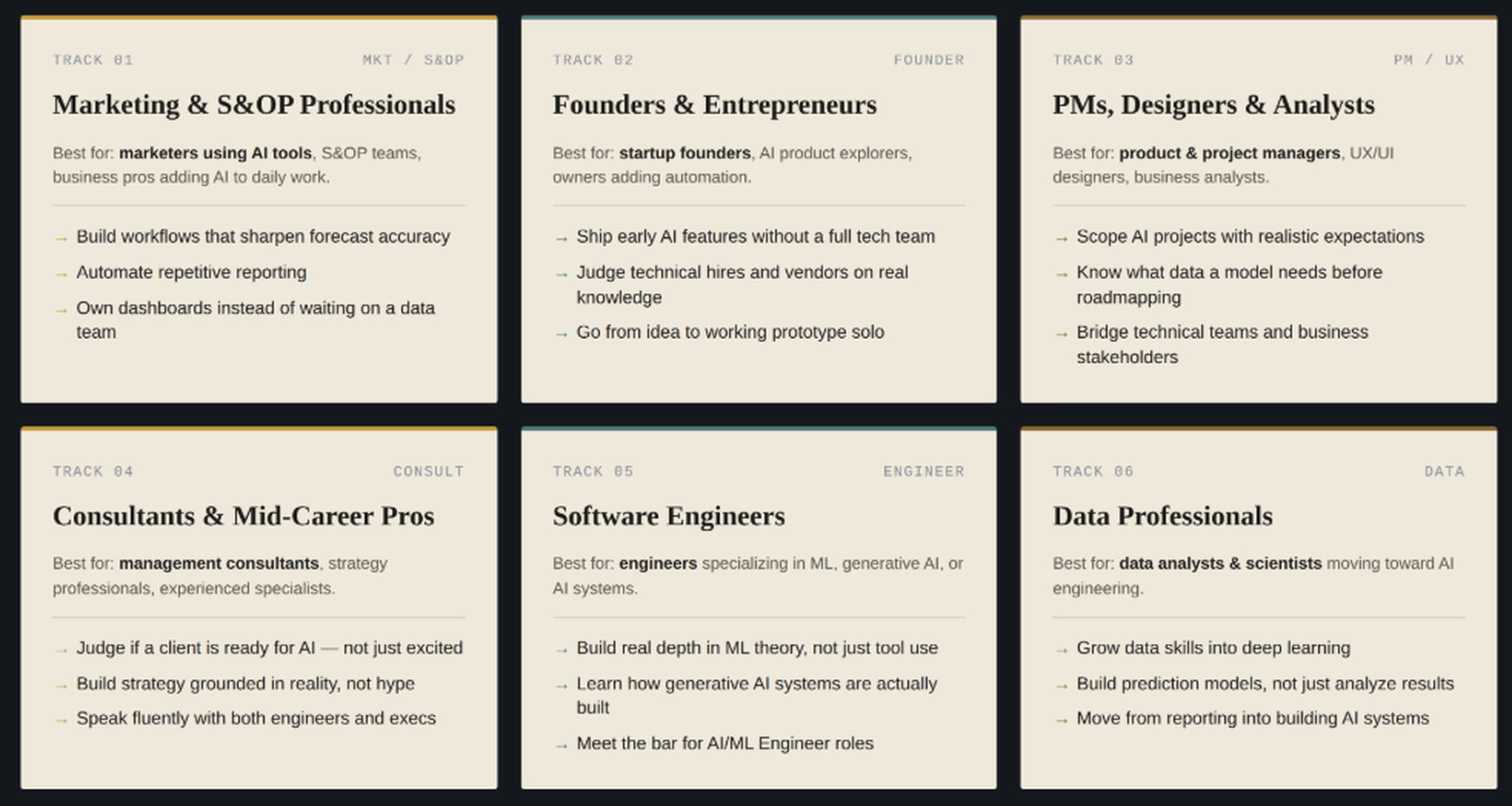
An AI Master's isn't only for engineers. It's built for six main groups: marketing and operations people, founders, project managers and designers, consultants, software engineers, and data professionals.
If you want to go from just "using AI tools" to actually "understanding and building with AI," this program is for you. If you just want a quick intro to AI, a short course or certificate is a better first step.
Ready to Build Real AI Skills?
Join our 15-week end-to-end AI Master's Program and learn how to apply AI through hands-on projects, practical coursework, and a final capstone demo that showcases your skills.
Marketing and S&OP Professionals
Best for: marketing professionals using AI tools, S&OP teams improving planning, and business professionals adding AI to daily work.
An AI Master's helps marketing and supply chain professionals:
- Build AI workflows that make forecasts more accurate
- Automate boring, repetitive reports
- Turn AI results into decisions leaders can actually use
- Build their own models and dashboards instead of always waiting on a data team
- Use AI across campaign planning, demand forecasting, and resource planning to make better decisions
Founders and Entrepreneurs
Best for: startup founders, entrepreneurs exploring AI products, and business owners adding AI automation.
An AI Master's helps founders and entrepreneurs:
- Build early AI features without needing a full tech team yet
- Judge technical hires and vendors with real knowledge, not guesswork
- Make smart "build it or buy it" decisions about AI tools
- Check if an AI product idea can actually be built
- Check if that idea can actually make money
- Go from idea to working prototype without relying only on an outside technical co-founder
Project Managers, Designers, and Analysts
Best for: product managers, project managers, UX/UI designers, and business analysts.
An AI Master's helps project managers, designers, and analysts:
- Manage AI projects with realistic expectations, not guesswork
- Understand what's actually possible in one sprint or project
- Understand what data a model needs before planning the roadmap
- Design user experiences that match what AI can really do
- Talk clearly with both technical AI teams and business stakeholders
- Feel confident sitting between AI teams and business leaders
Start Your UI/UX Design Journey with a Clear Roadmap
Follow a step-by-step plan covering design fundamentals, essential tools, portfolio building, and the skills needed to become a job-ready UI/UX designer
Consultants and Mid-Career Professionals
Best for: management consultants, strategy professionals, and experienced specialists.
An AI Master's helps consultants and mid-career professionals:
- Judge if a client is really ready for AI, not just excited about it
- Build an AI strategy based on what's realistic, not hype
- Speak confidently with technical teams during projects
- Speak confidently with executives about strategy and spending
- Build AI knowledge that clients now expect
- Build a mix of skills that's hard to get from short courses alone
Software Engineers and Technology Professionals
Best for: software engineers ready to specialize in machine learning, generative AI, or AI systems.
An AI Master's helps software engineers and tech professionals:
- Build real depth in machine learning theory, not just surface-level tool use
- Learn how generative AI systems are built
- Gain hands-on AI engineering skills for real production systems
- Meet the technical bar most AI Engineer and ML Engineer jobs expect
- Move from general coding work into specialized AI roles
Data Professionals Looking to Advance into AI Roles
Best for: data analysts and data scientists who want to move into AI engineering or machine learning.
An AI Master's helps data professionals:
- Grow their data skills into deep learning
- Build large-scale prediction models, not just analyze existing data
- Move from analyzing results to actually building the AI systems
- Move past a role that's stuck at reporting and analysis
- Transition into AI engineering or machine learning roles
What Background and Skills Do You Need for an AI Master's Program?
If you see yourself in one of these groups, the next question is simple: do you have the basic skills to succeed? Requirements vary by program, but most expect some level of comfort with numbers and logic.
You don't need a computer science degree. But you do need to be comfortable thinking in a technical way. Always check the specific program's requirements, since they can differ here's what usually matters.
Academic Backgrounds Suitable for AI Master's Programs
- Computer Science
- Engineering
- Mathematics or Statistics
- Data Science
- Business or other fields (accepted by many programs, depends on the school)
Technical Skills Required Before Starting
| Skill | Importance |
| Python | Essential |
| Statistics | Important |
| Linear Algebra | Important |
| Programming Fundamentals | Recommended |
| Data Handling | Useful |
Typical Admission Requirements
Exact rules vary by program, but most AI Master's programs ask for:
- A bachelor's degree (in any subject, though some prefer STEM or business)
- Basic Python skills, or a clear willingness to learn it
- Basic statistics knowledge
- A resume
- A statement of purpose (a short essay about your goals)
- Proof of English skills, if needed
If you're missing a couple of these, it's usually not a dealbreaker. Many programs offer extra modules or conditional admission if you're otherwise a strong candidate.
What You'll Learn in an AI Master's Program
Every program is a little different, but most are built around three main parts: the basics, applied AI skills, and real-world practice.
Core Technical Foundations
- Python for AI and data work
- Statistics and probability, to judge if a model is actually working
- Linear algebra and calculus, the math behind machine learning
- Data structures, algorithms, and handling large amounts of data
Applied AI and Machine Learning Skills
- Supervised and unsupervised machine learning
- Deep learning and neural networks
- Natural language processing and generative AI
- Deploying and monitoring models (MLOps basics)
- AI ethics, bias, and using AI responsibly
Industry Application and Capstone Projects
- Using AI to solve real problems in your own field (marketing, product, operations, etc.)
- Building and presenting a final capstone project, often based on your own industry
- Working with real (or realistic) data, not just simple textbook examples
- Working on AI projects the way you would at a real job, with both technical and non-technical teammates
What a Structured Program Actually Looks Like
Program length and format vary, but here's what a well-designed applied AI Master's typically includes:
- Format: 15 weeks, 31 sessions total, orientation plus 30 live weekend sessions, built for working professionals and aspiring AI builders
- Hands-on practice: 6+ mini build projects, with a hands-on build in every session covering agentic and vibe coding you ship real systems in every class, not just at the end
- Capstone: A final capstone project you present during a concluding showcase session
- Tools: 10+ production tools, such as FlowiseAI, Zapier, n8n, Lovable, Lindy, Claude, and ChatGPT
- Learning curve, in 3 milestones: first, understand LLMs, prompting techniques, and AI-assisted workflows; then, learn to design agent-based systems and workflow automation using no-code tools; finally, build and refine practical AI applications and capstone-ready solutions
- No-code friendly: every build uses no-code and visual tools, so the program is designed for builders, not just developers, you don't need to already know how to code to get real, hands-on AI experience
Explore the AI Master's Curriculum
Discover what you'll learn across AI foundations, machine learning, generative AI, and real-world applications. See how each module builds the skills needed to design, develop, and apply AI solutions.
Common Mistakes to Avoid When Choosing an AI Master's Program
Choosing AI Because It Is Trending
Being interested in AI isn't the same as having a career plan. These programs take real time and money to start from the job you want, not the headlines you've read.
Ignoring Program Curriculum and Outcomes
Don't just look at the program's name. Check what's actually taught, how up to date it is, and what jobs past students got afterward. If a program hasn't updated its lessons in the last year, that's a warning sign that AI skills change fast.
Underestimating Technical Requirements
Even "beginner-friendly" AI programs need comfort with Python, statistics, and logical problem-solving. Underestimating this can make your first few months much harder than expected — brush up on basics first if you need to.
Focusing Only on the Degree Instead of Skills
The degree opens doors, but the actual skills are what keeps you in the job. Choose programs with real hands-on projects over ones that are mostly just theory with little practice.
Final Verdict
An AI Master's is best for people who want real AI skills, real career growth, and the ability to use AI in either technical or business work not for people chasing a trend with no clear goal.
An AI Master's is most valuable when it matches a specific career goal whether that's becoming an AI engineer, leading AI projects, or using AI in the industry you're already in. If you want structured learning, hands-on practice, and long-term career growth, it can be a solid investment. If you just want to get familiar with AI tools, a certification or short course is a more practical first step.
Before you apply, it helps to think honestly about four things: your career goals, or what role or outcome you're actually working toward; your current skills, or how much of the basic foundation you already have; your time commitment, or whether you can really keep up the pace alongside your current life; and your expected outcome, or whether the program's track record actually matches the career move you want to make. Explore more at UpGrad KnowledgeHut
Frequently Asked Questions
What is the difference between an AI Master's and a Data Science Master's?
An AI Master's focuses more on building intelligent systems using machine learning, deep learning, neural networks, and generative AI. A Data Science Master's usually focuses more on collecting, analyzing, and interpreting data to support business decisions. The right choice depends on whether you want to build AI systems or work primarily with data insights.
Can an AI Master's help me switch careers from a non-technical field?
Yes. Many AI Master's programs are designed for professionals from business, finance, marketing, operations, and other fields who want to transition into AI-focused roles. A strong learning plan can help you build the technical foundation needed for the switch.
What projects should I build during an AI Master's program?
Good AI projects usually solve practical problems, such as recommendation systems, predictive models, chatbots, automation tools, computer vision applications, or generative AI solutions. Industry-focused projects can strengthen your portfolio and demonstrate job-ready skills.
Does an AI Master's provide better opportunities than online AI courses?
An AI Master's provides a structured curriculum, deeper technical knowledge, mentorship, academic credibility, and larger projects. Online courses can be useful for learning specific skills quickly, but they usually do not provide the same depth or guided experience.
Are AI Master's programs available online or only on campus?
Many universities and institutions now offer online, hybrid, and part-time AI Master's programs. These formats allow working professionals to gain advanced AI skills while continuing their careers.
What mathematics should I know before starting an AI Master's?
A basic understanding of statistics, probability, linear algebra, and calculus is helpful. You do not need to be a mathematics expert but understanding how these concepts support machine learning algorithms will make learning easier.
How does an AI Master's prepare students for real-world AI jobs?
Most programs combine theory with practical assignments, coding projects, model development, and capstone work. This helps students learn how to design, test, deploy, and improve AI solutions used in real business environments.
Can AI Master's graduates work in leadership or management roles?
Yes. Professionals who combine AI knowledge with business experience often move into roles such as AI Product Manager, AI Strategy Consultant, Technical Program Manager, or AI Innovation Lead.
What tools and technologies are commonly taught in AI Master's programs?
Programs often include tools and frameworks such as Python, TensorFlow, PyTorch, machine learning libraries, cloud AI platforms, data processing tools, and MLOps technologies used to build and deploy AI applications.
How do I know if an AI Master's program matches my career goals?
Review the program curriculum, specialization options, project work, faculty expertise, career outcomes, and industry connections. The best program is one that helps you move toward your specific target role rather than simply offering a general AI credential.
1639 articles published
KnowledgeHut is an outcome-focused global ed-tech company. We help organizations and professionals unlock excellence through skills development. We offer training solutions under the people and proces...
Get Free Consultation
By submitting, I accept the T&C and
Privacy Policy