
- Blog Categories
- Project Management
- Agile Management
- IT Service Management
- Cloud Computing
- Business Management
- BI And Visualisation
- Quality Management
- Cyber Security
- DevOps
- Most Popular Blogs
- PMP Exam Schedule for 2025: Check PMP Exam Date
- Top 60+ PMP Exam Questions and Answers for 2025
- PMP Cheat Sheet and PMP Formulas To Use in 2025
- What is PMP Process? A Complete List of 49 Processes of PMP
- Top 15+ Project Management Case Studies with Examples 2025
- Top Picks by Authors
- Top 170 Project Management Research Topics
- What is Effective Communication: Definition
- How to Create a Project Plan in Excel in 2025?
- PMP Certification Exam Eligibility in 2025 [A Complete Checklist]
- PMP Certification Fees - All Aspects of PMP Certification Fee
- Most Popular Blogs
- CSM vs PSM: Which Certification to Choose in 2025?
- How Much Does Scrum Master Certification Cost in 2025?
- CSPO vs PSPO Certification: What to Choose in 2025?
- 8 Best Scrum Master Certifications to Pursue in 2025
- Safe Agilist Exam: A Complete Study Guide 2025
- Top Picks by Authors
- SAFe vs Agile: Difference Between Scaled Agile and Agile
- Top 21 Scrum Best Practices for Efficient Agile Workflow
- 30 User Story Examples and Templates to Use in 2025
- State of Agile: Things You Need to Know
- Top 24 Career Benefits of a Certifed Scrum Master
- Most Popular Blogs
- ITIL Certification Cost in 2025 [Exam Fee & Other Expenses]
- Top 17 Required Skills for System Administrator in 2025
- How Effective Is Itil Certification for a Job Switch?
- IT Service Management (ITSM) Role and Responsibilities
- Top 25 Service Based Companies in India in 2025
- Top Picks by Authors
- What is Escalation Matrix & How Does It Work? [Types, Process]
- ITIL Service Operation: Phases, Functions, Best Practices
- 10 Best Facility Management Software in 2025
- What is Service Request Management in ITIL? Example, Steps, Tips
- An Introduction To ITIL® Exam
- Most Popular Blogs
- A Complete AWS Cheat Sheet: Important Topics Covered
- Top AWS Solution Architect Projects in 2025
- 15 Best Azure Certifications 2025: Which one to Choose?
- Top 22 Cloud Computing Project Ideas in 2025 [Source Code]
- How to Become an Azure Data Engineer? 2025 Roadmap
- Top Picks by Authors
- Top 40 IoT Project Ideas and Topics in 2025 [Source Code]
- The Future of AWS: Top Trends & Predictions in 2025
- AWS Solutions Architect vs AWS Developer [Key Differences]
- Top 20 Azure Data Engineering Projects in 2025 [Source Code]
- 25 Best Cloud Computing Tools in 2025
- Most Popular Blogs
- Company Analysis Report: Examples, Templates, Components
- 400 Trending Business Management Research Topics
- Business Analysis Body of Knowledge (BABOK): Guide
- ECBA Certification: Is it Worth it?
- Top Picks by Authors
- Top 20 Business Analytics Project in 2025 [With Source Code]
- ECBA Certification Cost Across Countries
- Top 9 Free Business Requirements Document (BRD) Templates
- Business Analyst Job Description in 2025 [Key Responsibility]
- Business Analysis Framework: Elements, Process, Techniques
- Most Popular Blogs
- Best Career options after BA [2025]
- Top Career Options after BCom to Know in 2025
- Top 10 Power Bi Books of 2025 [Beginners to Experienced]
- Power BI Skills in Demand: How to Stand Out in the Job Market
- Top 15 Power BI Project Ideas
- Top Picks by Authors
- 10 Limitations of Power BI: You Must Know in 2025
- Top 45 Career Options After BBA in 2025 [With Salary]
- Top Power BI Dashboard Templates of 2025
- What is Power BI Used For - Practical Applications Of Power BI
- SSRS Vs Power BI - What are the Key Differences?
- Most Popular Blogs
- Data Collection Plan For Six Sigma: How to Create One?
- Quality Engineer Resume for 2025 [Examples + Tips]
- 20 Best Quality Management Certifications That Pay Well in 2025
- Six Sigma in Operations Management [A Brief Introduction]
- Top Picks by Authors
- Six Sigma Green Belt vs PMP: What's the Difference
- Quality Management: Definition, Importance, Components
- Adding Green Belt Certifications to Your Resume
- Six Sigma Green Belt in Healthcare: Concepts, Benefits and Examples
- Most Popular Blogs
- Latest CISSP Exam Dumps of 2025 [Free CISSP Dumps]
- CISSP vs Security+ Certifications: Which is Best in 2025?
- Best CISSP Study Guides for 2025 + CISSP Study Plan
- How to Become an Ethical Hacker in 2025?
- Top Picks by Authors
- CISSP vs Master's Degree: Which One to Choose in 2025?
- CISSP Endorsement Process: Requirements & Example
- OSCP vs CISSP | Top Cybersecurity Certifications
- How to Pass the CISSP Exam on Your 1st Attempt in 2025?
- Most Popular Blogs
- Top 7 Kubernetes Certifications in 2025
- Kubernetes Pods: Types, Examples, Best Practices
- DevOps Methodologies: Practices & Principles
- Docker Image Commands
- Top Picks by Authors
- Best DevOps Certifications in 2025
- 20 Best Automation Tools for DevOps
- Top 20 DevOps Projects of 2025
- OS for Docker: Features, Factors and Tips
- More
- Agile & PMP Practice Tests
- Agile Testing
- Agile Scrum Practice Exam
- CAPM Practice Test
- PRINCE2 Foundation Exam
- PMP Practice Exam
- Cloud Related Practice Test
- Azure Infrastructure Solutions
- AWS Solutions Architect
- IT Related Pratice Test
- ITIL Practice Test
- Devops Practice Test
- TOGAF® Practice Test
- Other Practice Test
- Oracle Primavera P6 V8
- MS Project Practice Test
- Project Management & Agile
- Project Management Interview Questions
- Release Train Engineer Interview Questions
- Agile Coach Interview Questions
- Scrum Interview Questions
- IT Project Manager Interview Questions
- Cloud & Data
- Azure Databricks Interview Questions
- AWS architect Interview Questions
- Cloud Computing Interview Questions
- AWS Interview Questions
- Kubernetes Interview Questions
- Web Development
- CSS3 Free Course with Certificates
- Basics of Spring Core and MVC
- Javascript Free Course with Certificate
- React Free Course with Certificate
- Node JS Free Certification Course
- Data Science
- Python Machine Learning Course
- Python for Data Science Free Course
- NLP Free Course with Certificate
- Data Analysis Using SQL
- Home
- Blog
- Cloud Computing
- AI-102 to AI-103: Azure AI Apps and Agents Developer Exam Guide
AI-102 to AI-103: Azure AI Apps and Agents Developer Exam Guide
Updated on Oct 23, 2026
Share:
Table of Contents
View all
- What is the AI 103 certification?
- What is the AI 103 certification exam format?
- How much does AI 103 certification cost in different countries?
- How do you register for AI-103?
- What is the AI 103 certification exam syllabus?
- How to prepare for the AI 103 certification exam?
- How long does it take to prepare for AI-103?
Quick Overview
- The AI 103 certification validates skills in developing AI applications and agents using Microsoft Foundry and Azure services.
- The AI-103 exam covers five domains, with generative AI and agentic solutions carrying the highest weightage of 30-35%.
- The exam lasts 120 minutes, requires a passing score of 700 out of 1,000, and costs $165 in the United States, with regional fees varying by country.
- Preparation can take 2-4 weeks for experienced Azure AI developers or 8-12 weeks or longer for beginners, depending on their Python and Azure knowledge.
- This guide covers AI-102 vs AI-103 changes, exam format and fees, registration steps, syllabus, preparation resources, and study timelines.
Build on the AI-103 syllabus by learning how to design, develop, and implement AI agents through practical projects. Explore Applied Agentic AI Certification Course.
Master the Right Skills & Boost Your Career
Avail your free 1:1 mentorship session
What is the AI 103 certification?
AI 103 certification is related to Microsoft Certified: Azure AI Apps and Agents Developer Associate credential. It proves the abilities to design and manage AI apps and agents on Microsoft Azure.
The exam will test the knowledge of Microsoft Foundry, generative AI apps, AI agents, computer vision, text analytics, and information extraction. Candidates need to know Python, APIs, Azure services, and basics of AI apps development.
AI 103 certification is especially helpful for those who are interested not only in the usage of AI but also in the creation of AI solutions that integrate models, data sources, and third-party tools.
AI-102 vs AI-103: What has changed?
AI-102 concentrated on the implementation and management of Azure AI solutions through various services like language, vision, knowledge mining. AI 103 certification pays more attention to the development of generative AI apps and agentic flows.
Comparison point |
AI-102 |
AI-103 |
| Certification title | Azure AI Engineer Associate | Azure AI Apps and Agents Developer Associate |
| Exam status | Retired on June 30, 2026 | Current exam |
| Primary focus | Building and managing Azure AI solutions | Developing AI applications and agents |
| Generative AI and agents | Included in the earlier objectives | Dedicated domain with 30-35% weighting |
| Other skill areas | Vision, language, and knowledge mining | AI solution management, vision, text analysis, and information extraction |
| Preparation | AI-102 study resources | Updated AI-103 study guide and learning paths |
Also Read: 15 Best Azure Certifications 2026: Which one to Choose?
What is the AI 103 certification exam format?
The AI-103 exam tests practical knowledge of how to develop AI applications and agents on Azure.
Exam detail |
Information |
| Certification | Azure AI Apps and Agents Developer Associate |
| Exam code | AI-103 |
| Exam duration | 120 minutes |
| Passing score | 700 out of 1,000 |
| Exam fee | USD165; regional pricing may vary |
| Delivery | Proctored exam through Pearson VUE |
| Main focus | Generative AI, agents, and Azure AI solutions |
The cutoff mark is 700 out of Microsoft's total of 1,000 points. When planning to take the exam, it is necessary to check the duration and the methods of delivery on the official exam page, since Microsoft may change its policies and arrangements.
Also Read: Microsoft Azure Certifications Cost in 2026
How much does AI 103 certification cost in different countries?
The cost of the AI 103 certification exam depends on the country or region. Based on regional pricing, there can be taxes involved as well, thus the total cost can be different from the price mentioned in the table below.
Country or region |
Indicative exam fee |
| United States | USD165 |
| Canada | USD140 |
| Australia | AUD140 |
| United Kingdom | £106 |
| Germany | €126 |
| France | €126 |
| India | ₹4,865 |
| Japan | ¥20,300 |
| Brazil | USD99 |
| Philippines | USD83 |
Deepen your knowledge of generative AI and prompt engineering to support your preparation for AI-103 topics such as AI applications and generative AI solutions by enrolling in Generative AI and Prompt Engineering Course.
How do you register for AI-103?
Candidates may apply for the AIm103 certification exam via Microsoft Learn and schedule it through Pearson VUE. Depending on their location, candidates may take advantage of either the online proctored option or test centre examinations.
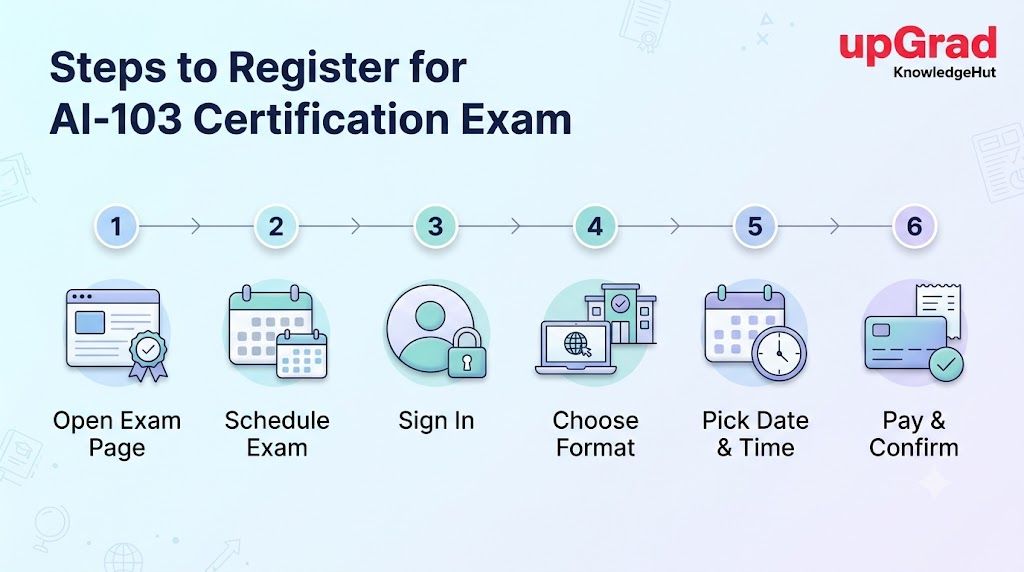
Follow these steps to register:
- Open the official exam page: Visit the AI-103 exam page.
- Select Schedule exam: Choose the Pearson VUE scheduling option.
- Sign in to Microsoft Learn: Use a personal Microsoft account and check that the name on the certification profile matches the required identification.
- Choose the delivery method: Select an available test centre or online proctoring option.
- Pick a date and time: Check the available appointments and select a suitable slot.
- Complete payment: Confirm the regional exam fee, pay, and save the booking confirmation.
It is recommended by Microsoft that people register using a personal Microsoft account since certification records associated with a work or school account could become inaccessible if the candidate leaves that organisation.
Also Read: Microsoft Azure Salary in 2026
What is the AI 103 certification exam syllabus?
The syllabus for the AI 103 certification exam includes five skill domains which are concerned with developing, deploying, securing and managing AI applications on Azure. Candidates should understand Python-based development, Microsoft Foundry, generative AI, AI agents, and the services used for processing text, images and documents.
AI-103 exam syllabus and domain weightings
Exam domain |
Weight |
| Plan and manage an Azure AI solution | 25-30% |
| Implement generative AI and agentic solutions | 30-35% |
| Implement computer vision solutions | 10-15% |
| Implement text analysis solutions | 10-15% |
| Implement information extraction solutions | 10-15% |
Also Read: Top Cloud Certifications
What topics are covered in each AI-103 exam domain?
1. Plan and manage an Azure AI solution
Learn how to select suitable models and Foundry services, configure deployments, manage costs, monitor performance, and secure AI applications. Responsible AI practices, access controls, and application monitoring are also important.
2. Implement generative AI and agentic solutions
This is the largest exam domain. Study how to build generative AI applications, implement retrieval-augmented generation (RAG), connect agents to APIs and knowledge sources, manage conversation history, and evaluate responses. You should also understand agent orchestration, safeguards, tracing, and performance monitoring.
3. Implement computer vision solutions
Focus on image and video generation, image editing, multimodal understanding, visual question answering, and extracting useful information from visual content. Learn how to apply appropriate safety controls to generated and analysed content.
4. Implement text analysis solutions
Prepare for tasks involving text summarisation, sentiment analysis, entity extraction, translation, and structured outputs. Speech processing, including speech-to-text and text-to-speech, is also part of this domain.
5. Implement information extraction solutions
Understand how to process documents using optical character recognition (OCR), analyse document layouts, extract structured fields, and create retrieval pipelines. Study vector search, hybrid search, and how retrieved information supports RAG applications.
Which AI-103 exam domains should you prioritise?
Begin with generative AI and agentic solutions since they make up 30-35% of the exam, then look at study planning and the management of Azure AI solutions, which carry a weight of 25-30%.
The two domains combined make up between 55-65%of the exam. After these, study computer vision, text analysis, and information extraction. Do not skip the smaller domains since each of them has an impact on the final score.
Looking to expand your AI and data analytics skills beyond AI 103 certification? Explore the PG Certificate in Data Analytics and Applied AI to build practical skills in data analysis and applied AI.
How to prepare for the AI 103 certification exam?
A well-organized study plan can make it easier to study by concentrating on the official objectives, making use of Microsoft's learning materials, and practicing the development of working AI applications rather than depending solely on theory.
1. Review the official AI-103 exam objectives
Read the official study guide and make a checklist of all five skill domains. Mark the topics you already understand and those that need more practice. Use the domain weightings to decide where to spend your time.
2. Follow the official Microsoft Learn AI-103 study resources
Microsoft offers learning paths that cover applications of generative AI, AI agents, natural language solutions, and the processing of visual data.
Begin by using the Azure learning materials on developing AI apps and agents. Focus on one topic at a time and carry out the practical exercises as much as you can.
3. Build hands-on Azure AI projects
Practical experience helps to apply concepts to real development tasks. Here's are some projects which are suitable for beginners, try building these projects:
- RAG application: Create a question-answering app that retrieves information from a set of documents.
- AI agent: Build an agent that calls an API or searches a knowledge source to complete a task.
- Document extraction tool: Extract names, dates, and other fields from sample documents.
- Image analysis application: Use a multimodal model to describe the image and respond to questions regarding its content.
4. Take the official AI-103 practice assessment
Use the practice assessment that is available via Microsoft's AI Skills Navigator to test your understanding. Look over the answers that you got wrong, go back to the relevant documentation and then repeat the assessment after studying the areas where you struggled. You have the option of using Microsoft's exam sandbox in order to get used to the testing interface.
Also Read: Top Business Analyst Certification
How long does it take to prepare for AI-103?
Preparation time depends on your Python skills, Azure experience, and familiarity with generative AI. The timelines below are estimates for planning purposes, not official Microsoft recommendations.
Experienced Azure AI developers: 2-4 weeks
Developers who already create AI applications using Azure should concentrate on the revised exam objectives, agent workflows, Microsoft Foundry, and the practice assessments. They must take extra time to study any areas that are unfamiliar to them.
Azure developers new to AI agents: 4-8 weeks
Developers who know about Azure but have little experience in generative AI should study RAG, model integration, agent tools, memory, and evaluation. Working on practical projects can help build their confidence.
AI developers new to Azure: 6-10 weeks
People who have experience in AI development but who know only a limited amount about Azure should, together with the exam objectives, study the relevant Azure services, deployments, identity management, monitoring, and security practices.
Beginners with limited Python and AI experience: 8-12 weeks or longer
Beginners may need additional time to learn Python, understand APIs, explore cloud computing fundamentals, and build basic AI applications before moving to advanced topics.
Set a realistic weekly schedule and move on to practice assessments when you can explain the key concepts and complete basic projects without relying entirely on step-by-step instructions.
Also Read: Is Microsoft Azure Certification Worth It?
Conclusion
The AI 103 certification offers a way for developers to demonstrate their skills in building generative AI applications and agents on Azure. Compared with AI-102, the exam places greater emphasis on agentic solutions, Microsoft Foundry, and practical AI development.
Start by reviewing the official syllabus, prioritising the highest-weighted domains, and practising with hands-on projects. With a clear study plan and regular practice, candidates can prepare more effectively for the exam and build skills relevant to real-world Azure AI solutions.
Have A Query? Get in Touch With Our Customer Support | upGrad KnowledgeHut
Frequently Asked Questions (FAQs)
1. How difficult is the AI 103 certification exam?
The AI 103 certification exam is an intermediate-level exam that tests practical skills in developing AI applications and agents using Python, Azure services, and Microsoft Foundry. Candidates need to understand generative AI, agentic solutions, computer vision, text analysis, and information extraction. Hands-on practice with Azure AI services can help with preparation.
2. Is AI 103 certification suitable for beginners?
The AI 103 certification is more suitable for candidates with some programming and AI knowledge than for complete beginners. Microsoft expects experience developing applications with Python and familiarity with generative AI and Azure services. Beginners can prepare by learning Python basics and Azure AI concepts before studying the exam syllabus.
3. Does AI 103 certification require coding?
Yes, practical coding knowledge is important for the AI 103 certification. The exam focuses on developing AI applications and agents using Python and Azure services, including generative AI and agentic solutions. Candidates should practise writing Python code and integrating AI services into applications.
4. What is the difference between AI-102 and AI 103 certification?
AI-102 was the Azure AI Engineer Associate exam, while AI-103 is for the Azure AI Apps and Agents Developer Associate certification. AI-103 places greater emphasis on generative AI applications, agentic solutions, and Microsoft Foundry. Microsoft retired AI-102 on June 30, 2026, making AI-103 the relevant path for new candidates pursuing this role.
5. Who should take the AI 103 certification?
The AI 103 certification is intended for developers and AI engineers who build, deploy, and manage AI applications and agents on Azure. It is a good fit for professionals working with Python, generative AI, Microsoft Foundry, and Azure AI services. Candidates should have some application development experience and familiarity with AI concepts.
6. What is the AI 103 certification exam fee in India?
Microsoft lists the AI-103 exam at US$165 as its US price, but the fee varies by the country or region where the exam is taken. The exact price in India should be confirmed on the official Microsoft exam page when scheduling through Pearson VUE, as regional pricing and applicable taxes may affect the final amount.
7. Is AI-103 replacing AI-102?
Yes, AI-103 is the successor to AI-102 for the Azure AI Apps and Agents Developer Associate certification path. AI-102 retired on June 30, 2026, and candidates planning to earn this credential should prepare for AI-103 instead. Previously earned AI-102 certifications remain on the holder’s Microsoft Learn transcript.
8. How do I schedule an AI-103 exam in India?
Visit the official AI-103 exam page and select Schedule exam. Sign in with a personal Microsoft account, choose Pearson VUE’s available online-proctored or test-centre option, and select an available date and time. Review the fee shown for India and complete payment to confirm the booking.
9. How many hours should I study daily for the AI 103 certification exam?
A practical starting point is 1-2 hours daily if you already have Python and Azure experience, with additional time for hands-on practice if needed. Beginners may need longer study sessions or a longer preparation period to learn the required concepts. Adjust the schedule based on practice assessment results and comfort with each exam domain.
10. Is AI 103 certification worth it?
The AI 103 certification can be valuable for developers and AI engineers who want to demonstrate skills in building AI applications and agents on Azure. It covers generative AI, agentic solutions, vision, text analysis, and information extraction. Its value depends on whether these skills align with career goals; practical projects and development experience remain important alongside certification.
1646 articles published
KnowledgeHut is an outcome-focused global ed-tech company. We help organizations and professionals unlock excellence through skills development. We offer training solutions under the people and proces...
Get Free Consultation
By submitting, I accept the T&C and
Privacy Policy