
- Home
- Blog
- Data Science
- Common Prompt Engineering Mistakes and How to Avoid Them
Common Prompt Engineering Mistakes and How to Avoid Them
Updated on Aug 06, 2026 | 0.9k+ views
Share:
Table of Contents
View all
- Top 10 Most Common Prompt Engineering Mistakes to Avoid
- Why Do Prompt Engineering Mistakes Matter?
- What Causes Prompt Engineering Mistakes?
- How to Avoid Prompt Engineering Mistakes
- Prompt Engineering Mistakes with Before and After Examples
- Best Practices for Writing Better Prompts
- Prompt Engineering Mistakes Across Different AI Models
- Tools That Help Identify Prompt Engineering Mistakes
- Conclusion
Quick Overview
- Common prompt engineering mistakes include writing vague prompts, providing insufficient context, skipping output formats, and combining multiple tasks into one prompt.
- These mistakes can lead to inaccurate responses, hallucinations, inconsistent outputs, and reduced productivity across AI models.
- Clear goals, relevant context, role prompting, structured instructions, and prompt refinement help produce more reliable AI outputs.
- This guide explains the most common prompt engineering mistakes, why they happen, how to avoid them, practical before and after examples, and tools for testing and improving prompts.
To build stronger practical skills in this area, professionals are also exploring specialized programs like the Generative AI and Prompt Engineering Course by upGrad KnowledgeHut.
Top 10 Most Common Prompt Engineering Mistakes to Avoid
Most prompt engineering mistakes happen because instructions are incomplete, unclear, or overly complicated. Understanding these common errors helps create prompts that consistently produce better AI responses.
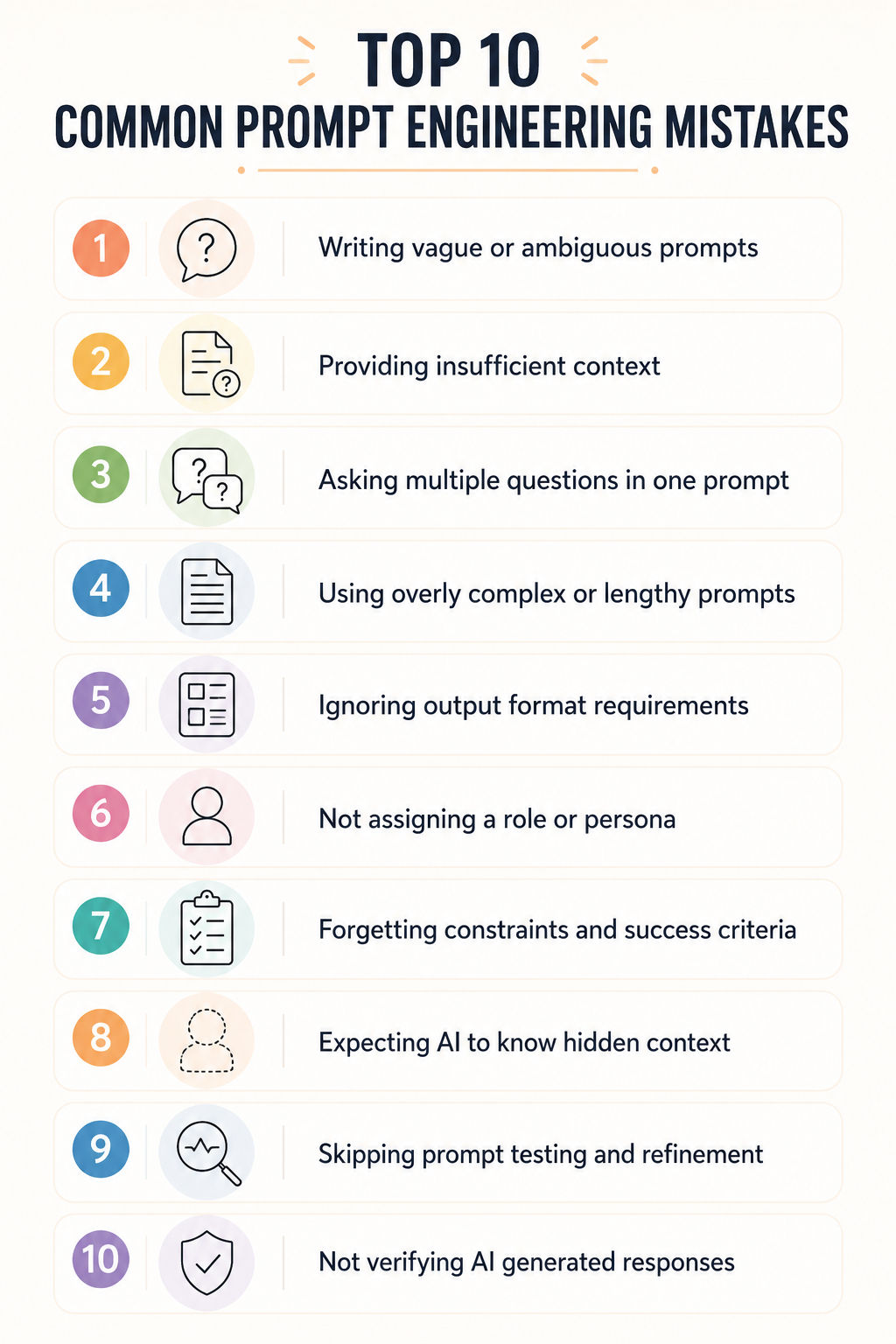
1. Writing Vague or Ambiguous Prompts
One of the biggest prompt engineering mistakes is asking AI broad questions without providing enough direction.
Instead of writing:
Explain marketing.
A clearer prompt would specify:
Explain digital marketing strategies for small ecommerce businesses using simple language.
Vague prompts often result in:
- Generic responses
- Missing important details
- Irrelevant information
- Multiple possible interpretations
To avoid ambiguity:
- Clearly define the topic.
- Mention the audience.
- State the purpose of the response.
- Include the expected depth.
The more specific the request, the more useful the output becomes.
2. Providing Insufficient Context
AI does not automatically understand the background behind a task. Missing context is another common reason for poor quality outputs.
For example, requesting:
Write an email.
does not tell the AI:
- Who the recipient is
- Why the email is being written
- The desired tone
- The expected outcome
Helpful context may include:
- Industry
- Audience
- Objective
- Experience level
- Brand voice
- Constraints
Providing relevant information enables AI to generate responses that are far more accurate and personalized.
3. Asking Multiple Questions in One Prompt
Combining several unrelated requests into one prompt often confuses AI and reduces output quality.
For example:
- Explain prompt engineering.
- Compare ChatGPT and Gemini.
- Create a blog outline.
- Suggest keywords.
Although AI may attempt to answer everything, the response often lacks depth.
A better approach is to divide large requests into smaller prompts.
Benefits include:
- Better organization
- Higher accuracy
- More detailed answers
- Easier editing
Breaking tasks into manageable pieces is one of the simplest ways to reduce prompt engineering mistakes.
4. Using Overly Complex or Lengthy Prompts
Long prompts are not always better.
Many users assume that adding every possible detail improves results. Unnecessary information may distract the model from the main objective.
Problems caused by lengthy prompts include:
- Important instructions become difficult to identify.
- AI may prioritize less relevant information.
- Responses become inconsistent.
Instead:
- Keep instructions concise.
- Organize information logically.
- Remove repeated details.
- Focus on the main objective.
A structured prompt is usually more effective than an extremely long one.
5. Ignoring Output Format Requirements
AI can produce many types of outputs, but it needs clear formatting instructions.
Without specifying a format, responses may not match expectations.
Examples include:
- Paragraphs instead of bullet points
- Long explanations instead of summaries
- Tables instead of lists
- Technical language instead of beginner friendly content
Always mention the preferred format, such as:
- Bullet points
- Table
- Numbered list
- JSON
- CSV
- Markdown
- Executive summary
Defining the desired structure saves editing time and improves consistency.
6. Not Assigning a Role or Persona
Role prompting helps AI understand the perspective from which it should respond.
Instead of asking:
Explain cloud computing.
A more effective instruction is:
Act as a cloud architect explaining cloud computing to business executives.
Role prompting can improve:
- Tone
- Vocabulary
- Level of technical detail
- Relevance
- Audience alignment
Common personas include:
- Teacher
- Software engineer
- Marketing consultant
- Product manager
- Financial analyst
- Data scientist
- Career coach
Choosing the appropriate role often produces more focused and practical responses.
7. Forgetting Constraints and Success Criteria
AI performs better when clear boundaries are defined.
Useful constraints include:
- Maximum word count
- Reading level
- Target audience
- Tone
- Language
- Required keywords
- Information to include
- Information to avoid
Success criteria may specify:
- Include three examples.
- Keep sentences under twenty words.
- Use bullet points.
- Avoid technical jargon.
Without these instructions, outputs may vary significantly between prompt executions.
8. Expecting AI to Know Hidden Context
Another common prompt engineering mistake is assuming AI remembers information that was never provided.
AI cannot accurately infer:
- Company policies
- Internal processes
- Project goals
- Personal preferences
- Confidential business information
Whenever necessary, include relevant background information directly in the prompt.
This ensures that responses remain aligned with the intended objective.
9. Skipping Prompt Testing and Refinement
Effective prompts are rarely perfect on the first attempt.
Prompt engineering is an iterative process that involves:
- Testing
- Reviewing
- Refining
- Comparing outputs
- Improving wording
Minor adjustments can significantly improve response quality.
Examples include:
- Adding context
- Changing the order of instructions
- Simplifying wording
- Specifying the audience
- Clarifying expectations
Continuous refinement leads to more reliable AI performance over time.
10. Not Verifying AI Generated Responses
Even the most advanced AI models can occasionally produce inaccurate or outdated information.
Before using AI generated content:
- Verify statistics.
- Check factual claims.
- Confirm the references.
- Review calculations.
- Validate technical details.
- Compare information with trusted sources.
Fact checking is especially important for:
- Healthcare
- Finance
- Legal content
- Academic writing
- Software development
- Business reports
The good news is that these issues can be improved with clearer communication, better structure, and step-by-step prompting techniques. Learning how to write effective prompts can save time, improve productivity, and make AI tools far more reliable.
Why Do Prompt Engineering Mistakes Matter?
Even small prompt engineering mistakes can have a significant impact on output quality. Poor prompts not only waste time but also reduce trust in AI generated content. Understanding these consequences helps users recognize why writing effective prompts is a critical skill.
Lower Response Accuracy
Unclear prompts often produce answers that only partially address the original request.
Common outcomes include:
- Missing information
- Irrelevant details
- Generic explanations
- Incorrect assumptions
Improving prompt clarity helps AI generate responses that better match the intended objective.
Increased Hallucinations
Hallucinations occur when AI generates information that appears convincing but is inaccurate or unsupported.
This is more likely when prompts:
- Lack context
- Ask speculative questions
- Contain ambiguous wording
- Require unavailable information
Providing clear instructions and verifying responses significantly reduces the likelihood of hallucinations.
Inconsistent Outputs
Two similar prompts can produce different results if instructions are incomplete or loosely defined.
This inconsistency creates challenges when AI is used for:
- Business documentation
- Customer support
- Marketing campaigns
- Content creation
- Software development
Using structured prompts with clear constraints improves consistency across multiple interactions.
Reduced Productivity
Poor prompts often lead to repeated revisions, additional follow up questions, and unnecessary editing.
This increases the overall time required to complete a task.
Well designed prompts help users:
- Reach accurate answers faster
- Reduce manual corrections
- Improve workflow efficiency
- Generate reusable prompt templates
Investing time in writing better prompts ultimately saves time throughout the project.
Poor User Experience
When AI repeatedly produces irrelevant or low-quality responses, users may lose confidence in the technology.
Common frustrations include:
- Receiving generic answers
- Spending time rewriting prompts
- Correcting factual mistakes
- Repeating the same instructions
Also Read: Prompt Engineering Best Practices for High-Quality Outputs
What Causes Prompt Engineering Mistakes?
Understanding why prompt engineering mistakes happen is just as important as knowing how to fix them. Most errors are not caused by AI itself but by unclear instructions, unrealistic expectations, or a lack of understanding of how large language models interpret prompts. Recognizing these causes helps create prompts that are more accurate, consistent, and effective.
1. Lack of Clear Objectives
One of the primary reasons behind prompt engineering mistakes is starting a conversation with AI without defining a clear goal.
If the objective is unclear, AI has to interpret the request on its own, which often leads to generic or incomplete responses.
For example, before writing a prompt, consider:
- What is the desired outcome?
- Who is the target audience?
- What problem should the response solve?
- What level of detail is required?
A clearly defined objective helps AI focus on the right information instead of making assumptions.
Best practice
- Write the purpose in one sentence before creating the prompt.
- Mention whether the response should educate, summarize, compare, analyze, or generate ideas.
- Avoid combining unrelated objectives in a single request.
2. Limited Understanding of LLM Behavior
Many users expect AI to think and reason exactly like a human expert. However, large language models generate responses by predicting patterns in language rather than understanding concepts the way people do.
This misunderstanding often leads to unrealistic expectations.
Common misconceptions include:
- AI automatically knows recent events.
- AI understands company specific processes.
- AI never makes factual mistakes.
- AI always remembers previous conversations.
- AI can infer missing details accurately.
Knowing these limitations helps users write prompts that provide the information AI actually needs.
Best practice
- Treat AI as a knowledgeable assistant rather than an all knowing expert.
- Provide necessary context instead of expecting AI to fill the gaps.
- Review outputs before using them in important work.
3. Overly Complex Prompts
Long prompts packed with multiple instructions, conditions, and exceptions can overwhelm the model.
Instead of improving quality, excessive complexity may result in:
- Missed instructions
- Partial responses
- Conflicting outputs
- Lower accuracy
Complex prompts are especially difficult when they ask AI to perform several unrelated tasks at once.
Rather than writing one large prompt, divide the task into logical stages.
For example:
- Generate an outline.
- Expand each section.
- Edit for grammar.
- Optimize for SEO.
- Create a summary.
This step by step approach improves both quality and consistency.
4. Missing Context
AI relies entirely on the information provided within the conversation.
When essential details are missing, it fills those gaps using probabilities, which may not match the user's expectations.
Examples of missing context include:
- Industry or domain
- Audience experience level
- Geographic location
- Business goals
- Brand guidelines
- Writing style
- Technical requirements
Providing relevant context enables AI to produce responses that are more useful and tailored to the situation.
Good prompts often answer questions such as:
- Who is this for?
- Why is this needed?
- Where will it be used?
- What outcome is expected?
5. Unrealistic Expectations
Another cause of prompt engineering mistakes is expecting AI to deliver perfect results from the very first prompt.
Prompt engineering is an iterative process.
Even experienced professionals frequently:
- Adjust wording
- Add missing details
- Remove ambiguity
- Refine constraints
- Test multiple versions
Explore upGrad KnowledgeHut Data Science Courses built for professionals looking to leverage AI tools more effectively in their workflows.
How to Avoid Prompt Engineering Mistakes
Avoiding prompt engineering mistakes does not require technical expertise. A few simple techniques can dramatically improve response quality across content creation, coding, research, business analysis, and other AI assisted tasks. These practices make prompts clearer, easier for AI to interpret, and more likely to produce consistent results.
1. Define Your Goal Clearly
Every prompt should begin with a clear objective.
Instead of asking AI to "write something about cybersecurity," specify exactly what is required.
Clearly define:
- Purpose
- Audience
- Desired outcome
- Level of detail
For example, specify whether the goal is to:
- Explain a concept
- Compare solutions
- Solve a problem
- Generate ideas
- Write professional content
- Summarize research
A well defined objective minimizes misunderstandings and improves response relevance.
2. Add Relevant Context
Context provides AI with the background information needed to generate accurate responses.
Helpful context may include:
- Industry
- Business size
- User experience level
- Target audience
- Product or service
- Geographic market
- Existing challenges
- Desired tone
The more relevant context AI receives, the more personalized and actionable its responses become.
Avoid adding unrelated information that may distract from the main objective.
3. Specify the Output Format
One of the easiest ways to improve AI responses is by telling the model exactly how the answer should be presented.
Examples of useful formats include:
- Bullet points
- Tables
- Numbered steps
- Checklists
- Executive summaries
- JSON
- CSV
- Markdown
- FAQs
Also specify:
- Word count
- Heading structure
- Reading level
- Writing style
A clearly defined format reduces editing effort and improves consistency.
4. Break Complex Tasks into Steps
Large requests often produce inconsistent results.
Breaking work into smaller tasks allows AI to focus on one objective at a time.
A structured workflow might look like this:
- Create an outline.
- Expand each section.
- Review grammar.
- Improve readability.
- Optimize for SEO.
- Generate FAQs.
Benefits include:
- Higher accuracy
- Better organization
- Easier revisions
- More detailed responses
This technique is widely used in professional prompt engineering workflows.
5. Use Role Prompting
Role prompting instructs AI to respond from the perspective of a specific expert or professional.
Examples include:
- Content strategist
- Product manager
- Software developer
- Financial advisor
- UX designer
- Marketing consultant
- Data analyst
Assigning a role helps AI choose appropriate terminology, tone, and depth of explanation.
For example, the response from a software architect will differ significantly from that of a beginner-friendly instructor.
Selecting the right persona improves relevance and clarity.
6. Iterate and Refine Prompts
Very few prompts are perfect on the first attempt.
Successful prompt engineering involves continuous improvement.
After reviewing the response:
- Identify missing information.
- Clarify unclear instructions.
- Simplify wording.
- Add useful constraints.
- Remove unnecessary details.
Small refinements often produce noticeable improvements in output quality.
Saving successful prompts also creates reusable templates for future projects.
7. Review Responses Critically
AI generated content should always be reviewed before publication or implementation.
During review, check for:
- Factual accuracy
- Logical consistency
- Grammar
- Completeness
- Bias
- Outdated information
- Unsupported claims
Also Read: How to Write Effective Prompts for AI Models
Prompt Engineering Mistakes with Before and After Examples
Learning from real examples is one of the fastest ways to improve prompting skills. The following examples demonstrate how small changes in wording, context, and structure can significantly improve AI responses. These examples also highlight common prompt engineering mistakes and practical ways to correct them.
Example 1 Content Writing Prompt
Poor Prompt
Write a blog about artificial intelligence.
Improved Prompt
Write a 1,000-word beginner friendly blog on artificial intelligence for small business owners. Include an introduction, five H2 headings, practical examples, a conclusion, and a FAQ section. Use a conversational tone to keep the language simple.
Difference in AI Output
- Covers a clearly defined audience.
- Produces a structured article instead of a generic explanation.
- Maintains consistent tone and readability.
- Requires fewer edits before publication.
Example 2 Coding Prompt
Poor Prompt
Write Python code.
Improved Prompt
Write a Python function that removes duplicate values from a list while preserving the original order. Include comments explaining each step and provide sample input and output.
Difference in AI Output
- Generates functional code instead of incomplete snippets.
- Includes documentation for easier understanding.
- Provides test examples.
- Reduces debugging effort.
Example 3 Data Analysis Prompt
Poor Prompt
Analyze these sales data.
Improved Prompt
Analyze the attached quarterly sales data. Identify the top performing products, highlight trends, calculate year-over-year growth, and summarize findings in bullet points with recommendations for improving sales.
Difference in AI Output
- Focuses on specific business objectives.
- Produces actionable insights.
- Organizes findings logically.
- Includes recommendations instead of only observations.
Example 4 Marketing Prompt
Poor Prompt
Create a marketing campaign.
Improved Prompt
Create a digital marketing campaign for a new fitness application targeting working professionals between 25 and 40 years old. Include campaign goals, messaging, content ideas, social media channels, and key performance indicators.
Difference in AI Output
- Provides audience specific recommendations.
- Includes measurable objectives.
- Generates practical campaign ideas.
- Aligns with business goals.
Example 5 Research Prompt
Poor Prompt
Research renewable energy.
Improved Prompt
Summarize recent developments in renewable energy focusing on solar and wind power. Present the findings in bullet points with advantages, challenges, and future trends. Limit the response to 800 words.
Difference in AI Output
- Narrows the research scope.
- Improves relevance.
- Produces organized findings.
- Saves editing time.
Best Practices for Writing Better Prompts
Writing effective prompts is a skill that improves with practice. Following a consistent framework reduces prompt engineering mistakes and helps generate reliable, high-quality outputs across different AI tools and use cases.
1. Be Specific
Specific prompts reduce ambiguity and improve accuracy.
Include details such as:
- Objective
- Audience
- Topic
- Desired depth
- Tone
- Word count
Specific instructions help AI understand exactly what is expected.
2. Focus on One Task at a Time
Avoid combining unrelated requests in a single prompt.
Instead of asking AI to:
- Write content
- Generate keywords
- Create images
- Produce code
Split the work into individual prompts.
This approach improves:
- Accuracy
- Organization
- Output quality
3. Use Structured Instructions
Well organized prompts are easier for AI to interpret.
A useful structure includes:
- Goal
- Context
- Instructions
- Output format
- Constraints
Structured prompts reduce confusion and improve consistency.
4. Include Constraints
Constraints guide AI toward the desired outcome.
Examples include:
- Word limit
- Reading level
- Target audience
- Tone
- Language
- Formatting style
- Keywords to include
- Topics to avoid
Clear constraints produce more predictable outputs.
5. Ask AI to Explain Its Reasoning When Appropriate
For analytical tasks, asking AI to explain its reasoning can improve transparency.
This approach is useful for:
- Problem solving
- Data analysis
- Strategy development
- Decision making
- Learning concepts
However, it is not necessary for every prompt. Simple content generation tasks often benefit more from concise instructions than detailed reasoning.
6. Continuously Improve Successful Prompts
Treat prompts as reusable assets.
After identifying a prompt that consistently delivers good results:
- Save it.
- Document why it works.
- Update it as requirements evolve.
- Create templates for recurring tasks.
Prompt Engineering Mistakes Across Different AI Models
Although the principles of effective prompting remain similar, different AI models respond differently to the same instructions. Understanding these differences helps users adapt prompts for better performance.
ChatGPT
ChatGPT performs well with structured prompts and detailed instructions.
It responds effectively to:
- Role prompting
- Step by step instructions
- Context rich prompts
- Clearly defined formatting
Claude
Claude generally performs well on long documents and detailed reasoning tasks.
It benefits from:
- Well organized instructions
- Clear objectives
- Logical workflows
- Explicit formatting
Gemini
Gemini integrates well with Google services and often handles research-oriented tasks effectively.
It performs best when prompts include:
- Clear goals
- Context
- Structured outputs
- Specific questions
Open-Source LLMs
Open-source models vary depending on their size, training data, and fine tuning.
Compared with commercial models, they often require:
- More detailed prompts
- Additional context
- Strong formatting instructions
- Explicit constraints
Tools That Help Identify Prompt Engineering Mistakes
Several tools help developers and AI professionals evaluate prompts, compare outputs, and improve response quality. These platforms support systematic prompt testing rather than relying on trial and error.
1. PromptLayer
PromptLayer helps track prompt versions and monitor AI interactions.
Key capabilities include:
- Prompt version control
- Performance tracking
- Request logging
- Team collaboration
It is useful for maintaining consistent prompts across production environments.
2. LangSmith
LangSmith provides tools for testing, debugging, and evaluating LLM applications.
Its features include:
- Prompt evaluation
- Workflow debugging
- Experiment tracking
- Performance monitoring
It is particularly valuable for teams building AI powered applications.
3. Promptfoo
Promptfoo is an open source framework for evaluating prompts across multiple models.
It supports:
- Automated testing
- Model comparison
- Regression testing
- Quality benchmarking
This helps identify which prompts consistently produce the best results.
4. Langfuse
Langfuse focuses on observability and analytics for LLM applications.
It enables teams to:
- Monitor prompt performance
- Analyze user interactions
- Detect failures
- Optimize prompt quality over time
5. OpenAI Playground
OpenAI Playground provides an interactive environment for experimenting with prompts.
Users can:
- Test different prompt variations.
- Compare outputs.
- Adjust parameters.
- Refine instructions.
- Explore model behavior.
Conclusion
Avoiding prompt engineering mistakes is essential for anyone who regularly works with AI tools. Clear objectives, relevant context, structured instructions, and continuous refinement can significantly improve response quality while reducing errors and inconsistencies.
The most important takeaway is that effective prompting is an iterative skill rather than a one time effort. Regular testing, reviewing outputs, and refining prompts lead to more accurate, reliable, and efficient AI generated responses across different models and use cases.
Contact our upGrad KnowledgeHut experts for personalized guidance on choosing the right course, career path, and certification to achieve your goals.
Frequently Asked Questions (FAQs)
What are the most common prompt engineering mistakes beginners make?
Beginners often write vague prompts, provide limited context, and expect AI to understand unstated requirements. They may also ask multiple questions in one prompt or skip reviewing the output. Following a clear prompt structure helps avoid these common mistakes.
Can prompt engineering mistakes affect AI generated code?
Yes. Poorly written prompts can result in incomplete, inefficient, or incorrect code. Specifying the programming language, functionality, constraints, and expected output helps AI generate more accurate and maintainable code.
How can businesses reduce prompt engineering mistakes across teams?
Businesses can standardize prompt templates, create prompt libraries, and establish review guidelines for AI-generated content. Regular training and sharing successful prompts also help teams produce more consistent and reliable results.
Are prompt engineering mistakes more common in complex AI tasks?
Yes. Complex tasks such as research, coding, and business analysis require detailed instructions and sufficient context. Breaking these tasks into smaller prompts helps improve accuracy and reduces the chances of incomplete or inconsistent responses.
Can prompt engineering mistakes impact AI generated images?
Yes. Image generation models also rely on clear prompts. Missing details about style, colors, composition, lighting, or subject matter can produce images that do not match the intended vision. Detailed prompts usually generate better visual results.
What is the difference between a weak prompt and a strong prompt?
A weak prompt is vague and lacks clear objectives, context, or formatting instructions. A strong prompt clearly defines the goal, audience, constraints, and expected output, making it easier for AI to generate relevant and accurate responses.
How do prompt engineering mistakes affect AI productivity?
Poor prompts often require multiple revisions, repeated follow up questions, and extensive editing. Writing clear and structured prompts from the beginning reduces rework, saves time, and improves overall productivity.
Is prompt engineering important for non-technical professionals?
Yes. Prompt engineering is valuable for marketers, writers, educators, HR professionals, analysts, and business teams. Learning how to communicate effectively with AI helps generate better content, insights, and solutions without requiring programming skills.
How can prompt templates help avoid prompt engineering mistakes?
Prompt templates provide a consistent framework by including objectives, context, constraints, and output requirements. They reduce ambiguity, improve response quality, and save time when performing repetitive AI assisted tasks.
What skills should be learned alongside prompt engineering?
Learning AI literacy, workflow automation, retrieval augmented generation (RAG), AI agents, and model evaluation can complement prompt engineering skills. Together, these capabilities help users build more effective and reliable AI powered workflows.
1639 articles published
KnowledgeHut is an outcome-focused global ed-tech company. We help organizations and professionals unlock excellence through skills development. We offer training solutions under the people and proces...
Get Free Consultation
By submitting, I accept the T&C and
Privacy Policy