
- Blog Categories
- Project Management
- Agile Management
- IT Service Management
- Cloud Computing
- Business Management
- BI And Visualisation
- Quality Management
- Cyber Security
- DevOps
- Most Popular Blogs
- PMP Exam Schedule for 2025: Check PMP Exam Date
- Top 60+ PMP Exam Questions and Answers for 2025
- PMP Cheat Sheet and PMP Formulas To Use in 2025
- What is PMP Process? A Complete List of 49 Processes of PMP
- Top 15+ Project Management Case Studies with Examples 2025
- Top Picks by Authors
- Top 170 Project Management Research Topics
- What is Effective Communication: Definition
- How to Create a Project Plan in Excel in 2025?
- PMP Certification Exam Eligibility in 2025 [A Complete Checklist]
- PMP Certification Fees - All Aspects of PMP Certification Fee
- Most Popular Blogs
- CSM vs PSM: Which Certification to Choose in 2025?
- How Much Does Scrum Master Certification Cost in 2025?
- CSPO vs PSPO Certification: What to Choose in 2025?
- 8 Best Scrum Master Certifications to Pursue in 2025
- Safe Agilist Exam: A Complete Study Guide 2025
- Top Picks by Authors
- SAFe vs Agile: Difference Between Scaled Agile and Agile
- Top 21 Scrum Best Practices for Efficient Agile Workflow
- 30 User Story Examples and Templates to Use in 2025
- State of Agile: Things You Need to Know
- Top 24 Career Benefits of a Certifed Scrum Master
- Most Popular Blogs
- ITIL Certification Cost in 2025 [Exam Fee & Other Expenses]
- Top 17 Required Skills for System Administrator in 2025
- How Effective Is Itil Certification for a Job Switch?
- IT Service Management (ITSM) Role and Responsibilities
- Top 25 Service Based Companies in India in 2025
- Top Picks by Authors
- What is Escalation Matrix & How Does It Work? [Types, Process]
- ITIL Service Operation: Phases, Functions, Best Practices
- 10 Best Facility Management Software in 2025
- What is Service Request Management in ITIL? Example, Steps, Tips
- An Introduction To ITIL® Exam
- Most Popular Blogs
- A Complete AWS Cheat Sheet: Important Topics Covered
- Top AWS Solution Architect Projects in 2025
- 15 Best Azure Certifications 2025: Which one to Choose?
- Top 22 Cloud Computing Project Ideas in 2025 [Source Code]
- How to Become an Azure Data Engineer? 2025 Roadmap
- Top Picks by Authors
- Top 40 IoT Project Ideas and Topics in 2025 [Source Code]
- The Future of AWS: Top Trends & Predictions in 2025
- AWS Solutions Architect vs AWS Developer [Key Differences]
- Top 20 Azure Data Engineering Projects in 2025 [Source Code]
- 25 Best Cloud Computing Tools in 2025
- Most Popular Blogs
- Company Analysis Report: Examples, Templates, Components
- 400 Trending Business Management Research Topics
- Business Analysis Body of Knowledge (BABOK): Guide
- ECBA Certification: Is it Worth it?
- Top Picks by Authors
- Top 20 Business Analytics Project in 2025 [With Source Code]
- ECBA Certification Cost Across Countries
- Top 9 Free Business Requirements Document (BRD) Templates
- Business Analyst Job Description in 2025 [Key Responsibility]
- Business Analysis Framework: Elements, Process, Techniques
- Most Popular Blogs
- Best Career options after BA [2025]
- Top Career Options after BCom to Know in 2025
- Top 10 Power Bi Books of 2025 [Beginners to Experienced]
- Power BI Skills in Demand: How to Stand Out in the Job Market
- Top 15 Power BI Project Ideas
- Top Picks by Authors
- 10 Limitations of Power BI: You Must Know in 2025
- Top 45 Career Options After BBA in 2025 [With Salary]
- Top Power BI Dashboard Templates of 2025
- What is Power BI Used For - Practical Applications Of Power BI
- SSRS Vs Power BI - What are the Key Differences?
- Most Popular Blogs
- Data Collection Plan For Six Sigma: How to Create One?
- Quality Engineer Resume for 2025 [Examples + Tips]
- 20 Best Quality Management Certifications That Pay Well in 2025
- Six Sigma in Operations Management [A Brief Introduction]
- Top Picks by Authors
- Six Sigma Green Belt vs PMP: What's the Difference
- Quality Management: Definition, Importance, Components
- Adding Green Belt Certifications to Your Resume
- Six Sigma Green Belt in Healthcare: Concepts, Benefits and Examples
- Most Popular Blogs
- Latest CISSP Exam Dumps of 2025 [Free CISSP Dumps]
- CISSP vs Security+ Certifications: Which is Best in 2025?
- Best CISSP Study Guides for 2025 + CISSP Study Plan
- How to Become an Ethical Hacker in 2025?
- Top Picks by Authors
- CISSP vs Master's Degree: Which One to Choose in 2025?
- CISSP Endorsement Process: Requirements & Example
- OSCP vs CISSP | Top Cybersecurity Certifications
- How to Pass the CISSP Exam on Your 1st Attempt in 2025?
- Most Popular Blogs
- Top 7 Kubernetes Certifications in 2025
- Kubernetes Pods: Types, Examples, Best Practices
- DevOps Methodologies: Practices & Principles
- Docker Image Commands
- Top Picks by Authors
- Best DevOps Certifications in 2025
- 20 Best Automation Tools for DevOps
- Top 20 DevOps Projects of 2025
- OS for Docker: Features, Factors and Tips
- More
- Agile & PMP Practice Tests
- Agile Testing
- Agile Scrum Practice Exam
- CAPM Practice Test
- PRINCE2 Foundation Exam
- PMP Practice Exam
- Cloud Related Practice Test
- Azure Infrastructure Solutions
- AWS Solutions Architect
- IT Related Pratice Test
- ITIL Practice Test
- Devops Practice Test
- TOGAF® Practice Test
- Other Practice Test
- Oracle Primavera P6 V8
- MS Project Practice Test
- Project Management & Agile
- Project Management Interview Questions
- Release Train Engineer Interview Questions
- Agile Coach Interview Questions
- Scrum Interview Questions
- IT Project Manager Interview Questions
- Cloud & Data
- Azure Databricks Interview Questions
- AWS architect Interview Questions
- Cloud Computing Interview Questions
- AWS Interview Questions
- Kubernetes Interview Questions
- Web Development
- CSS3 Free Course with Certificates
- Basics of Spring Core and MVC
- Javascript Free Course with Certificate
- React Free Course with Certificate
- Node JS Free Certification Course
- Data Science
- Python Machine Learning Course
- Python for Data Science Free Course
- NLP Free Course with Certificate
- Data Analysis Using SQL
- Home
- Blog
- Data Science
- Prompt Engineering vs Fine Tuning: Which One Should You Use?
Prompt Engineering vs Fine Tuning: Which One Should You Use?
Updated on Oct 05, 2026 | 462 views
Share:
Table of Contents
View all
Quick Overview
- Prompt engineering guides an AI model using carefully designed instructions without changing the model's underlying parameters, making it fast, flexible, and cost effective.
- Fine tuning trains a model on a specialized dataset to adapt its behavior for specific tasks, making it useful for consistent and highly customized outputs.
- Key differences include training data, model changes, cost, implementation time, customization, flexibility, maintenance, and best use cases.
- This guide explains the differences between prompt engineering and fine tuning, how each approach works, their applications, and the common challenges involved in implementation and maintenance.
Build smarter product strategies with AI Powered Product Management and learn how AI can support research, prioritization, and decision making.
Prompt Engineering vs Fine Tuning: Key Differences
The main difference in prompt engineering vs fine tuning is how customization is achieved. Prompt engineering works through instructions and context, while fine tuning uses additional training to adapt the model itself.
| Factor | Prompt Engineering | Fine Tuning |
| Training Data | Usually not required | Requires training examples |
| Model Changes | No model weights are changed | Model behavior is adjusted through training |
| Cost | Generally lower | Usually higher |
| Implementation Time | Faster to implement | Requires data preparation and training |
| Customization | Moderate | Higher for specific tasks |
| Flexibility | Easy to change prompts | Changes require retraining or updated versions |
| Maintenance | Prompt updates are usually simpler | Requires dataset and model maintenance |
| Best Use Cases | Instructions, formatting, context, role-based tasks | Specialized behavior, consistent task performance, domain adaptation |
Compare Prompt Engineering vs Fine Tuning to understand their differences, use cases, benefits, and when to choose each approach.
What Is Prompt Engineering?
Prompt engineering involves designing and improving the instructions in such a way that the AI model gives a more useful and predictable response.
In the case of prompt engineering as compared to fine tuning, prompting is generally the less invasive method since the model itself does not change.
How Prompt Engineering Works
A prompt can define:
- The task
- Context
- Role
- Desired format
- Constraints
- Examples
- Evaluation criteria
The process is usually iterative:
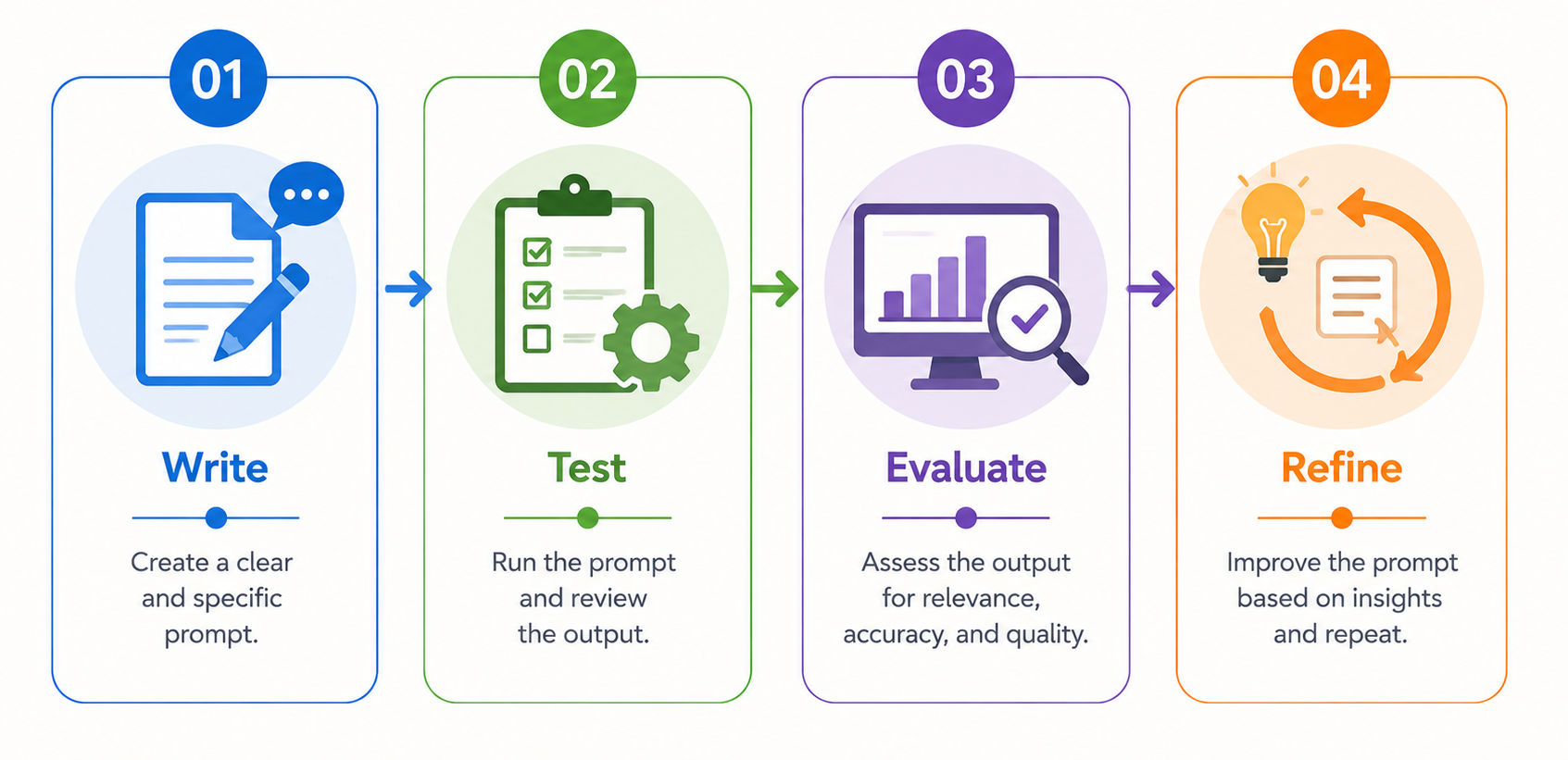
Common Prompt Engineering Techniques
Common techniques include:
- Zero shot prompting
- Few shot prompting
- Role based prompting
- Structured prompting
- Step by step task decomposition
- Context based prompting
Also Read: Types of Prompting Techniques
Applications of Prompt Engineering
Prompt engineering can support many applications, including:
- Content creation
- Customer service
- Data analysis
- Research
- Coding assistance
- Document summarization
- Information extraction
Avoid common Prompt Engineering mistakes and learn practical ways to create clearer prompts and achieve more reliable AI outputs.
What Is Fine Tuning?
Fine tuning is a method of adapting a model which involves training the existing AI model using examples that are specific to the task.
Fine tuning is different from prompt engineering in that it alters the way the model responds by adjusting its learned behaviour according to the training dataset.
How Fine Tuning Works
The process typically involves:
- Selecting a base model
- Preparing training examples
- Formatting the dataset
- Training the model
- Evaluating performance
- Deploying the customized version
Fine Tuning Data Requirements
The need for fine tuning is very much dependent on the quality of the data.
Training data should generally be:
- Relevant
- Consistent
- Representative
- Properly formatted
- Free from unnecessary noise
Fine Tuning Process
A typical process includes:
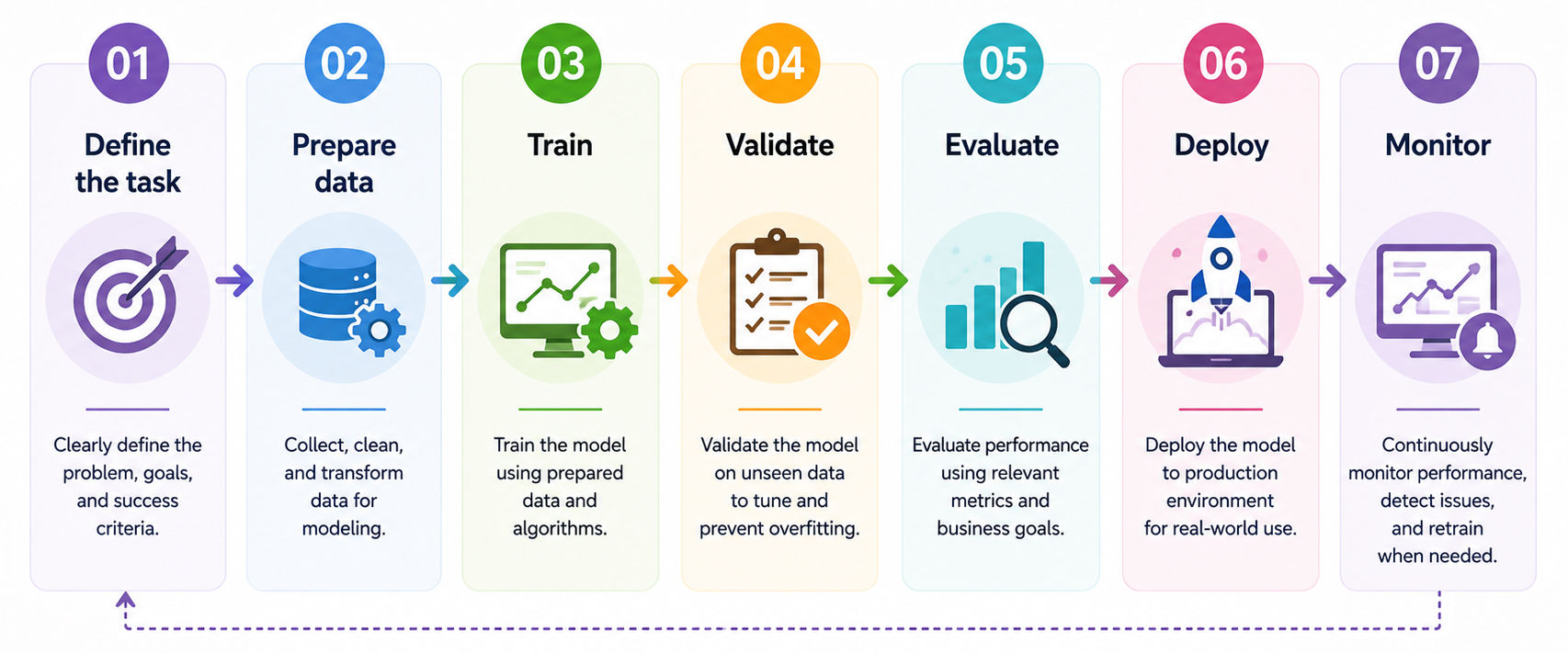
It is important to carry out an evaluation since the model which has been finely tuned should be compared with the original model to assess whether the extra training has led to an improvement in performance.
Applications of Fine Tuning
Fine tuning can be useful when a model needs:
- Specialized task behavior
- Consistent output style
- Domain specific patterns
- Repeated structured responses
- More predictable performance on a narrow task
Build practical data skills with Data Science Courses with Certification Online and prepare for data driven career opportunities.
Common Challenges in Prompt Engineering and Fine Tuning
While both methods can enhance model performance, prompt engineering and fine tuning also present different technical and operational challenges.
1. Inconsistent Model Outputs
Even when the prompt is similar, systems based on prompts can still give different results, and fine-tuned models may exhibit unexpected behaviour if the training data is inconsistent.
It is important to carry out testing and evaluation with regard to both methods.
2. Data Quality and Availability
Data quality is particularly important when carrying out fine tuning.
Challenges can include:
- Limited training examples
- Duplicate information
- Inconsistent labels
- Poor formatting
- Unrepresentative data
3. High Development and Training Costs
Prompt engineering usually involves less setup and can be tested rapidly.
Fine tuning may involve additional expenses for:
- Dataset preparation
- Training
- Evaluation
- Infrastructure
- Model storage
- Ongoing maintenance
4. Model Performance and Accuracy
No method ensures completely satisfactory outcomes.
Performance depends on:
- Model capability
- Task complexity
- Prompt quality
- Training data
- Evaluation methods
- Context quality
5. Scalability and Maintenance
It is easier to update prompt engineering when the requirements change frequently.
Since fine-tuned models have their behaviour changes dependent on the need for updated training data and additional training of the model, they can be more difficult to modify.
6. Security and Data Privacy
Both approaches need proper data protection.
When using prompt-based systems, one should consider both the information contained in the prompts and that is part of the external context. With fine tuning, even more care is needed since the training datasets might include sensitive or proprietary information.
7. Evaluation and Performance Monitoring
Evaluation must be incorporated in both methods.
Teams can monitor:
- Accuracy
- Relevance
- Consistency
- Response quality
- Cost
- Latency
- User satisfaction
Also Read: RAG vs Fine-Tuning
Conclusion
The key difference in prompt engineering vs fine tuning is how customization is achieved. Prompt engineering is usually faster, more flexible, and less expensive, making it a strong starting point for many applications.
Fine tuning is better suited to cases where deeper and more consistent behavioral customization is needed, and suitable training data is available.
The best decision depends on the level of customization required, available data, budget, task complexity, and maintenance needs. Teams should generally test prompt engineering first and consider fine tuning when prompting and contextual improvements are not enough.
Contact our upGrad KnowledgeHut experts for personalized guidance on choosing the right course, career path, and certification to achieve your goals.
Frequently Asked Questions (FAQs)
1. When should RAG be used instead of prompt engineering or fine tuning?
RAG is useful when an AI application needs access to current, external, or organization for specific information. Prompt engineering is better for guiding model behavior, while fine tuning is more suitable for consistent task or style adaptation.
2. Can prompt engineering and fine tuning be used together?
Yes. Fine tuning can adapt the model to specific behaviors, while prompts can provide task specific instructions and context. Using both can be useful when an application needs consistent behavior along with flexible instructions.
3. How does fine tuning affect model inference cost and latency?
Fine tuning does not automatically make inference faster or cheaper. Costs and latency depend on the selected model, deployment method, input and output length, and usage volume. Training and evaluation also add costs before deployment.
4. Does fine tuning improve model accuracy or only consistency?
Fine tuning can improve performance on specific tasks when the training data is relevant and high quality. It can improve both task accuracy and consistency, but results depend heavily on the dataset, model, and evaluation method.
5. How can teams measure whether fine tuning is actually better than prompting?
Teams should first establish a baseline using strong prompts and then compare the fine tuned model against the same evaluation set. Metrics such as accuracy, relevance, consistency, latency, and cost can help determine whether fine tuning provides enough improvement.
6. How does fine tuning affect a model when business requirements change?
A fine tuned model may require additional training or a new version when requirements change significantly. Prompting or retrieval can be easier to update for changing instructions or information without retraining the model.
7. Can fine tuning cause a model to forget information or capabilities it already has?
Yes, changes introduced during fine tuning can sometimes affect capabilities learned during the original training. Careful dataset design, evaluation, and comparison with the base model can help identify unwanted changes.
8. How should teams decide whether the problem is a knowledge issue or a behavior issue?
A knowledge issue means the model lacks access to relevant or current information, which may point toward retrieval. A behavior issue concerns how the model responds, follows instructions, or performs a task, which may be better addressed through prompting or fine tuning.
9. What is the risk of fine tuning on a small or biased dataset?
A small or biased dataset can cause the model to learn narrow or unrepresentative patterns. This may reduce generalization and introduce unwanted behavior. Training data should therefore be relevant, diverse, consistent, and carefully evaluated.
10. When should a team stop improving prompts and invest in fine tuning?
Fine tuning can be considered when repeated prompt improvements still fail to deliver the required consistency or task performance. Before investing, teams should confirm that the problem is behavioral, suitable training data exists, and the expected improvement justifies the added cost and maintenance.
1641 articles published
KnowledgeHut is an outcome-focused global ed-tech company. We help organizations and professionals unlock excellence through skills development. We offer training solutions under the people and proces...
Get Free Consultation
By submitting, I accept the T&C and
Privacy Policy