
- Blog Categories
- Project Management
- Agile Management
- IT Service Management
- Cloud Computing
- Business Management
- BI And Visualisation
- Quality Management
- Cyber Security
- DevOps
- Most Popular Blogs
- PMP Exam Schedule for 2025: Check PMP Exam Date
- Top 60+ PMP Exam Questions and Answers for 2025
- PMP Cheat Sheet and PMP Formulas To Use in 2025
- What is PMP Process? A Complete List of 49 Processes of PMP
- Top 15+ Project Management Case Studies with Examples 2025
- Top Picks by Authors
- Top 170 Project Management Research Topics
- What is Effective Communication: Definition
- How to Create a Project Plan in Excel in 2025?
- PMP Certification Exam Eligibility in 2025 [A Complete Checklist]
- PMP Certification Fees - All Aspects of PMP Certification Fee
- Most Popular Blogs
- CSM vs PSM: Which Certification to Choose in 2025?
- How Much Does Scrum Master Certification Cost in 2025?
- CSPO vs PSPO Certification: What to Choose in 2025?
- 8 Best Scrum Master Certifications to Pursue in 2025
- Safe Agilist Exam: A Complete Study Guide 2025
- Top Picks by Authors
- SAFe vs Agile: Difference Between Scaled Agile and Agile
- Top 21 Scrum Best Practices for Efficient Agile Workflow
- 30 User Story Examples and Templates to Use in 2025
- State of Agile: Things You Need to Know
- Top 24 Career Benefits of a Certifed Scrum Master
- Most Popular Blogs
- ITIL Certification Cost in 2025 [Exam Fee & Other Expenses]
- Top 17 Required Skills for System Administrator in 2025
- How Effective Is Itil Certification for a Job Switch?
- IT Service Management (ITSM) Role and Responsibilities
- Top 25 Service Based Companies in India in 2025
- Top Picks by Authors
- What is Escalation Matrix & How Does It Work? [Types, Process]
- ITIL Service Operation: Phases, Functions, Best Practices
- 10 Best Facility Management Software in 2025
- What is Service Request Management in ITIL? Example, Steps, Tips
- An Introduction To ITIL® Exam
- Most Popular Blogs
- A Complete AWS Cheat Sheet: Important Topics Covered
- Top AWS Solution Architect Projects in 2025
- 15 Best Azure Certifications 2025: Which one to Choose?
- Top 22 Cloud Computing Project Ideas in 2025 [Source Code]
- How to Become an Azure Data Engineer? 2025 Roadmap
- Top Picks by Authors
- Top 40 IoT Project Ideas and Topics in 2025 [Source Code]
- The Future of AWS: Top Trends & Predictions in 2025
- AWS Solutions Architect vs AWS Developer [Key Differences]
- Top 20 Azure Data Engineering Projects in 2025 [Source Code]
- 25 Best Cloud Computing Tools in 2025
- Most Popular Blogs
- Company Analysis Report: Examples, Templates, Components
- 400 Trending Business Management Research Topics
- Business Analysis Body of Knowledge (BABOK): Guide
- ECBA Certification: Is it Worth it?
- Top Picks by Authors
- Top 20 Business Analytics Project in 2025 [With Source Code]
- ECBA Certification Cost Across Countries
- Top 9 Free Business Requirements Document (BRD) Templates
- Business Analyst Job Description in 2025 [Key Responsibility]
- Business Analysis Framework: Elements, Process, Techniques
- Most Popular Blogs
- Best Career options after BA [2025]
- Top Career Options after BCom to Know in 2025
- Top 10 Power Bi Books of 2025 [Beginners to Experienced]
- Power BI Skills in Demand: How to Stand Out in the Job Market
- Top 15 Power BI Project Ideas
- Top Picks by Authors
- 10 Limitations of Power BI: You Must Know in 2025
- Top 45 Career Options After BBA in 2025 [With Salary]
- Top Power BI Dashboard Templates of 2025
- What is Power BI Used For - Practical Applications Of Power BI
- SSRS Vs Power BI - What are the Key Differences?
- Most Popular Blogs
- Data Collection Plan For Six Sigma: How to Create One?
- Quality Engineer Resume for 2025 [Examples + Tips]
- 20 Best Quality Management Certifications That Pay Well in 2025
- Six Sigma in Operations Management [A Brief Introduction]
- Top Picks by Authors
- Six Sigma Green Belt vs PMP: What's the Difference
- Quality Management: Definition, Importance, Components
- Adding Green Belt Certifications to Your Resume
- Six Sigma Green Belt in Healthcare: Concepts, Benefits and Examples
- Most Popular Blogs
- Latest CISSP Exam Dumps of 2025 [Free CISSP Dumps]
- CISSP vs Security+ Certifications: Which is Best in 2025?
- Best CISSP Study Guides for 2025 + CISSP Study Plan
- How to Become an Ethical Hacker in 2025?
- Top Picks by Authors
- CISSP vs Master's Degree: Which One to Choose in 2025?
- CISSP Endorsement Process: Requirements & Example
- OSCP vs CISSP | Top Cybersecurity Certifications
- How to Pass the CISSP Exam on Your 1st Attempt in 2025?
- Most Popular Blogs
- Top 7 Kubernetes Certifications in 2025
- Kubernetes Pods: Types, Examples, Best Practices
- DevOps Methodologies: Practices & Principles
- Docker Image Commands
- Top Picks by Authors
- Best DevOps Certifications in 2025
- 20 Best Automation Tools for DevOps
- Top 20 DevOps Projects of 2025
- OS for Docker: Features, Factors and Tips
- More
- Agile & PMP Practice Tests
- Agile Testing
- Agile Scrum Practice Exam
- CAPM Practice Test
- PRINCE2 Foundation Exam
- PMP Practice Exam
- Cloud Related Practice Test
- Azure Infrastructure Solutions
- AWS Solutions Architect
- IT Related Pratice Test
- ITIL Practice Test
- Devops Practice Test
- TOGAF® Practice Test
- Other Practice Test
- Oracle Primavera P6 V8
- MS Project Practice Test
- Project Management & Agile
- Project Management Interview Questions
- Release Train Engineer Interview Questions
- Agile Coach Interview Questions
- Scrum Interview Questions
- IT Project Manager Interview Questions
- Cloud & Data
- Azure Databricks Interview Questions
- AWS architect Interview Questions
- Cloud Computing Interview Questions
- AWS Interview Questions
- Kubernetes Interview Questions
- Web Development
- CSS3 Free Course with Certificates
- Basics of Spring Core and MVC
- Javascript Free Course with Certificate
- React Free Course with Certificate
- Node JS Free Certification Course
- Data Science
- Python Machine Learning Course
- Python for Data Science Free Course
- NLP Free Course with Certificate
- Data Analysis Using SQL
- Home
- Blog
- Data Science
- Generative AI Tech Stack: Tools, APIs, and Frameworks
Generative AI Tech Stack: Tools, APIs, and Frameworks
Updated on Aug 13, 2026 | 0.6k+ views
Share:
Table of Contents
View all
Quick Overview
- A Generative AI tech stack combines infrastructure, foundation models, data systems, APIs, frameworks, orchestration tools, and application interfaces to build and deploy GenAI solutions.
- The main layers typically include compute and infrastructure, foundation models, data and knowledge, orchestration and LLMOps, and the application layer.
- Popular technologies include LLM APIs, vector databases, LangChain, LlamaIndex, agent frameworks, cloud AI platforms, and model development tools.
- This guide explains the key layers, tools, APIs, frameworks, use cases, and factors to consider when choosing a Generative AI tech stack.
Build advanced AI skills with the Generative AI Masters Program and prepare for emerging AI career opportunities.
What Is a Generative AI Tech Stack?
A generative AI tech stack provides the technical foundation required to develop, deploy, and manage applications that generate text, images, audio, code, or other content. It connects models with data, applications, APIs, infrastructure, and monitoring systems.
Core Components of a Generative AI Tech Stack
A typical stack includes:
• Foundation models
• Model APIs
• Embedding and vector tools
• Data and knowledge systems
• Application frameworks
• AI orchestration tools
• Cloud infrastructure
• Monitoring and security tools
Each component contributes to the application's performance, scalability, and reliability.
How the Generative AI Stack Supports AI Application Development
The stack connects different technical layers, so developers can move from an AI model to a working application.
It helps with:
• Model access
• Data processing
• Prompt management
• Retrieval
• Tool integration
• Application orchestration
• Deployment
• Performance monitoring
A well-designed generative AI tech stack reduces unnecessary complexity and makes AI applications easier to maintain.
Explore What Is Generative AI and understand how it creates new content, from text and images to code and more.
Foundation Models and Generative AI Tools
Foundation models form the central intelligence layer of a generative AI tech stack. They provide the capabilities that applications use to understand prompts, generate content, and perform specialized tasks.
1. Large Language Models
Large language models are designed to process and generate human language.
They can support:
• Text generation
• Summarization
• Question answering
• Code generation
• Classification
• Conversational applications
Model capabilities, context length, latency, and cost can vary significantly, so model selection should match the application requirements.
2. Multimodal and Generative AI Models
Modern generative AI applications can work with more than text.
Multimodal models can process or generate:
• Text
• Images
• Audio
• Video
• Code
These models are useful when an application needs to work across different forms of information.
3. Open-Source vs Proprietary Models
Open-source models can offer greater customization and deployment flexibility, while proprietary models can provide managed access and advanced capabilities through hosted services.
The decision should consider:
• Customization
• Cost
• Model performance
• Infrastructure requirements
• Data control
• Licensing
4. Model Selection Criteria
The right model depends on several factors:
• Quality
• Latency
• Context capacity
• Cost
• Multimodal support
• Reliability
• Deployment options
Model selection should be driven by the actual application requirements rather than popularity alone.
Learn how Gen AI for Marketers can streamline daily workflows, improve productivity, and support smarter marketing tasks.
Generative AI APIs and Platforms
APIs connect applications with models and support AI capabilities. They make it possible to integrate generative AI into websites, software products, enterprise systems, and automated workflows.
1. LLM APIs
LLM APIs provide programmatic access to language models.
They can support:
• Text generation
• Summarization
• Question answering
• Structured outputs
• Conversational applications
2. Embedding APIs
Embedding APIs convert text or other supported information into numerical representations that capture semantic relationships.
They are commonly used for:
• Semantic search
• Retrieval systems
• Recommendation workflows
• Knowledge discovery
3. Image, Audio, and Multimodal APIs
These APIs extend AI applications beyond text.
They can support:
• Image generation
• Speech recognition
• Text to speech
• Image understanding
• Multimodal interactions
4. Cloud AI Platforms
Cloud AI platforms provide managed services for model access, deployment, data processing, security, and infrastructure.
They can help organizations with:
• Scalability
• Model management
• Access control
• Integration
• Monitoring
5. API Selection Considerations
When selecting APIs, evaluate:
• Pricing
• Latency
• Reliability
• Usage limits
• Model capabilities
• Security
• Integration support
The API layer should match both technical and business requirements.
Build in-demand analytics skills with Data Science Courses with Certification Online and prepare for data driven career opportunities.
Generative AI Frameworks and Development Tools
Frameworks provide reusable components for building AI applications. They can simplify model integration, retrieval, orchestration, agents, evaluation, and application development.
1. LLM Application Frameworks
LLM frameworks help developers connect models with application logic and external data.
They can support:
• Prompt management
• Retrieval workflows
• Tool integration
• Memory
• Structured outputs
2. Agentic AI Frameworks
Agentic AI frameworks help applications plan tasks, use tools, and coordinate multiple steps.
They can support:
• Tool calling
• Task planning
• Workflow orchestration
• Multi agent coordination
• Autonomous task execution
3. Model Development and Fine-Tuning Tools
These tools support adapting models to specific requirements.
They can be used for:
• Fine tuning
• Evaluation
• Dataset preparation
• Experimentation
• Model optimization
Fine tuning should be considered only when it provides a clear benefit over prompt design, retrieval, or model selection.
4. Prompt Engineering and Evaluation Tools
Prompt and evaluation tools help improve the consistency and quality of model outputs.
They can support:
• Prompt testing
• Version management
• Output evaluation
• Experiment tracking
• Quality monitoring
Build practical development skills with Generative AI for Developers and learn how to create AI powered applications.
Key Layers of a Generative AI Tech Stack
A generative AI tech stack usually works as a layered architecture. Each layer performs a different function, while the complete system connects to models, data, applications, infrastructure, and controls.
1. Foundation Models and Large Language Models
This is the model layer that provides core generative capabilities.
It may contain:
• Language models
• Multimodal models
• Image models
• Specialized models
2. Model APIs and AI Platforms
This layer provides access to models and supports AI services through managed platforms and APIs.
It handles:
• Model requests
• Authentication
• Usage management
• Integration
3. Data and Knowledge Layer
This layer provides the information the application needs to produce useful and grounded outputs.
It can include:
• Databases
• Documents
• Vector stores
• Knowledge bases
• Enterprise data
4. AI Application and Orchestration Layer
This layer connects models, data, prompts, tools, and application logic.
It manages:
• Workflow execution
• Retrieval
• Tool usage
• Agent behavior
• Application logic
5. Deployment and Infrastructure Layer
This layer supports hosting, scaling, networking, and compute requirements.
It may include:
• Cloud infrastructure
• Containers
• APIs
• Storage
• Compute resources
6. Monitoring and Security Layer
This layer helps organizations maintain reliability and control.
It covers:
• Monitoring
• Logging
• Access control
• Data protection
• Model evaluation
• Compliance
Explore the Top Generative AI Projects to Build in 2026 and gain practical experience with real world AI applications.
Generative AI Tech Stack for Different Use Cases
The ideal generative AI tech stack changes according to the application's purpose. Different use cases require different combinations of models, data systems, APIs, frameworks, and infrastructure.
1. Generative AI Chatbots
Chatbots generally require:
• A language model
• Conversation management
• Prompt handling
• Knowledge access
• Application integration
The stack should prioritize response quality, latency, and reliable information.
2. Retrieval Augmented Generation Applications
Retrieval augmented generation applications connect language models with external knowledge.
A typical stack includes:
• Embedding models
• Document processing
• Vector databases
• Retrieval systems
• LLMs
This approach helps applications use relevant external information during response generation.
3. AI Agents
AI agents require additional orchestration and tool integration.
Common requirements include:
• Agent frameworks
• Tool calling
• Workflow management
• Memory or state
• Monitoring
The architecture becomes more complex as the number of tools and autonomous actions increases.
4. Content Generation Applications
Content applications may require language, image, or multimodal models depending on the output.
Important considerations include:
• Output quality
• Brand consistency
• Content controls
• Evaluation
• Workflow integration
5. Enterprise Generative AI Applications
Enterprise applications often require a broader stack.
They may need:
• Secure data access
• Enterprise knowledge retrieval
• Identity management
• Governance
• Monitoring
• Compliance controls
• Scalable infrastructure
Also Read: Generative AI is changing creative industries in 2026.
How to Choose a Generative AI Tech Stack
Choosing a generative AI tech stack should begin with the application's actual requirements rather than selecting tools individually. The goal is to create a stack that balances performance, cost, flexibility, security, and scalability.
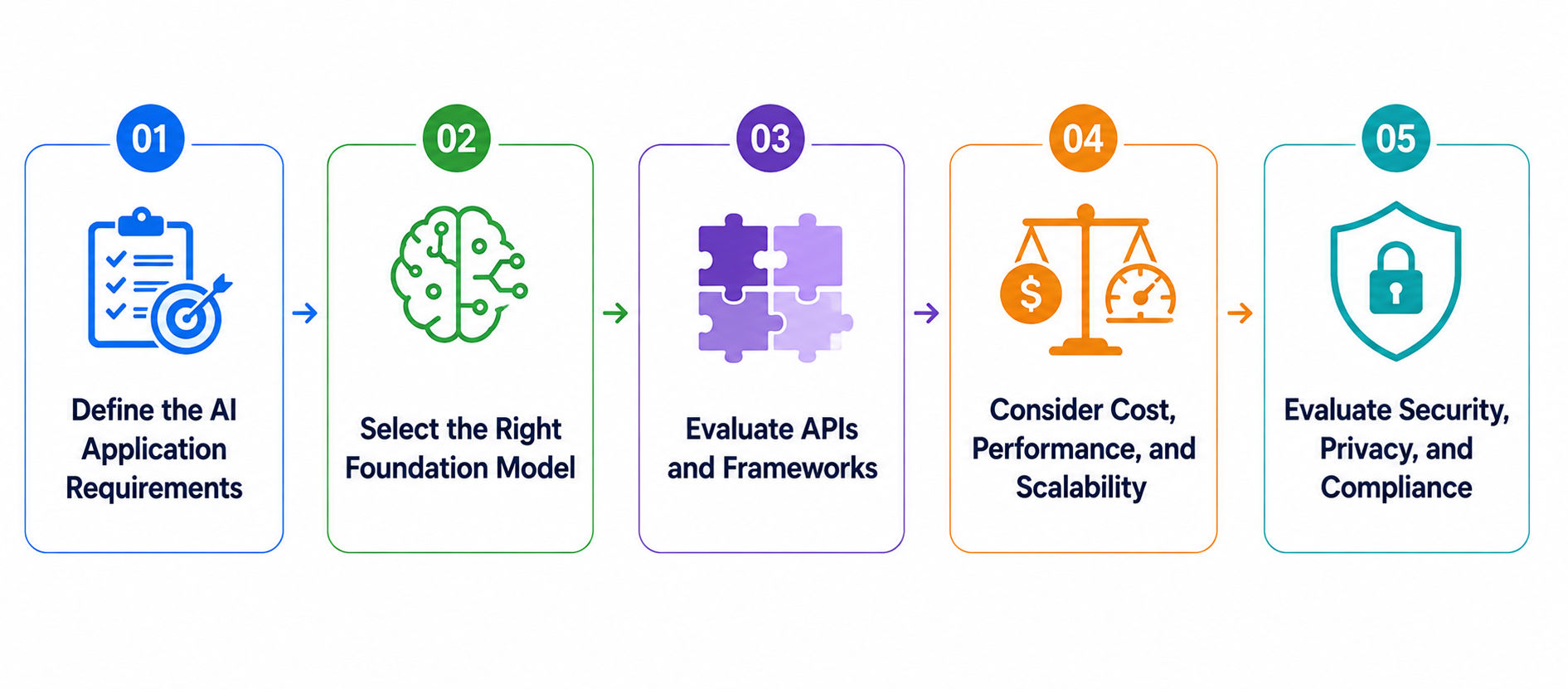
1. Define the AI Application Requirements
First, identify:
• What the application needs to generate
• Who will use it
• What data it requires
• Which systems it must connect with
• What level of automation is needed
A clear requirement makes later technology decisions easier.
2. Select the Right Foundation Model
Compare models based on:
• Quality
• Speed
• Cost
• Context capacity
• Modality
• Reliability
• Deployment needs
The best model is the one that meets the application's requirements efficiently.
3. Evaluate APIs and Frameworks
APIs and frameworks should be selected based on how well they support the required workflow.
Consider:
• Integration
• Documentation
• Development effort
• Community support
• Flexibility
• Maintenance requirements
Avoid adding frameworks that do not solve a specific development problem.
4. Consider Cost, Performance, and Scalability
A stack should perform well at the expected usage level without creating unnecessary costs.
Evaluate:
• Model usage costs
• Infrastructure costs
• Response latency
• Expected traffic
• Scaling requirements
5. Evaluate Security, Privacy, and Compliance
Security becomes particularly important when applications process sensitive business or customer information.
Evaluate:
• Data handling
• Access controls
• Encryption
• Logging
• Compliance requirements
• Vendor policies
Conclusion
A generative AI tech stack brings together models, APIs, frameworks, data, infrastructure, and security to support AI application development. The ideal stack depends on the application's specific requirements rather than the number of tools included.
The key factors to consider are use case, model performance, cost, scalability, integrations, and security. Starting with clear application requirements helps businesses select the right technologies without adding unnecessary complexity.
Contact our upGrad KnowledgeHut experts for personalized guidance on choosing the right course, career path, and certification to achieve your goals.
Frequently Asked Questions
1. How does a generative AI tech stack change from prototype to production?
A prototype may need only a model of API, basic prompts, and a simple application layer. Production systems often require stronger security, monitoring, evaluation, scalable infrastructure, data controls, and reliability measures.
2. What is the minimum generative AI tech stack needed to build an AI application?
A basic application can start with a foundation model, model of API, application layer, and relevant data source. Additional components such as retrieval, vector databases, monitoring, and security can be added as requirements become more complex.
3. When should a generative AI application use RAG instead of fine tuning?
RAG is useful when an application needs to access frequently changing or organization specific information. Fine tuning is more suitable when the goal is to adapt model behavior, style, or task performance rather than provide constantly updated knowledge.
4. How can businesses avoid vendor lock in when choosing AI APIs and models?
Businesses can reduce vendor dependence by using modular architectures, portable data formats, abstraction layers, and multiple model options where practical. Separating application logic from a single model provider can also make future switching easier.
5. How should teams evaluate the performance of a generative AI tech stack?
Performance should be evaluated across response quality, accuracy, latency, reliability, scalability, cost, and security. Teams should use relevant evaluation metrics and real application scenarios rather than judging the stack only by model performance.
6. What role does model routing play in a generative AI tech stack?
Model routing directs different requests to the most appropriate model based on factors such as complexity, cost, speed, or capability. This can help balance performance and operational costs across different application tasks.
7. How can businesses reduce inference costs in a generative AI application?
Costs can be reduced through smaller models where suitable, efficient prompts, caching, batching, model routing, and controlling unnecessary requests. Monitoring usage can also help identify expensive workflows and optimize resource consumption.
8. When should an AI application use an open-source model instead of a proprietary model?
Open-source models may be suitable when customization, deployment control, or data governance is important. Proprietary models can be preferable when teams need managed infrastructure, strong hosted capabilities, or faster implementation with less operational overhead.
9. How does a generative AI tech stack support human oversight and guardrails?
Guardrails can restrict model behavior, control tool access, validate outputs, and manage sensitive actions. Human approval can also be introduced for high risk or business critical decisions before an AI system takes action.
10. How can a generative AI tech stack handle model changes without rebuilding the application?
A modular architecture can separate the application from the underlying model provider. Using standardized interfaces, configurable model settings, evaluation processes, and abstraction layers can make it easier to replace or upgrade models without redesigning the entire application.
1639 articles published
KnowledgeHut is an outcome-focused global ed-tech company. We help organizations and professionals unlock excellence through skills development. We offer training solutions under the people and proces...
Get Free Consultation
By submitting, I accept the T&C and
Privacy Policy