
- Blog Categories
- Project Management
- Agile Management
- IT Service Management
- Cloud Computing
- Business Management
- BI And Visualisation
- Quality Management
- Cyber Security
- DevOps
- Most Popular Blogs
- PMP Exam Schedule for 2025: Check PMP Exam Date
- Top 60+ PMP Exam Questions and Answers for 2025
- PMP Cheat Sheet and PMP Formulas To Use in 2025
- What is PMP Process? A Complete List of 49 Processes of PMP
- Top 15+ Project Management Case Studies with Examples 2025
- Top Picks by Authors
- Top 170 Project Management Research Topics
- What is Effective Communication: Definition
- How to Create a Project Plan in Excel in 2025?
- PMP Certification Exam Eligibility in 2025 [A Complete Checklist]
- PMP Certification Fees - All Aspects of PMP Certification Fee
- Most Popular Blogs
- CSM vs PSM: Which Certification to Choose in 2025?
- How Much Does Scrum Master Certification Cost in 2025?
- CSPO vs PSPO Certification: What to Choose in 2025?
- 8 Best Scrum Master Certifications to Pursue in 2025
- Safe Agilist Exam: A Complete Study Guide 2025
- Top Picks by Authors
- SAFe vs Agile: Difference Between Scaled Agile and Agile
- Top 21 Scrum Best Practices for Efficient Agile Workflow
- 30 User Story Examples and Templates to Use in 2025
- State of Agile: Things You Need to Know
- Top 24 Career Benefits of a Certifed Scrum Master
- Most Popular Blogs
- ITIL Certification Cost in 2025 [Exam Fee & Other Expenses]
- Top 17 Required Skills for System Administrator in 2025
- How Effective Is Itil Certification for a Job Switch?
- IT Service Management (ITSM) Role and Responsibilities
- Top 25 Service Based Companies in India in 2025
- Top Picks by Authors
- What is Escalation Matrix & How Does It Work? [Types, Process]
- ITIL Service Operation: Phases, Functions, Best Practices
- 10 Best Facility Management Software in 2025
- What is Service Request Management in ITIL? Example, Steps, Tips
- An Introduction To ITIL® Exam
- Most Popular Blogs
- A Complete AWS Cheat Sheet: Important Topics Covered
- Top AWS Solution Architect Projects in 2025
- 15 Best Azure Certifications 2025: Which one to Choose?
- Top 22 Cloud Computing Project Ideas in 2025 [Source Code]
- How to Become an Azure Data Engineer? 2025 Roadmap
- Top Picks by Authors
- Top 40 IoT Project Ideas and Topics in 2025 [Source Code]
- The Future of AWS: Top Trends & Predictions in 2025
- AWS Solutions Architect vs AWS Developer [Key Differences]
- Top 20 Azure Data Engineering Projects in 2025 [Source Code]
- 25 Best Cloud Computing Tools in 2025
- Most Popular Blogs
- Company Analysis Report: Examples, Templates, Components
- 400 Trending Business Management Research Topics
- Business Analysis Body of Knowledge (BABOK): Guide
- ECBA Certification: Is it Worth it?
- Top Picks by Authors
- Top 20 Business Analytics Project in 2025 [With Source Code]
- ECBA Certification Cost Across Countries
- Top 9 Free Business Requirements Document (BRD) Templates
- Business Analyst Job Description in 2025 [Key Responsibility]
- Business Analysis Framework: Elements, Process, Techniques
- Most Popular Blogs
- Best Career options after BA [2025]
- Top Career Options after BCom to Know in 2025
- Top 10 Power Bi Books of 2025 [Beginners to Experienced]
- Power BI Skills in Demand: How to Stand Out in the Job Market
- Top 15 Power BI Project Ideas
- Top Picks by Authors
- 10 Limitations of Power BI: You Must Know in 2025
- Top 45 Career Options After BBA in 2025 [With Salary]
- Top Power BI Dashboard Templates of 2025
- What is Power BI Used For - Practical Applications Of Power BI
- SSRS Vs Power BI - What are the Key Differences?
- Most Popular Blogs
- Data Collection Plan For Six Sigma: How to Create One?
- Quality Engineer Resume for 2025 [Examples + Tips]
- 20 Best Quality Management Certifications That Pay Well in 2025
- Six Sigma in Operations Management [A Brief Introduction]
- Top Picks by Authors
- Six Sigma Green Belt vs PMP: What's the Difference
- Quality Management: Definition, Importance, Components
- Adding Green Belt Certifications to Your Resume
- Six Sigma Green Belt in Healthcare: Concepts, Benefits and Examples
- Most Popular Blogs
- Latest CISSP Exam Dumps of 2025 [Free CISSP Dumps]
- CISSP vs Security+ Certifications: Which is Best in 2025?
- Best CISSP Study Guides for 2025 + CISSP Study Plan
- How to Become an Ethical Hacker in 2025?
- Top Picks by Authors
- CISSP vs Master's Degree: Which One to Choose in 2025?
- CISSP Endorsement Process: Requirements & Example
- OSCP vs CISSP | Top Cybersecurity Certifications
- How to Pass the CISSP Exam on Your 1st Attempt in 2025?
- Most Popular Blogs
- Top 7 Kubernetes Certifications in 2025
- Kubernetes Pods: Types, Examples, Best Practices
- DevOps Methodologies: Practices & Principles
- Docker Image Commands
- Top Picks by Authors
- Best DevOps Certifications in 2025
- 20 Best Automation Tools for DevOps
- Top 20 DevOps Projects of 2025
- OS for Docker: Features, Factors and Tips
- More
- Agile & PMP Practice Tests
- Agile Testing
- Agile Scrum Practice Exam
- CAPM Practice Test
- PRINCE2 Foundation Exam
- PMP Practice Exam
- Cloud Related Practice Test
- Azure Infrastructure Solutions
- AWS Solutions Architect
- IT Related Pratice Test
- ITIL Practice Test
- Devops Practice Test
- TOGAF® Practice Test
- Other Practice Test
- Oracle Primavera P6 V8
- MS Project Practice Test
- Project Management & Agile
- Project Management Interview Questions
- Release Train Engineer Interview Questions
- Agile Coach Interview Questions
- Scrum Interview Questions
- IT Project Manager Interview Questions
- Cloud & Data
- Azure Databricks Interview Questions
- AWS architect Interview Questions
- Cloud Computing Interview Questions
- AWS Interview Questions
- Kubernetes Interview Questions
- Web Development
- CSS3 Free Course with Certificates
- Basics of Spring Core and MVC
- Javascript Free Course with Certificate
- React Free Course with Certificate
- Node JS Free Certification Course
- Data Science
- Python Machine Learning Course
- Python for Data Science Free Course
- NLP Free Course with Certificate
- Data Analysis Using SQL
- Home
- Blog
- Data Science
- OpenAI API vs Hugging Face: Which AI Platform Should You Choose?
OpenAI API vs Hugging Face: Which AI Platform Should You Choose?
Updated on Aug 06, 2026 | 0.9k+ views
Share:
Table of Contents
View all
- OpenAI API vs Hugging Face: Comparison table
- What is OpenAI API?
- What is Hugging Face?
- OpenAI API vs Hugging Face: Which is better for different use cases?
- Pros and cons of the OpenAI API and Hugging Face
- OpenAI API vs Hugging Face pricing: Which offers better value?
- OpenAI API or Hugging Face: Which one should you choose?
- Conclusion
Quick Overview:
- The OpenAI API is a managed AI platform that lets developers access advanced language, vision, and speech models through simple API calls.
- Hugging Face is an open-source AI platform that provides thousands of machine learning models, datasets, and tools for building and deploying AI applications.
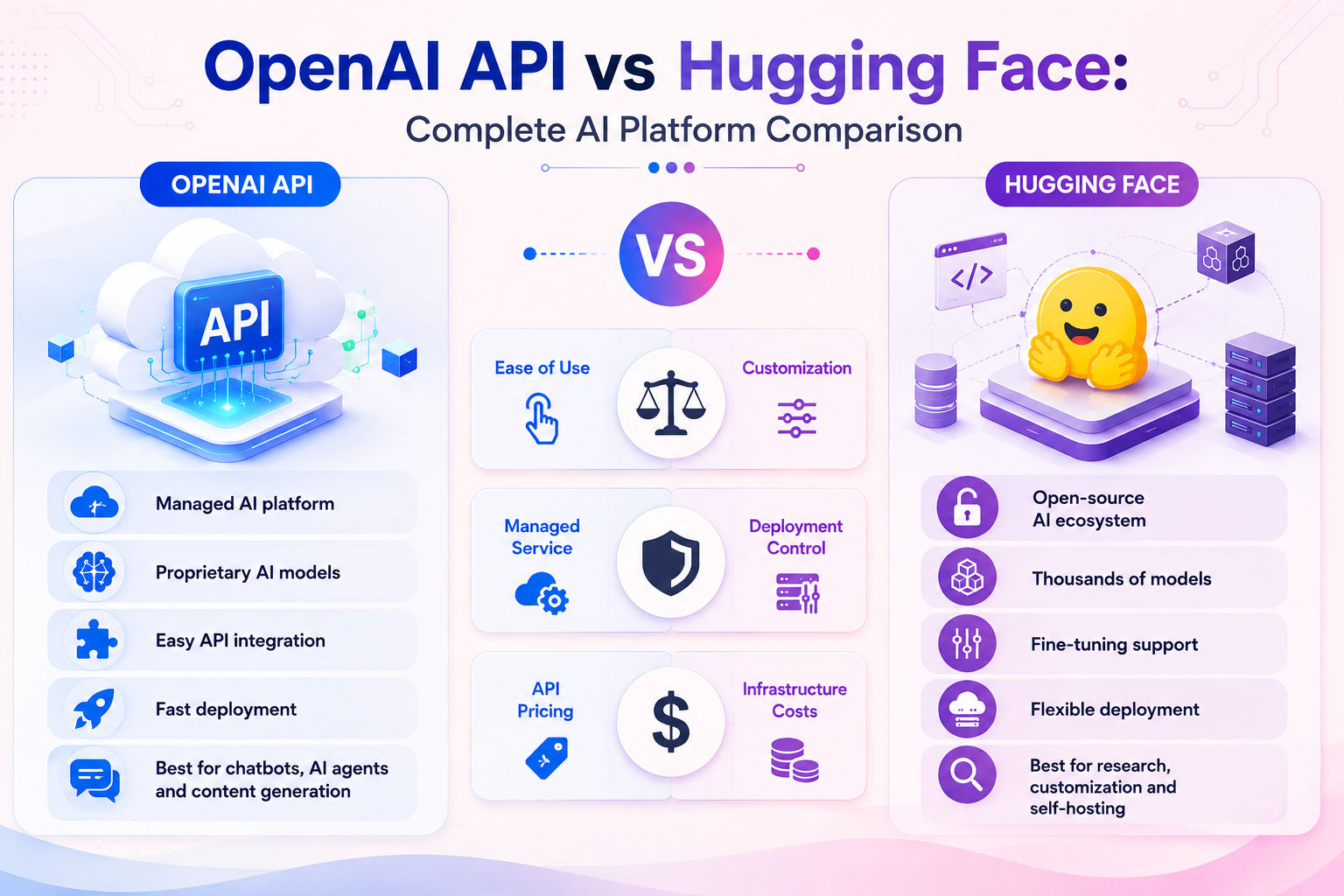
- In the OpenAI API vs Hugging Face comparison, OpenAI API prioritizes ease of use, while Hugging Face focuses on customization and deployment flexibility.
- The right platform depends on your needs, including budget, deployment preferences, scalability, and the level of control you want over your AI models.
- This guide compares OpenAI API vs Hugging Face across models, features, pricing, use cases, pros and cons, and deployment options to help you choose the right AI platform.
Ready to build AI applications with OpenAI API, Hugging Face, and LLMs? Enroll in upGrad KnowledgeHut Generative and Agentic AI Master Program to gain hands-on experience with modern AI tools and workflows.
OpenAI API vs Hugging Face: Comparison table
The OpenAI API and Hugging Face both enable AI application development but differ in their approach to models, deployment, pricing, and customization.
The table below compares OpenAI API vs Hugging Face across the key factors to help you quickly identify which platform best suits your needs.
Feature |
OpenAI API |
Hugging Face |
| Primary purpose | Access OpenAI's AI models through APIs | Discover, build, and deploy open-source AI models |
| Model ecosystem | Proprietary OpenAI models | Open-source models from multiple providers |
| Deployment | Cloud-hosted APIs | Cloud, self-hosted, or on-premises |
| Open-source support | No | Yes |
| Fine-tuning | Supported for select models | Extensive support for many open-source models |
| Infrastructure management | Fully managed by OpenAI | Managed or self-managed |
| Pricing model | Pay per token | Free, subscription, or infrastructure costs |
| Customization | Limited to supported API features | High level of model customization |
| Data control | Managed by OpenAI | Greater control with self-hosting |
| Primary use cases | Chatbots, AI agents, content generation, coding | Research, fine-tuning, custom AI, private deployments |
| Best suited for | Teams seeking a managed AI platform | Teams needing flexibility and deployment control |
Also Read: Best Way to Start a Career in Generative AI
What is OpenAI API?
The OpenAI API is a cloud service that lets developers use OpenAI's AI models in their own applications. Instead of building and running large AI models themselves, developers can send API requests to access features like text generation, image creation, speech processing, and embeddings. OpenAI handles the infrastructure, so developers can focus on building their applications.
The OpenAI API uses a simple request-and-response process. A developer sends a prompt or input to an API endpoint, and the AI model returns a response.
OpenAI manages the servers, updates, security, and scaling, so developers don't have to worry about running the models themselves.
Key features of the OpenAI API
- Access to advanced AI models through a single API
- Fully managed infrastructure with automatic scaling and updates
- Support for text, image, audio, and multimodal applications
- Features like function calling, structured outputs, and embeddings
- Fine-tuning for supported models
- Security and compliance features for business and enterprise users
Common use cases of the OpenAI API
The OpenAI API is widely used to build:
- AI chatbots and virtual assistants
- Content writing and marketing tools
- Coding assistants and developer tools
- Customer support automation
- Document summarization and information extraction
- Semantic search and RAG applications
- AI agents for automating business workflows
Also Read: Agentic AI Learning Roadmap
What is Hugging Face?
Hugging Face is an AI platform that helps developers build, train, fine-tune, and deploy machine learning models. It is best known for its large collection of open-source AI models, datasets, and developer tools.
Unlike the OpenAI API, which provides access to OpenAI's own models, Hugging Face lets developers choose from millions of models created by companies, researchers, and the open-source community.
The platform supports many AI tasks, including natural language processing (NLP), computer vision, speech recognition, and multimodal AI.
Hugging Face provides a Model Hub where developers can browse and use AI models. They can download models to run on their own computers or servers or use hosted inference services to run models in the cloud.
Developers can also fine-tune supported models with their own data and deploy them on cloud platforms or their own infrastructure.
Key features of Hugging Face
- Access to millions of open-source AI models
- Support for NLP, computer vision, speech, and multimodal AI
- Flexible deployment in the cloud or on your own infrastructure
- Fine-tuning and training with open-source tools
- Large collection of public datasets
- Active developer community with regular model updates
Common use cases of Hugging Face
Hugging Face is commonly used for:
- Building AI and machine learning applications
- Fine-tuning open-source language models
- AI research and experimentation
- Running self-hosted or private AI models
- Developing NLP, vision, and speech applications
- Comparing and testing different AI models
- Quickly building prototypes with pre-trained models
OpenAI API vs Hugging Face: Which is better for different use cases?
The right choice in OpenAI API vs Hugging Face depends on what you're building, from AI chatbots and coding assistants to enterprise applications.
1. AI chatbots and virtual assistants
If you're building customer support bots, AI assistants, or chat applications, the OpenAI API is often the easiest choice.
OpenAI provides fully managed AI models, so you can focus on building your application instead of managing servers or model deployment. It also offers models for conversations, reasoning, and multimodal tasks through a single API.
Best choice: OpenAI API
Choose Hugging Face if you:
- Want to use a specific open source chatbot model
- Need to host the model on your own servers
- Must meet strict data privacy or compliance requirements
2. Retrieval-Augmented Generation (RAG)
RAG applications combine AI models with external data sources such as company documents, databases, or knowledge bases.
Both platforms work well, but each has different strengths.
OpenAI makes it easy to build RAG applications with high-quality text generation through a managed API.
Hugging Face gives you access to many embedding, retrieval, reranking, and generation models, making it easier to customize every part of the RAG pipeline.
Best choice:
- Choose OpenAI API for faster development.
- Choose Hugging Face for more flexibility and model customization.
Also Read: RAG vs Fine Tuning
3. AI agents and workflow automation
AI agents can perform tasks like research, planning, using tools, and automating business processes.
The OpenAI API is usually the better choice because it reduces the need to manage AI infrastructure and speeds up development.
Hugging Face is a good option if you want to build custom agents using different open-source models.
Best choice: OpenAI API
- Choose Hugging Face if customization is more important than development speed.
4. Content generation and creative AI
For writing blog posts, marketing content, product descriptions, summaries, or social media posts, the OpenAI API offers a simple and reliable solution.
It supports text, images, audio, and multimodal AI through one API, making it easy to build content creation tools.
Hugging Face is useful if you want to experiment with open-source models or create your own fine-tuned content generation system.
Best choice: OpenAI API
5. Coding assistants and developer tools
For code generation, documentation, debugging, and coding assistants, the OpenAI API is a popular choice because it's easy to integrate and provides strong coding capabilities.
Hugging Face also offers many open-source coding models that can be customized or self-hosted.
Best choice: OpenAI API
Choose Hugging Face if you:
- Need to keep source code on your own infrastructure
- Want self-hosted code models
- Need to fine-tune models for specific programming tasks
6. Research and model experimentation
Hugging Face is the better platform for AI research and experimentation.
It gives developers access to millions of models and datasets, making it easy to compare models, fine-tune them, and test different approaches.
While OpenAI provides powerful models, it is not designed for the same level of open experimentation.
Best choice: Hugging Face
7. Enterprise AI applications
For business applications, the best choice depends on your requirements.
The OpenAI API is a good option if you want production-ready AI without managing infrastructure.
Hugging Face is a better fit if you need:
- More control over model selection
- Custom fine-tuning
- Private or self-hosted deployment
- An open-source AI strategy
Best choice: Depends on your needs
- Choose OpenAI API for simplicity and faster deployment.
- Choose Hugging Face for flexibility and control.
Also Read: Enterprise RAG Architecture Explained Step by Step
8. Running AI models locally or on premises
This is one of the biggest differences between the two platforms.
Hugging Face allows you to download and run open-source models on your own servers, private cloud, or on-premises infrastructure.
The OpenAI API is a cloud-based service, so it isn't designed for local model deployment.
Best choice: Hugging Face
If your organization has strict security, compliance, or data residency requirements, Hugging Face is usually the better option.
Quick comparison
Use Case |
Better Choice |
| AI chatbots and virtual assistants | OpenAI API |
| Retrieval-Augmented Generation (RAG) | OpenAI for simplicity, Hugging Face for customization |
| AI agents and workflow automation | OpenAI API |
| Content generation and creative AI | OpenAI API |
| Coding assistants and developer tools | OpenAI API |
| Research and model experimentation | Hugging Face |
| Enterprise AI applications | OpenAI for simplicity and faster deployment, Hugging Face for flexibility and control
|
| Local or on-premises deployment | Hugging Face |
Build the skills needed to work with OpenAI API, Hugging Face, and Generative AI. Explore upGrad KnowledgeHut Data Science and AI Courses for hands-on AI learning.
Pros and cons of the OpenAI API and Hugging Face
Comparing the strengths and limitations of OpenAI API vs Hugging Face makes it easier to identify which platform aligns with your project goals.
Pros and cons of the OpenAI API
Pros
1. Easy to implement and scale
OpenAI provides a fully managed API, so developers can start building AI applications without handling model hosting, GPU infrastructure, scaling, or maintenance.
2. Access to state-of-the-art models
The platform offers advanced language, reasoning, image, and audio models through a unified API, making it easier to build multimodal applications from a single provider.
3. Consistent developer experience
Teams can access multiple AI capabilities through similar API workflows, reducing engineering complexity compared with stitching together several vendors and tools.
4. Faster time to market
Because infrastructure management is handled by OpenAI, companies can focus on product development rather than machine learning operations.
Cons
1. Limited model choice
You are primarily limited to OpenAI-hosted models and capabilities. Organizations that want to evaluate dozens of model families may find this restrictive.
2. Less deployment flexibility
OpenAI is designed around hosted APIs rather than downloading and running models in your own environment. This can be a limitation for organizations with strict infrastructure or compliance requirements.
3. Potential vendor dependence
Applications built deeply around OpenAI APIs can become more difficult to migrate to alternative model providers later.
4. Usage costs can increase with scale
While the managed approach reduces operational overhead, high-volume applications can accumulate significant API costs as usage grows.
Pros and cons of Hugging Face
Pros
1. Massive model ecosystem
Hugging Face provides access to thousands of models from different organizations, including popular open-source models such as Llama, Mistral, and others, allowing teams to choose models that best fit their needs.
2. Deployment flexibility
Organizations can use managed inference services, deploy models in their own cloud environment, or run models locally depending on their requirements.
3. Strong support for customization
Hugging Face is particularly well suited for experimentation, fine-tuning, and building custom AI systems around open-source models.
4. Reduced vendor lock-in
Because the platform supports models from many providers, organizations have greater flexibility to switch models as requirements change.
Cons
1. Higher operational complexity
Model evaluation, deployment decisions, optimization, and infrastructure management often require more technical expertise than using a fully managed API.
2. Variable model quality
Open-source models differ significantly in performance, maintenance, documentation, and support. Teams usually need to evaluate multiple options before selecting a production model.
3. Infrastructure responsibilities
When self-hosting models, organizations must handle scaling, monitoring, security, and hardware costs themselves.
Also Read: How generative AI is changing data science roles in 2026
OpenAI API vs Hugging Face pricing: Which offers better value?
In terms of pricing, OpenAI API vs Hugging Face is a comparison between usage-based API costs and flexible self-hosting options.
The OpenAI API is usually more cost-effective for small to medium-sized applications because you only pay for what you use, and OpenAI manages the infrastructure.
Hugging Face can become more affordable for large-scale deployments, especially if you run open-source models on your own infrastructure.
API pricing vs. self-hosting costs
OpenAI API: Pay-as-you-go token pricing
The OpenAI API uses a simple usage-based pricing model. You pay only for what you use, based on the number of input and output tokens your application processes.
Prices are usually calculated per million tokens and depend on the model you choose. Smaller models generally cost less, while more advanced models may have higher costs.
OpenAI also provides features that can help reduce expenses, such as:
- Prompt caching, which lowers costs for repeated inputs
- Batch API discounts, which can reduce the price of large background processing tasks
Hugging Face: Compute Time and Infrastructure
Hugging Face uses a compute-based pricing model because it provides access to many different AI models rather than a single API.
- Free and community options: Access to public models, free Spaces, and basic testing tools.
- Dedicated Inference Endpoints: Pricing is based on the hardware used, such as CPUs or GPUs (T4, A100), and the time the resources run.
- Self-hosting: You can run models on your own servers or cloud infrastructure, but you handle hardware, storage, maintenance, and operating costs.
Hidden costs of self-hosting
Self-hosting can involve extra expenses beyond the model itself:
- Always-on costs: Dedicated GPUs may continue costing money even when they are not being used.
- Engineering effort: Teams must manage deployment, scaling, monitoring, security, and model updates.
- Infrastructure costs: Storage, networking, and cloud resources add to the overall expense.
Free plans and open-source options
Hugging Face offers more free options for developers who want to learn, experiment, or work with open-source AI.
You can:
- Access many public AI models for free
- Use free community resources with certain limits
- Build and share AI demos using Spaces
- Download compatible models and run them on your own computer
The OpenAI API is mainly a paid service. New users may receive promotional credits depending on current offers, but ongoing API usage generally requires a paid account.
Scenario |
Better Choice |
Why |
| Prototype or MVP | OpenAI API | Easy to start with no infrastructure to manage |
| Small production application | OpenAI API | Lower operational overhead and faster deployment |
| High-volume, steady traffic | Hugging Face | Self-hosting can reduce costs when GPU usage is consistently high |
| Strict security or data residency requirements | Hugging Face | Greater control over deployment and infrastructure |
| Best AI model quality with minimal setup | OpenAI API | Access to advanced proprietary models through a managed service |
| Research and model experimentation | Hugging Face | Large open-source ecosystem and flexible model choices |
| Applications with occasional traffic | OpenAI API | Pay only for usage instead of keeping servers running |
| Small teams without MLOps experience | OpenAI API | Lower overall maintenance and operational costs |
OpenAI API or Hugging Face: Which one should you choose?
If you're still deciding between OpenAI API vs Hugging Face, start by evaluating your budget, technical expertise, and deployment requirements.
When to choose the OpenAI API
The OpenAI API is a better choice if you:
- Want to build AI applications without managing servers or infrastructure
- Need a production-ready solution with quick setup
- Prefer simple APIs and SDKs
- Are building chatbots, AI assistants, coding tools, or content generation apps
- Want access to advanced proprietary AI models
- Prefer automatic scaling, updates, and maintenance
- Have a small team and want less operational work
Best suited for: Startups, SaaS companies, product teams, and developers who want to quickly launch AI features.
When to choose Hugging Face
Hugging Face is a better choice if you:
- Want to use open-source AI models
- Need to fine-tune models for specific tasks
- Want to run models locally or on private infrastructure
- Need more control over models, deployment, and data
- Are doing AI research or testing different models
- Want to avoid depending on a single AI provider
- Have the technical resources to manage AI infrastructure
Best suited for: ML engineers, researchers, enterprises, and teams building custom AI solutions.
Using both platforms together
You don't always have to choose only one. Many teams use both OpenAI and Hugging Face for different needs.
For example:
- Use OpenAI for production features like chatbots, AI agents, and content generation.
- Use Hugging Face for testing open-source models and building custom solutions.
- Use Hugging Face models for private data while using OpenAI for general AI tasks.
- Combine different models based on cost, performance, and security requirements.
Conclusion
Both the OpenAI API and Hugging Face are powerful AI platforms, but they are built for different goals. The OpenAI API is ideal if you want a managed solution with fast integration and access to advanced proprietary models. Hugging Face is a better fit if you need open-source models, self-hosting, and greater flexibility to customize and deploy AI applications.
Ultimately, the right choice comes down to your budget, technical expertise, deployment requirements, and long-term AI strategy. By matching the platform to your specific use case, you can build AI solutions that are both scalable and cost-effective.
Have A Query? Get in Touch With Our Customer Support | upGrad KnowledgeHut
Frequently Asked Questions (FAQs)
What is the difference between OpenAI API and Hugging Face?
The OpenAI API provides access to OpenAI’s managed AI models through simple APIs. Hugging Face is an open-source AI platform that offers thousands of models, datasets, and tools. OpenAI focuses on ease of use, while Hugging Face focuses on flexibility and customization.
Which is better for beginners: OpenAI API or Hugging Face?
The OpenAI API is usually easier for beginners because it requires less setup and infrastructure management. Developers can quickly build AI features using simple API calls. Hugging Face requires more technical knowledge for model selection, deployment, and customization.
Which platform is better for startups with limited budgets?
For most startups, the OpenAI API is easier and more cost-effective at the beginning because it requires less infrastructure. Hugging Face may become more valuable as the company grows and needs more customization.
Which platform should I choose for my AI project?
Choose OpenAI if you want fast development, reliable performance, and minimal maintenance. Choose Hugging Face if you need open-source models, customization, or self-hosting. The best choice depends on your project requirements, resources, and long-term goals.
What types of AI models are available on Hugging Face?
Hugging Face hosts a wide range of AI models, including large language models (LLMs), text classification models, image generation models, speech recognition systems, translation models, embeddings, and multimodal AI models. Developers can choose from thousands of community and enterprise-supported models.
Does Hugging Face support multimodal AI models?
Yes. Hugging Face supports multimodal models that work with combinations of text, images, audio, and video. The platform provides access to numerous open-source multimodal models through its model hub and inference services.
Which platform offers better API documentation for developers?
Both platforms provide extensive documentation, but their focus differs. OpenAI's documentation is generally considered easier for beginners because it focuses on a single ecosystem, while Hugging Face documentation covers a broader set of tools, models, frameworks, and deployment options.
How secure is the OpenAI API for enterprise applications?
OpenAI provides enterprise-focused security features, operational controls, and managed infrastructure designed for production workloads. However, organizations should still evaluate compliance, governance, privacy, and regulatory requirements before deployment.
Can I build AI agents using both the OpenAI API and Hugging Face?
Yes. Many organizations use OpenAI models for reasoning and task execution while leveraging Hugging Face models for specialized tasks, classification, retrieval, or experimentation. Combining both platforms can provide greater flexibility and optimization options.
What factors should I consider before choosing the OpenAI API or Hugging Face?
Evaluate model quality, deployment requirements, security needs, compliance obligations, customization requirements, team expertise, infrastructure costs, scalability goals, and long-term vendor strategy. In general, OpenAI is best for simplicity and speed, while Hugging Face is best for flexibility and control.
1639 articles published
KnowledgeHut is an outcome-focused global ed-tech company. We help organizations and professionals unlock excellence through skills development. We offer training solutions under the people and proces...
Get Free Consultation
By submitting, I accept the T&C and
Privacy Policy