
- Home
- Blog
- It Service Management
- Top Benefits of the ITIL Framework for Organizations in 2026
Top Benefits of the ITIL Framework for Organizations in 2026
Updated on Jul 30, 2026 | 205 views
Share:
Table of Contents
View all
- Top 10 Benefits of ITIL Framework for Organizations in 2026
- How Does the ITIL Framework Create Business Value?
- Which ITIL Practices Deliver the Biggest Organizational Benefits?
- Business Outcomes Organizations Can Expect After ITIL Adoption
- Challenges Organizations May Face When Implementing ITIL
- Best Practices for Maximizing ITIL Benefits
- Conclusion
Quick Overview
- The Top Benefits of the ITIL Framework for Organizations in 2026 include improved IT service quality, reduced downtime and operational costs, stronger change management, better customer satisfaction, improved business-IT alignment, and more effective risk management and decision-making.
- In 2026, ITIL also helps organizations manage increasingly complex digital services by supporting AI governance, value-driven service delivery, automation, resilience, and continual improvement.
- By connecting IT processes with measurable business outcomes, the framework helps organizations deliver more reliable services, improve user experiences, and create greater business value.
- In this guide, you will learn the key benefits of ITIL, its business value, important ITIL practices, expected outcomes, implementation challenges, and best practices.
Organizations looking to maximize the benefits of ITIL often invest in structured training programs. An ITIL® 5 Foundation Certification Training by upGrad KnowledgeHut can help teams build practical service management skills and accelerate successful ITIL adoption.
Master the Right Skills & Boost Your Career
Avail your free 1:1 mentorship session
Top 10 Benefits of ITIL Framework for Organizations in 2026
Organizations adopt the ITIL Framework because it helps them manage IT services in a better way. It brings more structure, improves service quality, reduces risks, and helps IT teams support business goals more effectively.
Every organization may see different results, but these are some of the biggest benefits of using ITIL.
1. Improves IT Service Quality
One of the most direct advantages of ITIL framework is the improvement it brings to overall service quality.
Without proper processes, different teams may handle the same issues in different ways. This can create delays and confusion.
ITIL provides clear processes for managing incidents, service requests, and changes. As a result, services become more reliable, problems are handled faster, and users get better experience.
2. Enhances Customer Satisfaction
Good technology services are not only about fixing technical problems. They are also about providing a smooth experience for users.
ITIL helps organizations focus on user needs through better communication, faster responses, and improved service quality.
When issues are handled properly and users receive regular updates, trust and satisfaction increase.
3. Reduces Operational Costs
Many organizations spend extra time and resources solving repeated problems or managing manual tasks.
ITIL helps reduce these challenges by creating standard processes, improving teamwork, and encouraging automation.
Better processes mean fewer repeated issues, improved productivity, and lower operational costs over time.
4. Standardizes IT Processes
As organizations grow, managing IT services consistently becomes more difficult.
ITIL creates a common approach for handling IT activities across different teams. Everyone follows clear processes, roles, and responsibilities.
This improves teamwork, reduces confusion, and makes it easier for organizations to expand their operations.
5. Improves Incident and Problem Management
Service issues can happen in any organization. The important part is how quickly and effectively those issues are handled.
ITIL helps teams restore services faster through Incident Management. Problem Management helps identify the actual cause of repeated issues and prevent them from happening again.
This leads to less downtime, better service stability, and fewer recurring problems.
6. Supports Better Change Management
Changes such as software updates, new applications, and infrastructure improvements can create risks if they are not managed properly.
ITIL helps teams review changes, understand possible impacts, and introduce updates in a controlled way.
This allows organizations to deliver improvements while keeping services stable and reliable.
7. Improves Business Alignment
IT should support business growth, not work separately from business goals.
ITIL helps organizations connect IT services with customer needs and business priorities. Teams can focus on delivering value instead of only completing technical tasks.
This helps IT become a strategic partner within the organization.
8. Enables Continuous Improvement
Successful organizations always look for ways to improve. ITIL encourages teams to review performance, identify problems, and make small improvements regularly.
Over time, these improvements can increase efficiency, improve service quality, and help organizations adapt to new challenges.
9. Supports Compliance and Risk Management
Organizations need to manage risks, follow regulations, and maintain proper control over IT services.
ITIL supports this through better documentation, clear responsibilities, and organized processes.
These practices help reduce risks, improve transparency, and make compliance easier to manage.
10. Enables Better Decision-Making with Metrics
Good decisions require accurate information.
ITIL encourages organizations to track important service metrics such as:
- Incident trends
- Service availability
- Customer satisfaction
- Change success rates
- Resolution times
These insights help leaders understand service performance, plan improvements, and make better business decisions.
Overall, ITIL helps organizations create reliable IT services, improve teamwork, reduce risks, and deliver better value to customers and the business.
Also Read: What is ITIL Certification?
How Does the ITIL Framework Create Business Value?
The Advantages of ITIL Framework become clearer when the framework is viewed as a business management approach rather than simply a collection of IT processes.
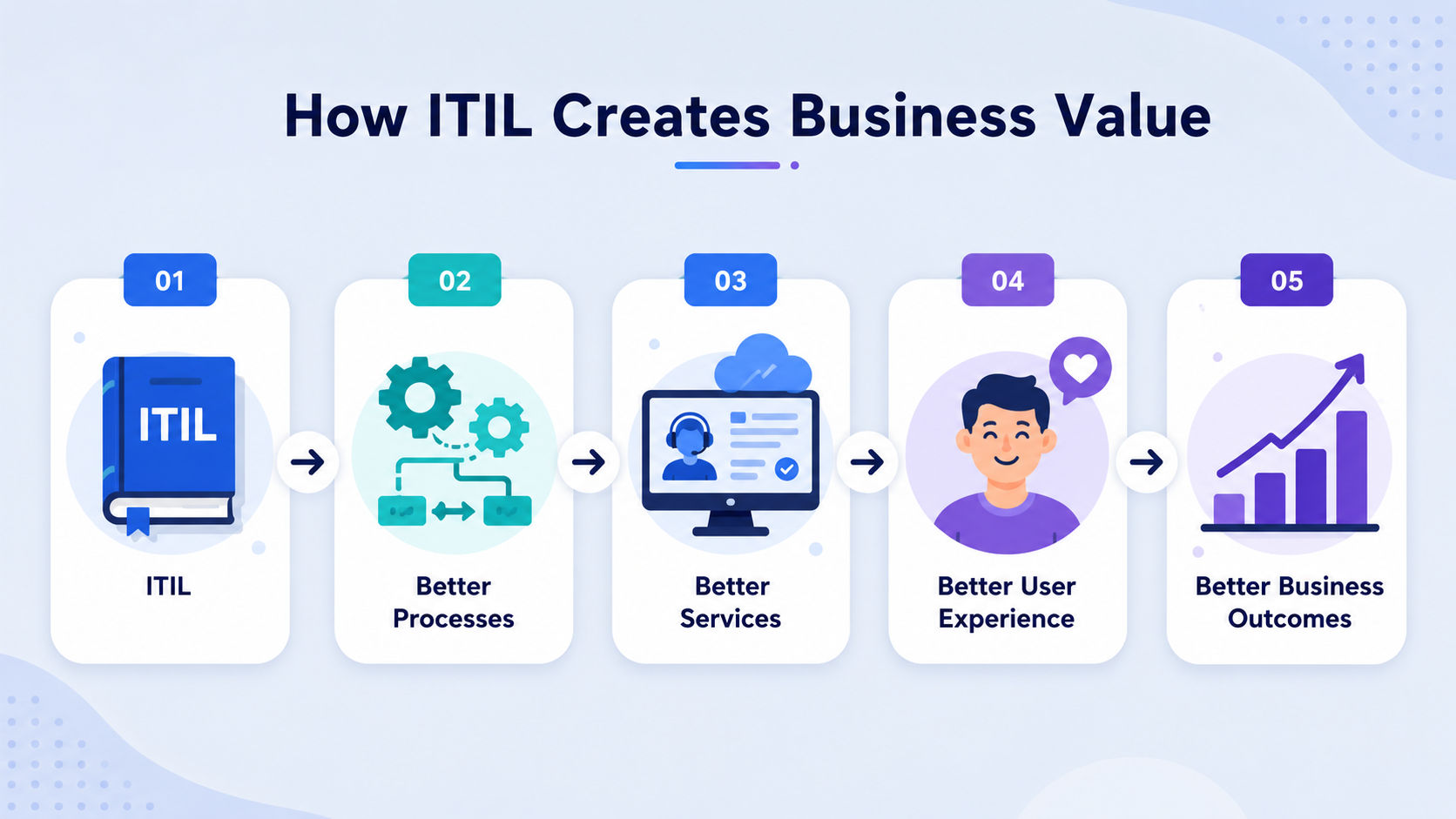
ITIL connects IT services with business objectives
ITIL helps move IT beyond a technical support function. A service can be evaluated according to the outcome it creates for customers, employees, and the wider organization.
For example, improving an internal employee service is not only about reducing ticket volume. It can also mean helping employees complete their work faster.
ITIL focuses on value rather than IT activity
One of the important ideas behind modern ITIL is value co-creation. PeopleCert describes ITIL Version 5 as focusing on value creation, stakeholder collaboration and digital products and services across their lifecycle.
This changes the conversation from “How many tickets were closed?” to “What improved because the service was managed better?”
ITIL creates a structured but adaptable approach
ITIL is guidance, not a rigid rulebook. Organizations can select and adapt to practices based on business size, service maturity, technology environment, and operational priorities.
That flexibility is important because a global enterprise and a growing technology company will not have identical service management needs.
A simple way to understand the value chain is:
ITIL → Better Processes → Better Services → Better User Experience → Better Business Outcomes
Also Read: Service Management in ITIL
Which ITIL Practices Deliver the Biggest Organizational Benefits?
Not all ITIL practices create the same level of impact. Some practices directly improve service reliability, reduce downtime, and help teams manage daily operations more effectively.
ITIL Practice |
Primary Organizational Outcome |
| Incident Management | Faster service restoration |
| Problem Management | Fewer recurring incidents |
| Change Enablement | Safer, controlled change |
| Service Level Management | Clear service expectations |
| Service Configuration Management | Better visibility of service relationships |
| Service Request Management | Efficient fulfilment of standard requests |
| Continual Improvement | Ongoing performance improvement |
| Knowledge Management | Faster resolution and knowledge sharing |
| IT Asset Management | Better asset lifecycle and cost control |
Building strong service management capabilities often requires continuous learning. Exploring ITSM Certifications from upGrad KnowledgeHut can help professionals develop the skills needed to improve service delivery, governance, and operational efficiency.
Business Outcomes Organizations Can Expect After ITIL Adoption
The real value of ITIL comes from the improvements organizations see after applying its practices. When IT services become more structured and efficient, businesses can achieve better performance, lower risks, and improved user experiences.
1. Reduced Downtime
With faster incident response and better problem management, teams can restore services quickly and prevent the same issues from happening again.
2. Improved SLA Compliance
Clear service targets and regular performance tracking help organizations identify gaps and improve their ability to meet service commitments.
3. Higher Customer Satisfaction
Reliable services, faster support, and clear communication create a better experience for customers and employees.
4. Lower Support Costs
Standard processes, better documentation, knowledge sharing, and automation help reduce repetitive tasks and improve support efficiency.
5. Improved Employee Productivity
When IT services work smoothly, employees spend less time dealing with technical issues and more time focusing on important business activities.
6. Better Governance
Defined roles, controlled changes, proper documentation, and risk management practices help organizations maintain better control over IT operations.
Before and After ITIL KPI Framework
| KPI | Before ITIL | After ITIL |
| MTTR | Baseline varies | Target faster restoration |
| Change Failure Rate | Baseline varies | Target fewer failed changes |
| First Contact Resolution | Baseline varies | Target higher resolution |
| CSAT | Baseline varies | Target improved satisfaction |
| SLA Compliance | Baseline varies | Target stronger achievement |
| Mean Time Between Failures | Baseline varies | Target longer service stability |
Challenges Organizations May Face When Implementing ITIL
Understanding the benefits of the ITIL Framework also requires knowing the challenges that can come during implementation. A successful ITIL adoption needs proper planning, team support, and a practical approach.
1. Resistance to Change
Employees may find it difficult to adjust to new processes, roles, or reporting methods, especially when existing ways of working have been followed for a long time.
Clear communication, proper training, and team involvement can help make the transition smoother.
2. Training Requirements
ITIL concepts are more effective when teams understand how to apply them in real situations, not just learn definitions.
Providing practical training helps employees use ITIL practices correctly in daily operations.
3. Over Documentation
Documentation is important in ITSM, but too much documentation can slow down work and create unnecessary complexity.
Organizations should focus on creating useful documents that support faster problem-solving and better service delivery.
4. Process Complexity
Implementing too many ITIL practices at once can make processes complicated and difficult for teams to follow.
A gradual approach allows organizations to introduce processes based on business needs and team readiness.
5. Leadership Commitment
Strong leadership support is important for long-term ITIL success. Without clear direction and involvement from leaders, ITIL initiatives may lose focus when other priorities appear.
6. Measuring ROI
Some ITIL benefits, such as improved user experience, better risk management, and stronger service reliability, may not show immediate financial results.
Organizations need the right metrics to measure progress and understand the overall value of ITIL adoption.
Best Practices for Maximizing ITIL Benefits
Organizations can get more value from ITIL by keeping implementation practical and closely connected to measurable business priorities.
1. Start with business objectives
Begin with the problem that needs solving. If downtime is the biggest concern, incident and problem management may deserve early attention. If deployment risk is the issue, change enablement may be more relevant.
2. Adopt ITIL incrementally
A phased approach allows teams to test, learn, and improve before expanding additional practices.
3. Measure KPIs regularly
Metrics should be reviewed consistently. A KPI has limited value if it is collected but never discussed or acted upon.
4. Combine ITIL with Agile and DevOps
ITIL does not have to compete with Agile or DevOps. Modern service management can work alongside iterative development, automation, continuous delivery and collaborative operating models.
5. Use automation
Automation can improve repetitive workflows such as service requests, notifications, approvals, ticket routing and reporting.
6. Promote continual improvement
The strongest ITIL implementations do not stop after processes are documented. Teams continue reviewing performance and looking for practical improvements.
Conclusion
The Top Benefits of the ITIL Framework go beyond improving IT support. They help organizations deliver reliable services, reduce downtime, control costs, manage risks, and align IT with business goals. By adopting ITIL gradually, tracking meaningful KPIs, and focusing on continual improvement, organizations can turn better IT processes into measurable business value.
In 2026, a practical and flexible ITIL approach can help businesses improve service quality while adapting to changing technology and customer expectations. Ultimately, ITIL works best when it is tailored to business needs rather than treated as a rigid set of rules.
Have A Query? Get in Touch With Our Customer Support | upGrad KnowledgeHut
Frequently Asked Questions (FAQs)
How long does it take to see the benefits of ITIL?
Organizations may see early improvements in areas such as incident handling, service requests, and process consistency within a few months. Larger benefits usually take longer because teams need time to adopt new practices, establish KPIs, and improve workflows. The timeline depends on the organization’s size, IT maturity, and implementation scope.
Is ITIL suitable for small businesses?
Yes, ITIL can be useful for small businesses, provided it is applied proportionately. Smaller organizations do not need to implement every practice or create complicated processes. They can start with practical areas such as incident management, service requests, change enablement, and knowledge management.
What should an organization assess before adopting ITIL?
Before adopting ITIL, organizations should examine their existing IT processes, service performance, pain points, technology environment, and business priorities. This assessment helps identify which practices need attention first instead of implementing ITIL everywhere at once.
How does ITIL affect IT team roles and responsibilities?
ITIL can make responsibilities clearer by defining who owns services, processes, incidents, changes, and improvement activities. It does not necessarily mean creating new roles for every practice. Existing teams can often take on responsibilities based on their size and operating model.
What technology is needed to gain ITIL benefits?
There is no single technology platform required for ITIL. Organizations can use IT service management tools for ticketing, workflows, knowledge management, reporting, configuration information, automation, and service monitoring. The important point is to select technology that supports the desired service management outcomes.
How does ITIL help organizations scale their IT operations?
As an organization grows, informal processes can become difficult to manage. ITIL provides repeatable approaches for handling incidents, changes, requests, service levels, and improvements. This can make it easier to expand IT operations without allowing service quality to become inconsistent.
What is the role of automation in maximizing ITIL benefits?
Automation can make ITIL practices faster and less dependent on manual effort. Organizations can automate routine service requests, ticket routing, notifications, approvals, status updates, and reporting. This allows IT teams to spend more time on complex problems and improvement initiatives.
How does ITIL support AI-driven IT service management?
ITIL can provide the governance and service management structure around AI-enabled operations. Organizations can use AI for areas such as ticket classification, knowledge search, incident analysis, forecasting, and workflow automation while maintaining appropriate oversight, accountability, and risk controls.
What is the best way to get employees to adopt ITIL practices?
Employee adoption improves when teams understand why processes are changing and how the changes will make their work easier. Practical training, clear communication, leadership support, and early wins can make adoption smoother than simply introducing new policies and procedures.
What is the biggest mistake organizations make when adopting ITIL?
One common mistake is focusing too heavily on implementing processes instead of solving business problems. ITIL adoption becomes more effective when organizations define clear objectives, prioritize the most important practices, involve stakeholders, measure outcomes, and adapt the approach as their needs change.
1639 articles published
KnowledgeHut is an outcome-focused global ed-tech company. We help organizations and professionals unlock excellence through skills development. We offer training solutions under the people and proces...
Get Free Consultation
By submitting, I accept the T&C and
Privacy Policy
Ready to fast-track your ITSM career?