
- Blog Categories
- Project Management
- Agile Management
- IT Service Management
- Cloud Computing
- Business Management
- BI And Visualisation
- Quality Management
- Cyber Security
- DevOps
- Most Popular Blogs
- PMP Exam Schedule for 2025: Check PMP Exam Date
- Top 60+ PMP Exam Questions and Answers for 2025
- PMP Cheat Sheet and PMP Formulas To Use in 2025
- What is PMP Process? A Complete List of 49 Processes of PMP
- Top 15+ Project Management Case Studies with Examples 2025
- Top Picks by Authors
- Top 170 Project Management Research Topics
- What is Effective Communication: Definition
- How to Create a Project Plan in Excel in 2025?
- PMP Certification Exam Eligibility in 2025 [A Complete Checklist]
- PMP Certification Fees - All Aspects of PMP Certification Fee
- Most Popular Blogs
- CSM vs PSM: Which Certification to Choose in 2025?
- How Much Does Scrum Master Certification Cost in 2025?
- CSPO vs PSPO Certification: What to Choose in 2025?
- 8 Best Scrum Master Certifications to Pursue in 2025
- Safe Agilist Exam: A Complete Study Guide 2025
- Top Picks by Authors
- SAFe vs Agile: Difference Between Scaled Agile and Agile
- Top 21 Scrum Best Practices for Efficient Agile Workflow
- 30 User Story Examples and Templates to Use in 2025
- State of Agile: Things You Need to Know
- Top 24 Career Benefits of a Certifed Scrum Master
- Most Popular Blogs
- ITIL Certification Cost in 2025 [Exam Fee & Other Expenses]
- Top 17 Required Skills for System Administrator in 2025
- How Effective Is Itil Certification for a Job Switch?
- IT Service Management (ITSM) Role and Responsibilities
- Top 25 Service Based Companies in India in 2025
- Top Picks by Authors
- What is Escalation Matrix & How Does It Work? [Types, Process]
- ITIL Service Operation: Phases, Functions, Best Practices
- 10 Best Facility Management Software in 2025
- What is Service Request Management in ITIL? Example, Steps, Tips
- An Introduction To ITIL® Exam
- Most Popular Blogs
- A Complete AWS Cheat Sheet: Important Topics Covered
- Top AWS Solution Architect Projects in 2025
- 15 Best Azure Certifications 2025: Which one to Choose?
- Top 22 Cloud Computing Project Ideas in 2025 [Source Code]
- How to Become an Azure Data Engineer? 2025 Roadmap
- Top Picks by Authors
- Top 40 IoT Project Ideas and Topics in 2025 [Source Code]
- The Future of AWS: Top Trends & Predictions in 2025
- AWS Solutions Architect vs AWS Developer [Key Differences]
- Top 20 Azure Data Engineering Projects in 2025 [Source Code]
- 25 Best Cloud Computing Tools in 2025
- Most Popular Blogs
- Company Analysis Report: Examples, Templates, Components
- 400 Trending Business Management Research Topics
- Business Analysis Body of Knowledge (BABOK): Guide
- ECBA Certification: Is it Worth it?
- Top Picks by Authors
- Top 20 Business Analytics Project in 2025 [With Source Code]
- ECBA Certification Cost Across Countries
- Top 9 Free Business Requirements Document (BRD) Templates
- Business Analyst Job Description in 2025 [Key Responsibility]
- Business Analysis Framework: Elements, Process, Techniques
- Most Popular Blogs
- Best Career options after BA [2025]
- Top Career Options after BCom to Know in 2025
- Top 10 Power Bi Books of 2025 [Beginners to Experienced]
- Power BI Skills in Demand: How to Stand Out in the Job Market
- Top 15 Power BI Project Ideas
- Top Picks by Authors
- 10 Limitations of Power BI: You Must Know in 2025
- Top 45 Career Options After BBA in 2025 [With Salary]
- Top Power BI Dashboard Templates of 2025
- What is Power BI Used For - Practical Applications Of Power BI
- SSRS Vs Power BI - What are the Key Differences?
- Most Popular Blogs
- Data Collection Plan For Six Sigma: How to Create One?
- Quality Engineer Resume for 2025 [Examples + Tips]
- 20 Best Quality Management Certifications That Pay Well in 2025
- Six Sigma in Operations Management [A Brief Introduction]
- Top Picks by Authors
- Six Sigma Green Belt vs PMP: What's the Difference
- Quality Management: Definition, Importance, Components
- Adding Green Belt Certifications to Your Resume
- Six Sigma Green Belt in Healthcare: Concepts, Benefits and Examples
- Most Popular Blogs
- Latest CISSP Exam Dumps of 2025 [Free CISSP Dumps]
- CISSP vs Security+ Certifications: Which is Best in 2025?
- Best CISSP Study Guides for 2025 + CISSP Study Plan
- How to Become an Ethical Hacker in 2025?
- Top Picks by Authors
- CISSP vs Master's Degree: Which One to Choose in 2025?
- CISSP Endorsement Process: Requirements & Example
- OSCP vs CISSP | Top Cybersecurity Certifications
- How to Pass the CISSP Exam on Your 1st Attempt in 2025?
- Most Popular Blogs
- Top 7 Kubernetes Certifications in 2025
- Kubernetes Pods: Types, Examples, Best Practices
- DevOps Methodologies: Practices & Principles
- Docker Image Commands
- Top Picks by Authors
- Best DevOps Certifications in 2025
- 20 Best Automation Tools for DevOps
- Top 20 DevOps Projects of 2025
- OS for Docker: Features, Factors and Tips
- More
- Agile & PMP Practice Tests
- Agile Testing
- Agile Scrum Practice Exam
- CAPM Practice Test
- PRINCE2 Foundation Exam
- PMP Practice Exam
- Cloud Related Practice Test
- Azure Infrastructure Solutions
- AWS Solutions Architect
- IT Related Pratice Test
- ITIL Practice Test
- Devops Practice Test
- TOGAF® Practice Test
- Other Practice Test
- Oracle Primavera P6 V8
- MS Project Practice Test
- Project Management & Agile
- Project Management Interview Questions
- Release Train Engineer Interview Questions
- Agile Coach Interview Questions
- Scrum Interview Questions
- IT Project Manager Interview Questions
- Cloud & Data
- Azure Databricks Interview Questions
- AWS architect Interview Questions
- Cloud Computing Interview Questions
- AWS Interview Questions
- Kubernetes Interview Questions
- Web Development
- CSS3 Free Course with Certificates
- Basics of Spring Core and MVC
- Javascript Free Course with Certificate
- React Free Course with Certificate
- Node JS Free Certification Course
- Data Science
- Python Machine Learning Course
- Python for Data Science Free Course
- NLP Free Course with Certificate
- Data Analysis Using SQL
- Home
- Blog
- Project Management
- PRINCE2 Exam Format and Question Types: Complete Guide for 2026
PRINCE2 Exam Format and Question Types: Complete Guide for 2026
Updated on Oct 08, 2026 | 1.45K+ views
Share:
Table of Contents
View all
Quick Overview
- The PRINCE2 exam assesses your knowledge and understanding of PRINCE2 at Foundation level and your ability to apply the method in project situations at Practitioner level.
- The PRINCE2 exam format includes a 60-question, 60-minute closed-book Foundation exam and a 56-question-and-sub-question, 150-minute open-book Practitioner exam.
- Both PRINCE2 exams have a 60% passing score, requiring 36/60 marks for Foundation and 42/70 marks for Practitioner.
- Foundation uses multiple-choice question formats, while Practitioner focuses on applying PRINCE2 through project-based scenarios.
- This guide covers the PRINCE2 exam format, question types, exam structure, duration, scoring, and key differences between Foundation and Practitioner.
Ready to prepare for the PRINCE2 exam? Build your understanding of the exam format, question types, and core project management concepts with PRINCE2 Foundation and Practitioner Certification Training from upGrad KnowledgeHut.
Ultimate PMP Formula Cheat Sheet
Get a quick, exam-ready PMP cheat sheet with all essential formulas and key concepts in one place.
What is the PRINCE2 exam format?
PRINCE2 examination format is categorized into two forms, these are the PRINCE2 Foundation and PRINCE2 Practitioner. PRINCE2 Foundation examination tests the candidates' knowledge of the PRINCE2 principles while the PRINCE2 Practitioner tests the candidates' knowledge in application of PRINCE2 principles in projects.
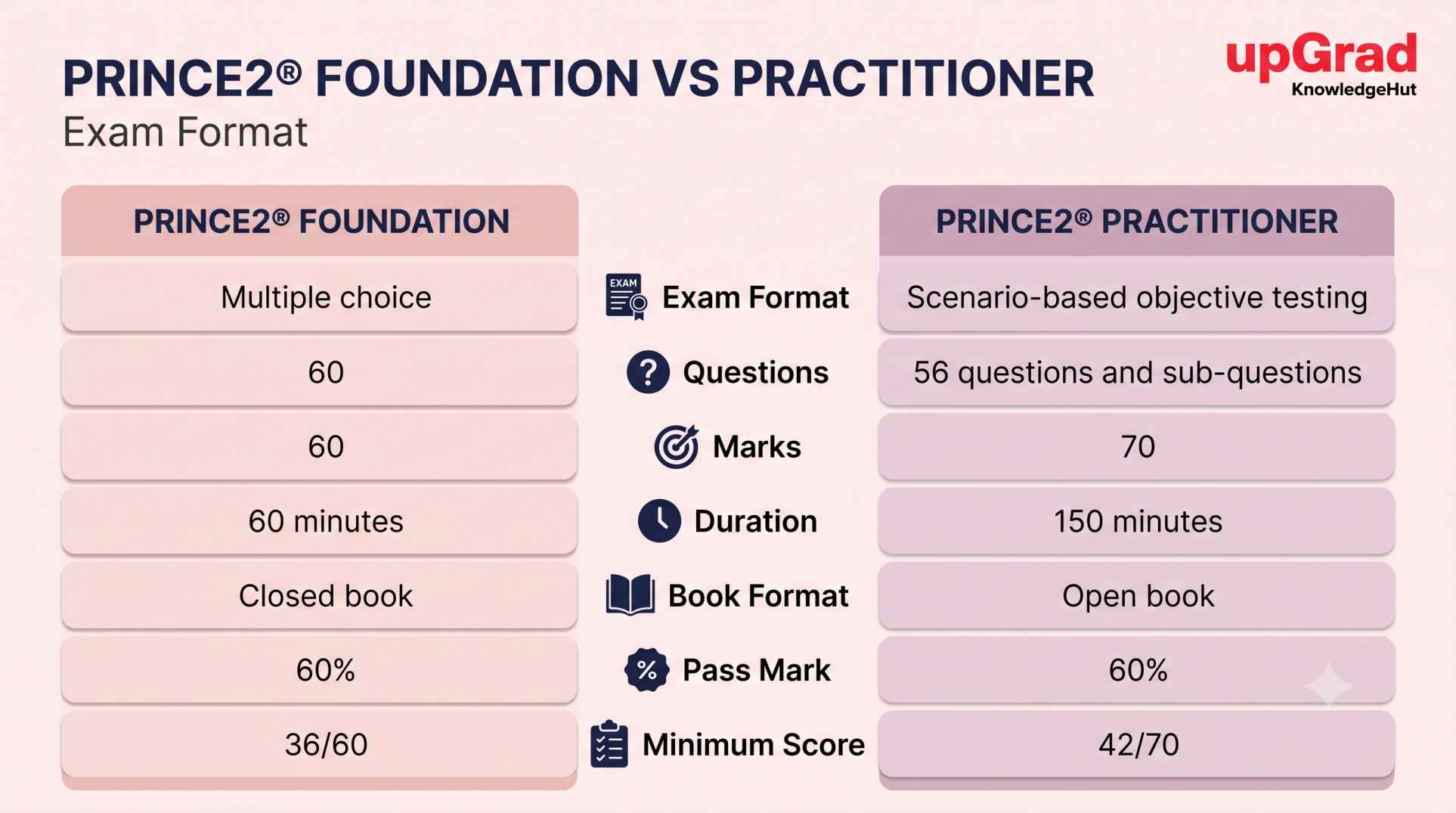
The following table gives a summary of the PRINCE2 examination format.
Exam factor |
PRINCE2 Foundation |
PRINCE2 Practitioner |
| Exam format | Multiple choice | Scenario-based objective testing |
| Questions | 60 | 56 questions and sub-questions |
| Marks | 60 | 70 |
| Duration | 60 minutes | 150 minutes |
| Book format | Closed book | Open book |
| Pass mark | 60% | 60% |
| Minimum score | 36/60 | 42/70 |
What is the format of the PRINCE2 Foundation exam?
The PRINCE2 Foundation certification is designed for beginners who want to learn the fundamentals of the PRINCE2 project management methodology. It checks whether you understand the basic PRINCE2 Project Management method. It is the entry-level exam and is mainly concerned with knowledge and understanding.
PRINCE2 Foundation exam structure
The Foundation exam includes:
- Exam mode: Online, remotely proctored
- Number of questions: 60 multiple-choice questions
- Exam duration: 60 minutes
- Exam type: Closed book
- Passing marks: 60%
- Minimum marks: 36 marks
- Question format: Objective multiple-choice questions
What does the Foundation exam test?
The Foundation exam focuses on the understanding of:
- PRINCE2 principles
- PRINCE2 practices
- PRINCE2 processes
- Project roles and responsibilities
- Management products
- Key terminology and concepts
What question types appear in the PRINCE2 Foundation exam?
The PRINCE2 Foundation exam uses various forms of objective type questions to assess the candidate’s knowledge of the terminologies and concepts.
Standard multiple-choice questions
You will need to choose one correct answer out of four possible options in these types of questions. These types of questions are widely used in order to check your understanding of PRINCE2 and project management terminology.
Negative-format questions
In negative-format questions you have to select an answer that is NOT true or NOT correct.
Example:
Which is NOT a characteristic of a project?
- Has a higher degree of risk than business as usual
- Involves people with different skills introducing a change that will impact others outside of the team
- Has a lifespan that usually covers the delivery of the desired outcomes and the realization of all the expected benefits
- A temporary management structure created for the implementation of business products
Multiple-response questions
In these questions, you are supposed to choose more than one answer. To score marks in this section, all correct answers must be chosen. This type of question is asked to test the wider knowledge of the topic.
Example:
Which of the following are described in a Product Description?
- The component parts of the product
- The products that are derived from this product
- The skills needed to create the product
- The method required to check the product
- 1, 2, 3
- 1, 2, 4
- 1, 3, 4
- 2, 3, 4
Fill-in-the-blank questions
In this type, the sentence will contain some blank part that requires the selection of the option that appropriately completes the given statement according to the PRINCE2 guideline and terminologies.
Example:
The purpose of the […?...] theme is to identify, assess and control uncertainty and improve the ability of the project to succeed.
Identify the missing word from the sentence.
A. Progress
B. Plan
C. Risk
D. Organisation
Correct statement questions
A statement question will contain multiple statements where only one is the correct statement about PRINCE2 concept, role, process, or practice. You have to pick the right statement.
Best-answer questions
These questions provide several answers, and more than one of them might appear as a right one. But there is always going to be an answer that is more suitable to the given question or situation according to the PRINCE2 guidelines.
"Only" questions
There is a specific kind of question that might have the word “only.” It means that the question might be asking which statement is only true in some specific situation.
Looking to build AI skills alongside your project management expertise? Explore the Applied Agentic AI Certification Course from upGrad KnowledgeHut to learn how AI agents can support modern project workflows and decision-making.
What is the PRINCE2 Practitioner exam format?
The PRINCE2 Practitioner examination is the second level of PRINCE2 certification. It is meant for professionals who wish to prove their capability in applying the PRINCE2 methodology to practical projects. The PRINCE2 Practitioner exam checks how good you are at making decisions using PRINCE2 in projects.
PRINCE2 Practitioner exam structure
The Practitioner exam includes:
- Exam mode: Online through remote proctoring or at an authorized test center
- Number of questions: 56 questions and sub-questions
- Total marks: 70 marks
- Exam duration: 150 minutes
- Exam type: Open-book exam using the official PRINCE2 manual
- Passing marks: 60%
- Minimum marks: 42 marks
- Question format: Objective multiple-choice questions
What does the Practitioner exam test?
The Practitioner exam evaluates the ability to:
- Apply PRINCE2 principles in projects
- Tailor PRINCE2 for different project environments
- Analyze project situations
- Make decisions based on PRINCE2 guidance
- Use PRINCE2 practices effectively
Which type of questions are asked in the PRINCE2 Practitioner exam?
The Practitioner examination tests candidates on question types that require analysis, interpretations, and decisions.
Understanding these question styles can help you approach the exam more effectively.
Scenario-based questions
Scenario-based questions are at the core of the Practitioner exam. Candidates are given a project scenario and are expected to use the PRINCE2 principles, practices, or processes in that situation.
It is important to know how PRINCE2 will be applied in real life and not just remember the theory.
Assertion and reason questions
This type of questions offers an assertion and reasons for it. Candidates have to decide whether the assertion is true and whether the given reason supports it. This type of question checks the ability to think logically and to know the PRINCE2 relationships.
Best-answer questions
Such questions are popular in the Practitioner exam. Several answers can look correct, but only one represents the best PRINCE2 practice according to the project scenario. This type of question tests candidate's judgment.
Problem-solving questions
Problem-solving questions test the ability of candidates to understand project problems and find out how to solve them using the help of PRINCE2 guidelines.
You may need to determine:
- Appropriate actions to take
- Suitable management controls
- Correct responsibilities
- Recommended project decisions
Want to use AI more effectively in project planning and execution? Build practical skills in generative AI and prompt engineering with the Generative AI and Prompt Engineering Course for Professionals from upGrad KnowledgeHut.
Conclusion
Understanding the PRINCE2 exam format helps you prepare for the type of questions you will actually face. Foundation focuses on understanding PRINCE2 concepts through multiple-choice questions, while Practitioner tests how well you can apply those concepts to project situations.
Knowing the question styles, exam duration, scoring, and book rules also helps you manage your time effectively. Use these details to structure your preparation around the specific exam level you plan to take.
Have A Query? Get in Touch With Our Customer Support | upGrad KnowledgeHut
Frequently Asked Questions (FAQs)
1. How many questions are in the PRINCE2 exam?
The PRINCE2 Foundation exam has 60 multiple-choice questions. The Practitioner exam has 56 questions and sub-questions, with a total of 70 marks available. Foundation lasts 60 minutes, while Practitioner lasts 150 minutes.
2. How many marks are needed to pass PRINCE2?
You need 36 out of 60 marks (60%) to pass the Foundation exam. For Practitioner, you need 42 out of 70 marks (60%). The pass mark is therefore 60% for both exam levels.
3. What is the difference between Foundation and Practitioner exam formats?
Foundation is a 60-minute, closed-book multiple-choice exam that tests your understanding of PRINCE2 concepts. Practitioner is a 150-minute, open-book exam with 56 questions and sub-questions worth 70 marks, focusing on applying PRINCE2 in project situations.
4. Does PRINCE2 have negative marking?
No, PRINCE2 exams do not use negative marking. You are not given a penalty for selecting an incorrect answer. This means you should attempt every question rather than leaving an answer blank.
5. How much time should I spend on each PRINCE2 question?
For Foundation, you have 60 minutes for 60 questions, so aim for about one minute per question. Practitioner gives you 150 minutes for 70 available marks, so allow more time for reading and analysing scenarios and avoid spending too long on one question.
6. Can I use the PRINCE2 manual during Practitioner?
Yes, the Practitioner exam is open book, so you can use the permitted PRINCE2 reference material during the exam. However, relying on the manual for every answer can waste valuable time, so it is better to know the key concepts and use the book mainly to confirm details.
7. How are Practitioner questions different from Foundation questions?
Foundation questions mainly test knowledge and understanding of PRINCE2 concepts and terminology. Practitioner questions focus on applying that knowledge to project scenarios, so you need to analyse the situation and select the response that best fits PRINCE2.
8. Is PRINCE2 recognized outside Europe in 2026?
Yes, PRINCE2 has strong global recognition, especially in regions like the Middle East, India, Australia, and parts of Asia. Many multinational companies use PRINCE2 frameworks, making the certification valuable for cross-border project roles and structured enterprise environments.
9. What preparation approach works best for each exam?
For Foundation, focus on understanding PRINCE2 terminology, principles, practices, and processes, then practise different multiple-choice question styles. For Practitioner, spend more time working through project scenarios and practising how to apply PRINCE2 concepts to specific situations.
10. What mistakes cause candidates to lose marks?
Common mistakes include reading questions too quickly, overlooking words such as “NOT,” confusing similar PRINCE2 terms, and choosing an answer that sounds generally correct rather than the one that best fits the method. In Practitioner, failing to use the scenario details or relying too heavily on the manual can also cost valuable marks.
1648 articles published
KnowledgeHut is an outcome-focused global ed-tech company. We help organizations and professionals unlock excellence through skills development. We offer training solutions under the people and proces...
Get Free Consultation
By submitting, I accept the T&C and
Privacy Policy