
- Blog Categories
- Project Management
- Agile Management
- IT Service Management
- Cloud Computing
- Business Management
- BI And Visualisation
- Quality Management
- Cyber Security
- DevOps
- Most Popular Blogs
- PMP Exam Schedule for 2025: Check PMP Exam Date
- Top 60+ PMP Exam Questions and Answers for 2025
- PMP Cheat Sheet and PMP Formulas To Use in 2025
- What is PMP Process? A Complete List of 49 Processes of PMP
- Top 15+ Project Management Case Studies with Examples 2025
- Top Picks by Authors
- Top 170 Project Management Research Topics
- What is Effective Communication: Definition
- How to Create a Project Plan in Excel in 2025?
- PMP Certification Exam Eligibility in 2025 [A Complete Checklist]
- PMP Certification Fees - All Aspects of PMP Certification Fee
- Most Popular Blogs
- CSM vs PSM: Which Certification to Choose in 2025?
- How Much Does Scrum Master Certification Cost in 2025?
- CSPO vs PSPO Certification: What to Choose in 2025?
- 8 Best Scrum Master Certifications to Pursue in 2025
- Safe Agilist Exam: A Complete Study Guide 2025
- Top Picks by Authors
- SAFe vs Agile: Difference Between Scaled Agile and Agile
- Top 21 Scrum Best Practices for Efficient Agile Workflow
- 30 User Story Examples and Templates to Use in 2025
- State of Agile: Things You Need to Know
- Top 24 Career Benefits of a Certifed Scrum Master
- Most Popular Blogs
- ITIL Certification Cost in 2025 [Exam Fee & Other Expenses]
- Top 17 Required Skills for System Administrator in 2025
- How Effective Is Itil Certification for a Job Switch?
- IT Service Management (ITSM) Role and Responsibilities
- Top 25 Service Based Companies in India in 2025
- Top Picks by Authors
- What is Escalation Matrix & How Does It Work? [Types, Process]
- ITIL Service Operation: Phases, Functions, Best Practices
- 10 Best Facility Management Software in 2025
- What is Service Request Management in ITIL? Example, Steps, Tips
- An Introduction To ITIL® Exam
- Most Popular Blogs
- A Complete AWS Cheat Sheet: Important Topics Covered
- Top AWS Solution Architect Projects in 2025
- 15 Best Azure Certifications 2025: Which one to Choose?
- Top 22 Cloud Computing Project Ideas in 2025 [Source Code]
- How to Become an Azure Data Engineer? 2025 Roadmap
- Top Picks by Authors
- Top 40 IoT Project Ideas and Topics in 2025 [Source Code]
- The Future of AWS: Top Trends & Predictions in 2025
- AWS Solutions Architect vs AWS Developer [Key Differences]
- Top 20 Azure Data Engineering Projects in 2025 [Source Code]
- 25 Best Cloud Computing Tools in 2025
- Most Popular Blogs
- Company Analysis Report: Examples, Templates, Components
- 400 Trending Business Management Research Topics
- Business Analysis Body of Knowledge (BABOK): Guide
- ECBA Certification: Is it Worth it?
- Top Picks by Authors
- Top 20 Business Analytics Project in 2025 [With Source Code]
- ECBA Certification Cost Across Countries
- Top 9 Free Business Requirements Document (BRD) Templates
- Business Analyst Job Description in 2025 [Key Responsibility]
- Business Analysis Framework: Elements, Process, Techniques
- Most Popular Blogs
- Best Career options after BA [2025]
- Top Career Options after BCom to Know in 2025
- Top 10 Power Bi Books of 2025 [Beginners to Experienced]
- Power BI Skills in Demand: How to Stand Out in the Job Market
- Top 15 Power BI Project Ideas
- Top Picks by Authors
- 10 Limitations of Power BI: You Must Know in 2025
- Top 45 Career Options After BBA in 2025 [With Salary]
- Top Power BI Dashboard Templates of 2025
- What is Power BI Used For - Practical Applications Of Power BI
- SSRS Vs Power BI - What are the Key Differences?
- Most Popular Blogs
- Data Collection Plan For Six Sigma: How to Create One?
- Quality Engineer Resume for 2025 [Examples + Tips]
- 20 Best Quality Management Certifications That Pay Well in 2025
- Six Sigma in Operations Management [A Brief Introduction]
- Top Picks by Authors
- Six Sigma Green Belt vs PMP: What's the Difference
- Quality Management: Definition, Importance, Components
- Adding Green Belt Certifications to Your Resume
- Six Sigma Green Belt in Healthcare: Concepts, Benefits and Examples
- Most Popular Blogs
- Latest CISSP Exam Dumps of 2025 [Free CISSP Dumps]
- CISSP vs Security+ Certifications: Which is Best in 2025?
- Best CISSP Study Guides for 2025 + CISSP Study Plan
- How to Become an Ethical Hacker in 2025?
- Top Picks by Authors
- CISSP vs Master's Degree: Which One to Choose in 2025?
- CISSP Endorsement Process: Requirements & Example
- OSCP vs CISSP | Top Cybersecurity Certifications
- How to Pass the CISSP Exam on Your 1st Attempt in 2025?
- Most Popular Blogs
- Top 7 Kubernetes Certifications in 2025
- Kubernetes Pods: Types, Examples, Best Practices
- DevOps Methodologies: Practices & Principles
- Docker Image Commands
- Top Picks by Authors
- Best DevOps Certifications in 2025
- 20 Best Automation Tools for DevOps
- Top 20 DevOps Projects of 2025
- OS for Docker: Features, Factors and Tips
- More
- Agile & PMP Practice Tests
- Agile Testing
- Agile Scrum Practice Exam
- CAPM Practice Test
- PRINCE2 Foundation Exam
- PMP Practice Exam
- Cloud Related Practice Test
- Azure Infrastructure Solutions
- AWS Solutions Architect
- IT Related Pratice Test
- ITIL Practice Test
- Devops Practice Test
- TOGAF® Practice Test
- Other Practice Test
- Oracle Primavera P6 V8
- MS Project Practice Test
- Project Management & Agile
- Project Management Interview Questions
- Release Train Engineer Interview Questions
- Agile Coach Interview Questions
- Scrum Interview Questions
- IT Project Manager Interview Questions
- Cloud & Data
- Azure Databricks Interview Questions
- AWS architect Interview Questions
- Cloud Computing Interview Questions
- AWS Interview Questions
- Kubernetes Interview Questions
- Web Development
- CSS3 Free Course with Certificates
- Basics of Spring Core and MVC
- Javascript Free Course with Certificate
- React Free Course with Certificate
- Node JS Free Certification Course
- Data Science
- Python Machine Learning Course
- Python for Data Science Free Course
- NLP Free Course with Certificate
- Data Analysis Using SQL
How to Advance from CSPO to A-CSPO: What You Need to Know
Updated on Jul 25, 2026 | 292 views
Share:
Table of Contents
View all
Quick Overview
- To advance from CSPO to A-CSPO, you need an active CSPO certification, at least 12 months of Product Owner experience in the past five years, and completion of a Scrum Alliance-approved A-CSPO course.
- No certification exam is required, making the transition focused on practical learning, advanced Product Ownership skills, and preparation for senior Product Owner and product leadership roles.
- Many Agile professionals pursue the CSPO to A-CSPO path to deepen their Product Ownership expertise, move beyond Scrum fundamentals, and prepare for senior Product Owner and product leadership roles.
- This guide covers the requirements to upgrade from CSPO to A-CSPO, key differences between foundational and advanced Product Owner skills, the step-by-step certification process, and the career opportunities available after earning A-CSPO.
Build a solid Product Ownership foundation with upGrad KnowledgeHut CSPO Certification Training before advancing to A-CSPO.
Master the Right Skills & Boost Your Career
Avail your free 1:1 mentorship session
Understanding the CSPO to A-CSPO Certification Path
The CSPO to A-CSPO certification path is for Product Owners who already understand the basics and want to build more advanced skills.
The CSPO certification teaches the core responsibilities of a Product Owner. This includes managing the product backlog, setting priorities, and working closely with the Scrum team.
The A-CSPO certification takes your knowledge to the next level. It focuses on advanced topics such as making better product decisions, managing stakeholders, discovering customer needs, testing new ideas, using customer feedback, and handling larger product responsibilities.
This certification is part of Scrum Alliance's Product Owner learning path. It also prepares you for the next step, which is becoming a Certified Scrum Professional Product Owner (CSP-PO).
What Is A-CSPO?
The Advanced Certified Scrum Product Owner (A-CSPO) is an advanced certification from Scrum Alliance. It is designed for experienced Product Owners who want to improve their product management, leadership, and stakeholder management skills.
A-CSPO is the next step after earning the CSPO certification. It is meant for professionals who have real experience working as Product Owners and want to take on bigger product responsibilities and solve more complex challenges.
The A-CSPO certification covers advanced topics, including:
- Product strategy and long-term planning
- Understanding customer needs and expectations
- Improving and managing the product backlog
- Prioritizing work based on business value
- Building strong relationships with stakeholders
- Making better product decisions
- Leading products more effectively
The main goal of the A-CSPO certification is to help Product Owners go beyond the basics of Scrum. Instead of focusing only on the Scrum framework, it teaches practical skills that help create better products and deliver more value to customers.
CSPO vs A-CSPO: What's the Difference?
CSPO helps you build a strong foundation in the Product Owner role and Scrum practices. A-CSPO builds on that foundation by developing advanced skills for handling complex product challenges, working with stakeholders, and delivering greater business value.
The table below highlights the key differences between the two certifications:
Feature |
CSPO |
A-CSPO |
Level |
Foundational | Advanced |
Experience Required |
No | 12 months of PO experience within the last 5 years |
Focus |
Scrum basics and Product Owner fundamentals | Advanced Product Ownership skills and techniques |
Stakeholder Management |
Basic collaboration and communication | Advanced stakeholder influence and alignment |
Product Strategy |
Introductory concepts | In-depth strategic product thinking |
Practical Exercises |
Moderate | Extensive, real-world application focused |
Certification Goal |
Entry-level Product Owner | Experienced Product Owner seeking growth and leadership |
Who Is Eligible to Upgrade?
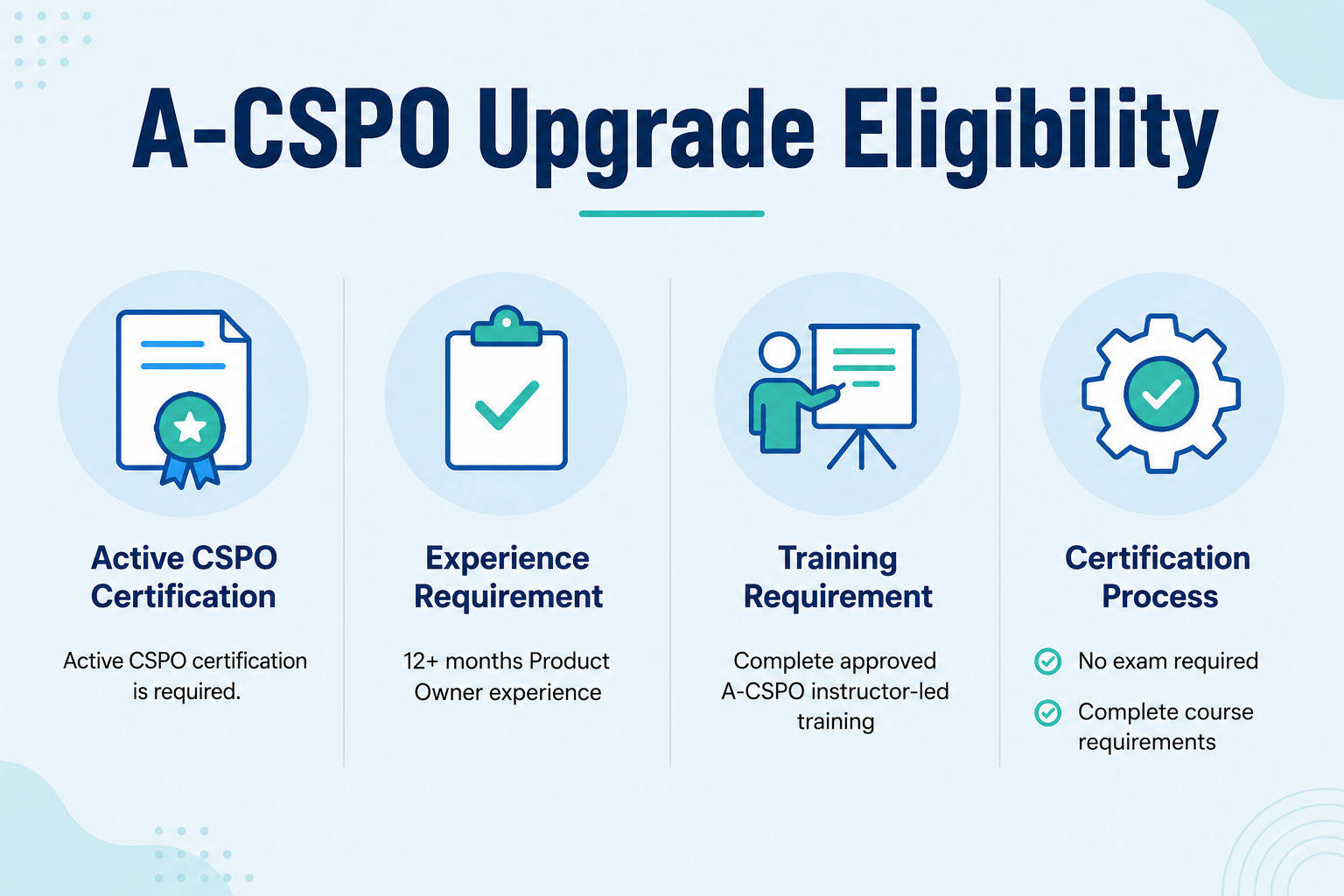
To upgrade from CSPO to A-CSPO, candidates must meet the eligibility requirements defined by Scrum Alliance. As an advanced certification, A-CSPO is intended for Product Owners with both Scrum knowledge and practical experience.
Active CSPO Certification
An active Certified Scrum Product Owner (CSPO) certification is mandatory. If the CSPO certification has expired, renewal is required before enrolling in the A-CSPO course.
Eligibility Requirements
Candidates must:
- Hold an active CSPO certification.
- Complete an approved A-CSPO training course conducted by a Scrum Alliance Certified Scrum Trainer (CST).
- Have at least 12 months of Product Owner experience within the last five years.
- Successfully complete all course requirements.
Required Product Owner Experience
Relevant experience includes:
- Managing and prioritizing the product backlog.
- Collaborating with stakeholders to define product goals.
- Working closely with Scrum teams during product development.
- Making product decisions based on business value.
Training and Experience Validation
A-CSPO does not require a certification exam. Certification is awarded after completing an interactive instructor-led training program that includes workshops, practical exercises, group discussions, and real-world case studies.
Candidates must also document their Product Owner experience in the Scrum Alliance system to complete the certification process.
Expand Scrum knowledge and Product Ownership capabilities with upGrad KnowledgeHut Agile Management training to support the transition from CSPO to A-CSPO.
Step-by-Step Process to Advance from CSPO to A-CSPO
Moving from CSPO to A-CSPO is a natural next step for Product Owners who want to build advanced skills and take on more complex product challenges.
The process involves meeting the experience requirements, completing the right training, and earning the advanced certification.
Step 1: Keep the CSPO Certification Active
The first step is to have an active CSPO certification. Keeping the certification current ensures that the Scrum fundamentals needed for A-CSPO are already in place.
Step 2: Build Product Owner Experience
A-CSPO is designed for experienced Product Owners. Candidates need at least 12 months of Product Owner experience within the last five years to connect advanced concepts with real product situations and challenges.
Step 3: Join an Approved A-CSPO Course
The next step is to enroll in an A-CSPO course from a Scrum Alliance Certified Scrum Trainer (CST). The training focuses on practical learning through real-world examples, workshops, discussions, product discovery methods, stakeholder management, and advanced Product Owner practices.
Step 4: Complete the Training Program
Unlike many certifications, A-CSPO does not require a separate exam. Certification is earned by actively participating in the instructor-led course and completing the required learning activities.
Step 5: Earn the A-CSPO Certification
After successfully completing the course and meeting all requirements, the A-CSPO certification is awarded by Scrum Alliance. The certification can then be added to professional profiles, resumes, and career portfolios to showcase advanced Product Owner skills.
Career Benefits of Advancing from CSPO to A-CSPO
Advancing from CSPO to A-CSPO signals a move from basic Scrum knowledge to true product mastery. It builds the expertise needed to navigate complex products, manage tough stakeholder dynamics, and drive bottom-line business value.
1. Accelerated Career Growth
A-CSPO deepens expertise in product vision, backlog strategy, and cross-functional alignment. This advanced skill set opens doors to high-level roles:
- Senior Product Owner
- Product Manager
- Agile Product Lead
- Product Strategist
2. Leadership & Strategic Impact
The certification sharpens high-level decision-making and leadership abilities:
- Aligns daily product work directly with overarching business goals.
- Enables confident, value-based trade-offs under pressure.
- Improves collaboration with executives, development teams, and end users.
- Prepares professionals to lead large-scale, high-stakes product initiatives.
3. Enhanced Product Strategy
Rather than focusing solely on day-to-day task tracking, A-CSPO shifts focus toward strategic output:
- Drafting long-term product roadmaps and visions.
- Uncovering deep customer insights through discovery methods.
- Utilizing data and ROI metrics to dictate backlog order.
4. Industry Credibility & Global Reach
Backed by Scrum Alliance, A-CSPO carries international recognition. It offers verified proof of advanced product leadership, making profiles stand out to top employers worldwide.
Conclusion
Advancing from CSPO to A-CSPO helps experienced Product Owners build advanced Product Ownership skills and prepare for strategic leadership roles. With no certification exam and a practical, experience-driven approach, A-CSPO enhances professional credibility, expands career opportunities, and supports long-term growth in Agile product management.
For professionals aiming to progress into senior Product Owner or Product Manager roles, A-CSPO is a valuable next step in the Scrum Alliance certification journey.
Have A Query? Get in Touch With Our Customer Support | upGrad KnowledgeHut
Frequently Asked Questions (FAQs)
How long does it take to move from CSPO to A-CSPO?
The timeline depends on Product Owner experience. Since Scrum Alliance requires at least 12 months of Product Owner experience within the last five years, many professionals become eligible after gaining hands-on experience while working in Agile teams. Once eligible, the certification can be completed by attending an approved A-CSPO course.
Is A-CSPO worth pursuing after CSPO?
A-CSPO is a valuable next step for professionals who want to move beyond Scrum basics and develop stronger Product Ownership skills. The certification focuses on product strategy, stakeholder management, and value-driven decision-making, making it especially useful for career growth into senior product roles.
Does A-CSPO expire after certification?
Yes. Like other Scrum Alliance certifications, A-CSPO must be renewed periodically to remain active. Renewal typically involves earning the required Scrum Education Units (SEUs) and paying the renewal fee, helping professionals stay current with Agile practices.
What skills should be developed before enrolling in an A-CSPO course?
Having practical experience with backlog management, stakeholder communication, Sprint Planning, product prioritization, and customer collaboration makes the learning experience much more valuable. A basic understanding of Agile metrics and product strategy is also beneficial.
What should be considered when choosing an A-CSPO training provider?
Look for a Scrum Alliance-approved training provider with experienced Certified Scrum Trainers (CSTs), interactive workshops, real-world case studies, and post-training support. Practical learning opportunities often provide greater long-term value than lecture-based sessions.
What soft skills become stronger after completing A-CSPO?
Along with Product Ownership practices, A-CSPO helps strengthen communication, negotiation, facilitation, conflict resolution, collaboration, and leadership skills. These abilities are essential for working with cross-functional teams and diverse stakeholders.
What happens after completing the A-CSPO certification?
After earning A-CSPO, many professionals continue building their expertise through practical experience before pursuing the Certified Scrum Professional - Product Owner (CSP-PO) certification. Others use A-CSPO to qualify for more senior Product Owner or Product Manager opportunities.
Can A-CSPO support career growth in Agile organizations?
Yes. Many Agile organizations prefer professionals who demonstrate both practical experience and advanced Scrum knowledge. A-CSPO showcases a commitment to continuous learning and can strengthen eligibility for senior Product Owner and product leadership positions.
What common mistakes should professionals avoid when moving from CSPO to A-CSPO?
A common mistake is treating A-CSPO as just another certification instead of an opportunity to strengthen practical Product Ownership skills. Gaining meaningful Product Owner experience, actively participating in training, and applying the concepts at work help maximize the value of the CSPO to A-CSPO journey.
Can international employers recognize the A-CSPO certification?
Yes. Since Scrum Alliance certifications are recognized globally, A-CSPO can strengthen professional credibility across organizations that use Agile and Scrum practices. It demonstrates advanced Product Ownership capabilities recognized in many international job markets.
1648 articles published
KnowledgeHut is an outcome-focused global ed-tech company. We help organizations and professionals unlock excellence through skills development. We offer training solutions under the people and proces...
Get Free Consultation
By submitting, I accept the T&C and
Privacy Policy
Ready to learn about Agile Certifications Roadmap?