
What Is CSPO Certification? A Complete Beginner's Overview
Updated on Jul 23, 2026 | 255 views
Share:
Table of Contents
View all
- What is CSPO Certification?
- Why is CSPO Certification Important?
- Who Should Pursue a CSPO Certification?
- What Skills Do You Learn in a CSPO Certification Course?
- What Are the Eligibility Requirements for CSPO Certification?
- How Long Does It Take to Earn a CSPO Certification?
- CSPO Certification vs CSM Certification
- CSPO Certification vs PSPO Certification
- Benefits of Becoming a Certified Scrum Product Owner
- Career Opportunities After CSPO Certification
- Conclusion
Quick Overview
- The Certified Scrum Product Owner (CSPO) certification is a globally recognized credential from Scrum Alliance that prepares professionals to lead product development in Agile environments.
- CSPO builds practical Product Owner skills, including product ownership, backlog management, stakeholder collaboration, and Agile product delivery.
- No formal prerequisites or certification exam are required, making CSPO an accessible starting point for aspiring Product Owners and product professionals.
- In this guide, you'll learn what CSPO certification is, who it is for, eligibility requirements, how to earn it, the skills and career benefits it offers, and how it compares with CSM and PSPO to help you choose the right Scrum certification.
Looking to earn a globally recognized CSPO Certification? Explore the upGrad KnowledgeHut CSPO Certification Training for hands-on learning from Certified Scrum Trainers.
Master the Right Skills & Boost Your Career
Avail your free 1:1 mentorship session
What is CSPO Certification?
CSPO Certification stands for Certified Scrum Product Owner, a credential issued by the Scrum Alliance that confirms a person understands the Scrum framework and can perform the accountabilities of a Product Owner on a Scrum team.
Purpose of the certification
The course prepares learners to take on the Product Owner accountability in a Scrum team, with a focus on customer value, backlog management, and return on investment for the work being done.
What skills it validates
- Understand Scrum roles, events, and the Product Owner's responsibilities.
- Create, manage, and continuously refine a product backlog.
- Prioritize work based on customer needs, business value, and product goals.
- Communicate and collaborate effectively with stakeholders, Scrum teams, and customers.
- Apply a product-focused mindset to maximize value throughout the product lifecycle.
Why Was the CSPO Certification Created?
As more companies adopted Agile ways of working, the market needed a reliable way to identify people who actually understood the Product Owner accountability rather than picking up the role informally.
A trained Product Owner helps a Scrum team stay focused on the right features, cutting down wasted development effort and improving delivery speed.
The certification was built to prepare professionals who can translate business goals into a backlog that a development team can actually execute, closing the common gap between what a business wants and what gets built.
What Does a Certified Scrum Product Owner Do?
A Certified Scrum Product Owner typically handles the following:
- Defining and communicating the product vision so the whole team understands the "why" behind the work
- Managing the product backlog, keeping it visible, transparent, and clear to everyone on the team
- Prioritizing features and backlog items based on value, risk, and business need
- Collaborating with stakeholders, customers, and the development team to gather input and set expectations
- Maximizing product value by making sure the team is always working on the most valuable item next
Why is CSPO Certification Important?
CSPO Certification matters because it builds a structured, recognized skill set for a role that many people fall into without formal preparation. Below are the main reasons the certification holds value for a career in Agile product management.
1. Helps Build Product Management Skills
The course walks learners through backlog management, prioritization, and stakeholder handling, giving beginners a practical foundation instead of learning purely through trial and error on the job.
2. Improves Agile and Scrum Knowledge
Even professionals who already work in Agile teams often pick up gaps in their understanding of Scrum theory, events, and the reasoning behind Agile practices, and the CSPO course fills in those gaps.
3. Enhances Career Opportunities
Many job postings for Product Owner, Product Manager, and Business Analyst roles list Scrum certifications as a preferred qualification, so holding a CSPO can widen the pool of roles a candidate qualifies for.
4. Increases Earning Potential
Certified Product Owners often report stronger compensation than uncertified peers with similar experience, since the badge signals a validated understanding of value driven product delivery.
5. Builds Industry Credibility
A CSPO credential from Scrum Alliance is recognized by employers and recruiters globally, giving a resume added weight during screening.
6. Enables Better Stakeholder Management
The course spends significant time on communication and collaboration techniques, preparing Product Owners to manage differing stakeholder expectations more confidently.
Who Should Pursue a CSPO Certification?
CSPO Certification suits a wide range of professionals, not just those already working as Product Owners. Since there is no strict educational prerequisite, the course is open to anyone willing to learn Agile product ownership.
1. Aspiring Product Owners
Those hoping to step into a Product Owner role for the first time gain a structured introduction to the accountability before taking it on.
2. Product Managers
Product Managers working alongside Scrum teams benefit from understanding backlog management and Agile prioritization more deeply.
3. Business Analysts
Business Analysts who translate requirements into deliverables find the certification useful for understanding how a backlog is built and refined.
4. Project Managers
Project Managers moving into Agile environments often use CSPO Certification as a bridge between traditional project management and Scrum based delivery.
5. Scrum Masters
Scrum Masters who want a fuller picture of the Product Owner accountability, and how it interacts with their own role, often add CSPO alongside a CSM credential.
6. Software Developers
Developers who want to understand the reasoning behind backlog prioritization and product decisions gain useful context from the course.
7. UX/UI Professionals
Designers who work closely with Product Owners benefit from understanding how product decisions are prioritized and validated.
8. Entrepreneurs and Startup Founders
Founders acting as their own Product Owner can use the course to structure their product vision and backlog more effectively.
9. Anyone Transitioning into Agile Roles
Professionals moving from non-Agile backgrounds into Scrum based organizations often start with CSPO Certification as their entry point into Agile roles.
What Skills Do You Learn in a CSPO Certification Course?
The CSPO curriculum is built around the practical responsibilities of a Product Owner, broken down into the following areas.
- Scrum Framework Fundamentals: Covers Scrum roles, events, and artifacts, along with the values and principles behind the framework.
- Product Ownership Responsibilities: Explains what the Product Owner accountability actually involves day to day, and how it differs from other roles on the team.
- Product Vision Development: Teaches how to craft and communicate a clear product vision that guides the team's decisions.
- Product Backlog Management: Covers how to build, order, and maintain a healthy product backlog over time.
- User Story Writing: Focuses on writing clear, testable user stories that a development team can act on without confusion.
- Prioritization Techniques: Introduces frameworks for deciding what to build next based on value, cost, and risk.
- Release Planning: Explains how Product Owners plan releases around business milestones and customer needs.
- Stakeholder Communication: Builds skills for managing expectations, negotiating scope, and keeping stakeholders informed.
- Value Driven Product Development: Reinforces the mindset of always optimizing for the value delivered rather than simply following a plan.
- Agile Product Strategy: Ties the tactical backlog work back to a broader product strategy so daily decisions support long term goals.
Strengthen Agile expertise with upGrad KnowledgeHut Agile Management Courses, offering hands-on learning across Scrum, Product Ownership, Agile coaching, and enterprise Agile frameworks.
What Are the Eligibility Requirements for CSPO Certification?
There are no strict eligibility requirements for CSPO Certification. Scrum Alliance designed the course to be open to professionals from a wide range of backgrounds and experience levels.
Is Prior Scrum Experience Required?
No prior Scrum experience is required, though a basic familiarity with the Scrum guide and Agile Manifesto can help a learner follow the course content more easily.
Educational Qualifications
There is no formal degree or educational background required to enroll in the CSPO course, making it accessible to professionals from IT, business, design, and other fields.
Professional Experience
No minimum years of work experience are mandated for the base CSPO Certification, unlike the Advanced CSPO, which requires at least 12 months of Product Owner experience within the past five years.
Is CSM Certification Required Before CSPO?
No. CSPO and CSM sit on separate tracks within Scrum Alliance, and a candidate does not need a CSM before taking the CSPO course.
Also Read: Is CSPO Worth It?
CSPO Certification Course Curriculum
Module |
Topics Covered |
| Scrum Basics | Agile Manifesto, Scrum Values, Scrum Roles |
| Product Ownership | Responsibilities, Accountability |
| Product Vision | Strategy, Roadmaps |
| Product Backlog | Refinement, Prioritization |
| User Stories | Writing Effective Stories |
| Stakeholder Management | Collaboration and Communication |
| Sprint Planning | Product Owner's Role |
| Product Metrics | Measuring Success |
How Long Does It Take to Earn a CSPO Certification?
Training Duration
The mandatory CSPO course typically runs 16 hours, delivered across two full days, whether attended live online or in person.
Certification Timeline
Since there is no separate exam, the certification is issued shortly after the course is completed, and the membership profile is set up on the Scrum Alliance website.
Renewal Requirements
Renewal cycle: CSPO Certification must be renewed every two years.
Renewal fee: Scrum Alliance does not charge a separate renewal fee for CSPO in most cases, though costs may apply depending on how education units are earned.
Scrum Education Units required for renewal: Professionals typically need 20 SEUs within the two year period, earned through further training, webinars, conferences, or other approved learning activities.
CSPO Certification vs CSM Certification
The CSM vs CSPO comparison helps professionals understand the distinct responsibilities of a Product Owner and a Scrum Master.
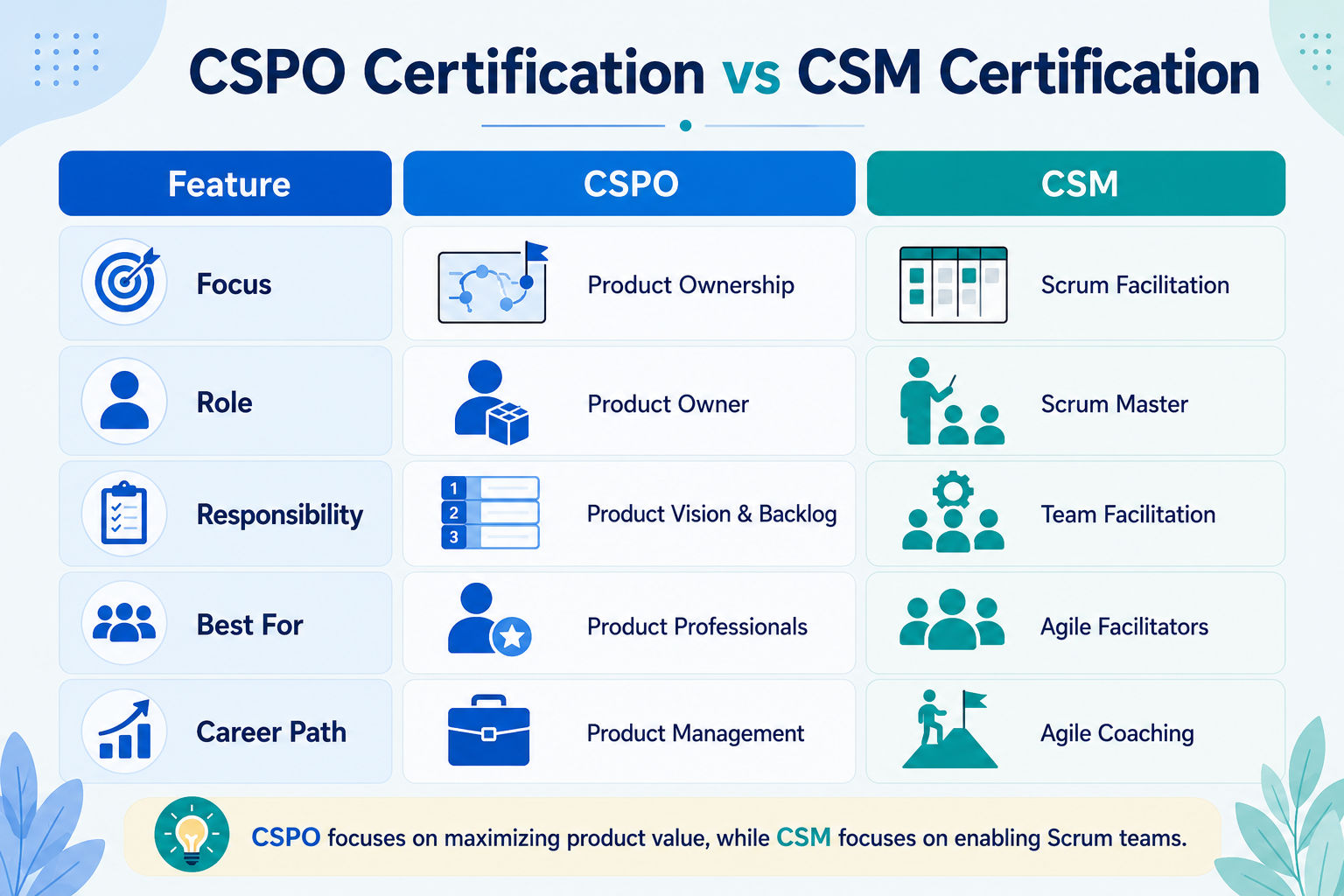
Feature |
CSPO |
CSM |
| Focus | Product Ownership | Scrum Facilitation |
| Role | Product Owner | Scrum Master |
| Primary Responsibilities | Product Vision and Backlog | Team Facilitation |
| Best For | Product Professionals | Agile Facilitators |
| Career Path | Product Management | Agile Coaching |
CSPO Certification vs PSPO Certification
Many professionals compare CSPO vs PSPO before choosing a Product Owner certification. Compare the key differences below to identify the certification that best fits career objectives.
Factor |
CSPO |
PSPO |
| Issuing organization | Scrum Alliance | Scrum.org |
| Training requirement | Mandatory 16-hour course | Not mandatory, though recommended |
| Examination | No exam, course completion based | Online exam required |
| Difficulty | Based on course engagement | Based on exam performance |
| Cost | Roughly 300 to 1,500 USD depending on trainer | Roughly 200 USD for the entry level exam, more with training |
| Recognition | Renews every two years with SEUs | Lifetime validity, no renewal |
| Best suited for | Beginners wanting structured, guided learning | Professionals comfortable with self-study and exams |
Benefits of Becoming a Certified Scrum Product Owner
Better Product Decision Making
Structured prioritization frameworks help Product Owners make clearer, more defensible product decisions.
Stronger Customer Focus
The course reinforces a customer first mindset that carries into daily backlog decisions.
Improved Collaboration with Scrum Teams
Certified Product Owners understand how their role connects with the Scrum Master and development team, reducing friction.
Greater Career Flexibility
The skills learned apply across Product Owner, Product Manager, and Business Analyst roles, giving certified professionals more options.
Global Recognition
Scrum Alliance certifications are recognized by employers across regions and industries.
Networking Opportunities
Training sessions bring together professionals from different companies and industries, creating space for peer learning.
Access to Scrum Alliance Community
Certified members gain access to resources, events, and a global community focused on Agile practices.
Also Read: CSPO Preparation Mistakes to Avoid
Career Opportunities After CSPO Certification
CSPO Certification opens doors to several common job roles, including:
- Product Owner
- Associate Product Manager
- Product Manager
- Business Analyst
- Agile Product Owner
- Product Consultant
- Digital Product Manager
- Innovation Manager
Also Read: Career Benefits of CSPO Certification
Conclusion
CSPO Certification is a valuable first step for anyone looking to build a career in Agile product management. It develops practical skills in product ownership, backlog management, stakeholder collaboration, and delivering customer value through Scrum.
With global recognition from Scrum Alliance, the certification can enhance your professional credibility and open doors to diverse product-focused roles.
Have A Query? Get in Touch With Our Customer Support | KnowledgeHut
Frequently Asked Questions (FAQs)
Can CSPO Certification Support a Transition into Product Management?
Yes. CSPO helps build foundational product ownership and Agile skills that are highly relevant to product management roles. The certification also demonstrates commitment to learning modern product development practices. Many professionals use it as a starting point for product-focused career paths.
Can a Non-Technical Professional Pursue CSPO Certification?
Yes. CSPO Certification is open to professionals from business, marketing, operations, finance, customer service, and many other domains. Technical expertise is not a mandatory requirement. The certification focuses on product value, stakeholder collaboration, and Agile product delivery.
Is CSPO Certification valuable outside the software industry?
Yes. Agile practices are widely adopted across industries such as healthcare, banking, retail, manufacturing, and education. CSPO Certification builds skills in customer value, prioritization, and stakeholder collaboration that apply across diverse business environments.
Does CSPO training include practical learning activities?
Yes. Scrum Alliance-approved CSPO courses include interactive workshops, product backlog exercises, user story creation, and group discussions. Practical learning helps reinforce Scrum concepts and prepares participants for real Product Owner responsibilities.
What qualities contribute to success after earning CSPO Certification?
Success as a Product Owner depends on combining Agile knowledge with strong communication, stakeholder management, customer-focused thinking, and decision-making skills. Continuous learning and practical application further strengthen long-term career growth.
What industries actively hire CSPO-certified professionals?
CSPO-certified professionals are in demand across technology, finance, healthcare, retail, manufacturing, telecommunications, education, and consulting. Any organization adopting Agile product development can benefit from skilled Product Owners.
What certification can be pursued after CSPO?
Advanced Scrum Alliance certifications offer a natural progression after CSPO. Additional Product Owner experience, combined with advanced learning, helps professionals expand Agile expertise and prepare for leadership roles.
What common misconceptions exist about CSPO Certification?
A common misconception is that CSPO is only for software developers or experienced Product Owners. In reality, the certification is designed for professionals from diverse backgrounds who want to understand Agile product ownership and customer-focused product development.
What factors should be considered when selecting a CSPO training provider?
Important considerations include Scrum Alliance authorization, Certified Scrum Trainer (CST) credentials, course curriculum, participant reviews, practical exercises, post-training support, and learning resources. Comparing these factors helps identify a training program aligned with career objectives.
How can CSPO Certification strengthen long-term career growth?
CSPO Certification builds a strong foundation in Agile product ownership while opening pathways to advanced Scrum certifications and leadership opportunities. Continuous learning and practical experience can further accelerate career progression in product management and Agile delivery.
1638 articles published
KnowledgeHut is an outcome-focused global ed-tech company. We help organizations and professionals unlock excellence through skills development. We offer training solutions under the people and proces...
Get Free Consultation
By submitting, I accept the T&C and
Privacy Policy
Ready to learn about Agile Certifications Roadmap?