
How Release Train Engineers Are Shaping Enterprise Agile in 2026
Updated on Jul 28, 2026 | 160 views
Share:
Master the Right Skills & Boost Your Career
Avail your free 1:1 mentorship session
Quick Overview
- Release Train Engineers (RTEs) are helping organizations scale Enterprise Agile by aligning teams, managing dependencies, and driving delivery.
- They bridge the gap between business strategy and execution through Agile Release Trains.
- RTEs play a key role in PI Planning, risk management, and continuous improvement.
- In this guide, you'll learn how RTEs are shaping Enterprise Agile, their key responsibilities, and the skills needed to succeed in 2026.
To strengthen your program level Agile leadership skills, consider the AI-Empowered SAFe® 6 Release Train Engineer (RTE) Course, designed for current and aspiring Release Train Engineers.
How Release Train Engineers Are Driving Enterprise Agile Success in 2026
Enterprise Agile has become significantly more complex over the past few years. Organizations are scaling Agile beyond software development into operations, marketing, finance, customer experience, and product innovation. While this creates greater business agility, it also introduces new coordination challenges.
Large organizations often operate multiple Agile Release Trains simultaneously. Each train includes several cross functional teams working toward common objectives while depending on other teams to deliver their part of the solution. Without clear coordination, dependencies multiply, priorities shift, and delivery slows down.
Distributed and hybrid work has added another layer of complexity. Teams may now work across different countries, time zones, and business functions. Maintaining alignment without constant communication becomes increasingly difficult.
This growing complexity explains why the RTE for Enterprise Agile has become one of the most valuable leadership roles within SAFe. Instead of allowing teams to operate independently, the RTE creates alignment across the entire Agile Release Train and ensures every team moves toward common business goals.
Organizations increasingly depend on the RTE for Enterprise Agile because coordinated execution has become just as important as technical excellence.
Who Is a Release Train Engineer?
A Release Train Engineer is the leader responsible for helping an Agile Release Train operate smoothly from planning through delivery. Rather than managing individual projects or directing technical decisions, the RTE enables collaboration across multiple Agile teams working toward shared objectives.
Unlike a traditional project manager who primarily focuses on schedules, budgets, and reporting, an RTE for Enterprise Agile concentrates on improving delivery flow, removing organizational obstacles, and strengthening collaboration between teams.
For example, if two development teams depend on the same architectural component before beginning their own work, the Release Train Engineer coordinates discussions, identifies alternative solutions, and helps prevent delays before they impact delivery.
The role requires balancing strategic thinking with day-to-day execution. Successful Release Train Engineers understand both business priorities and Agile principles, allowing them to bridge communication gaps between leadership and delivery teams.
As organizations scale Agile practices, the RTE for Enterprise Agile serves as the central point of coordination that keeps multiple teams working as one unified organization.
Before pursuing an RTE role, check out Release Train Engineer Salary in 2026 to learn how experience and skills influence compensation.
The Evolving Role of Release Train Engineers in Enterprise Agile
The responsibilities of Release Train Engineers have expanded significantly in recent years. While Program Increment Planning remains an important responsibility, today's RTE contributes throughout the entire delivery lifecycle by improving organizational agility, supporting leadership, and enabling continuous improvement.
Beyond Program Increment Planning
Program Increment Planning is only one part of the RTE's responsibilities. Modern Release Train Engineers continuously monitor delivery progress, manage cross team dependencies, facilitate problem solving sessions, and encourage regular improvements throughout every iteration. Instead of planning once every few months, they help organizations remain adaptable as priorities evolve.
Driving Organizational Agility
An effective RTE for Enterprise Agile influences far more than delivery schedules. They coach leaders on Agile practices, encourage better collaboration between departments, remove enterprise level blockers, and promote Lean thinking across the organization. Their success is measured not only by delivery speed but also by the maturity of the Agile ecosystem they help build.
For example, if approval processes consistently delay releases, the RTE collaborates with leadership to simplify governance instead of asking teams to work harder around the problem.
Supporting AI Augmented Agile Delivery
AI is becoming an important part of Enterprise Agile delivery. Release Train Engineers increasingly use intelligent dashboards, sprint analytics, predictive risk identification, and capacity forecasting to improve decision making. These tools help identify delivery risks earlier while providing greater visibility across multiple teams.
However, AI supports decision making rather than replacing leadership. The RTE for Enterprise Agile still relies on experience, communication, and coaching to resolve conflicts, build trust, and guide organizational change. As AI capabilities continue to evolve, dedicated discussions around AI driven Agile delivery deserve separate attention because they extend well beyond the responsibilities of the Release Train Engineer.
Core Responsibilities of a Release Train Engineer
As Enterprise Agile grows across large organizations, the responsibilities of a Release Train Engineer extend well beyond facilitating meetings. Every day, the role requires balancing business priorities, team collaboration, risk management, and continuous improvement. A successful RTE for Enterprise Agile ensures that multiple teams work together efficiently while staying aligned with organizational goals.
1. Program Increment Planning
Program Increment Planning is one of the most important responsibilities of a Release Train Engineer. The RTE prepares teams for planning sessions, facilitates discussions, aligns objectives, and helps everyone understand shared priorities. Instead of allowing individual teams to plan in isolation, the RTE ensures that every team contributes toward common business outcomes.
For example, during PI Planning, an RTE may identify that two feature teams require the same infrastructure upgrade. Addressing this dependency early prevents delays later in the Program Increment.
2. Dependency Management
Large Agile programs involve numerous dependencies between teams. A Release Train Engineer continuously monitors these relationships to ensure work progresses smoothly. When one team's progress affects another, the RTE brings stakeholders together to resolve issues before they become major blockers.
Effective dependency management improves delivery predictability and reduces unnecessary waiting time across the Agile Release Train.
3. Risk Identification
Every large Agile initiative faces technical, operational, and business risks. Rather than reacting after problems occur, the Release Train Engineer encourages early identification of risks and develops mitigation strategies with the relevant teams.
For instance, if a vendor's integration is likely to delay product development, the RTE coordinates discussions with business leaders and technical teams to create alternative delivery plans before customer commitments are affected.
4. Facilitating ART Events
The Release Train Engineer facilitates key Agile Release Train events that keep everyone aligned throughout delivery. These include PI Planning, Scrum of Scrums, Product Owner synchronization meetings, Inspect and Adapt workshops, and other collaborative sessions.
The objective is not simply to conduct meetings but to encourage meaningful conversations, faster decision making, and stronger collaboration among teams.
5. Metrics and Reporting
Enterprise leaders require visibility into delivery progress without becoming involved in day-to-day team activities. The Release Train Engineer gathers meaningful delivery metrics and presents insights that support informed business decisions.
Rather than focusing only on velocity, modern RTE for Enterprise Agile professionals track predictability, dependency trends, risk exposure, flow efficiency, and business outcomes to provide a more complete picture of program health.
6. Stakeholder Communication
One of the most valuable responsibilities of an RTE is maintaining communication between technical teams and business leadership. Different stakeholders often have different priorities, and misunderstandings can slow down delivery.
The Release Train Engineer ensures executives understand delivery progress while helping Agile teams stay informed about changing business priorities. This transparency builds trust across the organization.
7. Continuous Improvement
Continuous improvement is an ongoing responsibility rather than an occasional activity. After every Program Increment, the Release Train Engineer facilitates retrospectives, gathers feedback, identifies improvement opportunities, and encourages teams to experiment with better ways of working.
The daily work of an RTE for Enterprise Agile revolves around enabling collaboration rather than directing people. By removing obstacles, improving communication, and keeping teams aligned, the RTE creates an environment where large scale Agile delivery can succeed consistently.
Before applying for an RTE position, read Release Train Engineer Job Description Templates for 2026 to understand the qualifications and responsibilities employers look for.
Skills Every Release Train Engineer Needs in 2026
Technical knowledge alone is no longer enough for Release Train Engineers. Organizations now expect RTEs to combine leadership, communication, business understanding, and data driven thinking to guide Enterprise Agile initiatives successfully.
The most effective RTE for Enterprise Agile professionals continuously develop both interpersonal and strategic skills.
1. Leadership
Release Train Engineers lead through influence rather than authority. They build trust, encourage collaboration, and help teams solve problems together instead of making decisions for them. Strong leadership creates confidence during periods of uncertainty and organizational change.
2. Facilitation
Facilitation remains one of the defining skills of an RTE. Whether leading PI Planning, dependency discussions, or executive reviews, the ability to guide productive conversations ensures teams reach decisions efficiently while keeping everyone engaged.
3. Conflict Resolution
Large Agile programs naturally involve competing priorities and differing perspectives. An effective RTE helps resolve disagreements by encouraging open communication, understanding the needs of each stakeholder, and focusing discussions on shared business objectives.
For example, when two teams compete for limited development capacity, the RTE facilitates discussions that balance customer value with technical priorities.
4. Systems Thinking
Enterprise Agile requires understanding how different teams, products, technologies, and business processes influence one another. Systems thinking enables Release Train Engineers to evaluate the broader impact of decisions rather than optimizing only individual teams.
This perspective helps organizations avoid local improvements that create larger problems elsewhere.
5. Business Communication
A Release Train Engineer regularly communicates with executives, architects, Product Managers, Scrum Masters, and delivery teams. Explaining technical challenges in business language and translating business priorities into actionable plans are essential communication skills.
Strong communication improves alignment and reduces misunderstandings throughout the organization.
6. Data Driven Decision Making
Successful RTEs rely on delivery data rather than assumptions. Metrics such as predictability, cycle time, dependency trends, and delivery flow help identify improvement opportunities and support objective decision making.
Modern RTE for Enterprise Agile leaders use dashboards to understand patterns while combining data with practical experience before making recommendations.
7. Change Management
Enterprise Agile transformation often involves new processes, changing responsibilities, and evolving organizational structures. Release Train Engineers help people adapt by addressing concerns, encouraging collaboration, and guiding teams through continuous change without disrupting delivery.
8. AI Literacy
AI is becoming part of everyday Agile operations. Release Train Engineers should understand how AI supports planning, reporting, analytics, capacity forecasting, and risk detection. Although AI simplifies many administrative activities, leadership, coaching, and collaboration remain in human responsibilities.
An RTE who understands AI can help teams adopt these tools effectively while ensuring decisions remain aligned with business objectives.
The RTE for Enterprise Agile is no longer expected to simply coordinate delivery but to guide enterprise-wide collaboration and continuous improvement.
Also Read: Release Train Engineer Jobs to learn about current roles, responsibilities, and hiring trends.
Career Path to Becoming a Release Train Engineer
Becoming a Release Train Engineer is rarely the first step in an Agile career. Most professionals build their expertise over several years by working closely with Agile teams, leading delivery initiatives, and coaching others through change. This progression helps them develop the technical understanding, leadership skills, and business perspective required to manage complex Agile environments.
A common career path looks like this:
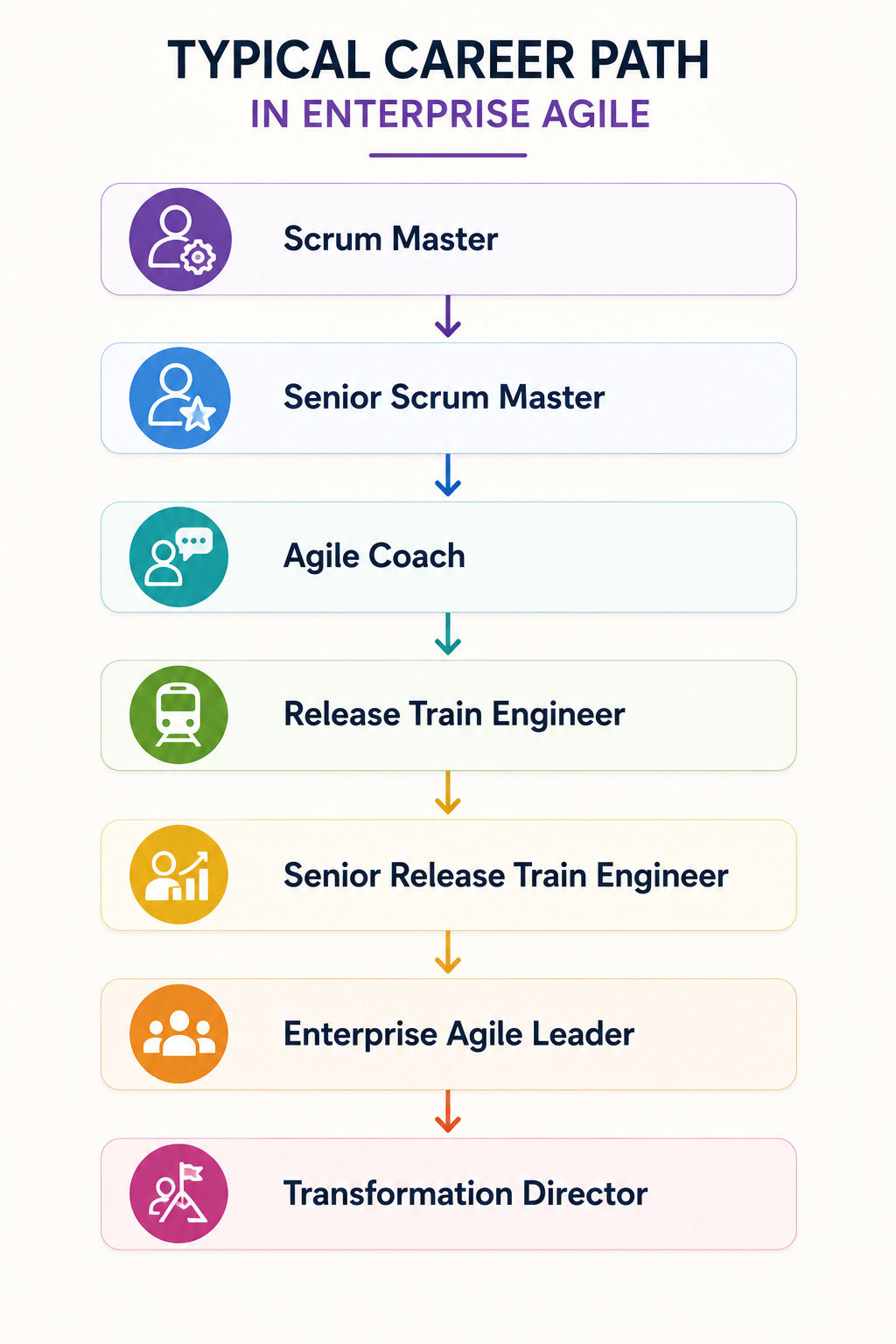
Each stage builds capabilities that prepare professionals for broader organizational responsibilities.
Professionals moving into the RTE for Enterprise Agile role are expected to understand Agile frameworks, facilitate collaboration across multiple teams, and communicate effectively with both delivery teams and senior leadership.
Experience Expectations
Most organizations prefer candidates with several years of experience in Agile delivery before taking on the RTE role. Experience as a Scrum Master, Agile Coach, Product Manager, or Project Manager provides valuable exposure to planning, stakeholder management, and team facilitation.
Hands on experience with large scale Agile programs is often more valuable than simply understanding Agile concepts.
Certifications
Professional certifications help validate knowledge and demonstrate commitment to Enterprise Agile practices. Many aspiring Release Train Engineers begin with Scrum certifications before progressing to SAFe focused credentials that emphasize Agile Release Train leadership.
While certification strengthens a resume, employers typically look for professionals who can apply Agile principles in real business environments rather than relying solely on theoretical knowledge.
Practical Leadership Experience
Release Train Engineers regularly guide teams through uncertainty, changing priorities, and organizational challenges. Professionals aspiring to this role should actively seek opportunities to lead cross functional initiatives, facilitate planning sessions, and coordinate work across multiple teams.
For example, a Scrum Master who volunteers to coordinate dependencies between several product teams gains practical experience that closely resembles the responsibilities of an RTE.
Coaching Experience
Coaching is a core part of the role. Successful Release Train Engineers help Scrum Masters, Product Owners, and business leaders improve collaboration rather than solving every problem themselves.
Professionals who enjoy mentoring teams, encouraging continuous improvement, and helping organizations adopt Agile ways of working often transition successfully into the RTE for Enterprise Agile role.
As Enterprise Agile adoption continues to grow, opportunities for experienced Agile professionals to move into Release Train Engineer positions are expanding across industries including technology, banking, healthcare, manufacturing, and telecommunications.
Looking to build a successful RTE career? Release Train Engineer (RTE) Career Path for 2026 explains the typical career journey, promotion opportunities, and next steps after certification.
Is SAFe Release Train Engineer Certification Worth It?
For professionals looking to lead large scale Agile initiatives, SAFe Release Train Engineer Certification can be a valuable investment. Rather than focusing on individual Scrum teams, the certification prepares professionals to coordinate Agile Release Trains, facilitate collaboration across departments, and improve enterprise-wide delivery.
The certification is particularly valuable for professionals who want to move beyond team level Agile practices and contribute to organizational transformation.
Who Should Pursue It?
The certification is well suited for experienced Scrum Masters, Agile Coaches, Project Managers, Delivery Managers, Product Managers, and other professionals involved in large Agile programs.
If your goal is to coordinate multiple teams instead of managing a single team, this certification aligns well with that career direction.
Skills Gained
Participants develop practical skills in Program Increment Planning, ART facilitation, dependency management, Lean Agile leadership, stakeholder communication, continuous improvement, and organizational coaching.
These competencies prepare professionals to perform effectively as an RTE for Enterprise Agile in complex delivery environments.
Enterprise Recognition
Many organizations implementing the SAFe framework recognize Release Train Engineer Certification as evidence of Enterprise Agile expertise. While certification alone does not guarantee career growth, it demonstrates familiarity with widely adopted Agile practices and frameworks.
Combined with practical experience, it can strengthen opportunities for leadership roles in Enterprise Agile transformation.
Career Opportunities
Certified Release Train Engineers are increasingly sought after in organizations scaling Agile across multiple business units. Opportunities exist in sectors such as financial services, healthcare, retail, manufacturing, consulting, and information technology.
As organizations continue investing in Enterprise Agile, demand for experienced RTE for Enterprise Agile professionals is expected to remain strong.
Learning Outcomes
The certification helps professionals understand how to facilitate Agile Release Trains, align business strategy with execution, manage enterprise risks, improve delivery flow, and coach teams toward continuous improvement.
These outcomes extend beyond technical delivery and focus on building long-term organizational agility.
Certification Roadmap
For many professionals, the journey begins with foundational Agile knowledge before progressing into Enterprise Agile leadership. A typical roadmap may include Scrum experience, SAFe learning, Release Train Engineer Certification, and ongoing practical leadership across large Agile programs.
The certification serves as a milestone rather than the destination. Continuous learning and real-world experience remain essential for long-term success.
Choosing the right certification can accelerate your Agile career. Explore Best Agile Management Certification Training Courses to understand which programs best match your professional goals.
Conclusion
Enterprise Agile in 2026 is defined by scale, speed, and constant change. Organizations are coordinating more teams, delivering products faster, and responding to evolving customer needs with greater urgency than ever before. In this environment, successful delivery depends on more than strong development teams. It requires effective coordination across the entire organization.
That is why the RTE for Enterprise Agile has become a critical leadership role. By aligning business objectives, managing dependencies, facilitating collaboration, reducing risks, and fostering continuous improvement, Release Train Engineers help organizations deliver value consistently without losing sight of strategic priorities.
Contact our upGrad KnowledgeHut experts for personalized guidance on choosing the right course, career path, and certification to achieve your goals.
Frequently Asked Questions
What does an RTE do in Enterprise Agile?
A Release Train Engineer coordinates multiple Agile teams working within an Agile Release Train. They facilitate key events, manage dependencies, remove delivery obstacles, monitor progress, and ensure business goals remain aligned with execution. Their focus is on enabling collaboration rather than managing individual projects.
Is a Release Train Engineer the same as a Project Manager?
No. While both roles support successful delivery, a Project Manager typically manages scope, budget, and timelines. A Release Train Engineer focuses on servant leadership, team alignment, continuous improvement, and helping multiple Agile teams deliver value together within the SAFe framework.
Who should become a Release Train Engineer?
The role is ideal for experienced Scrum Masters, Agile Coaches, Project Managers, Delivery Managers, and other Agile professionals who want to lead large scale Agile programs. Strong leadership, facilitation, and coaching skills are essential for success in this position.
Is SAFe Release Train Engineer Certification worth it?
For professionals aiming to lead Enterprise Agile initiatives, SAFe Release Train Engineer Certification can be a valuable career investment. It helps build expertise in Program Increment Planning, Agile Release Train facilitation, dependency management, and enterprise level collaboration, making candidates more competitive for leadership roles.
Why is the RTE for Enterprise Agile important in 2026?
As organizations scale Agile across multiple teams and departments, delivery becomes more complex. An RTE for Enterprise Agile helps align business strategy with execution, manages cross functional dependencies, reduces risks, and supports continuous improvement, enabling organizations to deliver value faster and more effectively.
What skills are required to become a successful Release Train Engineer?
A successful Release Train Engineer needs leadership, facilitation, coaching, conflict resolution, stakeholder management, systems thinking, and communication skills. Knowledge of the SAFe framework and the ability to make data driven decisions are also valuable for managing Enterprise Agile initiatives.
Can a Scrum Master become a Release Train Engineer?
Yes. Many Release Train Engineers begin their careers as Scrum Masters before progressing to senior Scrum Master or Agile Coach roles. Gaining experience in coaching multiple teams, managing dependencies, and leading large Agile programs provides a strong foundation for transitioning into the RTE role.
Does a Release Train Engineer need technical expertise?
While coding experience is not mandatory, understanding software development, Agile practices, and system architecture is beneficial. Technical knowledge helps Release Train Engineers communicate effectively with development teams and make informed decisions during planning and delivery.
How is AI influencing the role of Release Train Engineers?
AI helps Release Train Engineers improve planning, reporting, capacity forecasting, and risk identification through intelligent analytics. However, AI complements rather than replaces the role, as leadership, collaboration, coaching, and decision making still rely on human expertise.
What industries hire Release Train Engineers?
Release Train Engineers are in demand across industries adopting Enterprise Agile, including information technology, banking, financial services, healthcare, manufacturing, telecommunications, retail, and consulting. As more organizations scale Agile practices, the demand for experienced RTE for Enterprise Agile professionals continues to grow.
1638 articles published
KnowledgeHut is an outcome-focused global ed-tech company. We help organizations and professionals unlock excellence through skills development. We offer training solutions under the people and proces...
Get Free Consultation
By submitting, I accept the T&C and
Privacy Policy
Ready to learn about Agile Certifications Roadmap?