
How to Become a Release Train Engineer in 2026?
Updated on Sep 02, 2026 | 12 min read | 6.7K+ views
Share:
Table of Contents
View all
Quick Overview
- A Release Train Engineer (RTE) is a servant leader and chief Scrum Master for an Agile Release Train (ART), responsible for coordinating multiple Agile teams and helping them deliver value through SAFe.
- Building Agile and SAFe knowledge is the starting point, followed by gaining experience in Scrum Master, Agile Coach, or project management roles and developing program level leadership skills.
- PI Planning, facilitation, dependency management, stakeholder coordination, and servant leadership are key capabilities for an RTE. Earning the SAFe Release Train Engineer Certification can also validate the required knowledge and skills.
- This guide explains how to become a Release Train Engineer in 2026, the RTE role and responsibilities, required skills and qualifications, certification path, career portfolio, job opportunities, and salary expectations.
Build program level Agile leadership skills with the AI-Empowered SAFe® 6 Release Train Engineer (RTE) Course and prepare to lead complex Agile delivery.
Master the Right Skills & Boost Your Career
Avail your free 1:1 mentorship session
How to become a release train engineer in 2026? step-by-step process
Learning How to Become Release Train Engineer requires a combination of Agile experience, SAFe knowledge, facilitation skills, and program level exposure.
The following steps provide a practical path toward developing the capabilities expected from an RTE:
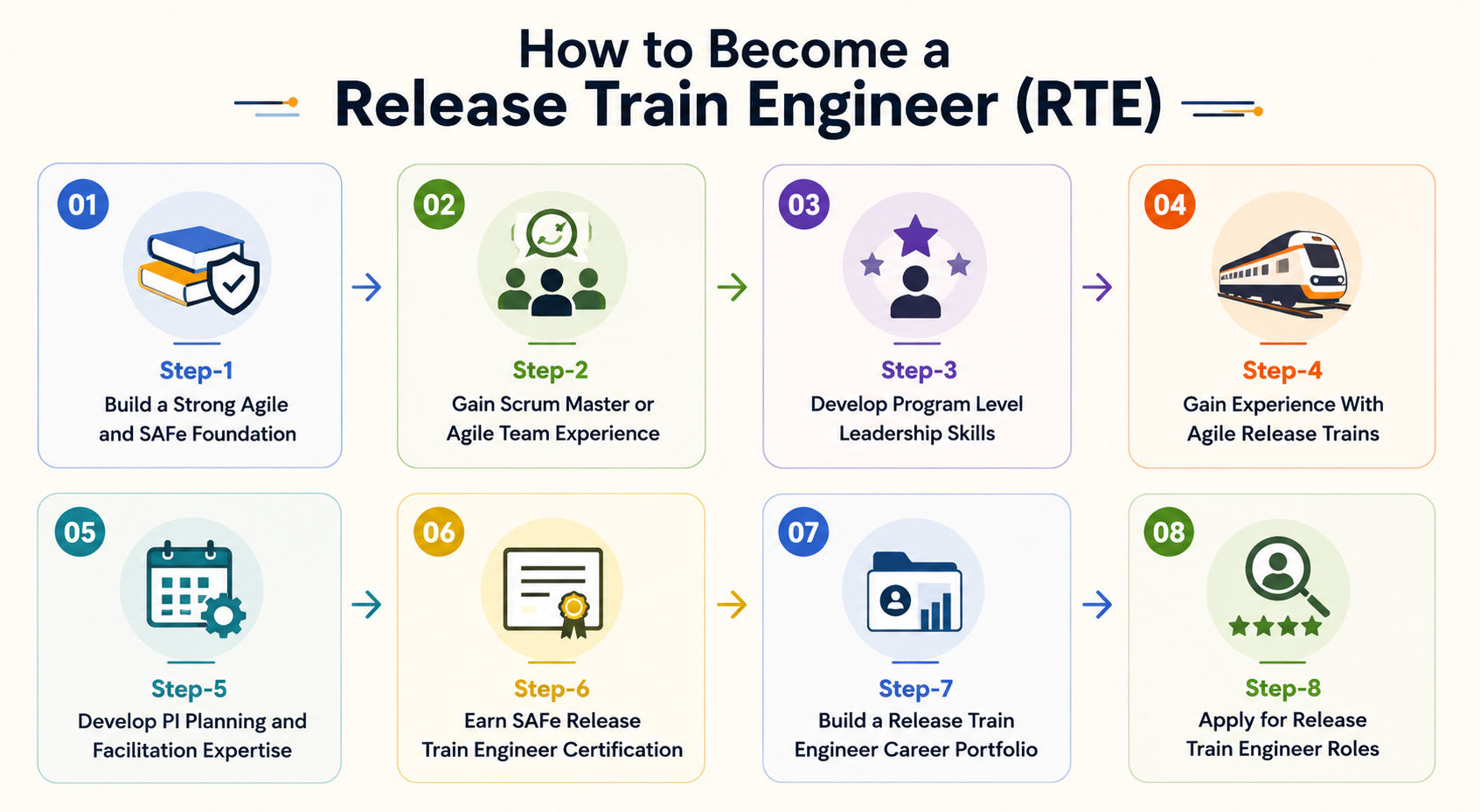
Step 1: Build a Strong Agile and SAFe Foundation
Start by understanding Agile principles, Scrum, and the SAFe framework.
Focus on:
- Agile principles
- Scrum practices
- SAFe roles
- Agile Release Trains
- Program Increments
- Lean Agile principles
- SAFe ceremonies
Step 2: Gain Scrum Master or Agile Team Experience
Experience working directly with Agile teams provides a useful foundation for the RTE role.
Professionals can develop experience in:
- Facilitating team events
- Removing impediments
- Supporting delivery
- Coaching teams
- Managing dependencies
- Working with stakeholders
Step 3: Develop Program Level Leadership Skills
RTEs work across multiple teams and stakeholders, so program level leadership becomes essential.
Build skills in:
- Communication
- Facilitation
- Conflict resolution
- Decision making
- Stakeholder management
- Risk management
Step 4: Gain Experience with Agile Release Trains
Understanding how an Agile Release Train operates is important for How to Become Release Train Engineer.
Gain exposure to:
- Cross team coordination
- Program level planning
- Dependencies
- Risks
- PI objectives
- ART events
Step 5: Develop PI Planning and Facilitation Expertise
PI Planning is a major part of the RTE role.
Develop capability in:
- Planning sessions
- Stakeholder alignment
- Dependency identification
- Risk and issue tracking
- Facilitation
- Follow through
Step 6: Earn SAFe Release Train Engineer Certification
A SAFe Release Train Engineer certification can provide structured knowledge of the RTE role and SAFe practices.
Certification can help professionals strengthen their understanding of:
- ART leadership
- PI Planning
- Program execution
- Risk and dependency management
- Inspect and Adapt
- Agile coaching
Step 7: Build a Release Train Engineer Career Portfolio
A portfolio can demonstrate experience beyond simply holding a certification.
It can include:
- PI Planning experience
- Program level facilitation
- Dependency management
- Risk handling
- Agile coaching activities
- Stakeholder coordination
- Process improvement outcomes
Step 8: Apply for Release Train Engineer Roles
Once relevant skills and experience are developed, professionals can explore RTE opportunities.
Potential routes include:
- Internal transition
- Scrum Master progression
- Agile Coach progression
- Program level Agile roles
- Direct RTE opportunities
Also Read: SAFe RTE Certification Cost, Fees & Exam Details 2026
What does a release train engineer do?
Understanding the RTE role is an important part of How to Become Release Train Engineer. An RTE acts as a servant leader and facilitator for the Agile Release Train, helping multiple teams remain aligned and focused on delivering value.
1. Facilitating Agile Release Train Events
RTEs facilitate major ART events and ensure teams and stakeholders remain aligned.
This can include:
- PI Planning
- Inspect and Adapt
- System Demo
- Scrum of Scrums
- ART syncs
2. Coordinating Multiple Agile Teams
RTEs help coordinate dependencies and collaboration across teams working toward shared objectives.
The focus is on:
- Alignment
- Dependencies
- Delivery progress
- Shared priorities
- Communication
3. Managing Program Increment Planning
RTEs help prepare, facilitate, and follow up on PI Planning.
They support teams in:
- Defining objectives
- Identifying dependencies
- Addressing risks
- Aligning stakeholders
- Creating realistic plans
4. Removing Cross Team Impediments
Some problems cannot be resolved within a single Agile team.
RTEs help address:
- Cross team blockers
- Organizational dependencies
- Resource constraints
- Process issues
- External dependencies
5. Supporting Inspect and Adapt
The RTE helps the ART regularly evaluate its performance and identify improvements.
Teams can review:
- Delivery outcomes
- Quality
- Flow
- Problems
- Improvement opportunities
6. Managing Risks and Dependencies
RTEs maintain visibility into risks and dependencies that may affect program delivery.
This involves:
- Identifying risks early
- Tracking dependencies
- Escalating critical issues
- Coordinating resolution
- Communicating impact
7. Coaching Teams and Stakeholders
RTEs also support Agile maturity across the ART.
Coaching can involve:
- Agile practices
- Collaboration
- Facilitation
- Continuous improvement
- Stakeholder alignment
Explore the Top 12 Release Train Engineer (RTE) Tools for 2026 to discover tools that support PI Planning, collaboration, tracking, and Agile delivery.
What skills are required to become a release train engineer?
The skills required for How to Become Release Train Engineer extend beyond knowledge of SAFe. Successful RTEs need to coordinate people, resolve complex problems, manage risks, and keep multiple teams moving toward shared outcomes.
1. SAFe and Agile Framework Knowledge
Strong knowledge of:
- SAFe
- Scrum
- Lean Agile principles
- PI Planning
- Agile Release Trains
2. Program and Stakeholder Management
RTEs need to work across teams and organizational levels.
Important skills include:
- Stakeholder alignment
- Program coordination
- Communication
- Dependency management
- Expectation management
3. Facilitation and Communication
Clear communication is essential when coordinating multiple teams.
RTEs need to facilitate:
- Planning
- Discussions
- Conflict resolution
- Decision making
- Program reviews
4. Conflict Resolution and Problem Solving
Large Agile programs naturally create competing priorities and dependencies.
RTEs should be able to:
- Identify root causes
- Encourage collaboration
- Resolve disagreements
- Facilitate trade offs
- Keep teams focused on shared outcomes
5. Risk and Dependency Management
RTEs need strong visibility into risks that can affect program delivery.
Useful capabilities include:
- Risk identification
- Dependency mapping
- Issue tracking
- Escalation
- Mitigation planning
6. Leadership and Coaching
RTE leadership is largely based on influence and facilitation.
Strong RTEs help teams:
- Improve collaboration
- Adopt Agile practices
- Resolve impediments
- Learn from outcomes
- Improve continuously
7. Data Driven Decision Making
Program level decisions benefit from reliable delivery data.
RTEs can use:
- Program metrics
- Flow metrics
- Delivery trends
- Quality measures
- Risk indicators
Build practical Agile expertise with the Best Agile Management Certification Training Courses and choose the right certification to advance an Agile career.
What qualifications are needed to become a release train engineer?
A successful RTE profile usually combines education with practical Agile experience and knowledge of large scale delivery.
For professionals exploring How to Become Release Train Engineer, experience within Agile teams and programs can be especially valuable.
1. Educational Background
A formal background in areas such as:
- Business
- Management
- Information technology
- Engineering
- Project management
2. Agile and SAFe Experience
Experience with Agile teams and SAFe environments can strengthen readiness for RTE responsibilities.
Relevant exposure includes:
- Scrum
- Agile delivery
- ARTs
- PI Planning
- Cross team coordination
3. Scrum Master or Agile Leadership Experience
Scrum Master, Agile Coach, or similar experience can provide valuable preparation.
These roles can help develop:
- Facilitation
- Coaching
- Stakeholder management
- Impediment removal
- Continuous improvement
4. SAFe Release Train Engineer Certification
A SAFe RTE certification demonstrates structured knowledge of Release Train Engineer responsibilities and SAFe practices.
It can strengthen a professional profile when combined with relevant hands-on experience.
Explore the Release Train Engineer (RTE) Career Path for 2026 to understand key roles, skills, certifications, and growth opportunities.
Release train engineer salary in 2026
Based on the provided Glassdoor salary benchmark, the average Release Train Engineer salary is ₹26.0L per year.
This figure represents the reported average base salary and should be viewed as a market benchmark rather than a fixed salary for every RTE role. Actual compensation can vary based on experience, organization, responsibilities, location, and professional skills.
Also Read: Release Train Engineer Salary in 2026
Conclusion
Learning How to Become Release Train Engineer means building on Agile and Scrum experience with strong facilitation, stakeholder management, risk management, coaching, and PI Planning skills.
The career suits professionals who enjoy coordinating multiple teams and improving large scale delivery. Gaining practical ART experience alongside relevant SAFe knowledge and certification can support the transition.
Have A Query? Get in Touch With Our Customer Support | upGrad KnowledgeHut
Frequently Asked Questions (FAQs)
1. How much Agile experience is needed before becoming a Release Train Engineer?
There is no fixed experience requirement for How to Become Release Train Engineer. Experience with Scrum, Agile delivery, team coordination, and stakeholder management can provide a strong foundation. Exposure to larger programs and cross team work can further improve readiness.
2. Can a Scrum Master become a Release Train Engineer without becoming an Agile Coach?
Yes. Scrum Master experience can provide a useful foundation for How to Become Release Train Engineer. Skills in facilitation, impediment removal, coaching, and team coordination can be expanded into program level planning, dependency management, and ART coordination.
3. Can a Project Manager transition into a Release Train Engineer role?
Yes. Project Managers often bring experience in planning, risk management, stakeholder coordination, and delivery management. For How to Become Release Train Engineer, they would need to strengthen Agile, SAFe, PI Planning, and cross team facilitation skills.
4. What is the biggest difference between a Scrum Master and a Release Train Engineer?
A Scrum Master generally supports an individual Agile team, while an RTE coordinates multiple teams within an Agile Release Train. Understanding this broader program level responsibility is essential when considering How to Become Release Train Engineer.
5. Is SAFe Release Train Engineer certification enough to get an RTE job?
Certification can demonstrate structured SAFe and RTE knowledge, but it does not guarantee employment. For How to Become Release Train Engineer, candidates should also build practical experience in PI Planning, stakeholder coordination, risk management, and cross team delivery.
6. How can professionals gain RTE experience without currently working on an Agile Release Train?
Professionals can seek opportunities to facilitate cross team meetings, support PI Planning, coordinate dependencies, manage program risks, and contribute to large Agile initiatives. These experiences can build relevant capabilities for How to Become Release Train Engineer.
7. What does a typical Release Train Engineer career path look like after becoming an RTE?
RTEs can progress toward senior program, Agile leadership, transformation, or enterprise delivery roles. Career growth usually comes through broader responsibilities, larger programs, stronger leadership, and greater strategic influence.
8. Can a Release Train Engineer role be performed remotely?
Some RTE responsibilities can be performed remotely through collaboration and virtual facilitation tools. However, the feasibility depends on the organization's working model, team structure, stakeholder needs, and the level of coordination required.
9. Which industries hire the most Release Train Engineers?
RTE roles are commonly relevant in organizations with large-scale Agile delivery, including technology, financial services, telecommunications, healthcare, and other enterprise environments. Demand depends on the organization's adoption of SAFe and similar scaled Agile practices.
10. How can candidates demonstrate RTE experience during a job interview?
Candidates should discuss specific experience with PI Planning, ART events, cross team dependencies, risk management, stakeholder alignment, and continuous improvement. Clear evidence of program level coordination can strongly support the case for How to Become Release Train Engineer.
1639 articles published
KnowledgeHut is an outcome-focused global ed-tech company. We help organizations and professionals unlock excellence through skills development. We offer training solutions under the people and proces...
Get Free Consultation
By submitting, I accept the T&C and
Privacy Policy
Ready to learn about Agile Certifications Roadmap?