
What Does a Release Train Engineer Do Day-to-Day?
Updated on Jul 28, 2026 | 174 views
Share:
Table of Contents
View all
Master the Right Skills & Boost Your Career
Avail your free 1:1 mentorship session
Quick Overview
- A Release Train Engineer (RTE) coordinates Agile Release Trains, aligns teams, and removes blockers to keep delivery on track.
- RTEs facilitate SAFe events, manage dependencies, and coach teams to improve collaboration and execution.
- They focus on enabling delivery, not managing people.
- In this guide, you'll learn an RTE's day to day responsibilities, key activities, and the tools they use to drive successful Agile delivery.
If your goal is to facilitate Agile Release Trains and drive enterprise execution, the AI-Empowered SAFe® 6 Release Train Engineer (RTE) Course provide the knowledge and hands-on experience to get started.
What Does a Release Train Engineer Do?
The simplest answer to What Does a Release Train Engineer Do is that they act as the chief facilitator for an Agile Release Train. Their responsibility is to ensure that multiple Agile teams work together efficiently, communicate openly, and deliver value on time.
Within the SAFe framework, the Release Train Engineer serves as the servant leader for the Agile Release Train. They coordinate teams, facilitate large planning events, support continuous improvement, and help remove organizational obstacles that slow delivery.
Think of a Release Train Engineer as the conductor of an orchestra. Every musician is skilled individually, but someone must ensure they perform in harmony. Similarly, the RTE helps multiple Agile teams move toward the same business objective.
Curious about the earning potential of an RTE? Explore Release Train Engineer Salary in 2026 for the latest salary trends across experience levels.
A Day in the Life of a Release Train Engineer
Every day looks slightly different depending on where the organization is in its Program Increment. During PI Planning, schedules are packed with workshops and alignment sessions. During regular iterations, the focus shifts toward monitoring progress, coaching teams, and resolving delivery issues.
1. Morning: Reviewing ART Health
Most Release Train Engineers begin the day by reviewing delivery dashboards and Agile metrics. They check sprint progress, dependency status, blocked work items, quality indicators, and team capacity. This early review helps identify risks before they become larger delivery problems.
For example, if one team's delayed API affects three other teams, the RTE identifies the dependency early and starts coordinating a solution before the delay impacts the entire release.
2. Daily Coordination Meetings
A significant portion of the day involves facilitating meetings rather than attending them passively. Scrums, Product Owner Sync sessions, ART Sync meetings, and leadership discussions help everyone stay aligned and informed about changing priorities.
Instead of running status meetings, the RTE encourages problem solving, collaboration, and quick decision making that keeps delivery moving.
3. Coaching Teams Throughout the Day
Coaching is one of the most valuable responsibilities of an RTE. Throughout the day, they mentor Scrum Masters, support Product Managers, guide leadership teams, and help improve communication between departments. They also facilitate conversations whenever conflicts arise between priorities or teams.
For example, if two teams disagree about ownership of a shared feature, the Release Train Engineer helps facilitate a discussion that leads to a practical solution without delaying delivery.
4. Managing Risks and Dependencies
Enterprise delivery creates dozens of cross-team dependencies. The RTE continuously tracks these relationships, identifies blockers, monitors risks, and escalates issues when necessary. Their goal is to solve problems before they affect customer delivery.
Dependency boards, risk registers, and regular communication help keep everyone aware of changing priorities and potential bottlenecks.
5. End of Day Planning
Before the day ends, Release Train Engineers review upcoming milestones, follow up on unresolved action items, update leadership, and prepare for the next day's discussions. This preparation allows the Agile Release Train to start the next day with clarity rather than confusion.
Wondering how to advance your career as an RTE? Read Release Train Engineer (RTE) Career Path for 2026 to understand the skills, certifications, and roles that support long term growth.
Core Responsibilities of a Release Train Engineer
While understanding What Does a Release Train Engineer Do on a daily basis is useful, the role extends far beyond routine meetings. Release Train Engineers are responsible for maintaining the health of the Agile Release Train throughout the entire Program Increment.
One of the biggest responsibilities is facilitating PI Planning. This event brings together business leaders, architects, Product Managers, Product Owners, Scrum Masters, and development teams to align shared objectives. The RTE ensures the event runs smoothly and that everyone leaves with realistic commitments.
Managing ART execution is another critical responsibility. The RTE monitors delivery progress, identifies trends, tracks risks, and supports teams throughout development. When priorities change, they help the organization adapt without creating unnecessary disruption.
Release Train Engineers also promote continuous improvement by facilitating Inspect and Adapt workshops. These sessions encourage teams to reflect on recent work, identify recurring problems, and agree on measurable improvements for future Program Increments.
Another major responsibility is coaching leadership. Enterprise agility requires support beyond development teams. Product Managers, executives, and business stakeholders often benefit from guidance on Lean Agile principles, collaborative decision making, and value-based planning.
After earning your RTE certification, explore Release Train Engineer Jobs to understand the career opportunities available in enterprise Agile environments.
Tools Release Train Engineers Use Every Day
Technology plays an important role in helping Release Train Engineers manage visibility across multiple Agile teams. Although tools do not replace leadership, they provide the transparency needed for informed decision making.
Jira is widely used for tracking stories, features, dependencies, and sprint progress across multiple teams. It provides visibility into delivery status and helps identify blocked work quickly.
Azure DevOps serves a similar purpose, particularly in organizations using Microsoft technologies. It combines Agile planning, source control, testing, and deployment of information into a single platform.
Confluence helps teams document PI objectives, meeting notes, architectural decisions, and knowledge sharing. Instead of relying on scattered documents, teams have a centralized source of information.
Miro becomes especially valuable during PI Planning. Distributed teams use collaborative boards to visualize dependencies, objectives, risks, and planning activities in real time.
Communication platforms such as Microsoft Teams and Slack enable rapid discussions across distributed teams. These tools reduce delays by making collaboration immediate and accessible.
Power BI supports executive reporting by transforming delivery data into dashboards that highlight trends, predictability, risks, and performance over time.
Common Tools Used by Release Train Engineers
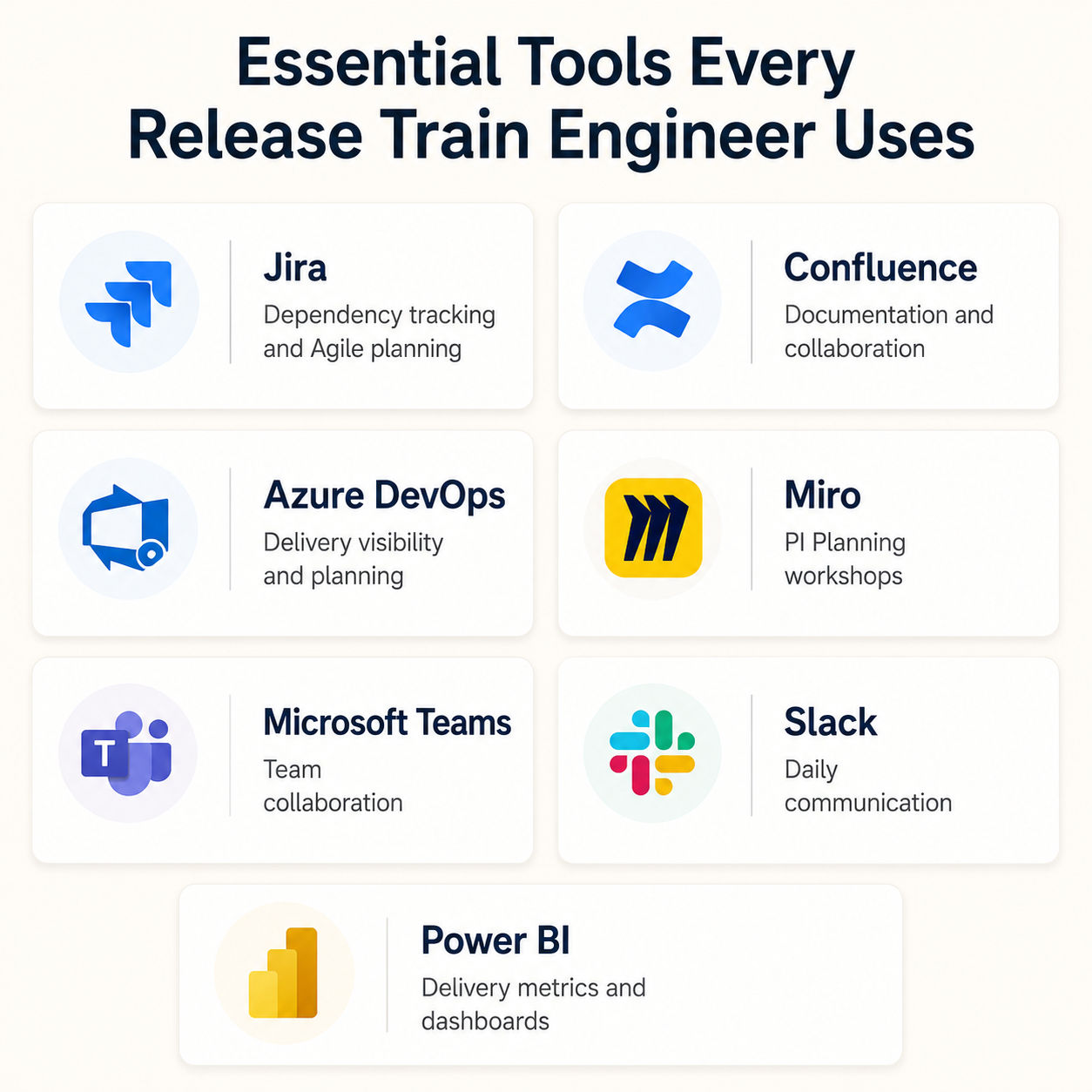
For example, during PI Planning, an RTE may use Miro for collaborative planning, Jira for backlog management, Teams for virtual discussions, and Power BI to review ART performance after execution.
If you're evaluating different Agile certifications, Best Agile Management Certification Training Courses provides a comprehensive comparison to help you make an informed choice.
Conclusion
So, What Does a Release Train Engineer Do every day? The answer goes far beyond facilitating meetings. A Release Train Engineer serves as the connector between teams, leadership, Product Management, architects, and business stakeholders. Their success depends on helping people collaborate, solving delivery challenges, improving flow, and enabling continuous value delivery.
For professionals exploring enterprise Agile careers, understanding What Does a Release Train Engineer Do is the first step toward recognizing why this role has become one of the most valuable leadership positions within SAFe. Building expertise in Scrum, Lean Agile practices, facilitation, and SAFe certifications can open the path toward becoming an effective Release Train Engineer.
Contact our upGrad KnowledgeHut experts for personalized guidance on choosing the right course, career path, and certification to achieve your goals.
Frequently Asked Questions
What does a Release Train Engineer do every day?
A Release Train Engineer reviews ART health, facilitates coordination meetings, removes cross team blockers, tracks risks, and coaches Agile teams. The goal is to keep multiple teams aligned and deliver value together.
Does a Release Train Engineer manage projects?
No. An RTE focuses on facilitating collaboration, improving delivery flow, and enabling Agile practices rather than managing projects through traditional planning and control methods.
Does an RTE write code?
Typically, no. The role centers on coaching, coordination, facilitation, and leadership. While technical knowledge is helpful, coding is not usually part of an RTE's daily responsibilities.
How many teams does a Release Train Engineer support?
A typical Agile Release Train includes five to twelve Agile teams. In large enterprises, an RTE may support even more teams depending on the size and complexity of the organization.
What meetings does a Release Train Engineer facilitate?
RTEs commonly facilitate ART Syncs, Scrum Scrums, Product Owner Syncs, PI Planning, Inspect and Adapt workshops, and stakeholder alignment meetings to ensure smooth collaboration.
Which tools do Release Train Engineers use?
Common tools include Jira, Azure DevOps, Confluence, Miro, Microsoft Teams, Slack, and Power BI. These platforms support planning, communication, documentation, dependency tracking, and reporting.
Is Release Train Engineer a leadership role?
Yes. An RTE is an enterprise Agile leadership role that guides multiple teams, coaches leaders, and promotes collaboration without relying on direct authority.
Can a Scrum Master become a Release Train Engineer?
Yes. Many experienced Scrum Masters move into the RTE role after developing expertise in Agile coaching, cross team coordination, facilitation, and SAFe practices.
Is a Release Train Engineer a stressful job?
The role can be demanding because it involves coordinating multiple teams and handling complex delivery challenges. Strong communication, facilitation, and prioritization skills help manage the workload effectively.
What certification helps become a Release Train Engineer?
The SAFe Release Train Engineer certification is the most widely recognized credential for aspiring RTEs. It equips professionals with the knowledge and practical skills needed to lead Agile Release Trains successfully.
1638 articles published
KnowledgeHut is an outcome-focused global ed-tech company. We help organizations and professionals unlock excellence through skills development. We offer training solutions under the people and proces...
Get Free Consultation
By submitting, I accept the T&C and
Privacy Policy
Ready to learn about Agile Certifications Roadmap?